

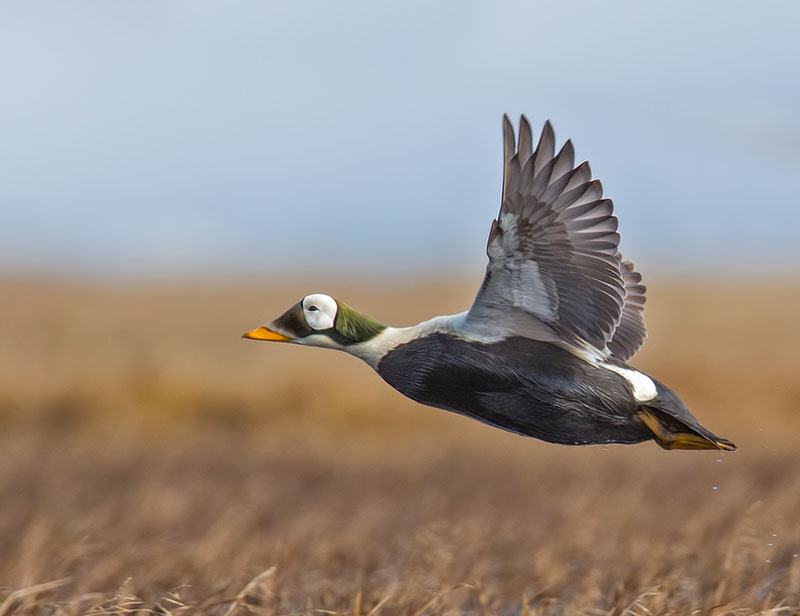
While observing birds, it’s fascinating to note how sparrows and other songbirds can dart through trees and branches while other species, like eagles, can soar high above, rarely flapping their wings. These differences in flight are due to varied wing shapes.
Understanding these differences begins with exploring the structure of the bird wings. Let’s take a closer look.
The Anatomy of Bird Wings
Understanding the intricate structure of a bird’s wing helps us understand how they can fly. Here’s a quick overview of its parts.
- Coracoid: A robust bone connecting the sternum to the scapula, it supports the chest during flight, anchoring wing muscles and preventing thoracic cavity collapse during wing strokes.
- Blade of scapula: A long, flat bone that provides structural support for the shoulder, serving as an attachment point for flight muscles and supporting wing movement and stability.
- Humerus: A relatively short upper wing bone connecting the shoulder to the elbow that provides structural support for the upper wing and acts as a lever, transferring power generated by flight muscles.
- Tertials: Feathers located on the inner part of the wing, closest to the body. They streamline the wing during flight and create drag to slow the bird down when landing, similar to airplane flaps.
- Radius: The thinner and shorter of the two long bones in the forearm. Supports the wing, allowing for flexion and extension at the elbow joint for precise adjustments during flight.
- Ulna: A thick, long bone in the forearm anchoring the secondary flight feathers, contributing to wing strength, flexibility, and stability during flight.
- Radiale: One of the small carpal (wrist) bones aiding in wing movement and flexibility.
- Ulnare: The other small carpal bone contributing to overall wing flexibility and control during flight.
- Metacarpus: A fused bone structure formed by the merging of some hand bones, it supports primary flight feathers and plays a crucial role in wing maneuverability and control.
- Basal phalanx: The first bone segment of the wing digits, providing attachment points for primary flight feathers and contributing to wing flexibility and control.
- Terminal phalanx: The end bone segment of the wing digits, providing attachment points for the outermost primary flight feathers.
- Primaries: Outermost flight feathers crucial for generating lift and thrust during flight.
- Secondaries: Attached to the ulna, they help with lift and soaring, contributing to wing shape and aerodynamics.

How does flying work?
Birds flying is a result of a fascinating combination of anatomy, physics, and other adaptations. Everything in flying birds has evolved to accommodate that.
For example, they have lightweight and honeycombed bones filled with air sacs, reducing weight while retaining structural integrity; some of the bones are fused together to provide extra rigidity.
Their bodies are streamlined, compact, and covered in contour feathers to reduce air resistance. Birds also have a unique respiratory system that allows for continuous airflow through the lungs, providing efficient oxygen uptake.
The foundation of flight, however, lies in the shape of their wing. The upper surface of the wing is curved, while the bottom is relatively flat. As a bird flaps its wings, air flows faster over the curved upper surface and slower beneath the flatter underside.
This difference in airflow speed results in lower pressure above the wing and higher pressure below it, generating lift and allowing the bird to rise.
Flapping is essential for both thrust and lift. The powerful downstroke propels the bird forward and upward, while the upstroke is often more passive, with some birds folding their wings slightly to reduce air resistance.
Steering and stability are achieved through precise adjustments of wing and tail feathers. The tail acts like a rudder, aiding in turns and braking. Birds can also change the shape and angle of their wings to control their flight path with remarkable accuracy.
Differences In Wing Shapes
Birds have evolved various wing shapes to adapt to their environments and lifestyles. Broadly speaking, there are four types of wings:
- Elliptical wings
- Active soaring wings
- Passive soaring wings
- High-speed wings
The two types of wings that generally require constant flapping are elliptical and high-speed wings.

Elliptical wings are short and broad with rounded tips, offering high maneuverability. They are ideal for quick, tight turns, quick take-offs, and short bursts of speed.
You can commonly see these types of wings in birds that live in forests or must navigate dense vegetation where agility is crucial, e.g. in many songbirds, sparrows, crows, magpies, or even birds of prey who hunt in woodlands.
High-speed wings are medium-length, narrow, and pointed. They are designed for fast, sustained flight and are common in birds that hunt in open areas or migrate over long distances, such as falcons, swifts, and ducks.
The other two types are perfect for non-flapping flight. Active soaring (also known as high aspect ratio) wings are long, narrow, and pointed.
They are excellent for soaring and gliding over long distances and make use of wind currents and thermals. This wing type is common in seabirds, such as gulls and albatrosses.
Passive soaring wings, on the other hand, are long, broad, rounded, and end in long finger-like primaries. They are great at catching thermals to soar high in the sky without much flapping. Many large raptors, such as hawks and eagles but also vultures, have these wings.

There are also some extreme and specialized wing types. Hummingbirds, for example, have small, narrow, and highly flexible wings, their structure specially adapted for hovering flight. They can rotate their wings in a figure-eight pattern, allowing them to hover with wingbeats and fly backwards – abilities most other birds lack.
Frequently Asked Questions
What is the end of a bird’s wing called?
The end of a bird’s wing is called a wingtip.
Why are birds’ wings curved?
Birds’ wings are curved to create lift by causing air to move faster over the top of the wing and slower underneath, resulting in lower pressure above the wing and higher pressure below.
What are the 4 types of bird wings?
The four types of bird wings are elliptical wings, high-speed wings, active soaring wings, and passive soaring wings.
Can a bird’s wing change shape?
A bird’s wing can change shape to adjust for different flying conditions, such as altering the angle of attack, spreading or folding feathers, and modifying wing curvature for better maneuverability and lift.
What are wing flaps called?
When it comes to birds, then wing flaps can refer to wing beats, which encompasses the entire cycle of wing movement as a bird flaps, or wing strokes, which can be used to describe the individual movements of the wing during the flapping process (e.g. downstroke or upstroke).
