


Pigeons are known for their cooing sounds, so much so that it’s more than easy to recognize them even before making eye contact.
Their sounds can be peaceful, or sometimes even somewhat alarmed but why do they coo, and do they only coo around us?
Communication Or Something More?
Small birds often sing melodic and warbling songs, while other, larger birds can make harsher calls. Pigeons make another unique vocalization that sounds like “coo.”
Most members of the pigeon and dove family make similar, low-pitched cooing sounds. The calls of Mourning Doves and some other dove species can be so low and deep, they are often confused with owl hoots!
Rock Pigeons also make low-pitched sounds, but they mostly coo. “Cooing” is a low-pitched, tremulous vocalization and the one that we hear pigeons make the most. Anyone who has paid any attention to Rock Pigeons has heard it. If not, go to a local park, look for pigeons feeding on bird seed or bread crumbs and you’ll eventually hear one coo!
Although it doesn’t sound quite like a purring cat, pigeon cooing might be an avian equivalent. These familiar birds coo for a few different reasons, and based on how often pigeons do it, they must enjoy cooing.
Rock Pigeons certainly coo to communicate with each other in a basic fashion, but they might also coo to express “happy” feelings. Although that’s probably impossible to prove, and pigeon intelligence is far simpler than that of people or even cats, pigeons do coo when they are relaxed and safe.
In other words, they look content and sort of like a purring cat, coo while they are relaxing. Although we can’t prove that pigeons coo because they are happy, we do know that they coo for the reasons mentioned below.
Territory
Like many other birds, Rock Pigeons vocalize to show where they live. Although their voices can sound peaceful and even soothing, when pigeons coo, they are basically telling other pigeons to keep away!
It’s both a statement and a warning. A pigeon cooing for territorial reasons is saying, “I live here, this is my home. Don’t even think of coming close, I’ll kick you out!” The louder the pigeon coos, the better that statement works because loud coos show how strong and healthy the bird is.
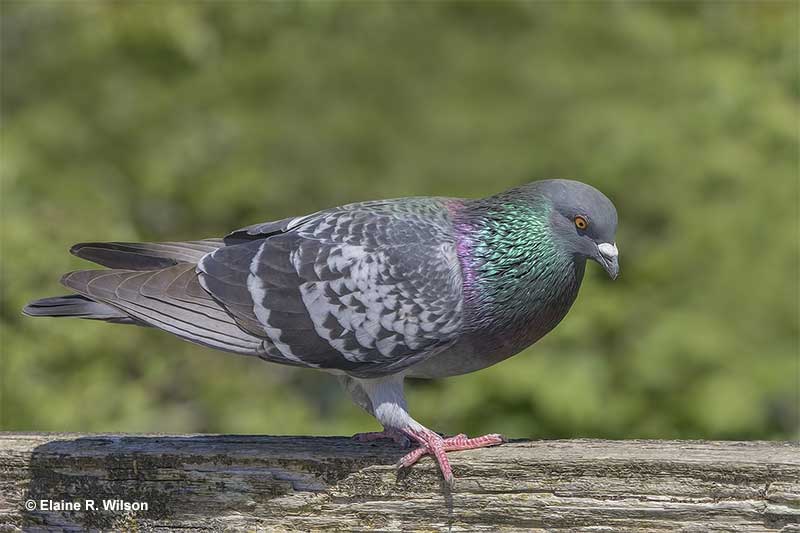
On the other hand, a pigeon with a weak-sounding coo doesn’t broadcast confidence or power. Instead, a feeble coo is like a big auditory sign to come and invade. It tells other pigeons that the bird might not be able to defend its territory.
Pigeons often make this call when they are nesting and can give it while sitting on their nest or perching near it. They usually couple the “oo-ooo-ooor” cooing sound with postures where they bow their head and twitch their wings.
Looking for a mate
Pigeons also coo to find a mate. The deep cooing vocalization is nothing like the cheerful whistles of cardinals nor a robin’s beautiful song, but it has the same purpose. Like those and other songbirds, male pigeons also coo to find a mate.
Cooing is so important for mating; male Rock Pigeons that don’t coo would probably be permanent bachelors. To attract a female, they make deep cooing sounds along with a more complex cooing “song” that sounds like, “coo, roo-croo-coo”.
Upon hearing the male’s deep and simple cooing song, a female pigeon interested in mating comes close. After the female arrives, the male pigeon changes his tune to the more complex vocalization and starts posturing.
While he coos, the male pigeon fans his broad tail and makes bowing movements as he struts back and forth. He also inflates his throat to show off the pretty colors on each side of his neck.
If those movements sound familiar, you’ve probably seen them. I know I have, just about any time I’ve watched Rock Pigeons in parks, on sidewalks, and other typical Rock Pigeon habitat!
Cooing Around Humans
Pigeons can also coo around people. I think it’s a neat, peaceful sound, but not everyone feels that way! Cooing pigeons can drive some folks crazy, especially when they vocalize at night, over and over. It wouldn’t be an issue if the bird was calling on some remote cliff, but when they call just outside a window or their coos are amplified by attic space or eaves, pigeon coos aren’t so welcome.
In those cases, Rock Pigeons coo near people by accident. They just happen to live very close to people and vocalize to communicate, attract a mate, or defend their territory.
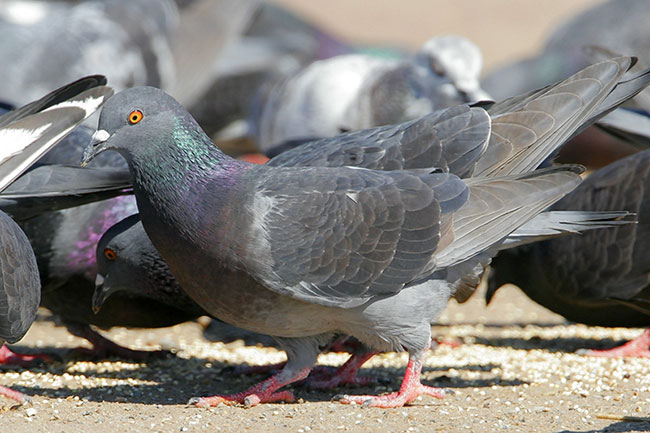
However, plenty of Rock Pigeons also coo in parks and other places very close to people. They aren’t doing it because they are stressed or feel threatened. In those circumstances, Rock Pigeons make other, more abrupt grunting and hissing calls!
Not to mention, Rock Pigeons in parks are also very accustomed to people. Instead of cooing because they feel threatened, they are more likely to coo for other reasons. If the Rock Pigeon is posturing in front of another pigeon, it’s probably displaying to a female.
However, if the bird is just cooing next to a person, it might associate people with food, or just feel content.
Frequently Asked Questions
Do pigeons coo when they are happy?
Yes, pigeons coo when they are happy. They also coo for other reasons, but pigeons do seem to coo when they are content.
Do only male pigeons coo?
No, female pigeons also coo. They make the same cooing calls as male birds, but males are louder.
Why do pigeons coo and walk in circles?
Pigeons coo and walk in circles to display to a mate. Pigeons that do this are usually males displaying to a female.
Are pigeons intelligent?
Yes, pigeons are intelligent birds. They aren’t as smart as crows and other highly intelligent birds but have excellent memory and recognize other individual pigeons.
Do pigeons recognize people?
Yes, pigeons recognize people. They learn to recognize people who are nice to them and folks who treat them poorly.