

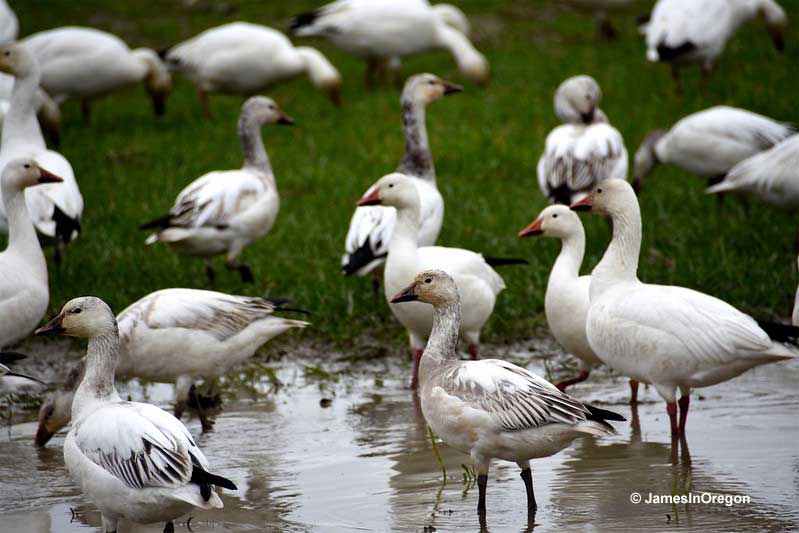
If you’ve observed birds for long enough, you’ve likely noticed that some species are only present in summer, disappearing come winter, or that certain times of the year bring unfamiliar birds to your feeders.
You may have seen large flocks gathering and then moving on. This is due to migration, the seasonal movement of birds between their breeding and wintering grounds, guided by routes known as flyways.
Bird Flyways
Bird flyways are the routes that migratory birds follow during their seasonal journeys between breeding and wintering grounds. These routes are like invisible highways in the sky, influenced by geographical features such as mountain ranges, coastlines, and river valleys, which provide navigational landmarks.
Flyways often span continents, connecting regions as far apart as North and South America, or Siberia and Africa.
Many bird populations fly between their wintering and breeding grounds twice a year. The specific routes that different bird species take vary, but each population has traditional stopover points along the way where they can rest and refuel.
Raptors choose routes where they can soar on thermals, terrestrial birds prefer to travel over land, wetland birds choose routes that have suitable foraging sites, and sea birds prefer ocean routes. These migratory routes can differ between the spring and autumn seasons, influenced by factors like wind direction and food availability at these stopovers.
Many species are born with an innate sense of direction, a kind of internal map encoded in their DNA. This genetic guidance ensures that even inexperienced young birds can find their way during their first migration. They also rely on environmental cues such as the sun, stars, and Earth’s magnetic field for orientation.
However, experience and learning also play crucial roles. Older birds often serve as guides, showing younger ones the way and teaching them specific landmarks and stopover sites where they can rest and refuel.
American Flyways
Atlantic Flyway
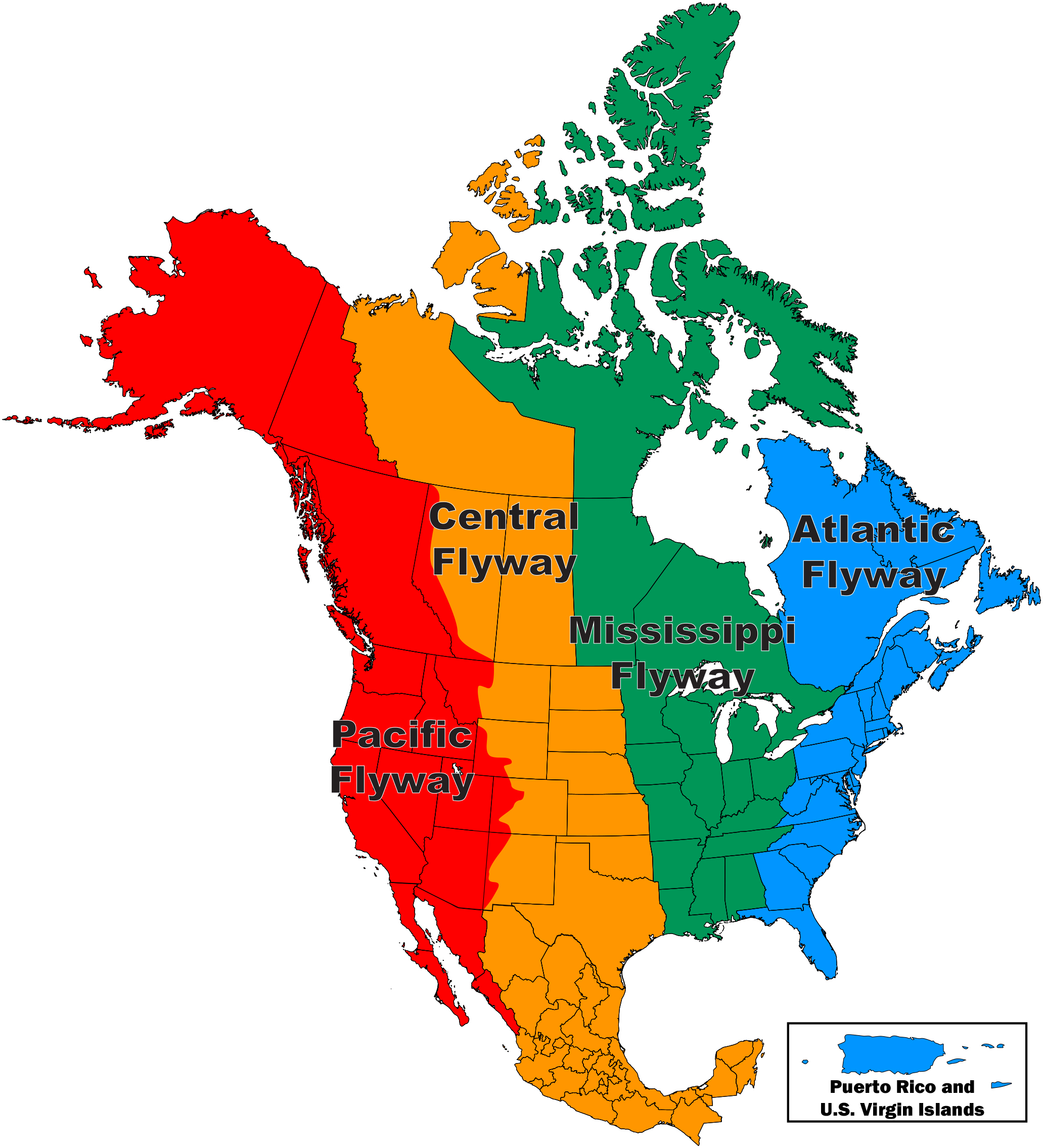
The Atlantic Flyway is a major flyway that stretches from Greenland and the Canadian Arctic to the southern tip of South America. The route uses the Atlantic Ocean’s coastline as a guiding landmark and avoids inland obstacles such as mountain ranges. It encompasses 17 U.S. states along the Eastern Seaboard and offers good sources of water, food, and shelter across its entire length.
The flyway is used by over 500 species of birds, including waterfowl, shorebirds, and songbirds. Many birds use this flyway to winter in the Caribbean or South America before migrating north in the spring. Spring migration along this flyway is briefer but more intense than fall migration, as birds hurry to reach their breeding grounds.
Mississippi Flyway
The Mississippi Flyway is a major bird migration route that stretches from the northern reaches of Canada to the Gulf of Mexico and Central and northern South America.
This flyway follows the Mississippi River, providing a natural navigational landmark and a rich corridor of diverse habitats, including wetlands, forests, and agricultural lands.
The flyway is bounded by the Appalachian Mountains to the east and the Rocky Mountains to the west but has no mountains or other blocking elements on the way itself. It offers good sources of food, water, and shelter across its length.
Mississippi Flyway is used by many species of ducks, geese, and other waterbirds due to the abundance of rivers, lakes, and wetlands in the region. A large number of migratory North American shorebirds and waterfowl fly this route.
Central Flyway
Another major bird migration route is the Central Flyway, which starts from central Canada and follows the Great Plains throughout the United States. It merges with the Mississippi Flyway between Missouri and the Gulf of Mexico and ends in South America although most birds stop at the Gulf of Mexico area.
The Central Flyway is used by over 380 bird species during the winter and spring migration. It is particularly important for waterfowl, with more than 50% of North America’s migratory ducks and geese using this route.
Pacific Flyway
The Pacific Flyway is the last of the four major migratory routes for birds in the Americas, extending from Alaska to Patagonia in South America.
It follows the western coast of North America, bounded by the Rocky Mountains to the east and the Pacific Ocean to the west, providing a diverse range of habitats from coastal wetlands and estuaries to forests and inland lakes.
Millions of migratory birds, including shorebirds, waterfowl, raptors, and songbirds, use the Pacific Flyway. The most important waterfowl wintering area along this route is the Central Valley, which supports about 60% of the total migratory bird population.
Allegheny Front Flyway
The Allegheny Front Flyway is a critical migratory route for birds traveling along the eastern United States from their breeding grounds to their wintering grounds. It primarily follows the Allegheny Mountains in the Appalachian Mountains and serves as a natural corridor guiding birds through this region.
The Allegheny Front, with its mix of forests, ridges, and valleys, provides ideal habitats and stopover sites for various bird species. This flyway is especially significant for raptors such as hawks, eagles, and falcons, which utilize the mountain’s updrafts to conserve energy during their migration.
Rest of the World
East Atlantic Flyway
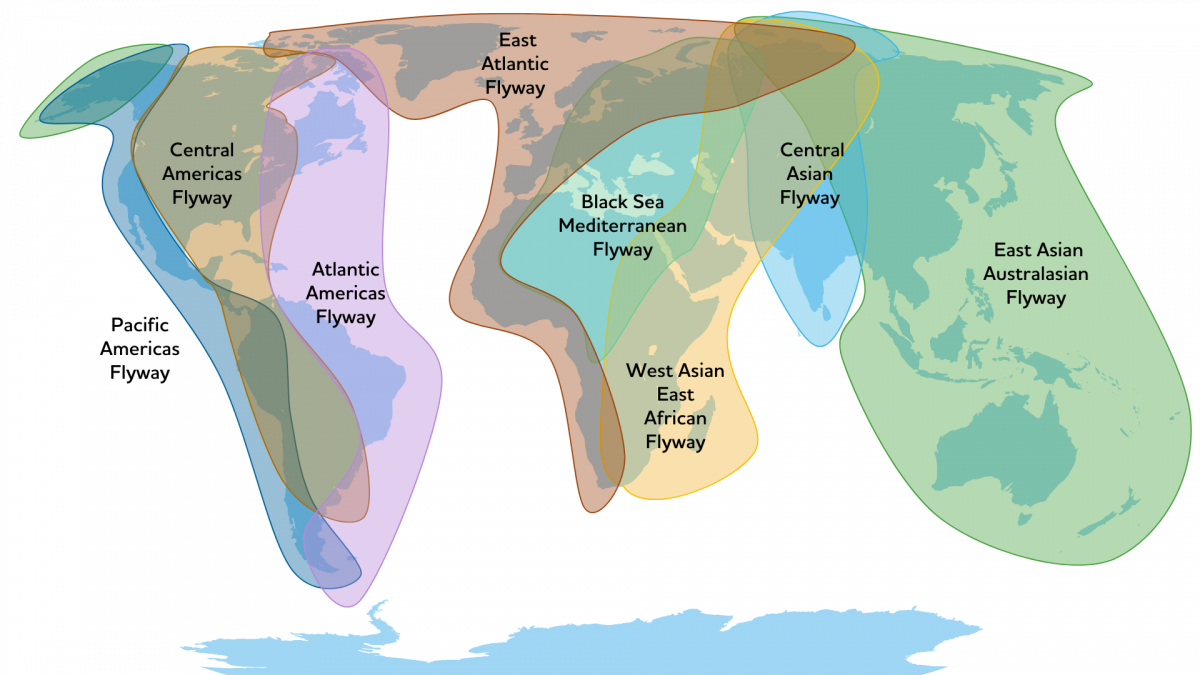
The East Atlantic Flyway is one of the major migration routes for birds traveling between their breeding grounds in the Arctic and northern Europe and their wintering areas in Africa and Western Europe.
This flyway follows the coastlines of Western Europe and West Africa, encompassing a variety of crucial habitats, including estuaries, mudflats, wetlands, and coastal lagoons.
It is used by about 90 million birds each year, especially shorebirds, waders, and waterfowl, and is one of the most important routes in the world for migratory waterbirds because of the large network of protected wetlands and coastal sites.
In the 2000s, birds using this flyway were found to be carrying the H5N1 avian influenza virus, raising awareness about the potential for disease transmission along migration routes.
Black Sea-Mediterranean Flyway
The Black Sea-Mediterranean Flyway is a group of migratory routes that connect Europe with Africa for birds traveling between their breeding grounds in Eastern Europe and Western Asia and their wintering areas in Africa.
This flyway spans the Black Sea region, through the Mediterranean Basin, and down into the Nile Delta and beyond.
Birds using this route have to get over the Ural Mountains or cross the Mediterranean, depending on where they come from and where they want to winter. It supports over 2 billion migratory birds, including 2 billion passerines and near-passerines and millions of raptors and ducks.
Asian-East African Flyway
The Asian-East African Flyway is a vital migratory route that extends from the breeding grounds in the northern and eastern parts of Asia, including Siberia, down through South Asia and the Middle East to the wintering areas in eastern and southern Africa. This flyway supports a diverse array of over 330 bird species, including waterfowl, waders, raptors, and songbirds.
Birds migrating along this route face several obstacles. They must negotiate numerous mountain ranges as they travel along the flyway. Birds also have to cross the deserts of southwest Asia and Arabia.
They must circumvent the Red Sea to the west or cross from the Arabian Peninsula into northeast Africa via the narrow Bab-el-Mandeb Strait. These sea crossings require significant energy expenditure and can be dangerous for birds.
Central Asian-Indian Flyway
Birds that choose to brave the Himalayan mountain range instead of flying southwest along the Asian-East African Flyway use the Central Asian-Indian Flyway that connects a large part of continental Eurasia to the Indian subcontinent.
Although it is considered the shortest in the world then it is definitely not the easiest.
Most of the over 300 species try to squeeze themselves into the Indian subcontinent from either side of the Tibetan massif. However, some species have adapted to fly over the mountain range, reportedly even over Mount Everest, including the Bar-headed Goose.
East Asian-Australasian Flyway
The East Asian-Australasian Flyways is considered the world’s largest flyway, stretching from the Arctic regions of Siberia and Alaska through East Asia down to Australia and New Zealand.
This flyway is also the most diverse when it comes to the number of species using it, which amounts to over 600 bird species, including shorebirds, waterfowls, raptors, and songbirds.
As the bird populations rely heavily on specific sites to rest and refuel, then it is crucial to protect them. The Flyway Site Network aims to do just that. It protects essential habitats, ensuring that migratory birds have safe and sustainable stopover points.
West Pacific Flyway
The West Pacific Flyway links New Zealand and the east coast of Australia to the east coast of northern Asia and eastern Siberia through the Pacific Ocean.
While the West Pacific Flyway is a major migration route, it is not isolated from other flyways in the region. It overlaps with the East Asian-Australasian Flyway on its western range and slightly with the Central Asian Flyway at its northeastern point. Many species navigate a combination of flyways and routes to reach their breeding and wintering grounds.
Frequently Asked Questions
How do birds know where they need to go?
Birds know where they need to go through a combination of genetic programming, environmental cues like the sun, stars, and Earth’s magnetic field, and learned behaviors from older, experienced birds.
What is the largest flyway in the world?
The largest flyway in the world is the East Asian-Australasian Flyway.
Which flyway is the shortest?
The shortest flyway in the world is the Central Asian-Indian Flyway.
How long do birds migrate?
The duration of bird migrations varies widely among species, ranging from a few weeks to several months. Some birds, like the Arctic Tern, can spend up to six months migrating between their breeding and wintering grounds, while others may complete their journeys in a matter of weeks.
Which birds migrate the longest distances?
Some birds with the longest migration distances include the Arctic Tern, Bar-tailed Godwit, and Sooty Shearwater.
