

Birds, with their vibrant feathers and enchanting songs, are the product of an extraordinary evolutionary journey spanning millions of years.
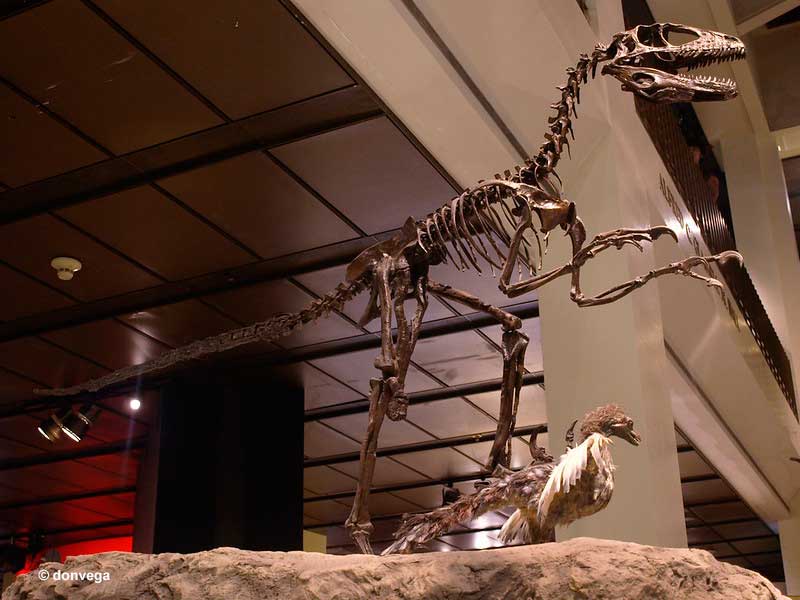
This journey began about 165-150 million years ago during the Jurassic period, in the age of dinosaurs. In fact, they are the only known dinosaurs still alive today!
The Evolution Of Birds
All modern birds evolved from a specialized subgroup of theropods called Paraves. Fossil evidence suggests that some of these ancient creatures could fly or at least glide, indicating that they might have been arboreal, living in trees much like modern birds.
Over millions of years, they developed various adaptations that enabled them to take to the skies. They became progressively smaller, and the evolution of lightweight, hollow bones reduced body weight without compromising strength.
Feathers, initially hair-like structures used for insulation, became specialized for flight, providing lift and aerodynamic efficiency. The transformation of forelimbs into wings was a crucial step, driven by natural selection favoring better fliers.
As early birds evolved, they diversified into a myriad of species, each adapting to different environments and lifestyles. The Late Cretaceous period saw the emergence of more modern bird species. Following the mass extinction event that wiped out most dinosaurs 66 million years ago, they rapidly filled the vacant ecological niches, leading to an explosion of diversity.
However, this is not the end. Birds continue to evolve, with recent studies showing morphological changes in response to climate change.
For example, a study of bird specimens from 1978 to 2016 found that their leg bones shortened by 2.4% while their wings lengthened by 1.3%, likely an adaptation to changing environmental conditions.
12 Ancient Birds Who Have Gone Extinct
Archaeopteryx

Archaeopteryx was a small, crow-sized animal that exhibited a blend of avian and reptilian features: it had feathers and broad wings like a bird, but also possessed teeth, a long bony tail, and clawed fingers akin to its theropod dinosaur ancestors.
Its wings and feathers, structurally similar to those of modern birds and likely black, suggest it could fly. However, its flight abilities were probably limited compared to modern birds, likely allowing for gliding or short bursts of powered flight rather than sustained flight over long distances.
This fossil turned out to be pivotal in the study of evolution. Discovered in the late 19th century in the limestone deposits of Bavaria, Germany, it lived about 150 million years ago during the Late Jurassic period.
It was initially considered the oldest known “bird” species, but recent discoveries of other bird-like fossils have led some paleontologists to question its classification.
Archaeopteryx was thus moved to a different clade by some and was not considered a direct ancestor of modern birds anymore. Despite this, it is often considered a transitional form between non-avian dinosaurs and modern birds.
Aurornis xui
Aurornis xui lived approximately 160 million years ago during the Middle to Late Jurassic period, making it about 10 million years older than Archaeopteryx, previously considered the oldest known bird.
It was roughly the size of a modern peasant, had clawed wings, a bony tail, and legs, and had traces of downy feathers preserved along its tail, neck, and chest. However, the absence of larger feathers suggests that it was not capable of flight.
The discovery of Aurornis xui has sparked a debate among paleontologists and led to a reconsideration of early bird evolution, pushing Archaeopteryx off its perch as the oldest known bird.
On the other hand, its classification as a bird is controversial due to varying definitions of what constitutes one. Some paleontologists argue that its forelimbs are too short for it to be considered a true bird, while others view it as a very primitive bird.
Terror Birds

Terror birds, scientifically known as Phorusrhacidae, were a family of large, carnivorous, mostly flightless birds that dominated South American ecosystems for millions of years, approximately 60 to 0.1 million years ago. These birds ranged in height from 3 to 10 feet, with the largest species being Titanis walleri.
Their powerful legs made them adept runners, capable of reaching speeds of up to 30 mph to chase down prey. The most distinctive feature of terror birds was their large, curved beaks. Their skull structure suggests they preferred hunting smaller prey that could be swallowed whole, using their beaks to deliver powerful downward strikes to kill it.
Fossil evidence indicates they had keen eyesight and strong, hooked claws, further enhancing their hunting capabilities. The extinction of terror birds is believed to be linked to climate changes and competition with other predators, including early mammals.
Pelagornis sandersi
Pelagornis sandersi was an extraordinary extinct bird species that lived approximately 25-28 million years ago during the Late Oligocene period. It is considered the largest flying bird ever discovered, boasting an estimated wingspan of 19.9 to 24.2 feet, roughly twice that of the Snowy Albatross, the flying bird with the largest wingspan today.
This bird likely inhabited coastal areas and was a masterful flyer despite its enormous size.
Computer models suggest it was an efficient glider, capable of traveling extreme distances over ocean waters in search of food. With bony, tooth-like projections on its beak, known as “pseudo-teeth,” it probably hunted near the ocean surface, using these projections to grip slippery prey.
The only known fossil of P. sandersi was uncovered in 1983 during construction at Charleston International Airport in South Carolina. It was later identified as a new species in 2014 by paleontologist Dan Ksepka. This species is believed to be a close relative of modern-day pelicans, storks, and other waterfowl.
Argentavis
Argentavis was the heaviest and one of the largest flying birds ever to exist, with an estimated wingspan of over 21 feet and a length of 11.5 feet from bill to tail.
Due to its large size, it probably had limited maneuverability and was best suited for soaring and gliding over open areas. It inhabited the grasslands of central Argentina during the Miocene epoch, thriving in environments where it could take advantage of wind and sloping terrain for take-off and thermal currents to stay aloft with minimal effort.
Reproductive behaviors of Argentavis are inferred from comparisons with modern birds. It likely laid one or two 2-pound eggs every two years, with parents taking turns incubating them and foraging for food.
The young birds were probably independent after about 16 months but took around 12 years to reach full maturity. This means that they must have had a very low mortality rate and likely only died due to old age and disease for the species to survive.
Although it doesn’t have any direct living descendants, the Andean Condor and New World Vultures have been mentioned as the closest living relatives.
Thunderbird
Teratornis merriami, a formidable bird with an estimated 11 to 12 feet wingspan, had strong legs, a robust beak, and powerful talons, indicating its role as a carnivorous hunter.
Its impressive size and physical traits likely made it an apex predator in its ecosystem. Fossil evidence shows that it roamed various environments across North America, from open plains to coastal regions, but probably needed cliffy areas for take-off.
This bird is often associated with the Thunderbird, a significant figure in Native American mythology depicted as a giant bird capable of creating storms and thunder with its wings. Although there’s no direct evidence that Native Americans encountered Teratornis merriami, its remarkable size and presence in the fossil record may have inspired these myths.
The extinction of Teratornis merriami, around 10,000 years ago, coincides with the end of the Pleistocene epoch, a time of significant climatic changes and the disappearance of many large mammals, which may have been its primary food source. Human activity and competition with other predators might have also contributed to its decline.
Giant Penguins

Penguins look cute and cuddly nowadays, but imagine one towering over you. Enter Palaeeudyptes klekowskii, the tallest penguin species ever discovered. This colossal bird, which lived about 37 to 40 million years ago, reached heights of up to 6.5 feet and weighed around 250 pounds.
Palaeeudyptes klekowskii thrived in a warmer Antarctic environment during the Eocene, when the region’s climate was similar to that of present-day South America.
This giant penguin shared its habitat with other large marine animals, competing for food and space. Its impressive size allowed it to dive deeper and stay underwater longer than modern penguins.
Despite its imposing stature and remarkable adaptations, Palaeeudyptes klekowskii eventually succumbed to climate change and increased competition with emerging marine predators.
Genyornis newtoni
If you are terrified of cobra chickens, otherwise known as Canada Geese, then the Genyornis newtoni would be your worst nightmare. It was a large, flightless bird standing about 6.5 feet tall that lived in Australia during the Pleistocene epoch, going extinct around 45,000-50,000 years ago due to both human activities and environmental changes.
It was originally thought to resemble emus or other ratites, but fossil discoveries, particularly a well-preserved skull, have revealed that Genyornis was more goose-like than previously thought.
The discovery revealed that it had a goose-like bill, a wide gape, and a strong bite force to crush soft plants and fruit. It also had adaptations for aquatic feeding, including protection for its ears and throat when submerging its head underwater. Genyornis is now considered to be closely related to waterfowl, particularly geese.
Moa
Once roaming the lush landscapes of New Zealand, the Moa was a diverse group of nine species of flightless birds. Their size varied from turkeys to towering giants of up to 12 feet in height. This makes them some of the largest birds that have ever lived.
These herbivores thrived in forests, scrublands, and grasslands, using their powerful legs to navigate and feed on vegetation.
Unlike modern birds, Moa had no wings or tail feathers, having evolved to fill a niche similar to that of large mammals in other parts of the world. Their primary predator was the Haast’s eagle, the largest eagle known to have existed.
Unfortunately, the arrival of Polynesian settlers around the 13th century led to their rapid extinction due to overhunting and habitat destruction. Nowadays, their closest relatives are ratites, like emus, and birds called tinamous that live in South America.
Haast’s Eagle
Haast’s Eagle is the largest eagle ever known. This extinct raptor, native to New Zealand, soared through the skies with a wingspan reaching nearly 10 feet.
With talons as large as a tiger’s claws and a powerful bill designed for tearing flesh, Haast’s Eagle was a formidable predator. It weighed up to 40 pounds but preyed and could take down much larger creatures, including the Moa, which could weigh over 500 pounds!
Haast’s Eagle became extinct around 1400 AD, shortly after the arrival of humans who hunted the Moa to extinction. Without their primary food source, the eagles could not survive. Their legacy lives on in Maori legends, where they are remembered as “Pouakai” – a monstrous bird that kills and eats humans!
Elephant birds
Elephant birds were herbivores, feeding mainly on the fruits and leaves of the dense Madagascar forests. These flightless giants, which roamed the island until around 1000 years ago, could reach heights of up to 10 feet and weigh as much as 2,000 pounds. But that’s not even the craziest thing about them.
They laid the largest eggs of any known animals, measuring up to 16 inches long and almost 10 inches wide, which could hold roughly 3 gallons of liquid, equivalent to about 150 chicken eggs. Unfortunately, a combination of human activity and climate change led to their extinction.
Dodo
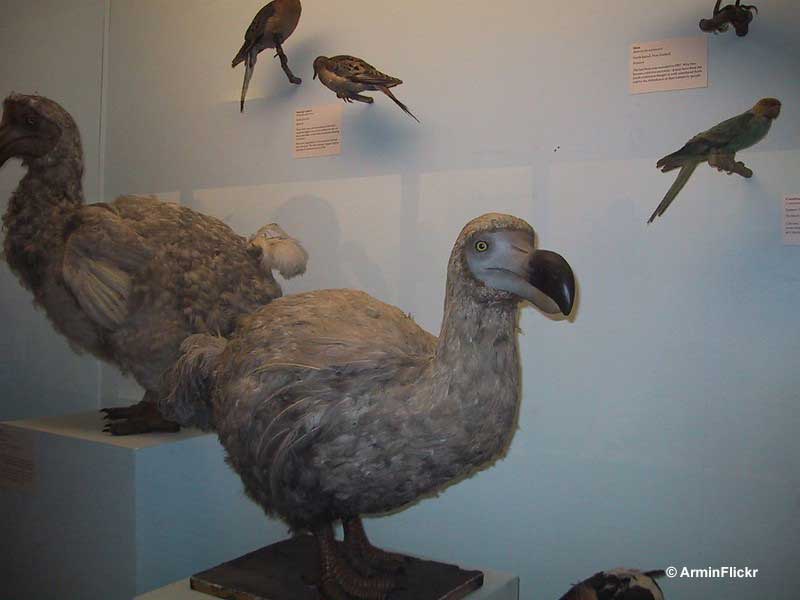
The dodo was a flightless bird native to Mauritius, an island in the Indian Ocean. Standing about 2 feet tall, it had a distinctive appearance with a large beak, stout body, and small, useless wings.
Dodo’s diet mainly consisted of fruits, seeds, nuts, and possibly small land vertebrates and marine invertebrates. It played a crucial role in its ecosystem by aiding in the dispersion of seeds.
The Dodo became extinct in the late 17th century, around 1681, primarily due to human activities. When sailors discovered Mauritius in the late 1500s, they introduced invasive species like rats, pigs, and monkeys, which preyed on dodo eggs and competed for food resources.
Additionally, overhunting by humans significantly reduced their population. The Dodo’s extinction is one of the earliest recorded instances of human-induced extinction and serves as a poignant reminder of the impact of human activities on biodiversity.
