

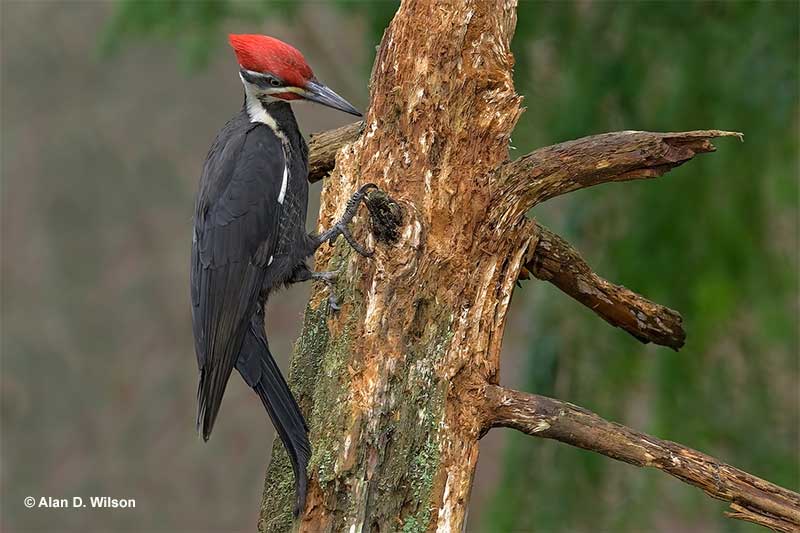
Kansas has 12 woodpecker species on the state’s official bird list. Three of those are rare winter visitors, but the rest are fairly common.
According to eBird data, just 8 of them visited Kansas, so today, we’ll take a closer look at them!
How many of them have you seen in Kansas? Were you able to identify all of them?
Woodpecker in Kansas
To see woodpeckers in Kansas, go birding in any spot with woodlands or some scattered big trees. In open areas, you might see Northern Flickers foraging on the ground, and beautiful Red-headed Woodpeckers sallying for bugs from high perches.
Put out a suet cake in your backyard feeder and you’ll probably get Downy and Red-bellied Woodpeckers. To see Hairy and Pileated Woodpeckers, visit eastern woodlands with big, old trees, and listen for them calling and making tapping sounds.
You should also see handsome Yellow-bellied Sapsuckers during migration and winter, and Ladder-backed Woodpeckers in arid brush in southwestern Kansas.
Red-bellied Woodpecker
Scientific name: Melanerpes carolinus
Length: 9.25 inches
Wingspan: 16 inches
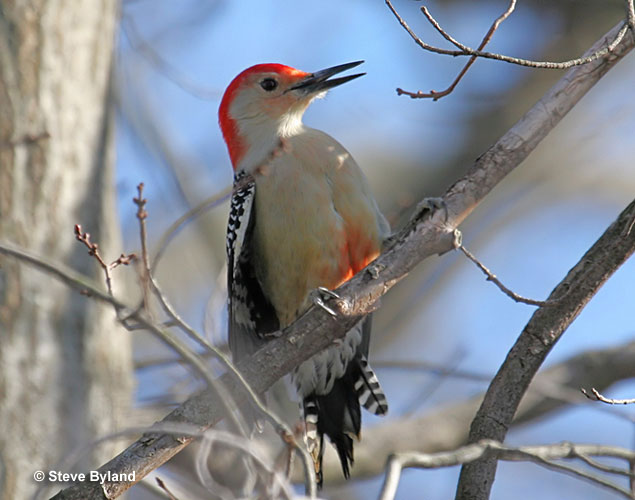
Red-bellied Woodpeckers are bold birds with a long, dark, chisel-like beak, and backs with zebra-like barring. They also have black and white bars on their long, closed wings, and a bold white rump with some black speckling.
Despite their name, it’s really hard to see the red on this bird’s underparts! Although they do have a bit of red or reddish-orange, it’s hidden on the lower part of their belly. The rest of their underparts and face are a pale gray-buff color, and they have a bit of orange above their beak.
Male Red-bellied Woodpeckers have bright red on their crown and nape. Females only have red on their nape and young birds only show a bit of orange on the back of their head.
We see pairs of this common woodpecker species in all sorts of woodlands. As long as big trees are present, they can even live in urban areas, and often come to feeders.
Key identifications:
- In most of their range, Red-bellied Woodpeckers are the only woodpecker species that has zebra-like, black and white barring on their back and wings.
- Red-bellied Woodpeckers have a pale face and red on their nape.
- This species has plain buff-gray underparts.
Downy Woodpecker
Scientific name: Dryobates pubescens
Length: 6.75 inches
Wingspan: 12 inches
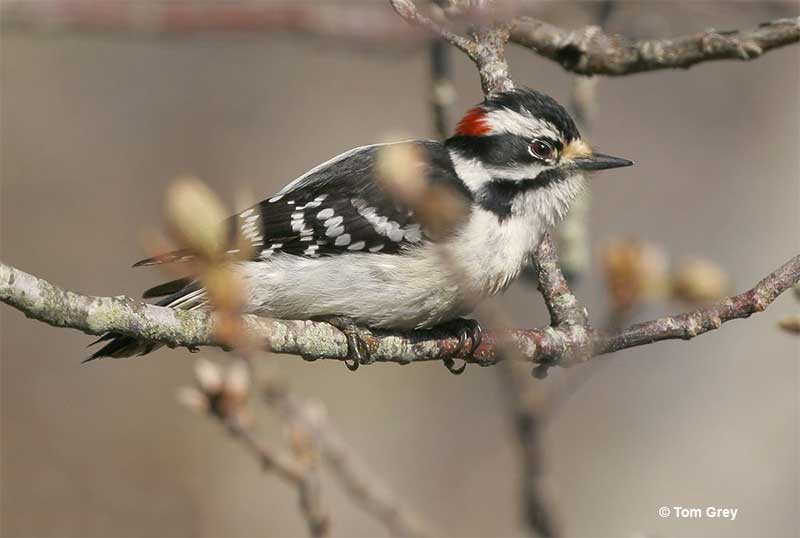
Downy Woodpeckers are small, cute woodpeckers with black and white plumage. They have bold, black and white markings on their heads, black and white wings, and white underparts.
They also have a white back, black rump, and black and white tail. This woodpecker is slightly bigger than a sparrow, and has white, tufted feathers above its short beak.
Male Downy Woodpeckers have a small red patch on the back part of their head. Females look like males but lack this red patch, and young birds have red on the top of their heads.
This small bird is common in all sorts of wooded habitats. They like to use their small beaks to peck into twigs and often forage with flocks of chickadees and other birds.
This beautiful little woodpecker is also a regular visitor to backyards and can live in urban areas with lots of trees. They also come to bird feeders, especially ones that offer suet and peanuts.
Key identifications:
- Downy Woodpeckers are smaller than all other woodpeckers in North America. They are nearly as small as a House Sparrow.
- This species has a short and stubby beak (for a woodpecker).
- Downy Woodpeckers have small dark markings on their white outer tail feathers.
Northern Flicker
Scientific name: Colaptes auratus
Length: 12.5 inches
Wingspan: 20 inches
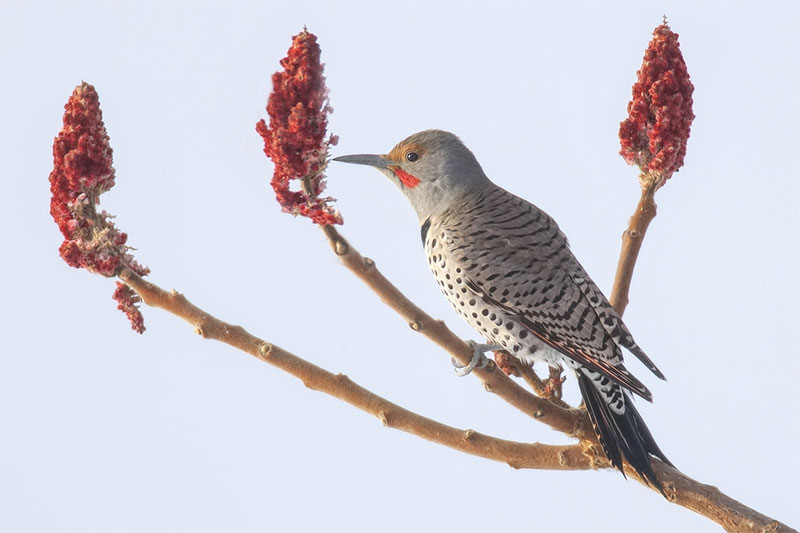
Northern Flickers are big, unique, gray and tan woodpeckers with bold white rumps. They have buff underparts with black spotting and a bold black patch on their chest, and fine black barring on their back and wings.
This species has some differences depending on where they live. Birds east of the Rocky Mountains have a small red spot on their nape, and a black moustache mark (males). Eastern birds also have bright yellow underwings.
West of the Rockies, Northern Flickers have grayer heads, and males have a red moustache. They also have reddish on their underwings.
Northern Flickers love parks, golf courses, and other semi-open habitats. In such places, we often see them in bounding flight, or perched on the ground as they forage for ants. These noisy birds also make laughing calls and “wicka-wicka” vocalizations.
Since this species eats ants, it rarely if ever comes to bird feeders.
Key identifications:
- In most of their range, Northern Flickers are the only woodpecker with gray and brown plumage.
- This species has a gray crown and fine black barring on its tan-colored back.
- Northern Flickers also have a black chest patch and black spotting on their underparts.
Red-headed Woodpecker
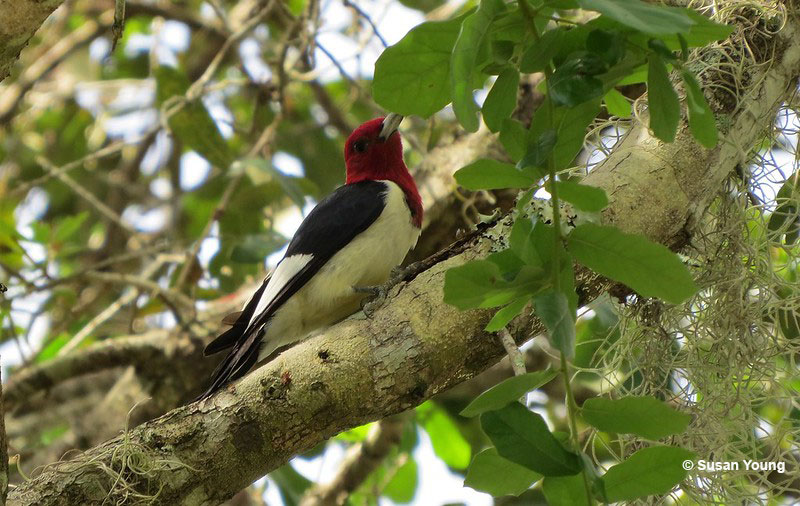
Scientific name: Melanerpes erythrocephalus
Length: 9.25 inches
Wingspan: 17 inches
Red-headed Woodpeckers are beautiful, medium-sized woodpeckers with a completely deep red head. Adults of both sexes look alike and have a sharp gray bill, and bright white underparts.
Their upperparts are glossy black with a snow-white rump, and big white patches on their wings. Juvenile Red-headed Woodpeckers have a similar plumage pattern but have a gray-brown head, and some dark markings on their wings and underparts.
This striking bird prefers semi-open habitats with mature oaks, snags, and other big trees. We see them on golf courses, at the edges of rivers and other wetlands, and other places with similar-looking habitat.
In some places, this beautiful bird also occurs in urban areas, especially in the southeastern USA.
Red-headed Woodpeckers like to peck into trees like other woodpeckers but they also catch insects in flight. With that in mind, we often see them sallying into the air from tall snags next to open areas.
Key identifications:
- Red-headed Woodpeckers are the only woodpecker species in eastern North America with an entirely red head.
- This species has a unique wing pattern with big white patches on the base of each wing.
- The Red-headed Woodpecker has a black tail and an extensive white rump.
Hairy Woodpecker
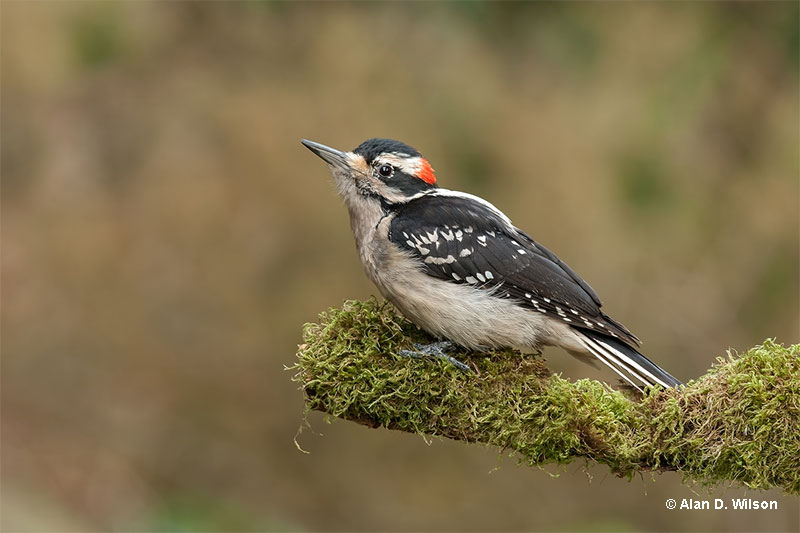
Scientific name: Dryobates villosus
Length: 9.25 inches
Wingspan: 15 inches
Hairy Woodpeckers are medium-sized, black and white woodpeckers with a fairly long and sharp beak. They have a bold black and white pattern on their head, white back, black rump, and black and white wings.
Hairy Woodpeckers also have white underparts and a pale front. Males have a small red patch on the back of their head, females lack this patch, and juveniles have a red patch on top of their head.
If that description sounds like a Downy Woodpecker, it’s true, these two species look almost exactly the same! However, in addition to details mentioned below, they also differ in another main way.
While Downy Woodpeckers like second growth and plants with thin stems, Hairy Woodpeckers only live in places with big, mature trees. We mostly find these woodpeckers in forest but they can also occur in parks and suburban areas that have lots of big trees.
Hairy Woodpeckers can also visit feeders, especially for suet.
Key identifications:
- Hairy Woodpeckers have noticeably longer beaks than Downy Woodpeckers, and are also larger birds.
- The Hairy Woodpecker has a big white patch on its back.
- This species has plain white underparts and clean white outer tail feathers.
Pileated Woodpecker
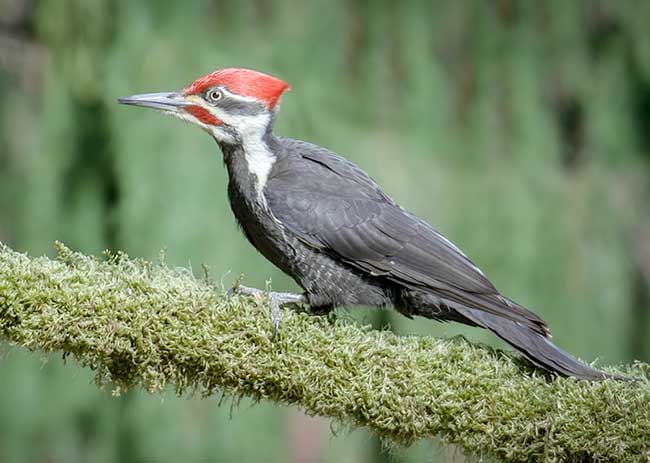
Scientific name: Dryocopus pileatus
Length: 16.5 inches
Wingspan: 29 inches
Pileated Woodpeckers are really big woodpeckers. These hefty birds are nearly the same size as an American Crow!
If the Ivory-billed Woodpecker is actually extinct, that makes the Pileated Woodpecker the biggest woodpecker in North America.
These unmistakable woodpeckers are mostly black with a thick white line on each side of their neck, and a white throat.
They also have a red crest and a long, grayish beak. Males have a small red moustache while females have a black line that extends from their beak to their neck.
Pileated Woodpeckers also have a small white patch on the upper part of each wing. It’s easier to see this mark and the white underwings when the big woodpecker takes flight.
This fantastic woodpecker lives in forests and woodlands with lots of big, mature trees. For that reason, we don’t usually see them in urban areas. However, they can visit feeders at houses next to or within forest!
Key identifications:
- In most places, Pileated Woodpeckers are the only big black and white woodpecker with a red crest.
- This species has a small white patch near the tip of each upperwing. They also have white wing linings.
- Pileated Woodpeckers have a lot of white on their face and a completely black back.
Yellow-bellied Sapsucker
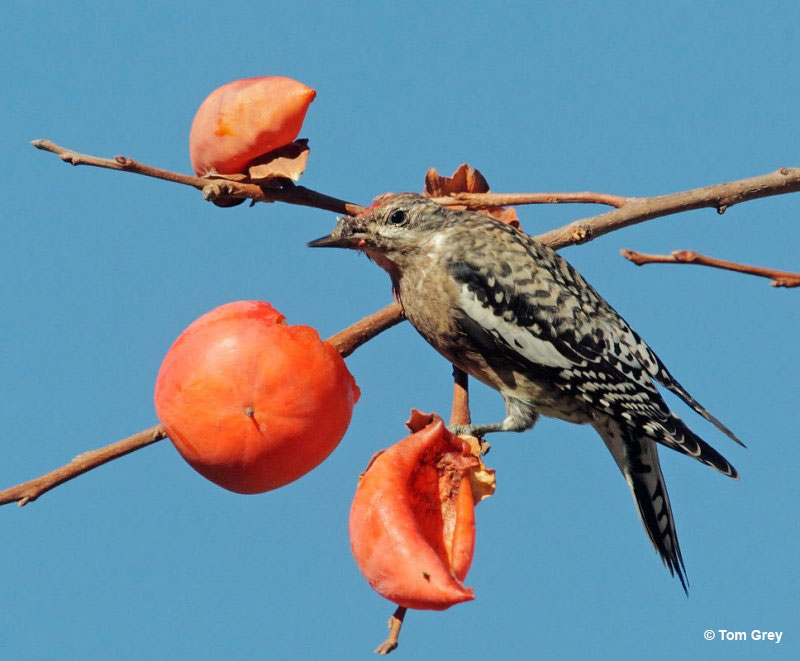
Scientific name: Sphyrapicus varius
Length: 8.5 inches
Wingspan: 16 inches
Yellow-bellied Sapsuckers are pretty, medium-sized woodpeckers with white shoulders. They have a black and white face, black chest, and uneven black and white barring on their backs.
This woodpecker species has pale yellow on its underparts, small black markings on its sides, and a red patch on its head.
Males also have a red throat bordered with black while females have a white throat. Juvenile Yellow-bellied Sapsuckers look like adults but are more dingy gray-brown, and lack red on their heads.
This migratory species likes to peck rows of small holes in deciduous trees. It drinks the sap that comes out as well as insects attracted to the sap.
Yellow-bellied Sapsuckers breed in northern and montane forests, and spend the winter in parks and a variety of woodland habitats from the southeastern USA to Central America.
On their breeding grounds, we often hear their distinctive tapping that starts with a few fast taps and then slows down.
Key identifications:
- Yellow-bellied Sapsuckers are the only woodpeckers in most of their range with white shoulders.
- This species has a black chest and uneven barring on its sides.
- The Yellow-bellied Sapsucker has lots of uneven, mottled black and white barring on its back.
Ladder-backed Woodpecker
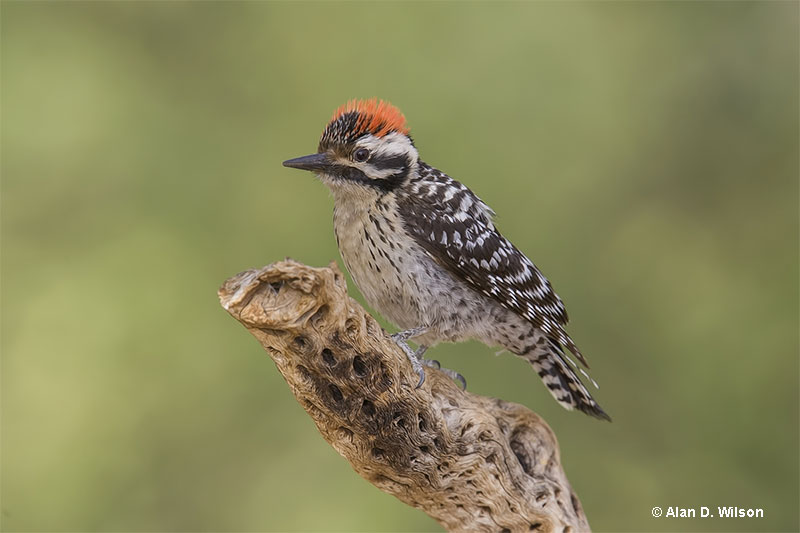
Scientific name: Dryobates scalaris
Length: 7.25 inches
Wingspan: 13 inches
The Ladder-backed Woodpecker is a small, black and white woodpecker of arid zones. It has a black and white “zebra” pattern on its back and wings, and some black speckling on off-white underparts.
Ladder-backed Woodpeckers also have a pair of thick black lines on their face, buff front, and a sharp, medium length beak. Males and juveniles have a red patch on the top of their head while females have a black crown.
Pairs of this small woodpecker pick insects and other arthropods from cactus and the trunks and branches of scrubby vegetation and small trees. They don’t peck into bark as much as other woodpeckers, and females forage more on twigs while males stick to trunks and larger branches.
Ladder-backed Woodpeckers are common in deserts and scrubby arid habitats. We find this handsome little woodpecker in many parts of the American Southwest as well as Texas north to southeastern Colorado.
Key identifications:
- Barred, black and white back.
- Two black lines on a pale face.
- Some black speckling on pale buffy underparts.
FAQ
How many woodpeckers does Kansas have?
Kansas has 12 woodpeckers on the state list. Three of those species are rare winter visitors.
Which woodpeckers are most common in Kansas?
The most common woodpeckers in Kansas are the Red-bellied Woodpecker, Downy Woodpecker, and the Northern Flicker.
Are woodpeckers protected in Kansas?
Yes, woodpeckers are protected in Kansas under the Migratory Bird Treaty Act.
More in Kansas: Most common birds | Hawks | State Bird