


From nature documentaries to animated movies, penguins captivate audiences worldwide. These birds are similar in some ways, but each species is unique.
From the regal Emperor Penguins to the rare Galápagos Penguins, let’s discover more about them!
Penguins & Their Lives
Penguins are a group of aquatic flightless birds from the Spheniscidae family. According to the IUCN Penguin Specialist Group and various other scientific organizations, there are 18 recognized species of penguins. However, that number is still under debate and recent research suggests there may be more species or subspecies.
Penguins primarily inhabit the Southern Hemisphere, with the Galápagos Penguin being the only exception, living just north of the equator. Larger penguins thrive in colder climates, while smaller ones prefer temperate or tropical environments.
Adapted to both land and sea, penguins spend roughly half their lives in each.
On land, penguins maintain an upright posture using their tails and wings for balance but may look awkward while waddling across the ground. However, they are exceptional swimmers, using their flipper-like wings to navigate the water with agility, much like birds fly through the air.
Most have distinctive black-and-white coloring, a form of countershading camouflage that protects them from predators. From below, their white bellies blend in with the reflective water surface, while from above, their dark backs merge with the ocean depths. Additionally, their smooth and dense plumage traps a layer of air for buoyancy and insulation in frigid waters.
Their diet consists mainly of krill, fish, squid, and other sea creatures, which they catch and swallow whole. Their spiny tongues and strong jaws are perfect for securing prey and their vision is particularly sharp underwater. They also have a specialized gland that enables them to drink seawater.
Emperor Penguin

Scientific name: Aptenodytes forsteri
Range: Endemic to Antarctica.
Height: 43-47 inches
The Emperor Penguin is one of the most iconic and also the tallest and heaviest penguin species, characterized by its black head and back, white belly, pale-yellow breast, and bright-yellow ear patches.
They can dive to depths of 1,755 feet and remain submerged for around 20 minutes in search of food, thanks to adaptations that allow them to function at low oxygen levels and the ability to reduce their metabolism and shut down non-essential organ functions.
Another unique factor is that they breed during the Antarctic winter, trekking 30-75 miles over ice to colonies that can number up to thousands of individuals. Females lay a single egg, which the male then incubates for two months. They endure the harshest conditions of any bird species, with temperatures reaching as low as -40°F and wind speeds up to 89 mph.
Currently, they are classified as near threatened, and their survival is increasingly at risk due to climate change, overfishing, habitat destruction, and human disturbance.
King Penguin

Scientific name: Aptenodytes patagonicus
Range: Breeds on the Subantarctic islands between 45 and 55 °S.
Height: 28-39 inches
The King Penguin, the second largest penguin species, has a black back, white belly, and distinctive orange and yellow markings on its head and neck. They thrive in cold ocean currents that provide abundant food, like small fish and squid, and breed on beaches or flat areas near the sea.
These penguins are expert divers, often reaching depths of over 300 feet, and can dive as deep as 1,000 feet, with dives usually lasting for about 5 minutes. The majority of the time, they go to a certain depth and then remain there for the duration of the dive. On land, they waddle or slide along the ground on their bellies.
Currently classified as of least concern, their population is estimated to be at around 2 million and increasing. However, in the early 1920s, they were nearly decimated in South Georgia and the Falklands by whalers, who burned millions of penguins for fuel due to the lack of firewood.
Little Penguin

Scientific name: Eudyptula minor
Range: Breeds along most of the New Zealand coastline.
Height: 12-13 inches
Little Penguins, also known as fairy penguins, little blue penguins, or kororā, are the smallest penguin species. They are recognized by their slaty blue upper bodies and flippers and white underbellies, perfect for camouflage. They have several subspecies, though their precise classification is debated, and they were once considered to be conspecific with the Australian Little Penguin.
Adapted to digging, they create burrows in sandy, rocky islands and prefer nesting in sandy dune vegetation, rocks, and caves. They come ashore at night to rest and avoid predators like swamp harriers, peregrines, gulls, snakes, rats, and lizards. Their nocturnal lifestyle and burrow nesting help them evade these threats.
Southern Rockhopper Penguin

Scientific name: Eudyptes chrysocome
Range: Inhabits the subantarctic waters of the western Pacific and Indian Oceans. Breed on islands off Patagonia and the Falkland Islands. During the non-breeding season, roam the waters around their breeding area.
Height: 18-23 inches
Southern Rockhopper Penguins are distinguished by their black head and back, white front, bright orange beak, and long yellow plumes extending from the sides of their heads. They breed on rocky shores and are named for their unique behavior of hopping over obstacles such as boulders and cracks, rather than sliding on their bellies or climbing awkwardly like other penguins.
Their behavior and diving patterns vary with environmental conditions such as sea ice, prey availability, breeding stage, and seasonality. For instance, night dives are shallower than day dives, and individuals in subantarctic regions dive longer and deeper.
Classified as vulnerable by the IUCN, their population has declined by about one-third in the last thirty years due to threats like commercial fishing and oil spills.
Macaroni Penguin

Scientific name: Eudyptes chrysolophus
Range: Breed from the Subantarctic to the Antarctic Peninsula and disperses widely in the oceans during the non-breeding season.
Height: 28 inches
Macaroni Penguins, closely related to Royal Penguins, wear a yellow crest, have a black face and back, and white underparts. According to some, the yellow crest resembles macaroni pasta, giving them their name. They molt once a year and spend the two weeks before that accumulating fat as they cannot feed during the three to four-week molting period when they shed and regrow their feathers.
Their breeding colonies, numbering up to 100,000 individuals, are among the largest and densest of all penguin species. After breeding in the summer, they disperse into the oceans for six months. A study found that Macaroni Penguins from Kerguelen traveled over 6,200 miles in the central Indian Ocean.
Despite having around 18 million individuals, making them the most numerous penguin species, they have seen widespread population declines since the mid-1970s and are listed as a vulnerable species.
Northern Rockhopper Penguin

Scientific name: Eudyptes moseleyi
Range: Breeds on rocky shores of just 7 subantarctic islands in the southern Indian and Atlantic Oceans.
Height: 21 inches
Northern Rockhopper Penguins have a black head and back, white underparts, a reddish-brown bill, red eyes, and distinctive black-and-yellow crests that look like eyebrows if people were to grow them out like hair. Similarly to the Southern Rockhopper Penguin, they prefer to jump over obstacles rather than awkwardly climb or slide.
They breed in large colonies, building nests from pebbles, grass, and other surrounding materials. Females lay two eggs with the first being smaller and the second larger. More often than not, only the second egg hatches.
This species is listed as endangered due to various threats such as climate change, overfishing, pollution, habitat destruction, and human disturbance.
Fiordland Penguin

Scientific name: Eudyptes pachyrhynchus
Range: Breeds along the southwestern coasts of New Zealand, and occasionally wanders to Australia.
Height: 24 inches
The Fiordland Penguin is a dark bluish-gray penguin with white underparts and a broad yellow eyebrow crest that extends over the eye and down the neck. They nest in coastal forests, sea caves, shrubland, and among rocks and boulders, breeding in loose colonies.
Like some other penguin species, they also lay two eggs with the first being smaller and typically having higher mortality. Despite that and additional threats, however, they have a higher breeding success rate than most other Eudyptes species.
The Fiordland Penguin is listed as near threatened; their population is estimated to be at 12,500-50,000 individuals with major threats including introduced terrestrial predators like cats and dogs, fisheries, and bycatch.
Snares Penguin

Scientific name: Eudyptes robustus
Range: Breeds in the Snares Islands off the coast of southern New Zealand.
Height: 20-28 inches
The Snares Penguin, confined to the Snares Islands, hence the name, has dark blue-black upperparts, white underparts, and a bright yellow eyebrow crest that droops down their face.
They nest in colonies of 10 to 1,200 nests, under forest cover or on coastal rocks. Their nests are shallow holes lined with grass, leaves, twigs, or pebbles.
Like other crested penguins, females lay two eggs with the second egg being larger than the first. The smaller chick often does not survive due to competition. In this species, the size difference is especially noticeable, with the second egg being up to 85% larger than the first one.
While their population is stable at around 63,000 mature individuals, the species is still classified as vulnerable. That is because their breeding is restricted to one small island group and new threats could wipe them out.
Royal Penguin

Scientific name: Eudyptes schlegeli
Range: Sub-Antarctic Macquarie Island and adjacent islands.
Height: 26-30 inches
Royal Penguins are very similar to Macaroni Penguins but have a white face and chin. Because of this and the occasional interbreeding, there has been some controversy over whether they are the same species or not.
These penguins nest on beaches or vegetated slopes, laying two eggs but usually raising only one chick. Both parents take turns incubating with one shift lasting 12 days. After hatching, the chick is under the male’s care until the female returns with food. If the female cannot make it, the chick will die.
Historically, Royal Penguins, along with King Penguins, were hunted for oil, with up to 150,000 penguins killed annually between 1870 and 1919. Since hunting ended, their population on Macquarie Island rocketed back up to over a million individuals.
Erect-crested Penguin
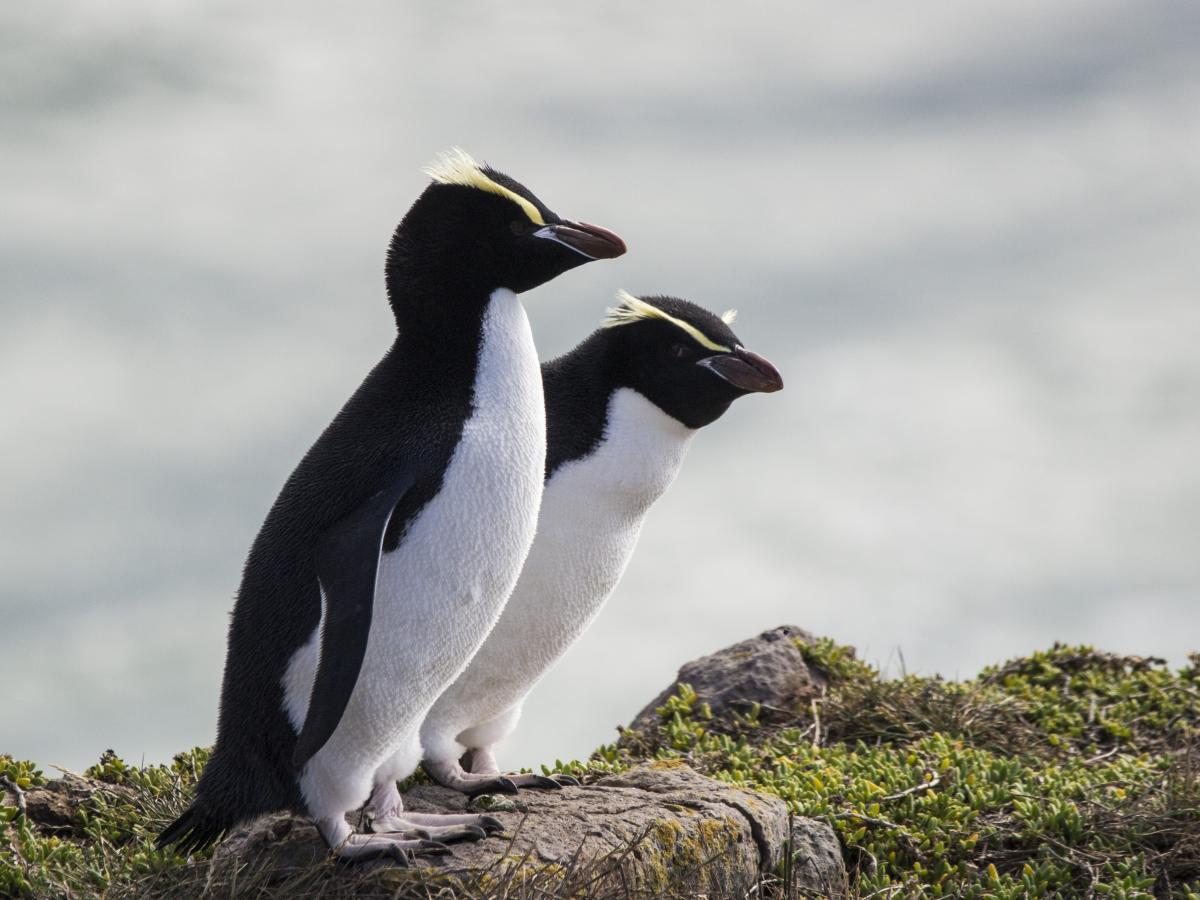
Scientific name: Eudyptes sclateri
Range: Only breed on the Bounty and Antipodes Islands off the coast of New Zealand.
Height: 20-28 inches
The Erect-crested Penguin, named for its yellow eye stripe that curls up into a spiky crest, has black upperparts and white underparts. They are social birds that nest in large colonies alongside rockhopper penguins, fur seals, and albatrosses. Each pair lays two eggs, but typically, only the larger second egg is incubated seriously and hatches.
The species is listed as endangered, and with good reason. Their population is confined to a very small range and low numbers, there are around 70,000 mature individuals.
Major threats include global warming, which reduces marine productivity and prey availability, competition and bycatch from commercial fisheries, nonnative predators, disease, disturbance, oil spills, and pollution.
Yellow-eyed Penguin

Scientific name: Megadyptes antipodes
Range: Endemic to New Zealand.
Height: 24-31 inches
The Yellow-eyed Penguin is the sole species in the Megadyptes genus, sporting a slaty blue-black back and tail, white underparts, and distinctive yellow band around the head, and pale-yellow eyes, hence the name. Although usually silent, their calls at breeding sites are very shrill and have earned them the name ‘hoiho’ in Māori, which means ‘noise shouter.’
During the breeding season, the penguins take day trips of up to 15 miles from their colonies to search for food but sometimes also shorter evening trips, mostly foraging along the seafloor.
With only 2,600-3,000 mature individuals remaining, it’s one of the rarest penguin species in the world and is listed as endangered. In 2004, an unknown disease wiped out 60% of chicks in certain areas, further threatening the survival of the species.
Adélie Penguin

Scientific name: Pygoscelis adeliae
Range: Along the coast of the Antarctic continent.
Height: 28-29 inches
Adélie penguins, with their distinctive black above and white below plumage and striking white eye rings, are known for their big and feisty personalities.
They can be selfish, as observed in Antarctic surveys, where they push each other into the water and only follow when they see that the victim is safe. On the other hand, they can also be curious, bold, and selfless, challenging predators larger than themselves and even protecting chicks from other species.
These penguins rely on sea ice for survival but need ice-free land to breed. Unfortunately, with shrinking sea ice due to climate change, their numbers have declined significantly over the past 25 years.
Despite these challenges, they are currently listed as a species of least concern, with a population of around 10 million mature individuals.
Chinstrap Penguin

Scientific name: Pygoscelis antarcticus
Range: A variety of islands and shores in the Southern Pacific and Antarctic Oceans.
Height: 27-30 inches
Chinstrap Penguins, named for the narrow black band under their heads resembling a helmet, are mostly black above and white below. Their loud and harsh calls have also earned them the nickname ‘stonecracker penguin’. These little “soldiers” are often regarded as the feistiest and most ill-tempered penguins.
Chinstrap Penguins nest in colonies and build circular nests from stones and neighbors often try to steal stones from each other. The pair lays two eggs, incubated in shifts by both parents. They venture up to 50 miles offshore each day to feast on krill, fish, shrimp, and squid. Remarkably, they microsleep over 10,000 times a day in brief 4-second intervals.
Their population numbers at around 8 million mature individuals with a stable to decreasing population, mostly due to climate change.
Gentoo Penguin

Scientific name: Pygoscelis papua
Range: Breed on many sub-Antarctic islands and the Antarctic Peninsula.
Height: 28-35 inches
Gentoo Penguins are overall black above and white below. Their identifying characteristic is a wide white band extending across the top of their heads. They have a wide range, breeding on ice-free surfaces along coastlines, and nesting in tufts of grass in coastal areas.
Their nests are made of stones, which are fiercely guarded and disputes over them can even lead to physical blows. These stones are prized, and males may win the favor of females by offering them a perfect stone. However, if a penguin cheats on their partner, the cheater is banished from the colony.
Gentoo Penguins are renowned as the fastest swimmers among penguins, reaching speeds of up to 22 mph. Interestingly, Gentoo Linux is named after them, reflecting its aim to be the highest-performing operating system.
African Penguin

Scientific name: Spheniscus demersus
Range: Southwestern coast of Africa.
Height: 24-28 inches
African penguins are easily identifiable by the pink patches of skin above their eyes and a black facial mask. Their bodies are black above and white below, with black spots and a black band across their chest unique to every penguin, similar to human fingerprints.
They lay two eggs in burrows dug in guano or nests under boulders or bushes. Both parents share the incubation duties and guard the chicks for about a month before they join a crèche. Breeding typically occurs in cooler winter months to avoid eggs overheating, which do not survive if abandoned in the sun.
Currently listed as endangered, the African Penguin has lost over 90% of its population. Their rapid decline, driven by commercial fishing and shifts in prey populations, shows no signs of reversing. Scientists estimate an 8% annual population decrease, predicting possible extinction in the wild by 2035 without immediate conservation efforts.
Humboldt Penguin

Scientific name: Spheniscus humboldti
Range: West coast of South America.
Height: 22-28 inches
Humboldt Penguins have a classic black-and-white appearance. They have a black head and a distinctive white border running from behind the eye to the throat, along with a black band across the breast extending down their flanks and a pink fleshy bill base. In Peru, they are called “pajaro-niño,” meaning “baby bird”, due to their waddling gait resembling a toddling infant.
These penguins are visual hunters, foraging 1 to 57 miles from their islands. They can stay underwater for up to 18 minutes and swim at speeds of 11-15 mph, primarily eating smaller fish like anchovies, krill, and sardines, attacking them from below.
Humboldt Penguins are listed as vulnerable, meaning they face a high risk of extinction in the wild. Major threats include overfishing reducing their food supply, climate change impacts like El Niño events, habitat loss from guano exploitation, bycatch in gillnet fisheries, predation by introduced species, and human disturbance.
Magellanic Penguin

Scientific name: Spheniscus magellanicus
Range: Along the southern half of the coasts of South America.
Height: 24-30 inches
Named after the Portuguese explorer Ferdinand Magellan, who first recorded the species in 1520, these penguins are primarily found along the coasts of Argentina, Chile, and the Falkland Islands, with some migrating to Brazil during the winter months. They have distinctive black backs and white bellies, with two black bands between the head and the chest.
Magellanic Penguins nest in burrows or under bushes, where they lay two eggs. Both parents take turns incubating the eggs and feeding the chicks once they hatch. Each year, the male returns to the same burrow and waits to be reunited with his mate from the previous year. They recognize each other through their calls.
Galápagos Penguin

Scientific name: Spheniscus mendiculus
Range: Endemic to the Galápagos Islands.
Height: 19-20 inches
Galápagos Penguins are the only penguin species found north of the equator. It is believed that the Humboldt Current brought these penguins from South America to the Galápagos Islands, where they evolved into a distinct species. The cool waters of the Humboldt and Cromwell Currents help them survive in the tropical climate. They have adapted unique features over millions of years to thrive in this environment.
To cool off, they swim or use behavioral adaptations like stretching out their flippers and hunching forward to shade their feet, which have high blood flow and lack insulation. They also pant to cool their throats and airways. To protect their eggs and chicks from the sun, they nest in deep crevices in the rocks.
Frequently Asked Questions
What makes penguins birds?
While flightless and highly adapted for marine life, penguins are considered to be birds because they have feathers, lay eggs, and share other characteristics that establish them as members of the Aves class.
How many penguin species are there?
There are currently 18 species, although the specific number is still debated.

Jennifer
Tuesday 25th of June 2024
Totally amazing