


Penguins are some of the most unique birds on the planet. They are flightless, have scale-like feathers, and are clumsy on land but absolutely fantastic swimmers!
Most penguins live in colonies, but how do they find a mate? Do they stay with that same bird for the rest of their lives?
The Bonds Between Penguins
Most penguins form fairly tight pair bonds, at least during the breeding season. They perform courtship rituals together and spend a lot of time together. After nesting, penguins are on their own and may or may not pair up again for another nesting season!
In other words, most penguins are “serially monogamous” where they don’t necessarily stay with the same mate for a second nesting season. Even so, the degree to which penguins have the same mate each nesting season varies by species.

For example, Emperor Penguins usually choose a new mate every year. Since the extreme conditions in their range provide a brief period for nesting, Emperor Penguins can’t wait around for their previous mate to return to the nesting colony.
King Penguins might pair up with the same mate only 30% of the time, while many smaller penguins pair might choose their previous year’s mate. In this regard, Gentoo Penguins vary a lot. Some Gentoos find a new mate each year, while others always pick the same mate for each nesting season!
The small “banded penguins” such as the Galapagos Penguin pick the same mate so often, one could argue that those species do mate for life.
How do penguins find their mates?
Penguins find their mates in similar ways to other birds. Before the breeding season, they go to certain places frequented by other members of the same species. In the case of penguins, these places can be islands or other places where penguins form nesting colonies.
Males then walk around while posturing and making certain vocalizations. If a female shows interest, they do more elaborate courtship displays. These vary by species but often include both birds looking close at each other as they bend down and do other postures.

They also frequently point their beaks to the sky and make loud calls, sometimes with their wings open. When Macaroni Penguins display like this, they also move their head back and forth.
Part of the courtship of male Gentoo and Adelie Penguins can also include small stones. Contrary to Internet belief, presenting a pebble to a female isn’t the most important aspect of penguin courtship. However, since these species do use stones for their nests, it might play some small role.
As for penguins reuniting with a previous mate, they probably find each other by going to the same spot where they nested the previous year. In part, they also recognize each other by listening for their mate’s voice.
The Role Of Fathers
Penguin fathers play vital roles in raising their young. One species, the Emperor Penguin, even takes care of all the incubation duties!
After laying her one egg, the mother penguin transfers her egg to her mate. This is a delicate, do or die process because if that egg falls onto the freezing ground, it quickly becomes unviable.
If that happens, both penguins start waddling back to the sea and won’t try another breeding attempt for another year. However, if she does successfully transfer her egg to the top of her mate’s feet, the father penguin incubates it for the next 65 to 75 days!
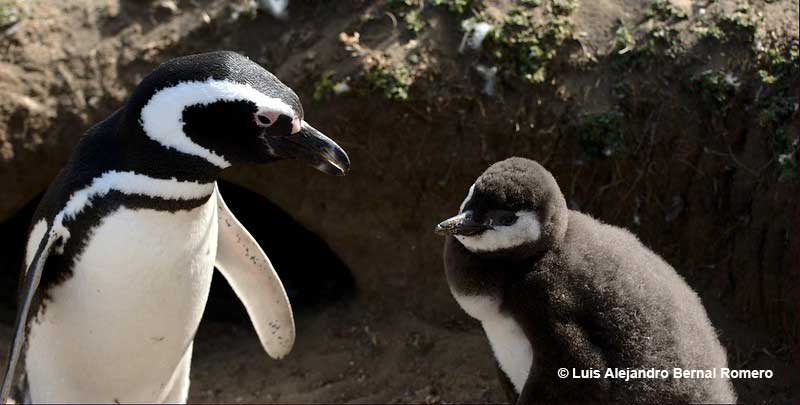
To regain the energy that the mother penguin lost in making her egg, she goes back to the ocean feed. In the meantime, the male penguin incubates the egg often huddling with other father penguins to stay warm.
After the egg hatches, the male Emperor Penguin feeds his baby crop milk for around a week. The mother returns around that time and takes over feeding her baby while the male forages at sea for 3 to 4 weeks.
None of the other penguin species raise young like this. Instead, both parents take turns incubating and feeding their young, often for several days at a time.
Fun Facts About Penguins & Their Breeding Habits
- If a mother Emperor Penguin doesn’t come back to her nest a week after the baby hatches, the baby dies because the male doesn’t have enough food for it.
- For their size, penguins lay smaller eggs than any other bird species.
- While most penguin species have one brood per season, the Little Penguins of Australia and New Zealand can have two or three broods. This is a pretty common behavior for smaller birds.
- “Isabelline Penguins” are penguins that were born with brown feathers instead of black plumage.
- To help prevent breakage, the shells of penguin eggs are thicker than eggs of most other birds.
- During 65 to 75 days of incubation, male Emperor Penguins don’t eat and can lose half their body weight!
- All penguins nest in dense colonies except for the Yellow-eyed Penguin of New Zealand. Pairs of these endangered bird species do not nest near each other.
- If a pair of Little Penguins have an unsuccessful nesting season, they can “divorce” and find a new mate.
Frequently Asked Questions
How do penguins recognize their partners?
Penguins recognize their partners by voice. Although penguin calls sound the same to us, to penguins, the differences between individuals are as clear as night and day.
What happens if a penguin’s mate dies?
If a penguin’s mate dies, it looks for a new mate the following nesting season.
How do penguins know when to mate?
Penguins know when to mate based on the amount of daylight they experience. The Galapagos Penguin also bases its mating times on water temperature. If water is too warm, they don’t mate because there’s less food available.