


There is no getting around it: Mother’s milk makes all mammals what they are. Linnaeus coined the name Mammalia from the Latin plural “mammalis,” meaning “of the breast.”
Oh, and sorry if it strikes you as shocking, but “mamma” actually means “breast” in Latin (feel free to blush now).
Mammalian milk was an extraordinary feed for mammalian babies – high in all essential nutrients, amino acids, and immune boosters; free from harmful bacteria and rich in good ones.
You may be surprised to hear that there are also milk producers outside our mammalian realm.
You’ve probably already guessed that these are birds. Still, avian milk producers are rare. Only Columbidae (pigeons and doves), flamingos, and Emperor Penguins have this parental superpower.
What Is Crop Milk Made Of?
Crop milk contains all the nutrients that chicks need to develop until they can forage food independently. It is very high in protein and fat, and unlike mammalian milk, it contains no sugars. Also, it has antibodies (IgA type), anti-oxidants, and probiotic bacteria, including Lactobacillus, Enterococcus, Veillonella, and Bifidobacterium (in pigeons).
Thus, besides nutrients, crop milk also provides milk immunity and healthy microbiota to chicks. Naturally, the exact crop milk composition varies between species.

What is bird crop anyway?
Bird crop is a part of the bird’s digestive system. It is a muscular, expendable pouch bird’s digestive system, an enlarged part of the esophagus.
The main purpose of the crop is to store food to eat subsequently. Many birds need to eat quickly to avoid predation and competition, so having an organ to store the food for later is handy.
While all birds have crops of varying capacities for food storage, only the few bird taxons listed above have the necessary glands for crop milk secretion.
Is crop milk the same as mammalian milk?
Nutrients and functions may be the same, but crop milk radically differs from the concurrent mammalian product. True milk is an emulsion, meaning that fat and protein particles are evenly distributed and mixed in the liquid, giving it a homogenous look and feel.
Crop milk is a suspension of protein and fat-filled cells that proliferate and shed from the crop’s lining. That is why crop milk looks more like yellowish cottage cheese, uneven and with curds. It doesn’t sound so tasty anymore.
Another critical difference is that mammalian milk contains quite a lot of carbohydrates (sugars), while bird milk has little to none.
What is also unique about crop milk production is that both parent birds produce crop milk in flamingos, pigeons, and doves. That is very different from mammals, whose milk production is exclusive to females. To make things even more distinctive, in Emperor Penguins, only dads are milk producers (and distributors).
As you see, avian and mammalian milk are very different liquid baby foods. However, there is one compelling similarity – the same hormone, prolactin, dictates the secretion of both substances.
Birds That Feed Their Babies Crop Milk
Three very different bird groups have independently evolved “milk” secretion as a solution to very different problems.
Pigeons
Pigeons needed to create pigeon milk because it’s the only way they can provide protein-rich food for their squabs. Pigeon diet contains no or very little animal matter, so pigeon milk is the way to concentrate the protein and fats from plant food for fast growth of their squabs.
Additionally, this “processed” baby food prevents digestive issues in the squab’s immature digestive systems. You could say that crop milk is the protein shake for baby pigeons!
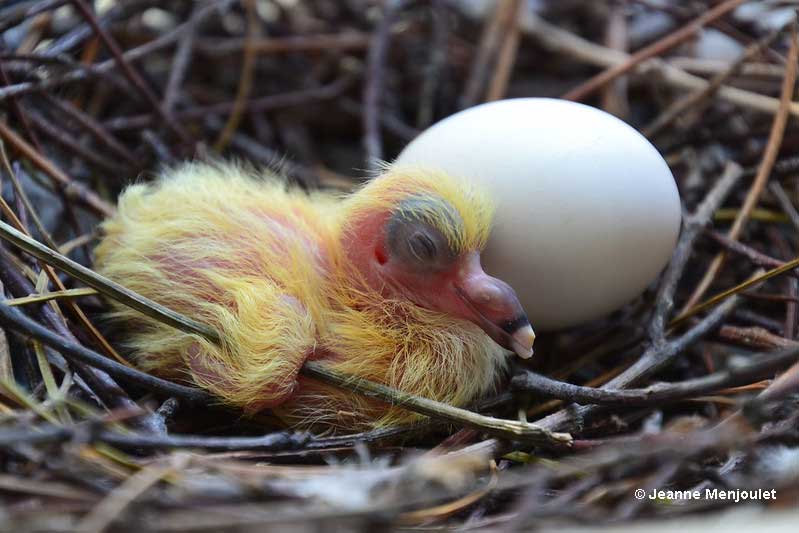
Pigeons and doves are the only birds with true crop milk – secreted in the crop. Both parents take turns feeding their chicks, but in Rock (or common) pigeons, it seems that males have a more prominent role.
Milk production starts about two days before egg hatching, and the chicks are fed crop milk only for about ten days. After that, much like human parents, they start introducing their version of “solids” alongside milk – adult food moistened and softened in the crop.
After two weeks, the squabs can thrive on the soft adult food mush. And yes – the parents continue regurgitating it directly into the young ones’ beaks.
Flamingos
The flamboyant flamingos owe their vivid colors to their weird nutrition. With their specialized bills, they filter miniature aquatic creatures like algae, small crustaceans like brine shrimp, mollusks, fly larvae, and tiny seeds from the lake or pond water of their habitats. Over time, carotenes from the food accumulate in their tissues, resulting in their pink plumage.
Eating tiny carotene-loaded creatures may give you awesome colors, but it is energy and time-consuming. For example, scientists calculated that Lesser Flamingos spend 70% of their day feeding.
That is one of the reasons why it was more efficient for flamingos to produce crop milk to feed their chicks. Another one is that the flamingo feeding apparatus takes some time to develop fully, so the chicks need liquid food while they mature.
Despite being called “crop milk,” flamingo milk is produced by cells in the entire digestive tract. The nurturing secretion is also rich in carotene, meaning that it has a red color! The milk of Greater Flamingos has much more fat and much less protein than pigeon milk and even contains plenty of red and white blood cells.
As I mentioned, both flamingo parents feed their chicks. The kids are entirely dependent on the milk until they’re about 45 days old – then they’ll start to forage on their own in the separated, big young flamingo flocks called ‘flamboyances.’
However, they won’t be pro at filtering shrimp from the very start, so the parents continue to supplement them with the precious crop milk until they’re between 9-13 weeks old.
Penguins
The Emperor Penguin males have a lot on their hands-slash-wing flaps. They have to incubate their eggs on a barren ice shelf in the frigid cold of Antarctic winter. Then, they have to make sure the hatchling is fed until the mother penguin returns from its months-long hunt at the sea because daddy penguin can’t hunt – or eat – while warming their chick.
Although he will be fasting for months, the male can at least rely on the food stocked inside of his body to feed his chick. For the first several days, he secretes a substance very similar to crop milk from his esophagus.
After that, he will also start regurgitating stored adult food. It will be enough until the mother returns with a new fish supply and the two parents switch duties.
Why Don’t All Parents Feed Their Babies This Way?
Although crop milk may seem universally convenient, for many birds, evolving the production just didn’t seem to pay off.
All birds that secrete crop milk face specific challenges to feed their young besides simply being altricial (hatching underdeveloped, blind, and helpless):
- Pigeons can’t feed their squabs protein-rich food for fast growth like insects.
- Flamingos have a delicate filtering apparatus in their bills, which takes extra time to develop and mature; also, it would take considerable (that is, too much) time for the chick to gather enough tiny organisms to support its fast-paced development.
- Emperor Penguin dads have to provide food for the chicks when they themselves can’t feed for months on end.
For most other birds who also have altricial chicks, it is much easier to hunt for a nutritious baby meal because these are abundant in the nesting season. Besides, it’s what adults also eat, so no special adjustments are needed. Various smaller animals preyed upon by birds provide enough nutrient richness for chick development.
FAQ
What is in crop milk?
Crop milk is made up of protein and fat-filled cells secreted by the small glands in the lining of the crop. The proteins and fats are suspended in liquid; unlike real milk, which is a smooth emulsion, crop milk is semi-solid, uneven, and chunky, reminding of a runny, pale cottage cheese.
Besides the basic nutrients, crop milk also contains vitamins, amino acids, anti-oxidants, crop epithelial cells, immune-modulating compounds like immunoglobins, and probiotic bacteria. The exact composition of crop milk depends on the species, current parental diet, and the phase of the chicks’ growth.
What does crop milk taste like?
I have certainly never tasted crop milk, and the Internet folks seem to be reluctant as well because there is no detailed information on crop milk taste anywhere. However, one scientific paper suggests that it has a “rancid flavor.” They didn’t go into detail about their discovery methods!
Why is flamingo crop milk red?
The flamingo crop milk has a deep red-orange color originating from tiny aquatic organisms – algae, plankton, shrimp, etc. – that adult flamingos filter from the water. The color itself comes from carotenes, which accumulate in adult birds’ tissues, resulting in their vivid plumage color.
How long do pigeons have crop milk?
Pigeons produce crop milk a bit over two weeks. They start secreting it roughly two days before the eggs are supposed to hatch, feed the chicks for around ten days exclusively with the milk, and then introduce adult food softened in the crop for several days. Around day 14, the milk production stops.
