


Flying seems to be one of the things that makes a bird a bird, and yet, some birds are flightless.
But have you ever wondered how many flightless birds there are? Sure, we know that ostriches and emus don’t fly; the same goes for penguins. Which brings us to the real question – how many flightless birds are there?
Why Can Some Birds Fly While Others Can’t?
Flying is certainly a big advantage. It makes sense that only a small number of birds are flightless. However, why should any birds be flightless? Wouldn’t it always be better to fly?
It usually is but there are situations where birds just don’t need to fly. Ostriches, Emus, and other big flightless birds have survived without needing to fly because they are too big and fast for most predators. They’ve been like that for a very long time too; Ratites are ancient birds, the ones closest to dinosaurs!
Other flightless birds “lost their wings” simply because they didn’t need them. Such birds mostly fall into two categories: birds on islands and waterbirds.
There are several situations where birds evolved on islands with few predators. They didn’t need to fly and adapted to living on the ground. It’s a similar situation for penguins and a few other aquatic birds that spend most of their lives in the water.
Penguins
Penguins are some of the best-known flightless birds. Watch a penguin standing on ice and it’s easy to understand why they can’t fly. They don’t have feathers like other birds, look pretty heavy, and have wings that look more like flippers!
However, penguins might be clumsy on land but they are incredibly agile underwater. These special birds are flightless because they became highly adapted to living in cold and aquatic conditions.

Penguins are built for swimming beneath the waves. Their wings resemble flippers for a good reason; penguins use them to propel themselves through the water.
To stay warm and swim better, penguins are also heavy birds with lots of blubber, too heavy to fly. Despite being flightless, penguins can also survive because they mostly nest on islands and other remote places with few land predators.
Ostriches
Ostriches are very tall birds with a prehistoric appearance. That’s no coincidence, Ostriches and other tall flightless birds are more closely related to their dinosaur relatives than other species.
They have also retained some of those ancient characteristics, including long, strong legs instead of broad wings. Those legs have helped Ostriches survive into modern times, mostly because they help them run at 30 to 40 mph!
Despite being flightless, Ostriches have also survived because they live on open plains with low vegetation. This makes it easier for Ostriches to spot predators at a distance and stay far enough away from predators to be caught.
Sadly, that strategy hasn’t worked in places where people started hunting them with guns. By the early 20th century, Ostriches were hunted to extinction in much of the Middle East and North Africa. On a bright note, these special birds have been reintroduced to parts of Saudi Arabia and elsewhere in the Middle East.
Emus
Emus are like the Australian equivalent of an Ostrich. Like Ostriches, they are tall, flightless birds of open plains, and can also run at 30 mph.
Although they aren’t as tall as Ostriches, Emus are still too big for most predators, and are common in many parts of Australia. They are also more adaptable and can live in brushy areas and open woodlands too.

Their adaptability also explains why these big birds can be flightless and still thrive. Emus feed on a wide variety of seeds and other plant matter, and lots of arthropods. In other words, they follow a diet sort of like a chicken. This makes it easy for them to find food and is also one of the reasons why it’s fairly easy to raise Emus on farms.
Cassowaries
In Australia, Emus forage in open areas while Cassowaries haunt tropical rainforests. These big, heavy, flightless birds with hair-like plumage creep through rainforests in northeastern Australia and New Guinea.
As tall as a person, cassowaries have probably survived being flightless because they are dangerous. They are too big for most predators and can defend themselves better than most birds. If a cassowary feels threatened, it can leap forward and kick out with one of its strong legs.
If the bird had soft feet, that might not be too much of a problem. However, a cassowary’s feet are tough and tipped with a big claw sharp enough to cause serious injury and even kill a person!
Even worse, you have to be especially careful around cassowaries because they can also get aggressive for territorial reasons. Fortunately, for the most part, these amazing birds spend their time walking in forest to forage for large fruits.
Rheas
Rheas are tall, slender birds with long necks, long, strong legs, and mostly gray plumage. They act a lot like Ostriches and replace them in open habitats of southern South America.
The male Greater Rheas can me more than 6 feet tall while Lesser Rheas are only a bit more than three feet tall. These flightless birds are excellent runners that can reach speeds of 37 mph! Undoubtedly, their running abilities have helped rheas survive into modern times.
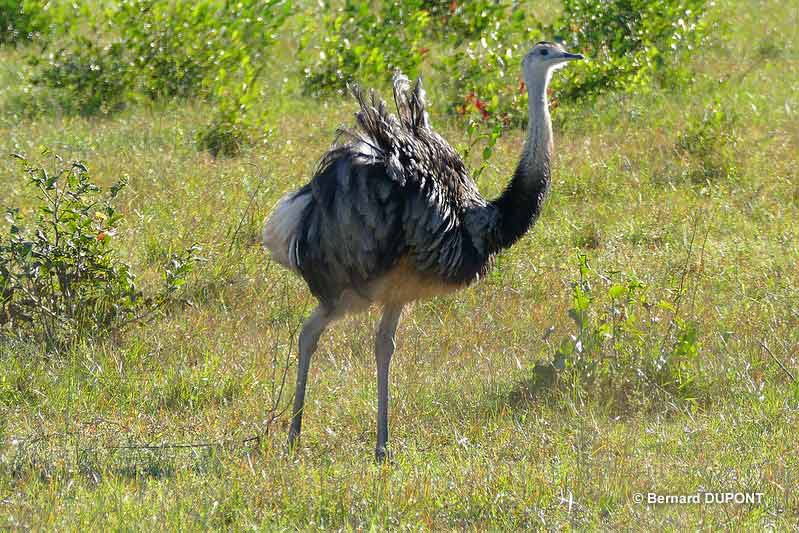
Like Ostriches, upon spotting a person or predator, they stay far enough away to be able to outrun the threat. Although they can’t fly, when running, rheas spread their sizeable wings to help them move back and forth.
Rheas also survive by feeding on a variety of seeds, fruits, and small creatures. Although these flightless birds are still fairly common, intensive agriculture has replaced large areas of habitat and they have declined in several areas.
Kiwis
Kiwis are unique, quail or chicken-sized birds with hair-like plumage, strong legs and feet, and long slender beaks. They almost look and act more like a mammal than a bird!
Their mammalian appearance might not be too surprising. Kiwis only live in New Zealand and evolved there in the absence of mammals (except for three bat species). We could say they fill niches used by mammals like opossums, hedgehogs, and skunks.
Like those small or medium-sized mammals, Kiwis are nocturnal and forage for worms and other arthropods. The absence of mammalian predators also made it possible for kiwis to be nearly blind or become blind and still be able to survive!
There are five species of Kiwis and all are threatened by introduced mammalian predators such as weasels, cats, and dogs. The smallest species, the Little Spotted Kiwi, would have gone extinct if the final few birds had not been transferred to predator free islands!
Kakapo
The Kakapo shows how much birds can evolve in the absence of predators. This moss-green bird is a type of parrot, and yet it can’t fly and is nocturnal!
With no mammalian predators hunting them, Kakapos evolved to live in and feed on vegetation in mossy forests. Although they climb trees and then glide to the ground, they didn’t need to fly to escape from predators. Instead, their highly camouflaged plumage and nocturnal habits protected them from most hawks, eagles, and owls.
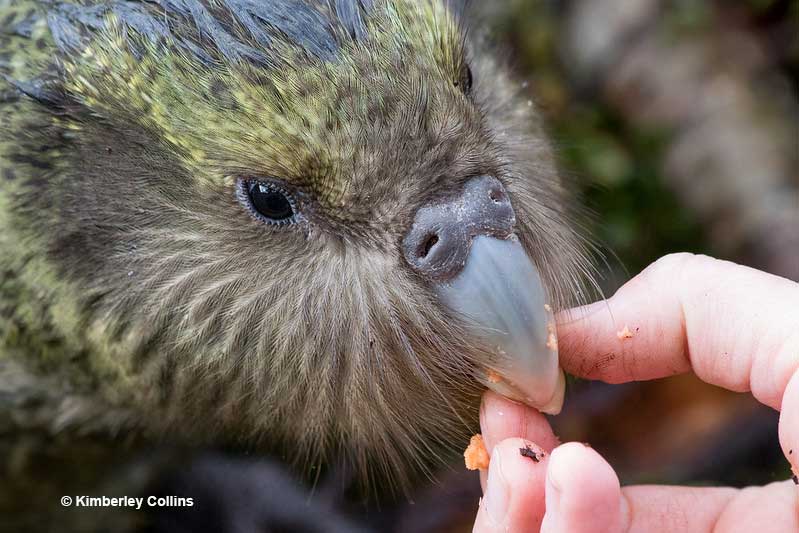
Kakapos also have poor eyesight and find much of their food by smell.
Those adaptations worked very well; historically, Kakapos occurred throughout New Zealand! These days it’s a different story. Kakapos began to decline shortly after humans arrived in 1200 A.D. and have become critically endangered.
The biggest threats they face are from rats, cats, dogs, other predators, and habitat destruction. To keep Kakapos from going extinct, all live on carefully managed, predator-free islands.
Dodo
The famous Dodo really did exist! Sadly, this unique pigeon species went extinct in the 17th century, less than 100 years after people arrived at its only home, Mauritius Island.
The Dodo was essentially a pigeon that evolved to live on a fairly small island with few to no predators but lots of food! It evolved accordingly, and since the Dodo didn’t need to fly, the bird eventually lost that capability.
Instead, Dodos evolved into a larger beak that was better suited to eating fruits and other types of island food.
They also evolved strong feet and legs and were well-suited to living on a tropical, predator-free island.
However, having never lived with predators, the Dodo lost its fear of other animals, especially mammals. Therefore, it wasn’t afraid of rats, other introduced animals, nor people. Tragically, the flightless pigeons quickly succumbed to being hunted and killed for food.
Flightless Rails
Rails are known for their terrestrial and skulking behavior. Given their ability to hide well and quickly run to safety, it’s no surprise that several rail species became flightless.
More than 50 rail species are known to have been flightless, but sadly, more than 30 have gone extinct.
Most flightless rails lost their ability to fly because they live or lived on islands with few mammalian predators. They didn’t have much reason to fly, so they evolved smaller wings and stronger legs and feet.
The ones that went extinct mostly occurred on islands in the Pacific, including Hawaii.
They probably died out shortly after people arrived because they lacked defenses against Polynesian rats. People ate some of them to extinction too!
Some of the flightless island rails that still occur are the Weka on New Zealand, the Calayan Rail in the Philippines, and the Invisible Rail of Halmahera, Indonesia.
Flightless Steamer Duck
The Flightless Steamer Duck is a big, gray, and white duck with an orange beak and legs. It lives along the southern, rocky coast of Chile where it feeds on mollusks and other small creatures.
True to its name, this duck is flightless! Instead of flying, it uses its small wings to propel itself along the surface of the water. Flightless Steamer Ducks probably evolved such small wings because there are very few terrestrial predators that can reach them. They never live away from the coast, only occurring on the water or in sheltered, rocky bays,
Two closely related flightless steamer ducks also occur in Argentina (the White-headed Steamer Duck), and on the Falkland Islands (the Falkland Steamer Duck).
These ducks also evolved a larger size, perhaps to compete with the common Flying Steamer Duck.
A few other flightless teal species also occur on remote Pacific Ocean islands.
Flightless Cormorant
Like a lot of other flightless bird species, the Flightless Cormorant only occurs on islands. It is restricted to the Galapagos Islands, and only lives on the coasts of Fernandina Island and Isabela Island.
Flightless Cormorants act and look like other cormorants, except they can’t fly and have tiny wings! These special birds swim underwater to catch fish and other sea creatures.

They probably lost their ability to fly because they never needed to escape from mammalian predators on the ground. Living on tropical islands with no winter and an abundant source of food, they didn’t need to migrate either.
Like many other flightless birds, Flightless Cormorants probably also benefited from becoming flightless in other ways. With shorter wings, they might have been able to grow bigger feet and other adaptations suited for catching underwater prey.
Titicaca Grebe
The Titicaca Grebe is one of three known grebe species that became flightless. The other two are the Junin Grebe of central Peru, and the extinct Atitlan Grebe that used to live in Guatemala.
Titicaca Grebes are restricted to Lake Titicaca and a couple other high elevation lakes in Bolivia. Apparently, those lakes were so big, Titicaca Grebes never had to fly away and search for other places to live.
Instead, they could just stay put and forage for fish. Since they nested in reeds and didn’t have to deal with terrestrial predators, they eventually lost their ability to fly.
It’s a similar situation for the Junin Grebe. Unfortunately, the Atitlan Grebe is gone and may have disappeared from interbreeding with the Pied-billed Grebe! Sadly, as with many flightless birds, Titicaca and Junin Grebes are very susceptible to changes to their limited habitat.
Both species have become endangered by pollution and other factors, the Junin Grebe gravely so.
Frequently Asked Questions
How many flightless birds are there?
There are at least 59 known species of flightless birds.
Did flightless birds evolve from flying birds?
Yes, flightless birds evolved from flying birds.
Who are the smallest flightless birds?
The smallest flightless birds are the Inaccessible Island Rail. This flightless bird is just 5.1 to 6.1 inches long, as big as a House Sparrow!
Are ostriches the largest flightless birds?
Yes, ostriches are the largest flightless birds. They can stand as tall as 9 feet!