

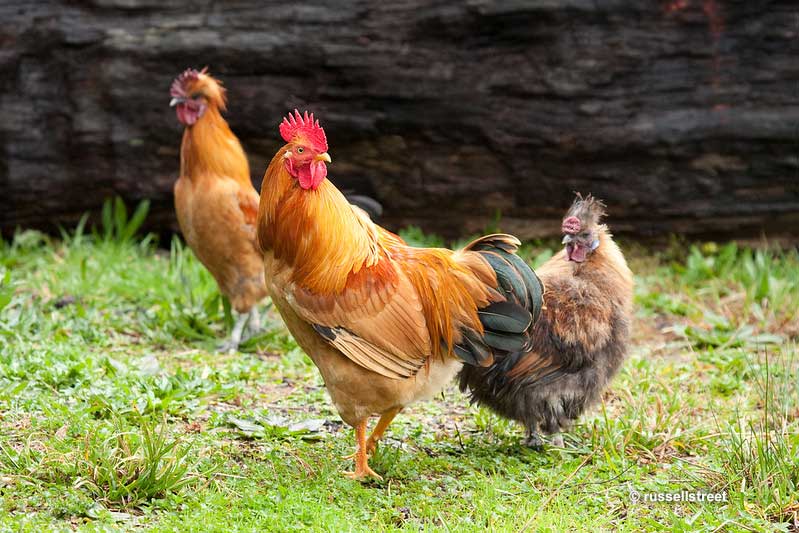
What’s a chicken? Yeah, we all know what chickens are, and lots of us love to dine on those plump birds, but where did they come from?
Although it might seem like it, chickens didn’t just hatch into being on a farm. At some point, they were wild birds that became domesticated.
Do wild chickens still exist? If so, where do they live and what do they look like?
Key takeaways:
- The domesticated chickens we know today all line from Red Junglefowl, an Asian wild chicken species.
- If domesticated chickens happen to escape, they usually return, but they are able to survive in the wild.
Do Wild Chickens Excist?
I recently visited a farm and noticed several free-range chickens wandering the grounds. The birds were used to people and I couldn’t help but wonder if they could survive on their own, out in the wild.
If some chickens escaped, no one would be giving them chicken feed but they could still eat seeds and bugs. However, would those birds be able to escape predators? I bet some could but it’s hard to believe that chickens that grew up on farms could survive in the wild.

Even so, wild chickens do exist! Feral chickens live in scrub, woodlands, and other habitats in parts of Hawaii, California, Florida, and some other parts of the world, especially on islands. I suspect feral chickens do better around people and on islands because there are fewer predators.
These birds are escaped domestic chickens, but even so, they aren’t that different from their ancestral, wild counterparts.
Those birds would be junglefowls that live in southeastern Asia. While the Red Junglefowl is the main ancestor for the domestic chicken, most are also related to Gray Junglefowls from India, and Green and Sri-Lankan Junglefowls from Indonesia and Sri Lanka.
The Red Junglefowl
DNA studies have shown that the Red Junglefowl is the main ancestor of the domestic chicken. Unsurprisingly, males look like chickens with iridescent green, orange, and reddish feathers. Hens resemble plain, brownish-colored chickens.

Although they are vastly outnumbered by their domesticated cousins, good numbers of Red Junglefowls still live in woodland habitats in southeastern Asia. They range from northern and eastern India to eastern China and south to Indonesia and the Philippines.
On a birding trip to Thailand, I was pleased to see wild Red Junglefowls on several occasions! They didn’t act much different than shy chickens but it was still neat to see them.
All domesticated chickens are descended from ancestors that lived in northern Thailand, Myanmar, and southwestern China. Today, we know that they were first domesticated 8,000 years ago!
As those domesticated birds eventually spread to other parts of Asia, they also mixed with other subspecies of Red Junglefowl, and the other three junglefowl species.
Although there are several other chicken-like birds, Red Junglefowls might have been easier to domesticate because they reproduce when they are given more food. This is a natural adaptation to sudden and unpredictable increases in bamboo seeds found in their native range.
How Do Wild Chickens Get By?
Wild chickens are pretty similar to domesticated chickens. Like the barnyard birds, whether the wild birds are feral chickens or wild Red Junglefowls, they scratch in leaf litter to forage.
They are pretty adaptable birds that can feed on a variety of seeds, bugs, and other small creatures. Red Junglefowls also feed on ripe fruit. This feeding strategy ensures that wild chickens can usually find things to eat throughout the year.
Like chickens on the farm, wild birds also have large broods with chicks that can move around and feed themselves shortly after hatching. This mobility helps in avoiding snakes and other predators that would quickly find their nest.
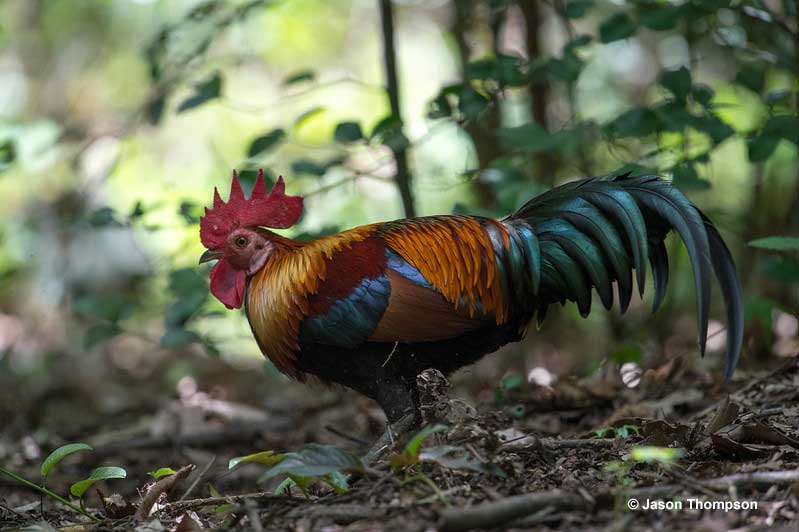
They are still very susceptible to predation but grow quick and learn to follow their mother around, run quickly, and eventually fly into trees to escape danger. Adult wild chickens fly into trees to escape predators too as well as to roost at night.
Another thing that helps young wild chickens is their plumage. They have a camouflaged pattern that helps hide them from predatory eyes.
In essence, wild chickens survive like so many other wild birds. They have natural adaptations to escape predators, eat a wide variety of food items, and breed twice per year.
Frequently Asked Questions
How long have chickens been domesticated?
Chickens have been domesticated for at least 8,000 years.
What is the difference between a chicken and a Red Junglefowl?
When we’re comparing domesticated chickens and Red Junglefowl, the first thing you need to know is that they are the ancestors of domesticated chickens.
Since they still live in the wild, we know they aren’t too different from other chickens, but Red Junglefowl live in the wild, so they are adapted for different dangers. Domesticated chickens, on the other end, are perhaps more dormant, and since they live relatively safe lives (unless a predator gets in their coop), there aren’t many dangers they need to look out for.
Can escapees survive in the wild?
Escapees can indeed survive in the wild. However, survival for an escaped domesticated chicken mostly depends on the number of predators in the surrounding area and the climate. Chickens need warm weather and are more likely to survive in places with fewer natural predators.
Do chickens come back?
Yes, chickens do usually come back. If an escaped chicken doesn’t get caught by a predator, it can navigate its way back to its coop.