

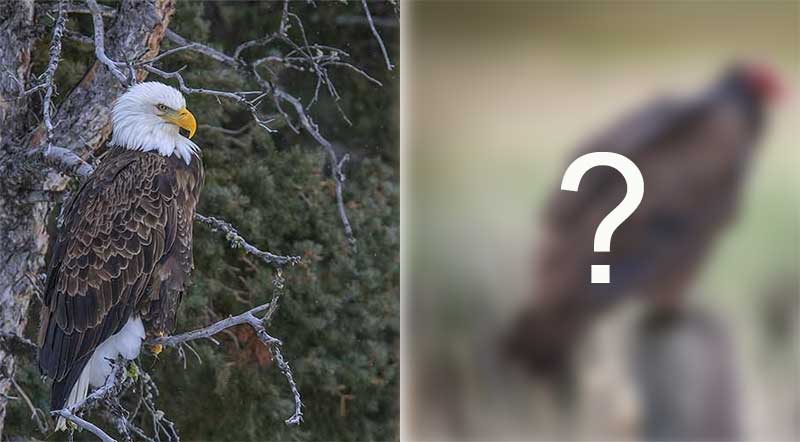
“Look, there’s an eagle!” I can’t tell you how many times I’ve heard someone say that and the bird turned out to be something else. It was still a cool bird, but an eagle? Nope, not quite.
Eagles are big, soaring birds, but so are a bunch of other species. How can you tell them from eagles? Which species look like eagles the most?
Read on to find out!
The Characteristics Of Eagles
A number of birds look sort of like eagles but if you know what to look for, eagles aren’t that difficult to recognize.
First, you have to know which species are possible. When birdwatching in North America, those would be the Bald Eagle and the Golden Eagle.

When perched, both are huge birds with massive beaks (much bigger than any hawk). The white head and tail of adult Bald Eagles make them easy to identify, but young Bald Eagles and Golden Eagles can be tricky.
Once again, I recognize them by their huge beaks, but I also look at their plumage. Young Bald Eagles and Golden Eagles of all ages have mostly dark brown plumage, especially on the front of the bird. Few hawks have that plumage pattern and none are as massive as an eagle.
In my experience, flying birds are easier to identify. One of the best ways to identify raptors is to focus on their shape, and eagles are no exception. In flight, Bald Eagles are huge birds that soar on flat wings. To me and other raptor watchers, they look sort of like a “flying board”!
Golden Eagles have similar, long broad wings but hold them in a slight “V”.
Birds You Can Mistake For Eagles
California Condor (Gymnogyps californianus)
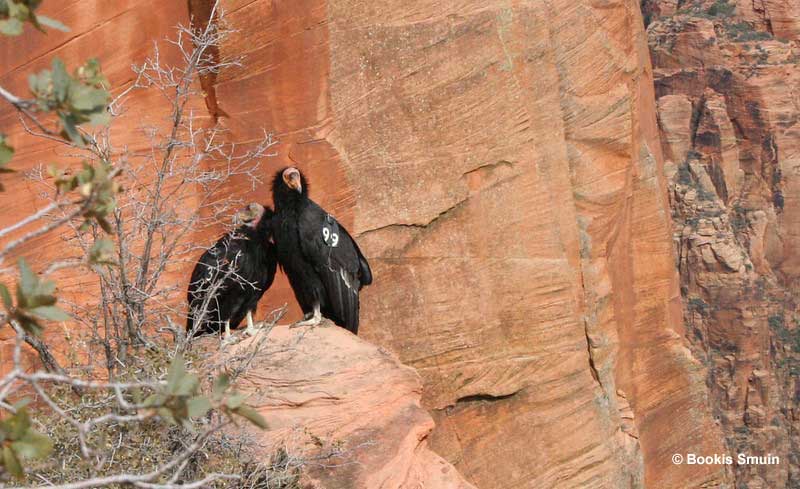
Range: South-central California, southern Utah, northern Arizona, and southern Nevada.
California Condors aren’t even related to eagles but they are so huge, sometimes people confuse them with the big birds of prey. Like eagles, condors soar on huge, broad wings and they also have dark plumage with some white.
However, as big and impressive as eagles are, California Condors are even bigger! While eagles have 6 and even 7 foot wingspans, condor wings measure 8 or 9 feet across. Condors also always have bald heads and their beaks are smaller than the eagle’s big, hooked beak.
Another way to know that you might looking at a California Condor and not an eagle depends on where you go birding. California Condors are rare and only live in certain parts of California, Utah, Nevada, and Arizona. If you are in condor country and see a giant bird with white in its wings that dwarfs nearby Turkey Vultures, you could be watching a condor!
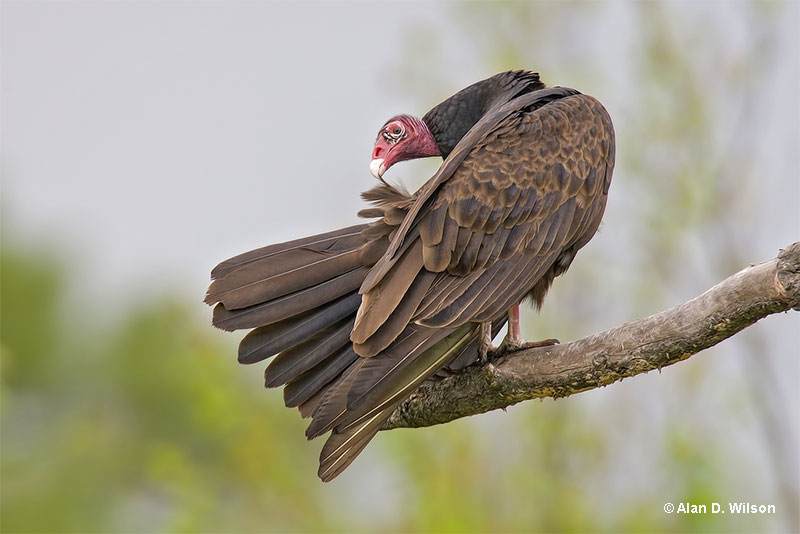
Turkey Vulture (Cathartes aura)
© Alan D. Wilson
Range: Southern Canada to southern Argentina
Turkey Vultures have to be one of the most common “false alarm eagles” in North America. Like eagles, they are big birds of prey that often soar on long, broad wings, and when you see one for the first time, they can make a big impression!
People wonder if they are seeing an eagle because they might have never heard of a Turkey Vulture but do have a notion of what an eagle is.
These big birds can also occur in similar situations. I’ve often seen eagles and Turkey Vultures soaring in the same field of view and feeding on carrion near each other.
Luckily, with a good look, it’s pretty easy to tell a Turkey Vulture from an eagle. They are easy to identify by their “V”-shaped wings, a small head, and a “rocking” flight.
Black Vulture (Coragyps atratus)
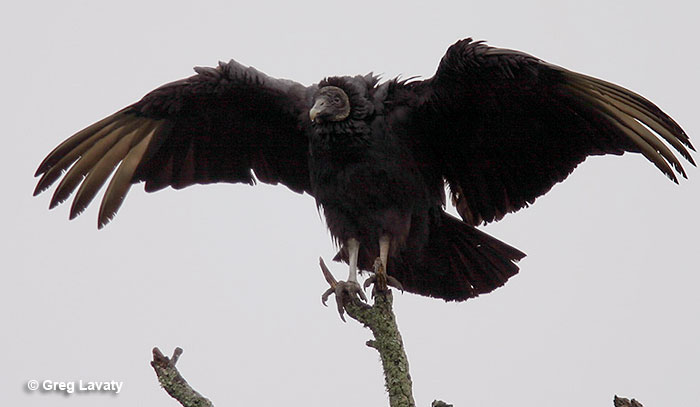
Range: Eastern USA to Argentina
Black Vultures are another big bird of prey that can also be confused with eagles. As with eagles, we also often see them in high, soaring flight.
They also have broad, flat wings and a short tail. Like eagles can do, Black Vultures feed on carrion too. However, they don’t have that hefty raptor head that eagles sport, and we often see Black Vultures in flocks. These social birds soar together, sometimes in sizeable groups, and also perch near each other.
Away from some wintering sites that concentrate on Bald Eagles, we rarely see eagles flocking together like that. Other things that help me recognize Black Vultures is that they are smaller than eagles and are mostly black except for a pale patch near the tips of their wings.
You won’t see Black Vultures pursuing ducks or flying down to the water to catch fish either!
Osprey (Pandion haliaetus)
© Alan D. Wilson
Range: Alaska, Canada, many parts of the USA, and coasts and wetland habitats in many other parts of the world.
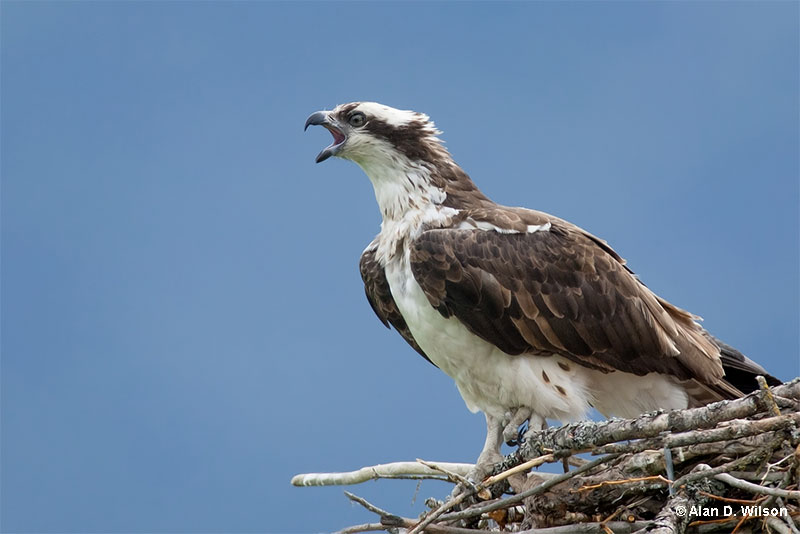
Ospreys aren’t eagles, but they sure act like one! Indeed, one of the common names for the Osprey is actually “Fish Eagle.” Like Bald Eagles, Ospreys dive down to the water to snatch fish with their sharp talons.
Unlike eagles, it’s the only way they catch food.
While eagles also prey on other animals and feed on carrion, Ospreys follow a strict, fish-only diet. They often share a habitat with Bald Eagles, and after snatching a fish, the bigger, stronger raptors can chase them and try to steal their catch.
Whether seen together or on their own, Ospreys are pretty easy to tell from eagles. While eagles are hefty birds with dark plumage, Ospreys are slender raptors with some dark markings on mostly white plumage. In flight, on account of their lanky wings, they can remind me more of a big gull than a raptor!
Ferruginous Hawk (Buteo regalis)

Dark morph. Photograph © Tom Grey.
Range: Southern Alberta, Canada, south through the Great Plains to California and central Mexico.
Big hawks are frequently confused with eagles, and with good reason. Essentially, they are like smaller versions of eagles.
With that in mind, anyone seeing a Ferruginous Hawk would have a good excuse for confusing it with an eagle. This biggest hawk in North America can measure up to 28 inches long, has a fairly large beak, and feathered legs with strong talons!
In some ways, it also acts like a Golden Eagle, and both birds often live in the same wide-open habitats. Both also prey on prairie dogs and ground squirrels. At least you can tell them apart by looking at their plumage!
The first time I saw a Ferruginous Hawk soaring over the Comanche Grasslands of eastern Colorado, its rufous legs against its white belly were easy to see.
Dark Ferruginous Hawks are trickier, but they always have a pale tail instead of the juvenile Golden Eagle’s dark tail with a prominent white base.
Red-tailed Hawk (Buteo jamaicensis)

Range: Alaska and Canada south to the Caribbean and Panama.
Along with Turkey Vultures, Red-tailed Hawks are frequently confused with eagles. Although not as large as an eagle, they are still pretty big and chunky birds of prey. They also soar on broad wings and have fair-sized hooked beaks and sharp talons.
However, the main reason Red-tailed Hawks get that false eagle label is because they are so common. Like millions of people on a daily basis, I often see big Red-tailed Hawks perched on roadside electrical towers and posts.
They look big, sometimes bigger than they really are, and that’s partly why folks think they are seeing an eagle. Take a closer look, though, and we can see that most Red-tailed Hawks have pale underparts with a dark “belly band.”
Whether perched or in flight, they also have that distinctive and beautiful deep pumpkin-orange tail. You won’t see those field marks on Bald and Golden Eagles!
Rough-legged Hawk (Buteo lagopus)
Range: Alaska, northern Canada and northern Eurasia, wintering in southern Canada, the northern and western USA, and parts of Europe and central and eastern Asia.
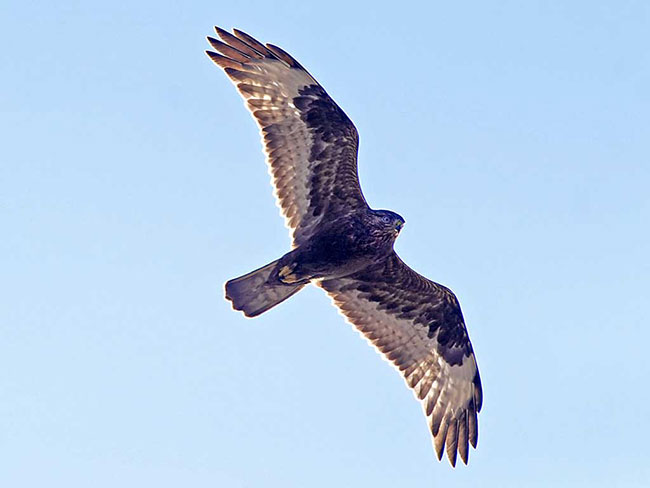
The Rough-legged Hawk is another big hawk species that can get labeled an eagle on account of its large size. To be honest, at 18 to 17 inches long, they are pretty big. These northern hawks also soar on long broad wings and a longish tail.
Not to mention, their tail has a pale color and pattern that can remind you of a Bald or Golden Eagle. However, the similarities pretty much end right there. This big hawk has much more mottled plumage and patterned wings than eagles.
It also frequently hovers in place as it hunts for rodents in open, snow-covered fields. Eagles, on the other hand, soar high overhead or swoop after their prey with fast and direct flight.
Although I have seen Rough-legged Hawks and eagles migrating on the same day at hawk count sites, I don’t usually see them “together” in other situations.
Swainsons’s Hawk (Buteo swainsoni)

Range: Breeds in Alaska, western and central Canada, the central and western USA, and northern Mexico. Winters in Argentina.
Do some summer birding in grasslands and open habitats anywhere west of Iowa, and you might see this pseudo-eagle. In western grassland habitats, Swainson’s Hawks are one of the more common raptors.
Look up and you might see one kiting against blue skies with its long, pointed wings and longish tail. You might also see it flying in some of the same places as Golden and Bald Eagles. Swainson’s Hawks can also hunt for some of the same rodents that Golden Eagles catch.
These hawks live in many of the same places as eagles but they are smaller and slenderer birds. In addition to their distinctive shape, I also tell them from eagles by their narrow white rump patch, dark flight feathers, and white throat patch.
Not to mention, if you go birding in those same places in winter, there probably won’t be any Swainson’s Hawks to look at. These migratory hawks fly all the way to Argentina!
Harris’s Hawk (Parabuteo unicinctus)
Range: Parts of Texas and the southwestern USA south to Chile and Argentina.
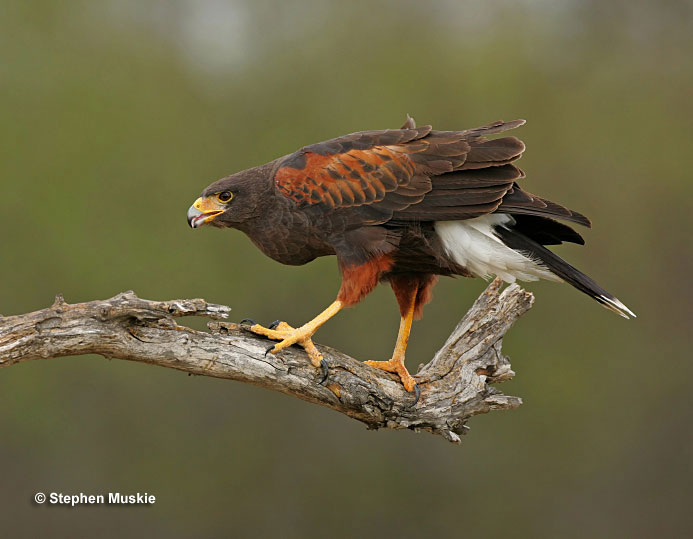
The Harris’s Hawk is a fair-sized raptor with broad wings and a longish tail. It also has a powerful appearance, which is certainly enough to confuse it with an actual eagle.
We can also see this raptor in the same places frequented by Golden Eagles and Bald Eagles (although Harris’s Hawks don’t necessarily forage in wetlands). Like eagles, Harris’s Hawks can also soar high overhead and perch on towers and other prominent spots.
A lot of other raptors do that, too, but Harris’s Hawks can trick us even further with eagle-like plumage. Similar to young Golden Eagles, they are dark, chocolate-brown raptors with bold, black-brown, and white tails.
Despite those similarities, with a good look, it’s pretty easy to tell them apart from Golden Eagles. When I see a Harris’s Hawk, the bird’s wings don’t look as long as those of an eagle and the hawk isn’t nearly as large.
Crested Caracara (Caracara plancus)
Range: Parts of Florida, southern Arizona and Texas south to Argentina.
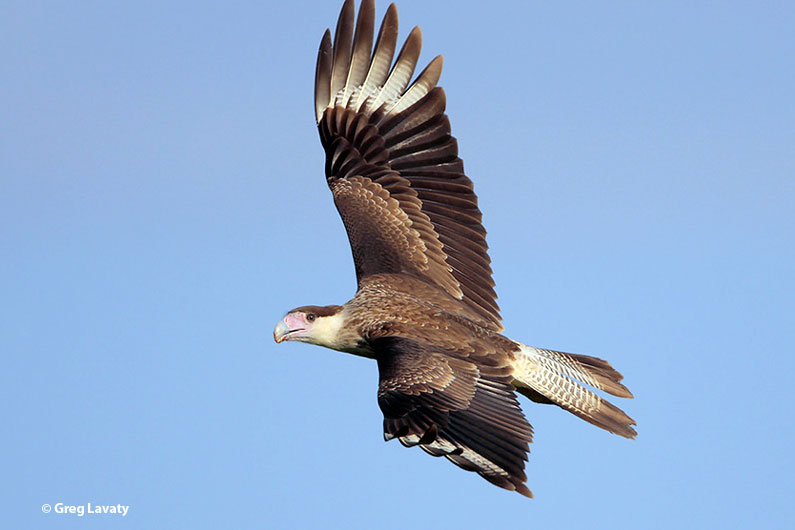
Crested Caracaras are odd, eagle-like falcons. Although not quite as large as eagles, they are still pretty big birds. Like eagles can do, Crested Caracaras feed on carrion. They also have the distinction of having a plumage pattern a bit like that of a Bald Eagle.
Crested Caracaras are black or sooty brown with a lot of white on their head and tail.
With a brief look, it’s easy to wonder if you saw a Bald Eagle. Get a better look, though, and you’ll see that the bird has a black crown, some white on its chest, and a broad black tip on its tail.
Crested Caracaras also show broad white patches near the tips of their long wings. I also feel like they do a lot more flapping than eagles. Indeed, their flight style reminds me more of Common Ravens than other raptors.
Frequently Asked Questions
How many eagle species are there in North America?
In North America, there are two eagle species. Those two species are the Bald Eagle and the Golden Eagle. There are also two more species that occur as rare vagrants; the White-tailed Eagle and the Steller’s Sea-Eagle.
What can be mistaken for a Golden Eagle?
Bald Eagles, Turkey Vultures, and Ferruginous Hawks can all be mistaken for a Golden Eagle.
Are there any Bald Eagle-like birds in the U.S.?
Yes, there are Bald Eagle-like birds in the USA. Golden Eagles look a lot like young Bald Eagles, and sometimes, people also confuse Turkey Vultures and big hawks with Bald Eagles.
Are hawks related to eagles?
Yes, hawks are related to eagles. They are in the same avian family, the Accipitridae.