

Domesticated birds have been with us for thousands of years and are a major part of our civilization. They’ve helped humans obtain a stable protein source, companionship, and assistance on various fronts – from crop pest control (ducks and chickens) to warfare (war pigeons).
The very beginning of domestication of many animals is still a misery. Yet, we know enough about that process and its history to re-create a compelling puzzle – an amazing story about bird-human relationships, cohabitation, and interdependence.
How Does Domestication Happen?
Domestication is a process in which humans take an originally wild species, tend to it, and then gradually change it by selecting certain traits (including docile behavior) for many generations by controlling its reproduction.
When I say “change”, I don’t simply mean “tame it.” Domestication is a process in which a species loses some of its wild characteristics and gains domestication traits. Although domestic animals are genetically similar to their wild ancestors and relatives, they often look and behave very differently.
Humans have actively participated in the domestication process by selecting for traits they would like to see in that particular breed.
By taking away the animal’s ability to choose its own partner and creating pairings ourselves, we’ve created a myriad of variations (called varieties or breeds) of all domestic animals. Charles Darwin called this “evolution through artificial selection.”
However, not all mutations appeared because of purposeful human choices. Typical spontaneous domestication traits we see in domesticated mammals include:
- New color patterns, often featuring white patches
- Smaller body size
- Floppier ears
- Altered tails
- Smaller brains
- Smaller teeth
Scientists assume that the physical transformations share a genetic link to the temperament changes humans favored in the selection process – tameness, friendliness, and submissiveness.
True Domestic Birds
Naturally, not all transformations we see in domesticated mammals can appear in birds (a chicken with floppy ears would be cool, though). Still, we definitely see the appearance of various plumage colors and the changes in body size – but domestic birds tend to be larger than their wild versions.
Domesticated birds readily reproduce in captivity and often have no naturally limited breeding seasons. Their ability to fly is reduced or gone. Also, the fear of humans is lessened – a big deal to achieve in prey birds like fowl and pigeons.
There are many traits that breeders purposefully select in domestic birds to achieve different goals and satisfy human demands. Here are some examples:
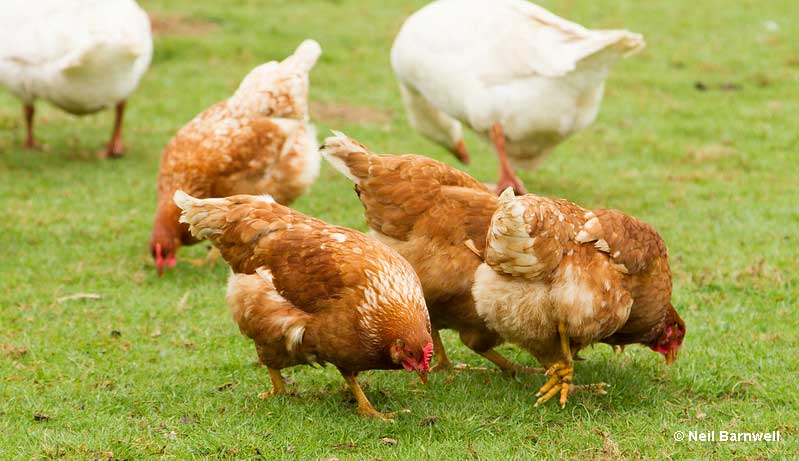
- Fowl and waterfowl were selected for larger, meatier bodies and/or higher egg production.
- Fighting chicken breeds were bred for more male aggression.
- Show and pet birds often have unusual color or feather mutations.
- The selection of the domestic canary was based on the male’s song quality and plumage features.
- Depending on the breed, domesticated pigeons were bred for special flying abilities, looks, or pronounced homing instinct (for message delivery).
- Tameness in many birds; as a consequence of long-term artificial selection, even feral pigeons quickly become docile and friendly towards humans who feed them – unlike their wild relatives.
Interestingly, very few bird species or groups were truly domesticated. Let’s have a look at them.
Fowl and Waterfowl
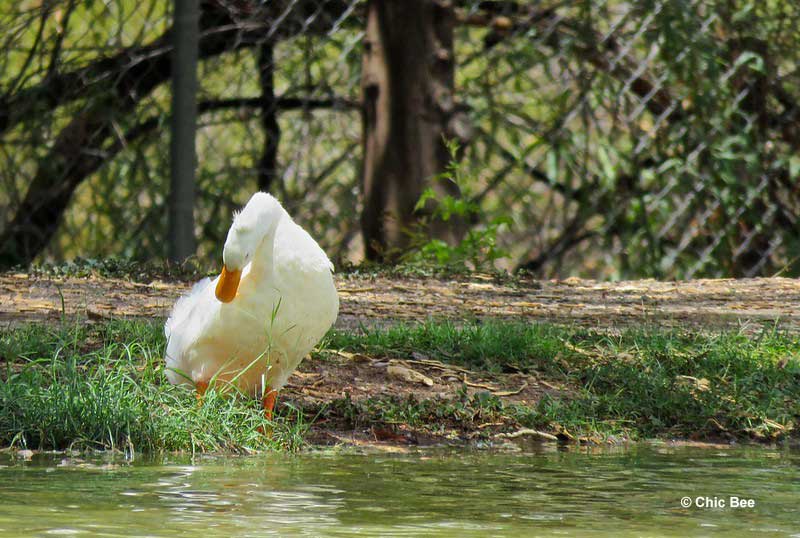
This group comprises domesticated landfowl – chickens, turkeys, quails, guineafowl, and waterfowl – ducks and geese. They are mostly kept for their meat and eggs but also for show and companionship. Goose fat is especially popular in traditional French cuisine.
Also, people have kept various species of Pheasants and Peafowl around for thousands of years. Still, they remained very similar to their wild ancestors and thrived if they escaped into a native-like environment. We could call them semi-domesticated.
Fowl Selection
There are thousands of domestic landfowl and waterfowl breeds, with two main selection branches according to their intended use by humans.
Meat birds were selected for maximum muscle mass to provide more meat, so they are bulkier, heavier, and grow faster. These include White Broilers – the number one factory farm meat breed due to muscle size and fast gain, and Red Rangers (or Red Broilers), a more natural-looking and resilient breed you can keep freerange.
As for waterfowl, Pekin ducks are the most common duck meat source.
The layers are chickens and duck breeds selected for high egg production. The most popular and highest-producing layers are the Leghorn and Rhode Island Red.
In the duck realm, Khaki Campbells are definite record holders, laying up to 340 eggs yearly.
Many backyard keepers and small-scale farmers prefer dual-purpose breeds. They lay a high number of eggs and also have a body mass that provides moderately high (but not extreme) meat yield. Brahma, Orpington, and Australorp chickens are some of the most well-known dual-purpose breeds. Most domestic duck breeds are dual-purpose.
Layers provide a good illustration of what artificial selection can achieve. While primitive chicken breeds produce 40-60 eggs yearly, while high-end layers (both chickens and ducks) can produce over 300!
Pigeons
The original Rock Dove lived in a limited range of habitats it is named after – cliffs, canyons, caves, and other rock formations of the Old World.
But how did the Rock Dove become the domestic pigeon? Physical evidence from Mesopotamia and Ancient Egypt tells us that domesticated pigeons have existed for at least 5000 years and maybe even 10,000 years.
Enter Columba livia domestica. Primarily a meat source, in time, it acquired other roles – of ornamental bird and pet, sacred animal, fertilizer provider (pigeon poop was a significant fertilizer in Persia, for example), messenger, and even war spy.
Domestic Pigeon Today
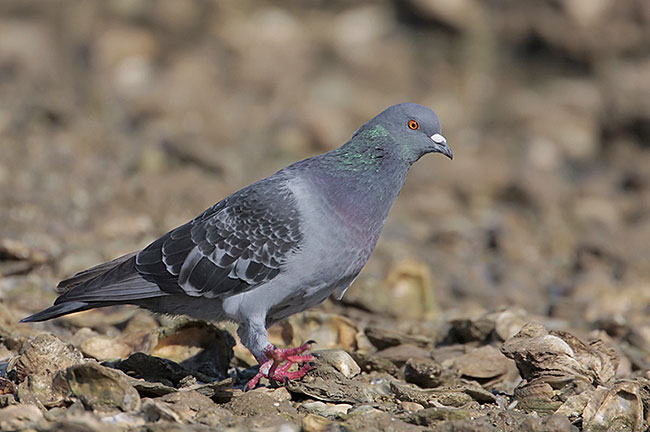
There are more than 800 breeds of domestic pigeons, bred for sports or shows (the latter are, amusingly, called ‘fancy pigeons’). However, we mostly encounter domestic pigeons in their feral shape, living freely (and in great numbers) in cities and towns across the globe.
Our tall buildings made a perfect substitute for the soaring cliffs on which the original Rock Dove nests. Thus, this adaptive and intelligent bird has learned to use this abundant new real estate with fantastic success.
Ironically, that stunning success made the original Rock Dove nearly extinct. Due to interbreeding, the wild populations are now “polluted” with diverse domestic pigeon genes. A group of wild birds in the rocky, isolated Outer Hebrides archipelago is likely the only authentic remnant of the original Rock Dove population.
Canaries
The Canary is one of the few songbirds that we consider genuinely domesticated – hence the scientific name Serinus canaria domestica. The domestication story began when Spanish sailors brought a small finch endemic to the Canary Islands to Europe in the 17th century.
Noted for its wonderful singing abilities, it became a popular cage bird. Selective breeding has introduced many new colors and feather mutations, sometimes through crossbreeding with other closely related finches.
Canaries were famously used as sentinel animals in the coal mines. The sudden bad shape or passing out of the coalmine canary warned miners about rising concentrations of dangerous gasses like carbon monoxide. Hence, we use the saying “canary in the coal mine” for early warnings or whistleblowers.
Not all canaries died after falling ill from poisonous gas. Some cages were equipped with very Victorian small oxygen tanks to revive the birds.
Although officially domesticated, canaries are still close to their wild versions. Their vibrant colors are a disadvantage in the wild and make the escapees highly vulnerable to predation. Otherwise, they do just fine without human care in conditions similar to their original home.
Around 500 domestic canary escapee descendants live on Sand Island in the Pacific’s Midway Atoll today. Personally, I would call canaries semi-domesticated rather than fully domesticated.
Are Pet Parrots Domesticated?
We keep many more bird species as pets, so many people automatically conclude they are also domesticated.
However, these birds still have so many similarities with their wild versions that, biologically speaking, they are not separate variants. Truly, there may be color mutations, but overall, they are still too wild to fit the “domesticated” definition.
Many parrot species can be tamed, but even behavioral adaptations are often the result of human work. For example, breeders commonly take parrot chicks from their parents and use hand-rearing to make them tamer and accustomed to human carers.
The resulting tameness is not genetic but behavioral and induced by imprinting.
Ratites Case – Ostrich, Emu, and Rhea
Ostrich, as well as Emu and Rhea, are flightless bird species that people farm for leather, meat, feathers, and eggs. However, ostriches have only been kept this way for the last 150 years or so, and others ratites even less. That time is too short for a true domestication process.
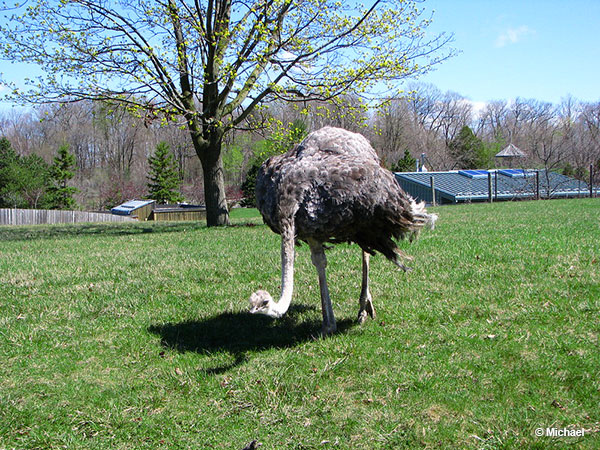
Farmed ratites adjusted to their farm lives – for example, they reproduce in captivity despite being unable to practice their natural breeding behavior. However, they are not truly domesticated.
Even taming them is questionable – in ostriches, the docile nature of captive-born chicks becomes a distant memory as soon as the birds reach maturity. Thus, many call them semi-domesticated.
Who knows, in one or two millennia, our descendants will perhaps raise tame ostriches that come over for headscratchers like docile chickens – instead of being unpredictable, kicking wild beasts.
Can Domesticated Birds Survive in the Wild?
Although most are easy prey for predators and perish quickly, some domesticated escapees thrive, especially in human-mediated landscapes like urban environments. For example, you can often spot domestic geese or domestic x wild goose hybrids in local wild geese flocks.
Due to limited flying abilities, chickens are unlikely to survive on their own for long in most parts of the world (they would have the best chances in their jungle homeland). On the other hand, domestic pigeons have been highly successful in their feral form, conquering all the world’s major cities. However, you’ll rarely find them in true wilderness.
Some domestic bird breeds can’t survive without care due to their extreme physical traits. White Broiler chickens, the dominant meat poultry breed, often have huge muscles and deformed bodies that thwart their movement, even in captivity.
The elongated tail feathers of Fantail pigeons prevent them from moving and flying quickly enough to escape predators.
Non-domesticated pet birds often have much higher survival rates and can even become invasive. Escapee Alexandrine and Rose-ringed parakeets are now thriving and reproducing across Western Europe, East Asia, and New Zealand, competing with native birds for food and shelter.
Frequently Asked Questions
Which bird was the first to be domesticated?
It is a close competition between geese and chickens. The first physical traces of goose domestication are between 7000 and 5500 years old and come from a Stone Age village called Tianluoshan in today’s East China.
On the other hand, the exact timing of chicken domestication is still a subject of debate. Some papers claim it happened 3,500 years ago. Other reputable sources stick to the hypothesis that it occurred 7000 to 10.000 years ago. Pheasants seem to be the first fowl grain-fed and baited by humans in China around 8000 years ago, but true domestication obviously didn’t follow.
Interestingly, the story of domestic poultry coincides with the beginning of rice cultivation and the creation of paddy fields in Asia.
Can some domesticated birds fly?
Many domesticated birds can fly, but it depends on the species and the breed – and what you consider “flying.”
In fowls and waterfowls, like ducks and chickens, the reduced ability to fly was one of the consequences of domestication. Because they didn’t need to fly anymore, their flying feathers reduced in size, and their bodies got heavier and stockier.
Still, except for the heavy-weight breeds, many chickens and ducks can fly off the ground just enough to perch on lower posts or branches. If the owner cuts their primary feathers to prevent them from flying, they won’t be able to – but it has nothing to do with their natural ability.
Guineafowl are known for being strong flyers, at least by fowl standards. They can fly up to 500 feet at a time; still, they prefer to move on foot (but like to sleep perched).
What is the most common domesticated bird in the world?
The most common of all birds is the domestic chicken – not only among domesticated. The descendent of the Red Junglefowl, it is by far the world’s most numerous and widespread bird. In 2022, there were around 26.56 billion chickens worldwide – a jump from 13.9 billion in 2000.
That means there are more than three times more chickens in the world than humans! Also, there are more than 1600 chicken breeds – the largest number of all domesticated birds.
Most of the world’s chickens are in the system of factory farming. Such mass production of chicken meat and eggs has many dreadful consequences.
The animal welfare on factory farms is extremely poor; they are a great source of environmental pollution and ideal mutation grounds for highly contagious and deadly bird flu strains such as H5N1.
That is why we should all support our small-scale, local farmers who keep their chickens and ducks humanely and sustainably.
