

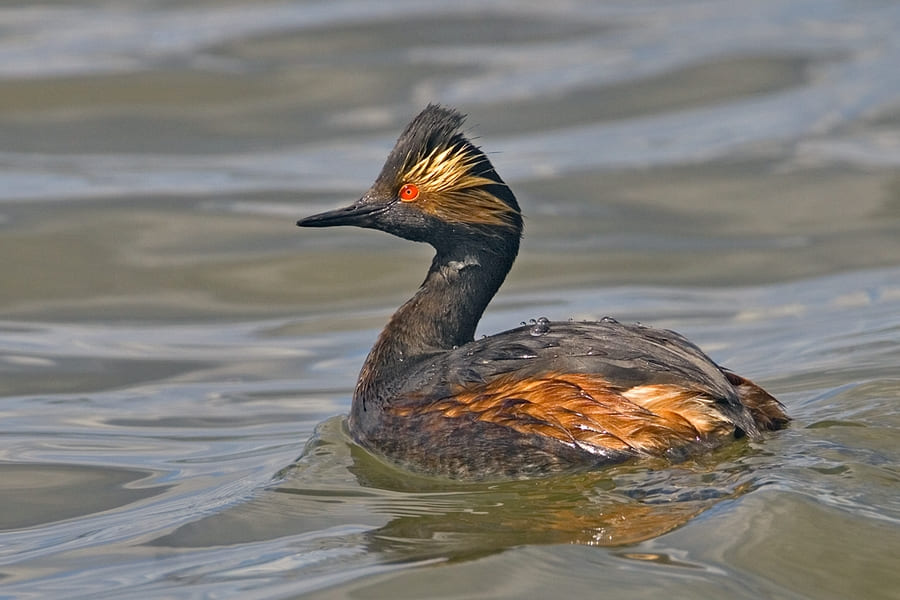
Grebes are duck-like birds with lobed toes that help make them excellent swimmers.
They are known for their remarkable diving and swimming abilities. Found across lakes, ponds, and marshes worldwide. Grebes are easily recognizable by their streamlined bodies, lobed feet, and unique courtship dances.
Identification
During these performances, pairs engage in synchronized movements, including head-shaking, mirroring each other’s actions, and even “rushing” across the water’s surface side by side. These intricate rituals not only strengthen the bond between mates but also showcase their agility and coordination, making the grebes’ dance a captivating spectacle.
Unlike ducks, grebes have distinctively pointed bills and are often seen gliding on the water’s surface before quickly disappearing underwater in search of fish and aquatic invertebrates. Their adaptability to both freshwater and saltwater environments, as well as their intricate nesting behavior, make grebes an intriguing subject of study for bird enthusiasts and biologists alike.
They are not often seen in flight or on the ground.
What you should know:
- Unlike ducks, sexes are similar in appearance.
- Clark’s and Western Grebe show little seasonal plumage differences.
- Red-necked Grebe, Horned and Eared Grebes exhibit substantially different plumages in summer and winter.
- Winter Pied-billed Grebes are browner and lack the black band on the bill, compared to their spring and summer plumage.
- Least Grebe has a limited range in the United States, typically far south Texas.
Identification challenges
Non-breeding plumaged Eared and Horned Grebes are very similar.
Western and Clark’s Grebes are very similar and were previously considered the same species. Winter plumages are very similar.
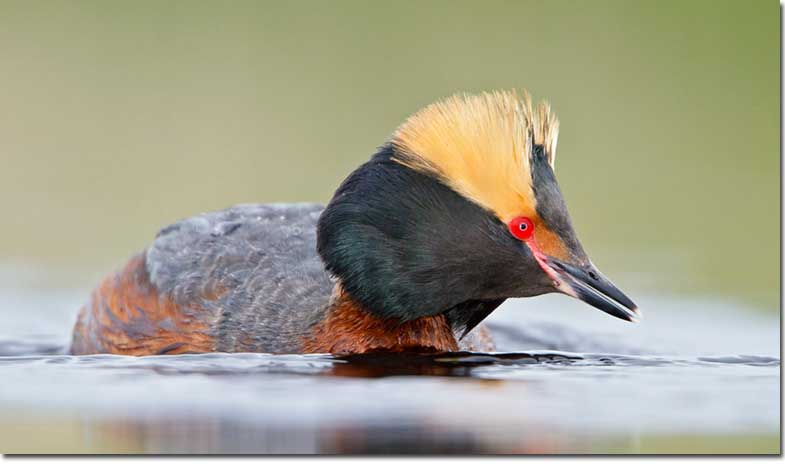
Horned Grebe male in breeding plumage. Photograph Glenn Bartley
Clark’s Grebe, in the back, and the similar Western Grebe in the front. Notice the differences in bill color. The black cap extends below the eye on the Western Grebe.
The two species become even more similar in the winter.
The Clark’s Grebe has less white on the face with the black cap extending down to the eye, gray in front of the eye.
The black cap on the Western is reduced upward.
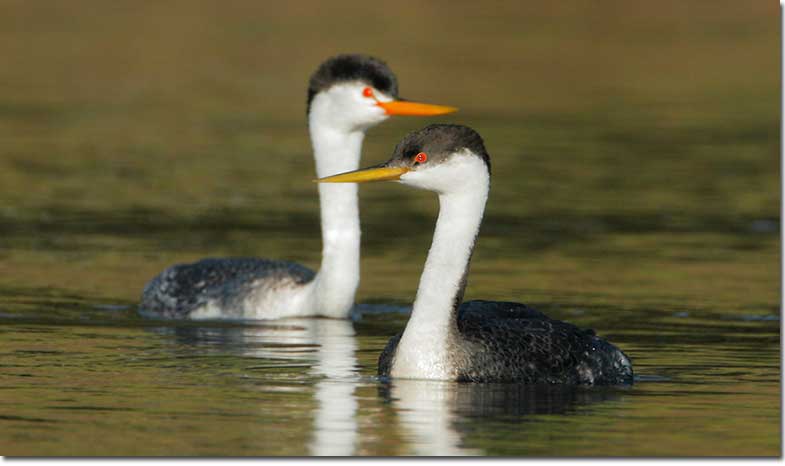
Photograph © Tom Grey.
Eared vs Horned Grebe
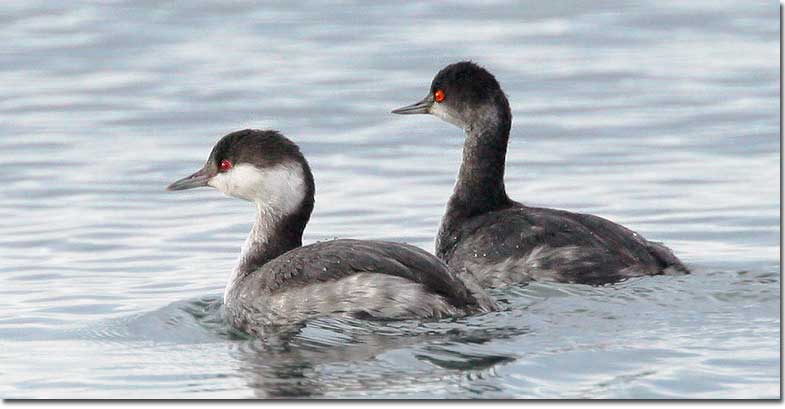
The following image shows both Eared and Horned Grebe in winter plumage. Confusing, huh? The Horned Grebe is on the left, and the Eared Grebe is on the right.
The Eared Grebe in this photo has much less white on the face and neck than the bird pictured above. The slight upward curve to the bottom of the bill is more obvious in this photograph. The bill is thinner than the Horned Grebe. In this photograph it is also easy to see the difference in head shape, the Eared Grebe has much more of a peaked head, compared to the flat top the Horned Grebe is sporting.
Western Grebe
Once considered the same species as Clark’s Grebe but now classified separately, the boldly patterned, black and white Western Grebe breeds over a large portion of western North America but winters primarily along the West Coast. Migratory movements occur at night, and Western Grebes usually travel in flocks.
The call is made up of two notes sounding like “crick-creek”.
The nest is a floating pile of plant material.
Eggs: 2-4.
Color: Pale bluish-white.
Incubation and fledging:
– Young hatch at 24 days.
– Young fledge (leave the nest) shortly after hatching to climb onto the back of a parent.
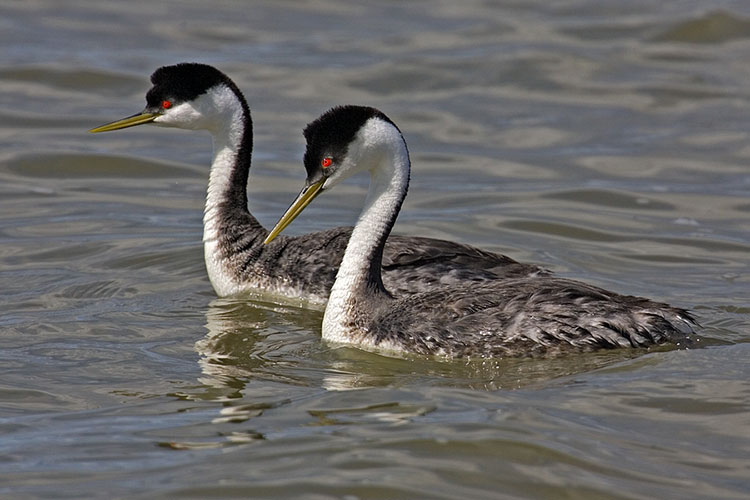
Western Grebes are capable divers and propel themselves underwater with their feet. Most dives last about half a minute. Weather is one major threat to Western Grebes, and can cause significant destruction of nests through storm generated wave action. Birds can also be frozen into lakes when surface water freezes overnight.
The Western Grebe has black upperparts, hindneck, and crown, and white underparts. It has a pointed, greenish-yellow bill and red eyes. The eyes are usually enclosed by a black area of feathers extending down from the crown and forehead.
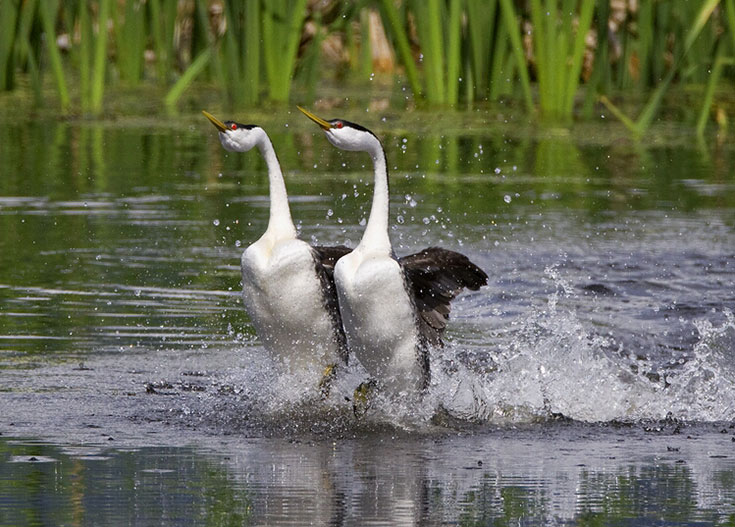
Male and female
Sexes are similar. The Western Grebe has black upperparts, hindneck, and crown, and white underparts. It has a pointed, greenish-yellow bill and red eyes. The eyes are usually enclosed by a black area of feathers extending down from the crown and forehead.
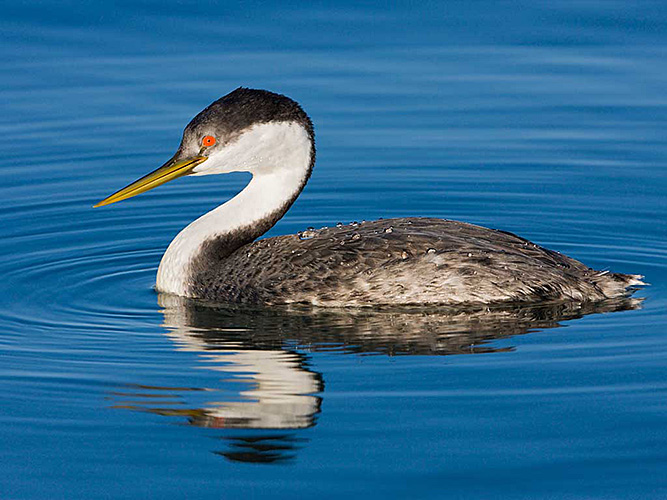
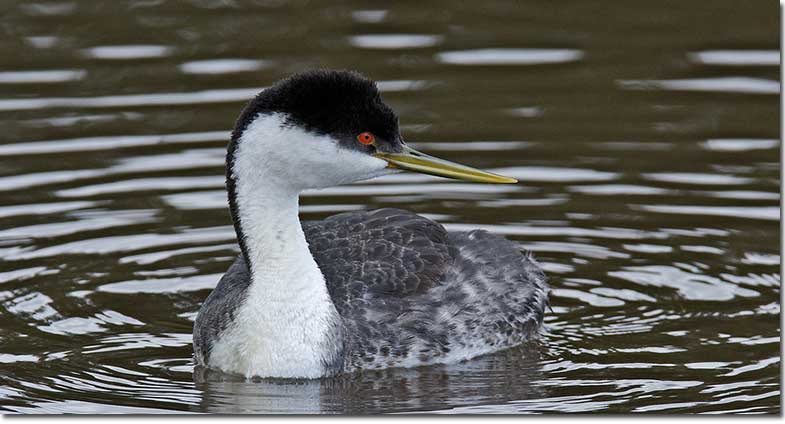
Western Grebe
Seasonal changes are small. Winter birds can have a pale area around the eye. Juveniles have neck and back feathers edged with gray.
Live in marshes with emergent vegetation and ocean bays. Eats primarily fish and orages by diving.
Breeds across much of the western U.S. and south-central Canada and winters along the West Coast and in the southwestern U.S.
Fun Facts
When the chicks are getting older and close to fledging age, the parent may spilt the brood between them.
Where Clark’s and Western Grebes breed in the same area, males of the two species are aggressive towards one another
Similar Species
- Clark’s Grebes have bills that are more orange, and usually have a white area immediately around the eye.
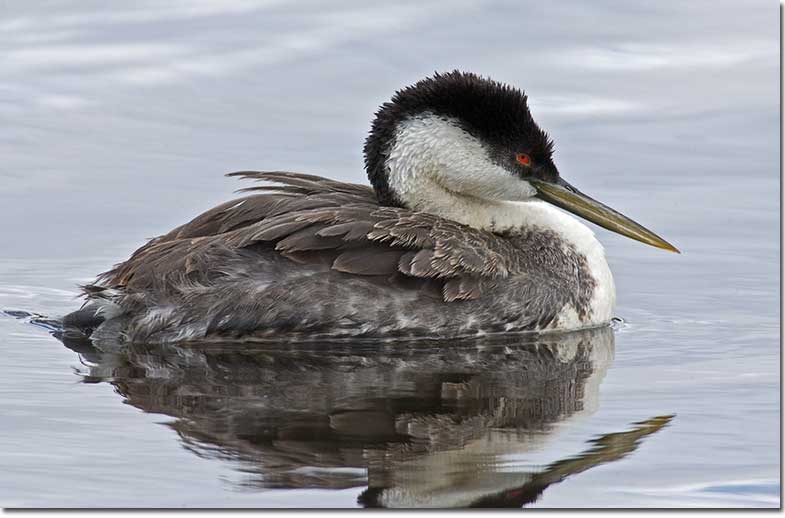
Dirty green color to the bill in this photograph. Photograph © Alan Wilson.
Check, neck and belly pure white. Red eye. Photograph © Alan Wilson.
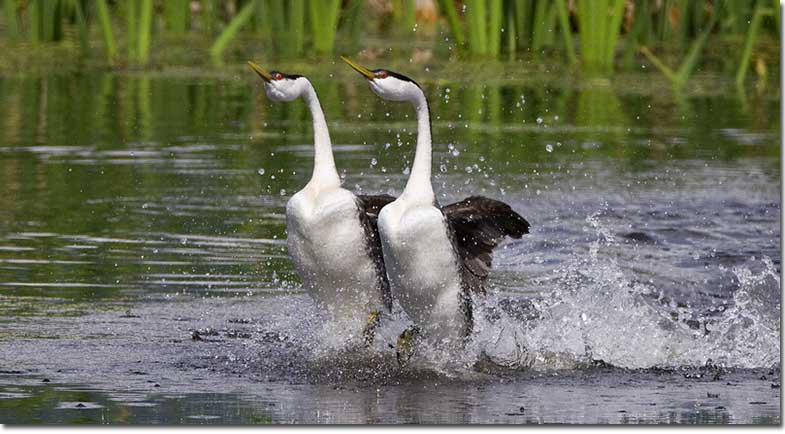
Both Western and Clark’s Grebe are famous for their running dances during courtship. Photograph © Elaine Wilson.
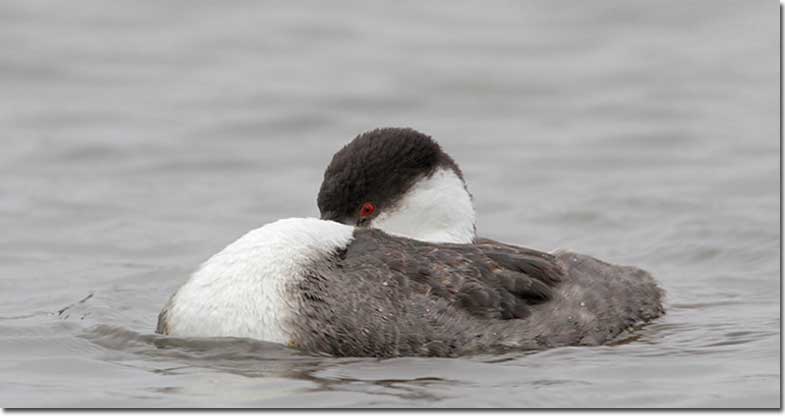
Note the black of the crown of the head extends below the eye. In non-breeding birds (generally September to February) the amount of black surrounding the eye of the Western Grebe recedes. The Western and Clark’s are then very similar, distinguished by the color of the bill. Photograph © Greg Lavaty.
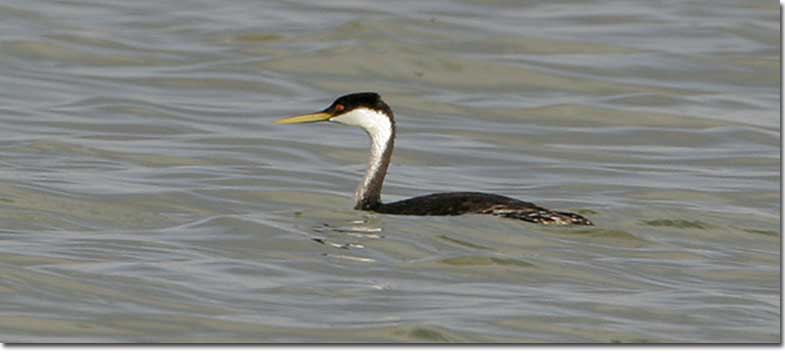
The color of the bill and the amount of black surrounding the eye are visible at a distance, if the light is good. Poor light and birds bouncing in the waves can provide a challenge. Photograph © Greg Lavaty.
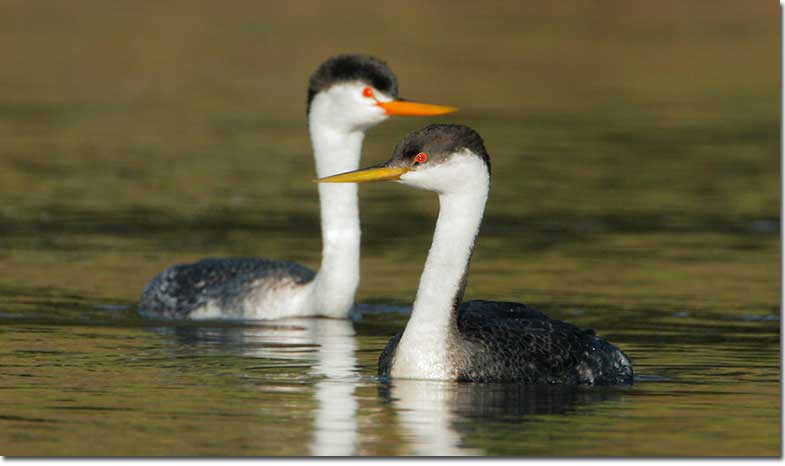
This photo shows both Clark’s Grebe (left) and the Western Grebe on the right. Note the differences in the color of the bill, sometines hard to distinguish when seen in poor light. In non-breeding plumage the black below the eye recedes, making the face pattern almost identical. Photograph © Tom Grey.
Clark’s Grebe
Formerly considered to be the same species as the Western Grebe, the Clark’s Grebe attained full species status based on mating preferences and genetic studies. One behavioral difference between the two species is a tendency for Clark’s Grebes to more often spring forward during a dive. A two-syllable “kree-eek”call note is given.
Not normally attracted by birders.
The nest is a floating mass of plant material anchored to emergent plants.
Number: 2-4.
Color: Bluish-white.
Incubation and fledging:
– Chicks hatch at 24 days.
– Young fledge (leave the nest) in minutes after hatching by climbing on to the back of a parent and remain with the adults for some time.
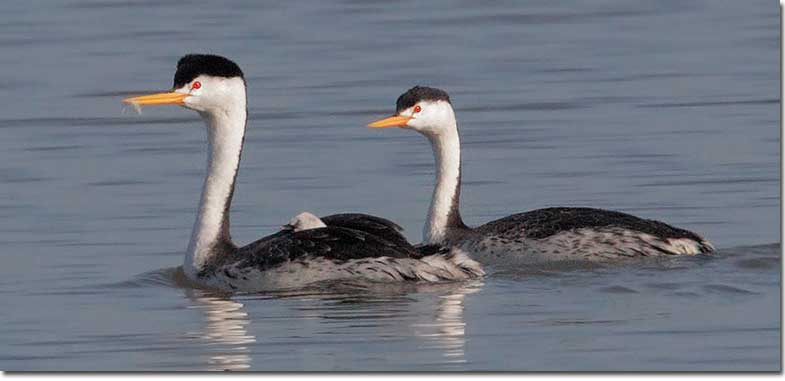
Juvenile riding the back of the adult. Photograph © Tom Grey.
Differences in bill color as well as one seemingly minor difference in call likely contribute to Clark’s Grebes being able to recognize one another and avoid Western Grebes while courting, even though the courtship displays of the two species appear to be identical.
A large, long-necked grebe with a long, pointed bill. The Clark’s Grebe is boldly patterned in black and white, with a black back, hind neck, and crown, and white underparts. The black on the head does not encircle the red eye, and its bill is orange-yellow. White secondaries.
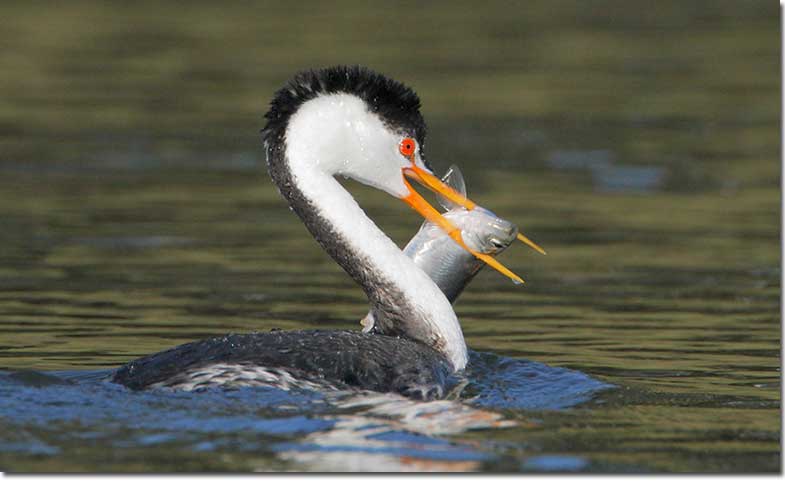
Winter adults have black nearing the eye, while summer adults have a white line above the eye. Long, thin bill has is orange. Photograph © Tom Grey.
A large, long-necked grebe with a long, pointed bill. The Clark’s Grebe is boldly patterned in black and white, with a black back, hind neck, and crown, and white underparts. The black on the head does not encircle the red eye, and its bill is orange-yellow. White secondaries. Length: 25 in. Wingspan: 29 in.
See image at bottom of page for comparison of Clark’s and Western Grebes.
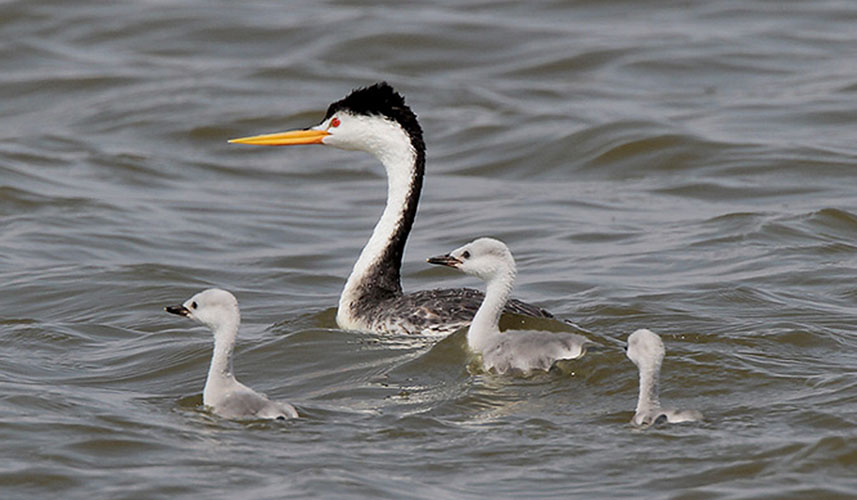
Photograph © Greg Lavaty.
Female
Sexes similar.
Seasonal change in appearance
Winter adults have black nearing the eye, while summer adults have a white line above the eye. Juveniles are mostly white, and immatures are similar to adults. Lakes, marshes, and ocean bays. Forages by diving underwater and eats fish. Breeds widely in the western U.S. and winters along the Pacific Coast and southwestern U.S.
Clark’s Grebe, in the back, and the similar Western Grebe in the front. Notice the differences in bill color. The black cap extends below the eye on the Western Grebe. Photograph © Tom Grey.
Fun Facts
Clark’s Grebes often use springing dives in which they spring forward as they enter their dive.
Clark’s and Western Grebe’s were once considered to be the same species.
Similar Species
Western Grebe
Western Grebes have greenish-yellow bills and the black on their head often encloses the eyes. Both species shown below.

Western Grebe
Common Loon
Might be confused with one of the loon species (in non-breeding plumage) by inexperienced birders. Loons are larger with heavy bodies and heavier bills.
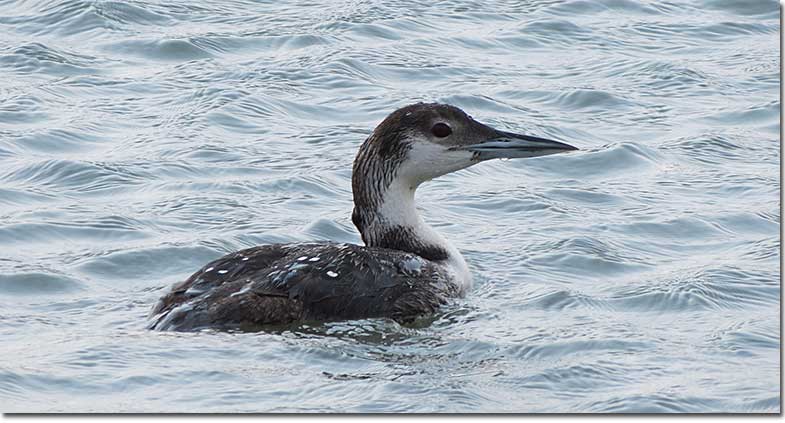
Common Loon in winter plumage
Eared Grebe
Length: 13 in. Wingspan: 16 in.
The most numerous grebe species in the world, the Eared Grebe has a somewhat scattered and variable breeding distribution from one year to the next, though it has predictable post-breeding movements. These Eared Grebe migrations take place at night.
The nest is a floating pile of plant material placed in shallow water.
Number: Usually lay 3-5 eggs.
Color: Whitish and often stained by nest material.
Incubation and fledging:
The young hatch at about 21 days, and leave the nest shortly after hatching, though they continue to associate with the adults for several weeks.
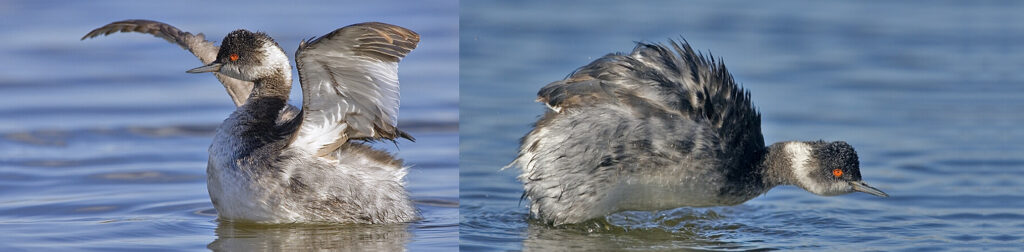
Photograph © Alan Wilson.
When gorging on brine shrimp in the fall, the Eared Grebe’s wing muscles diminish to the point where they can’t fly, and their digestive organs increase to help take on the abundant food. This process reverses in time for the next migration.
The Eared Grebe is a small swimming and diving bird with a compact body, medium length neck, somewhat large head, and a very thin, pointed bill.
The Eared Grebe is a small swimming and diving bird with a compact body, medium length neck, somewhat large head, and a very thin, pointed bill. Breeding birds have a blackish head with a large, bold, golden yellow patch fanning out behind each eye, a black neck and upperparts, and reddish flanks.
Seasonal change in appearance
Winter birds have a black cap, black or dusky cheeks, mostly dark or dusky foreneck and dark gray hindheck, and grayish upperparts with whitish flanks.
Eared Grebes breed on lakes and ponds with emergent vegetation, and winter lakes and salt bays in the southern and western U.S. They are less coastal than the Horned Grebe.
Diet
Eared Grebes dive to capture aquatic prey, primarily insects and crustaceans.
Behavior
Eared Grebes have legs set far back on their bodies, a position that is good for swimming but poor for walking on land. To take flight they must have a running start, paddling furiously through the water while flapping their wings. They are usually seen swimming on the surface, and frequently diving in search of prey.
Range
Eared Grebes breed across parts of western Canada and the western U.S. They winter primarily along the Pacific Coast and in inland waters of the southwestern and south central U.S. They are relatively rare in the eastern U.S. Horned Grebes may be stable, although their population is not well measured.
Fun Facts
A Eared Grebe courtship display involves a pair racing vertically across the water with wings partly spread open.
Nearly the entire population of Eared Grebes makes a post-breeding migration to a hypersaline lake such as Great Salt Lake, Mono Lake, or the Salton Sea to feed on brine shrimp.
Young Eared Grebes often ride on their swimming parents’ backs.
Vocalizations
The Eared Grebe’s song is a squeaky whistle, recalling that of the Sora. Calls include a series of shrill cries.
Similar Species
Horned Grebes have thicker bills, a reddish neck in summer or a whitish foreneck in winter, and white cheeks in winter.
Photos of Eared Grebes
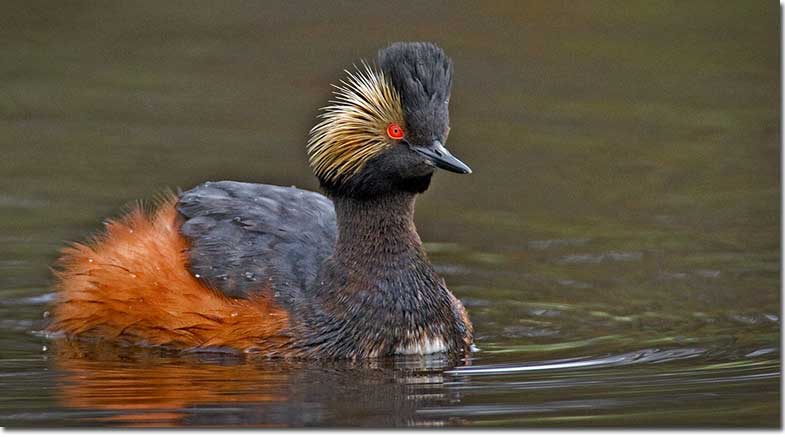
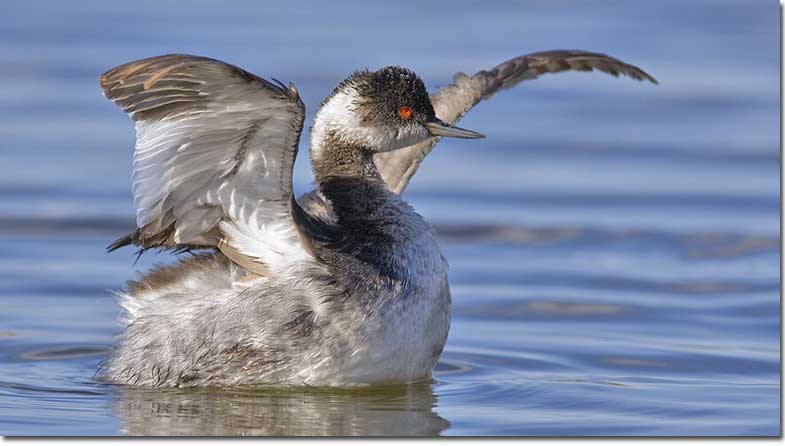
Breeding birds have a blackish head with a large, bold, golden yellow patch fanning out behind each eye, a black neck and upperparts, and reddish flanks. Note the size and shape of the bill. Eared Grebes cab be very colorful. Sexes are similar in appearance. Photograph by Alan Wilson.
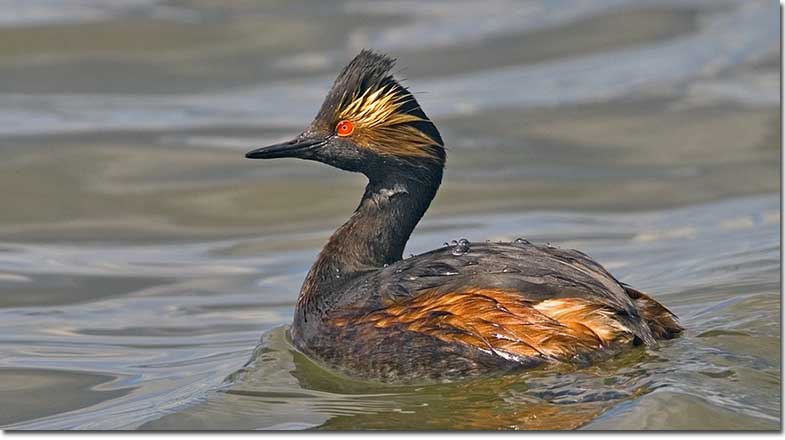
Wet feather day. Photograph by Alan Wilson.
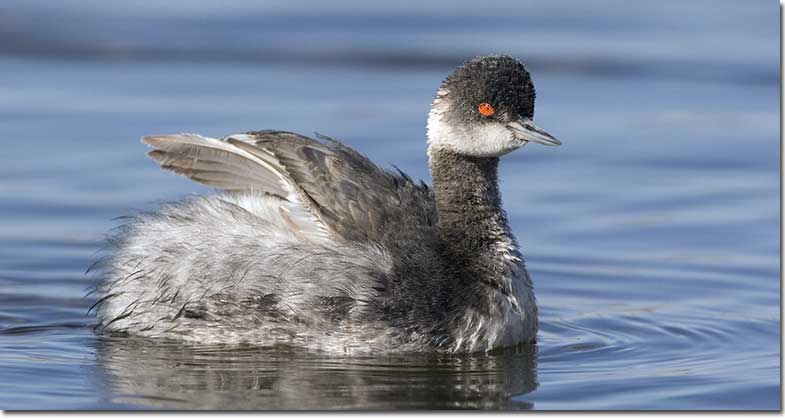
Winter birds have a black cap, black or dusky cheeks, mostly dark or dusky foreneck and dark gray hindheck, and grayish upperparts with whitish flanks. First fall birds similar to winter plumage of adults but may show rust color on the neck. Photograph by Alan Wilson.
Note red eye, high forehead, and rounded head. This bird seems to show a white spot in front of the eye, a feature on some winter-plumaged Horned Grebes but usually absent from Eared Grebes. Photograph by Alan Wilson.
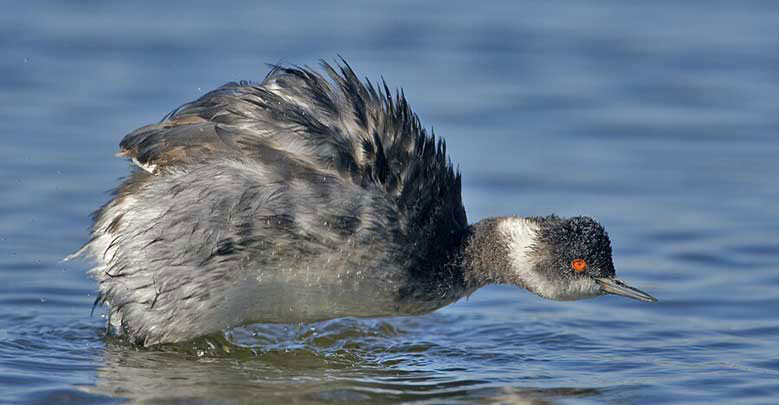
An aggressive stance, not sure who would want to mess with that fine, pointed bill. Photograph by Alan Wilson.
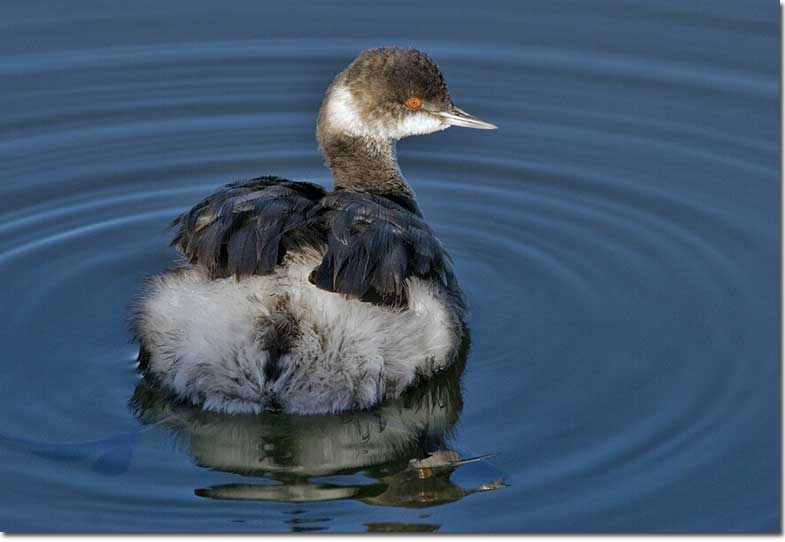
The amount of white on the neck varies, some will have more white, some less. Photograph by Alan Wilson.
Pied-billed Grebe
The Pied-billed Grebe is a nocturnal migrant that prefers to swim or dive away from danger rather than fly. When dawn is approaching, a migrating Pied-billed Grebe suddenly lands on any body of water it can find. It moves north early in the spring, and moves south in response to forming ice.
The Pied-billed Grebe’s song is a series of barks. Females also make soft grunts.
The nest is a floating pile of plant material placed in shallow water.
Number: Usually lay 4-8 eggs.
Color: Bluish-white and often stained by nest material.
Incubation and fledging:
The young hatch at about 23-27 days, and leave the nest shortly after hatching, though they continue to associate with the adults for several weeks.
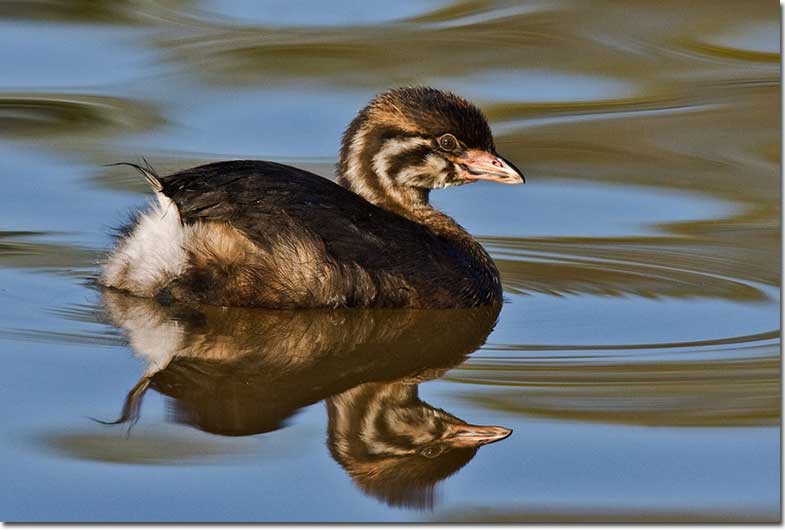
Young Pied-billed Grebe. Photograph © Alan Wilson.
Pied-billed Grebes usually require a running, flapping start across the water to become airborne. They can also sink slowly down under the water by releasing air from their air sacs and squeezing air out from between their body and their feathers.
The Pied-billed Grebe is a small swimming and diving bird with a compact body and a rather short, stout bill. Breeding birds have a blackish forehead and chin, a white bill with a black band, and mostly tan or brownish plumage.
Breeding birds have a blackish forehead and chin, a white bill with a black band, and mostly tan or brownish plumage.Pied-bills often look gray to black.
The Pied-billed Grebe is a small swimming and diving bird with a compact body and a rather short, stout bill. Breeding birds have a blackish forehead and chin, a white bill with a black band, and mostly tan or brownish plumage.
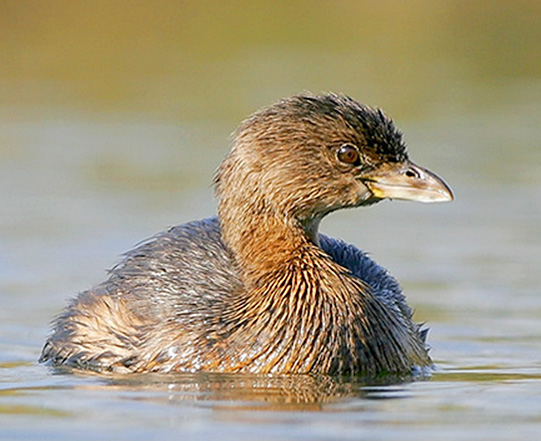
Winter plumage, © Greg Lavaty.
Appearance & habitat
Winter birds lack the black forehead and chin, and have a more uniform, brownish bill. Juveniles resemble winter adults, but have a striped cheek pattern. Pied-billed Grebes inhabit ponds, lakes, and marshes. Pied-billed Grebes dive to capture aquatic prey, including insects, fish, crustaceans, tadpoles, and other items.
Behavior & Range
Pied-billed Grebes have legs set far back on their bodies, a position that is good for swimming but poor for walking on land. To take flight they must have a running start, paddling furiously through the water while flapping their wings. They are usually seen swimming on the surface, and frequently diving in search of prey. When threatened, Pied-billed Grebes sometimes slowly submerge straight down, leaving their head out of the water like a periscope.
Pied-billed Grebes breed across much of the U.S. and south central Canada. They winter along the westernmost U.S. and across the southern U.S. Pied-billed Grebes have increased in recent decades.
Fun Facts
Pied-billed Grebes migrate at night, though southern populations may be resident year-round.
Pied-billed Grebes are aggressive and very territorial, even chasing other species away.
Young Pied-billed Grebes often ride on their swimming parents’ backs.
Similar Species
Eared and Horned Grebes have thinner bills, significant reddish and black plumage during the breeding season, and significant white plumage during winter.
Photos of Pied-billed Grebes
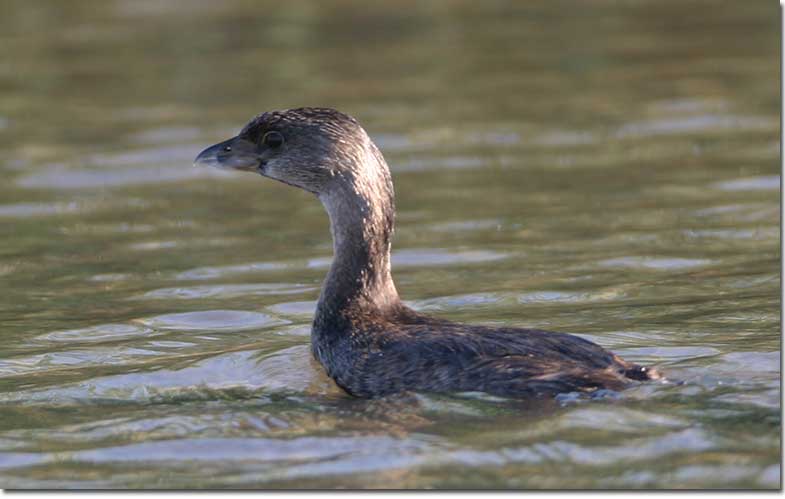
Winter birds lack the black forehead and chin, and have a more uniform, brownish bill. Sexes are similar. Photograph © Sam Crowe.
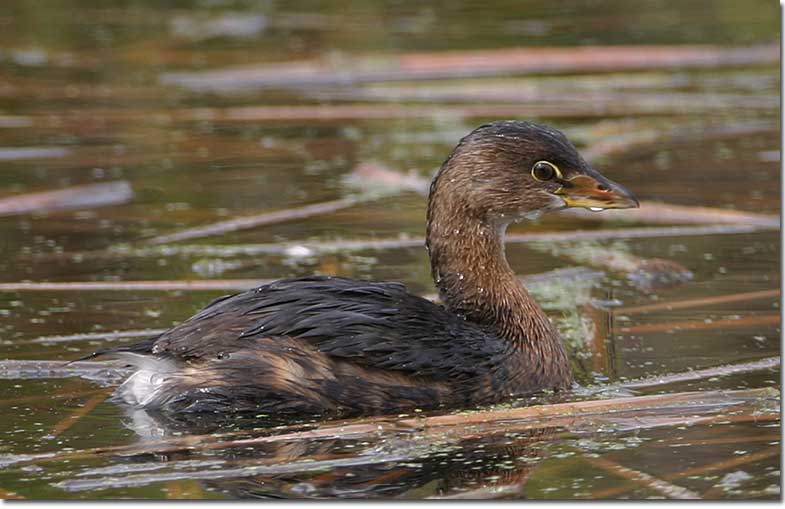
Note the dark mark in front of the eye. Photograph © Sam Crowe.
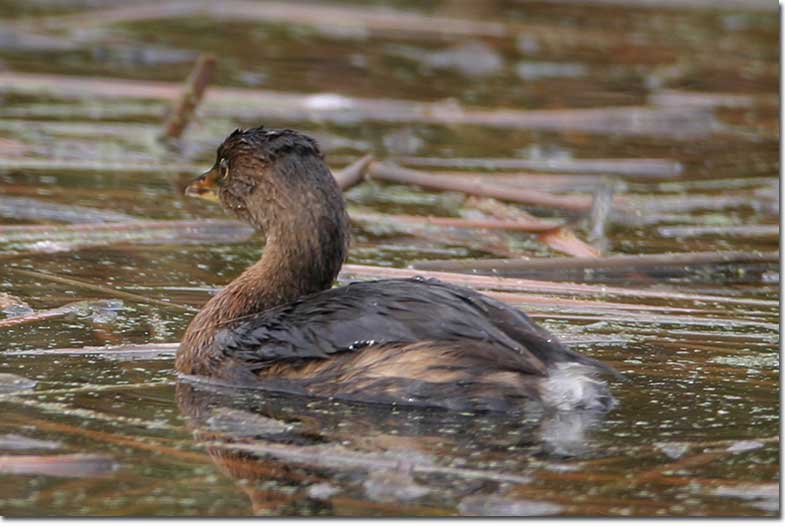
The tail shows a small puff of white, visible in this and the following photo. Photograph © Sam Crowe.
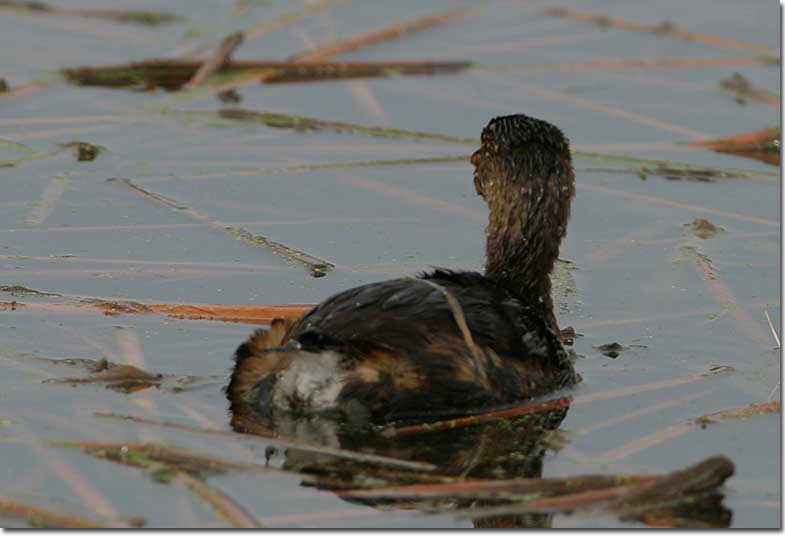
Photograph © Sam Crowe.
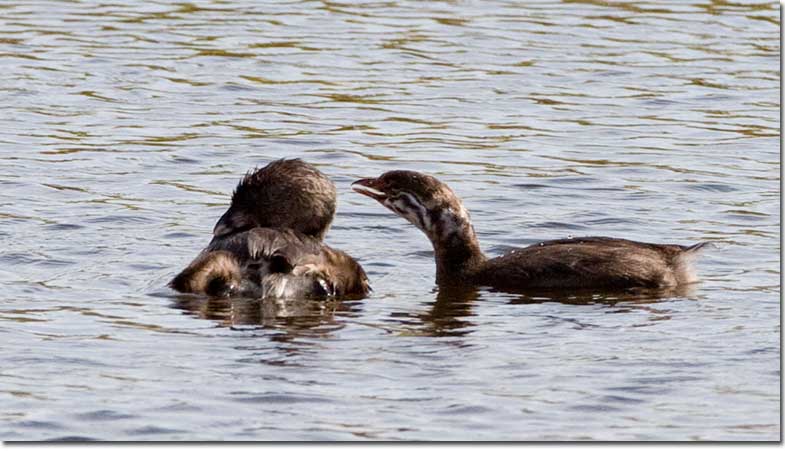
Juveniles resemble winter adults, but have a striped cheek pattern. Photograph © Sam Crowe.
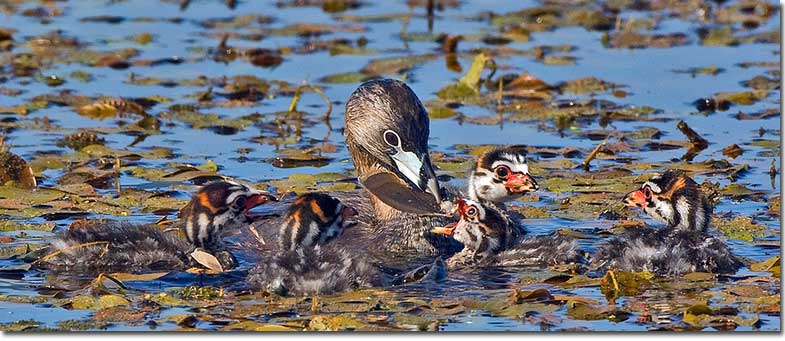
Very young Pied-billed Grebes have an amazing head pattern. Photograph © Elaine Wilson.
Least Grebe
The Least Grebe is the smallest grebe in North America, and occupies portions of southern Texas, although most of its range lies south of the U.S. The small size of the Least Grebe, and its ability to take off from water more rapidly than other grebes allows it to use even small, temporary bodies of water. The most common call is a trill of varying speed.
The nest is a pile of decaying vegetation in the water.
Number: 4-6.
Color: White.
Incubation and fledging:
– Young hatch at 21 days.
– Young fledge (leave the nest) shortly after hatching but remain with the adults for some time.
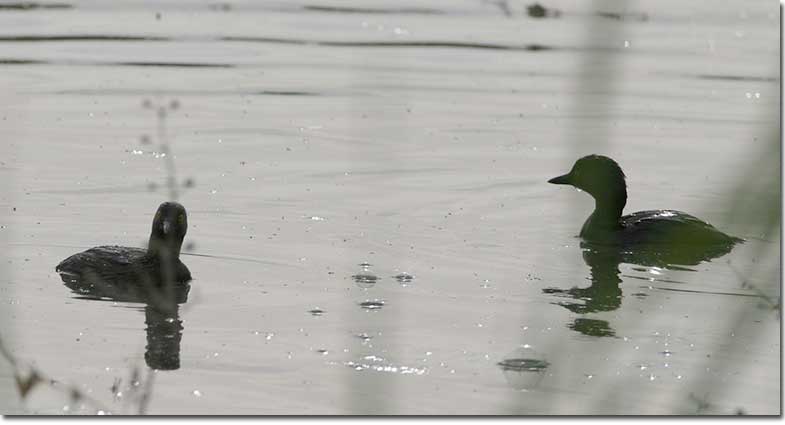
Pied-billed Grebes (below) can appear as black as the Least Grebe, but the shape of the billis different. Note the thinner look to the bill of the Least Grebes in silhouette above, compared to the shape of the Pied-billed Grebe. Photograph © Greg Lavaty.
Least Grebes form pairs during the breeding season, family groups in the fall, and may occur in small flocks in the winter. One source of mortality for Least Grebes in Texas is being trapped in ice when ponds freeze over, making them vulnerable to predators.
Least Grebe — Length: 9 inches, Wing span: 11 inches
The Least Grebe is very small with grayish plumage and yellow eyes. Blackish crown and throat. Length: 9 in. Wingspan: 11 in.
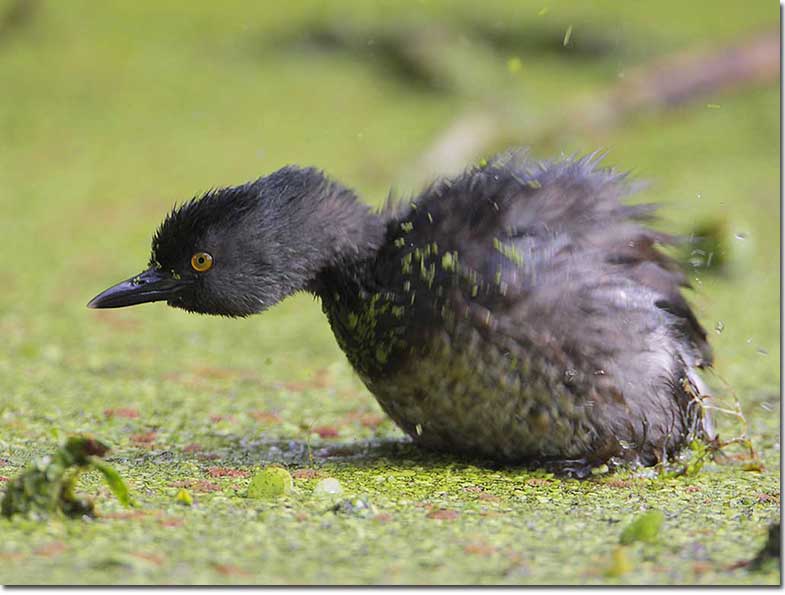
Least Grebe in an aggressive posture. Photograph © Greg Lavaty.
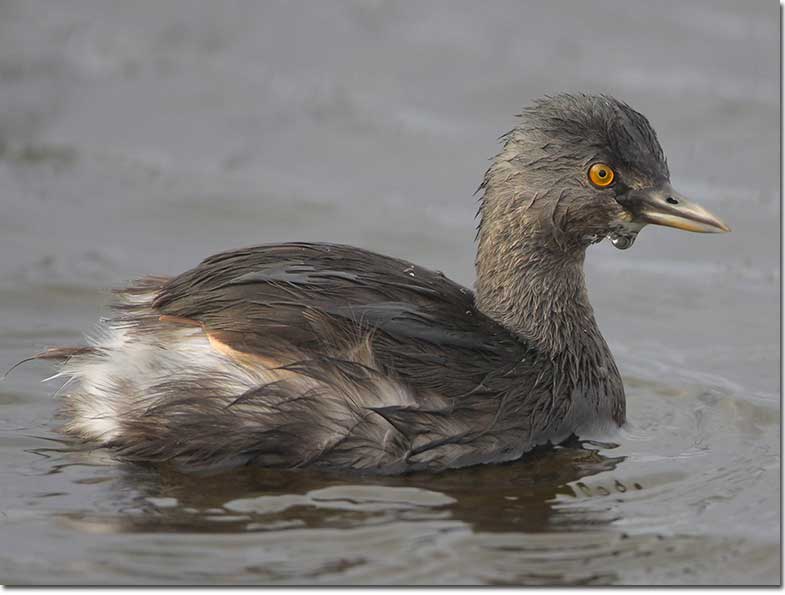
The body shape and behavior is clearly grebe-like. Might be confused with the Pied-billed Grebe, which is larger and has a different shape to the bill. Photograph © Greg Lavaty.
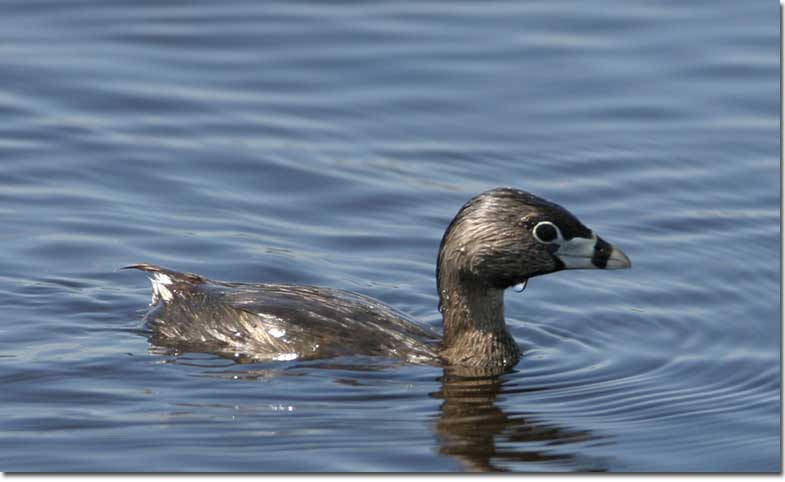
Seasonal change in appearance
Least Grebes are somewhat dingier and browner in the winter, and have whitish throats. Juveniles resemble adults but are browner.
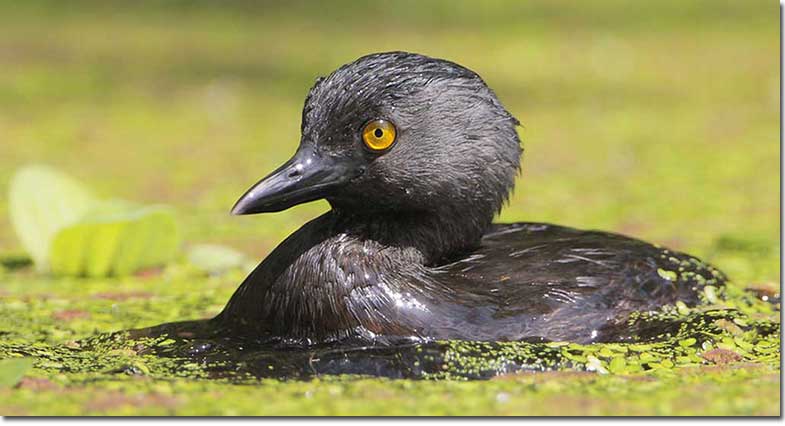
Photograph © Greg Lavaty.
Behavior
Forages by diving and swimming. Range Resident in south Texas and Mexico, as well as Central and South America.
Fun Facts
Almost nothing is known about the courtship behavior of Least Grebes.
Pied-billed Grebes are sometimes aggressive towards Least Grebes.
Similar Species
Other grebes are larger and lack bright yellow eyes.
Red-necked Grebe
Red-necked Grebes are known for the wide variety of elaborate courtship displays they participate in, although these are not as common on the breeding grounds as one might expect given that many pairs have formed prior to reaching breeding areas. Storms can produce waves which destroy many Red-necked Grebe nests and eggs.
“Crick-crick” calls and loud rattling or raspy notes are given on the breeding grounds.
The nest is a floating platform of plant materials.
Eggs: 4 to 5.
Color: Bluish-white.
Incubation and fledging:
– Young hatch at 20-23 days.
– Young fledge (leave the nest) shortly after hatching but remain with the adults for some time.
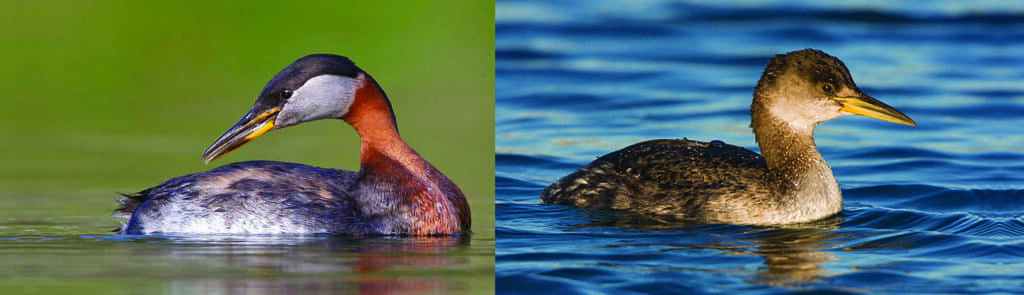
Photograph © Glenn Bartley.
Red-necked Grebes are very territorial, not only against other Red-necked Grebes but also against other water birds. A variety of chases and attacks are used, including an underwater attack in which the grebe swims underneath the intruder and jabs its underside with its bill.
When in breeding plumage it is not easily confused with other species. Winter plumage somewhat resembles Earned or Horned Grebe but bill is much larger.
Sexes are similar.
The Red-necked Grebe is a large grebe with a yellowish bill, dark gray upperparts, and a white throat and cheeks. The reddish neck and breast in breeding plumage give it its name.
Length: 18 in. Wingspan: 24 in.
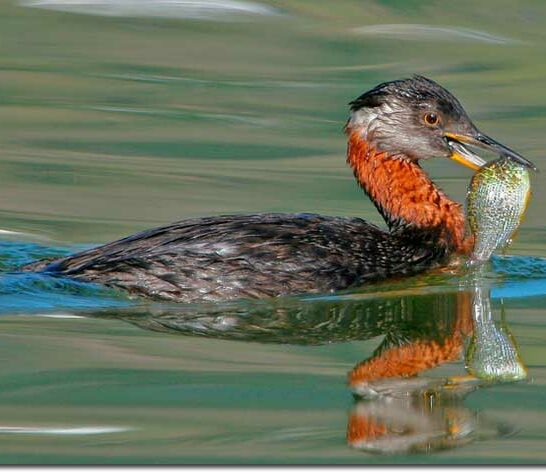
Photograph © Alan Wilson.
Appearance & Habitat
Breast and neck become whitish in the winter. Juveniles have black and white stripes on the face. Lives in lakes, ponds, and saltwater bays. Eats insects and fish, as well as other aquatic life.
Behavior & Range
Forages from the surface or by diving. Young will ride on the back of the adults.
Breeds from Alaska to eastern Canada and in parts of the northern U.S. Winters along the east and west coasts. Also occurs in Europe and Asia.
Fun Facts
Red-necked Grebes are very aggressive when on territory during the breeding season, actively chasing away potential rivals.
Great Horned Owls and mink prey on incubating adults.
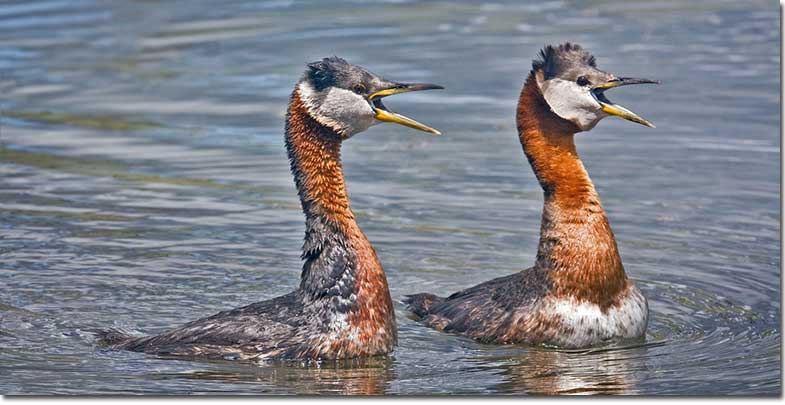
Courtship display. Black crown, black stripe on back of neck extends down to the dark back. White cheek and chin. Red throat and foreneck. Photograph © Elaine Wilson.
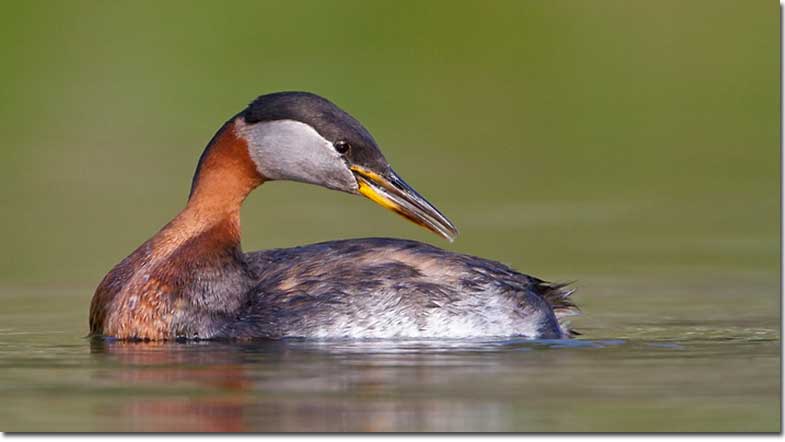
Note the bill color. The amount of yellow on the bill is variable. Typically more yellow on the lower mandible, especially in non-breeding birds. Photograph © Glenn Bartley.
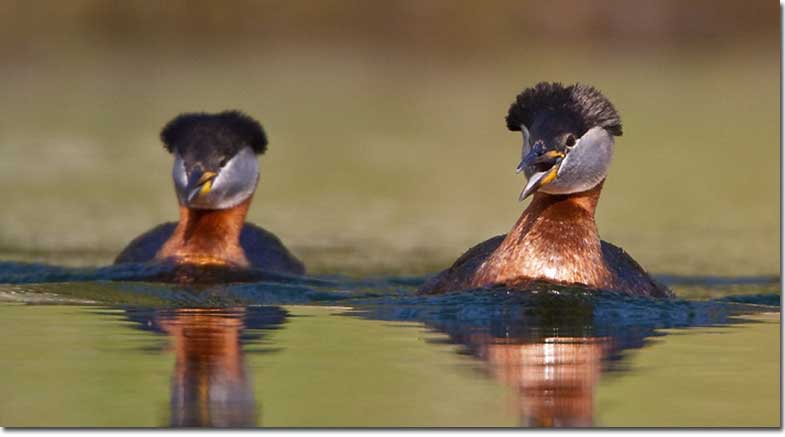
Crest up in courtship display. Photograph © Glenn Bartley.
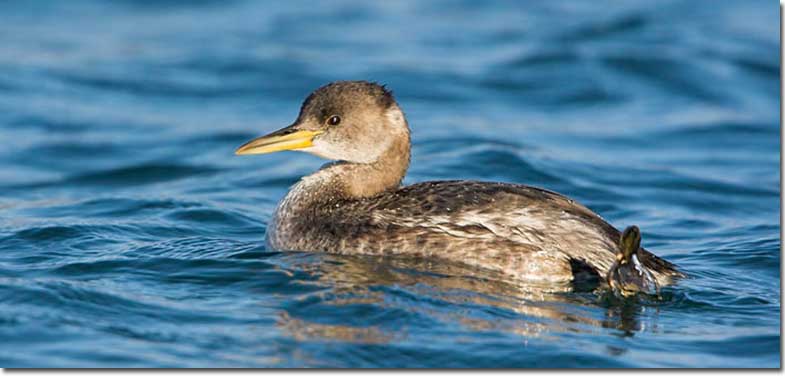
The breast and neck become whitish in the winter. There is less black and more yellow on the bill in non-breeding plumage. Photograph © Glenn Bartley.
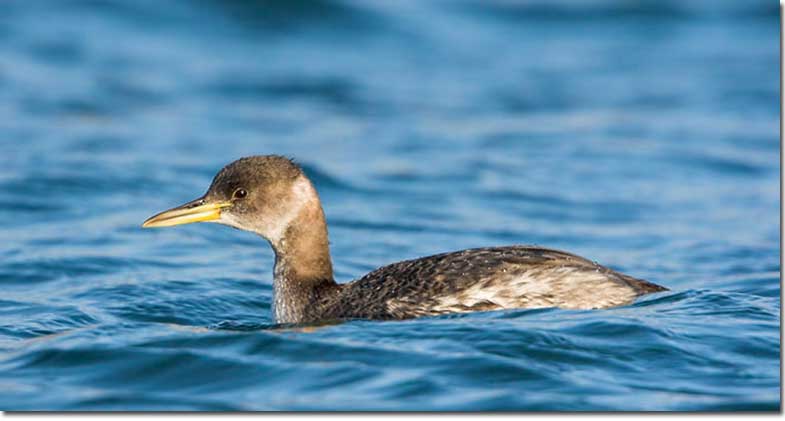
The bill is large and heavy. Photograph © Glenn Bartley.
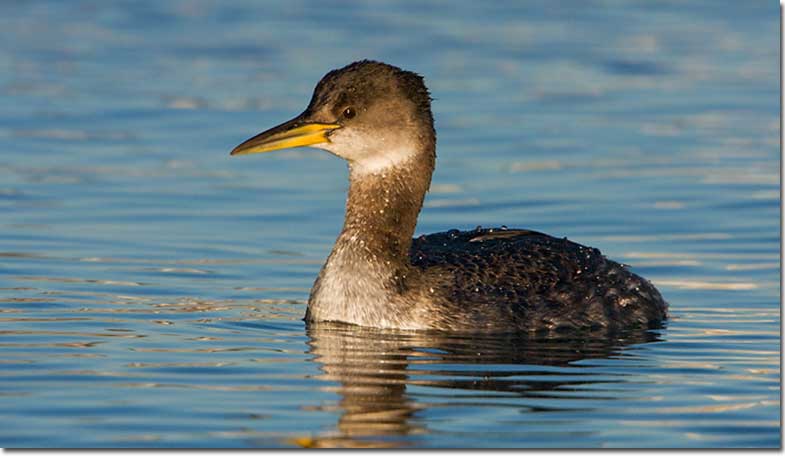
The amount of white on the neck varies. First winter birds have less white on the side of the head while adults will show more white extending to the back of the head and behind the eye. Compare this bird to the one above. Photograph © Glenn Bartley.
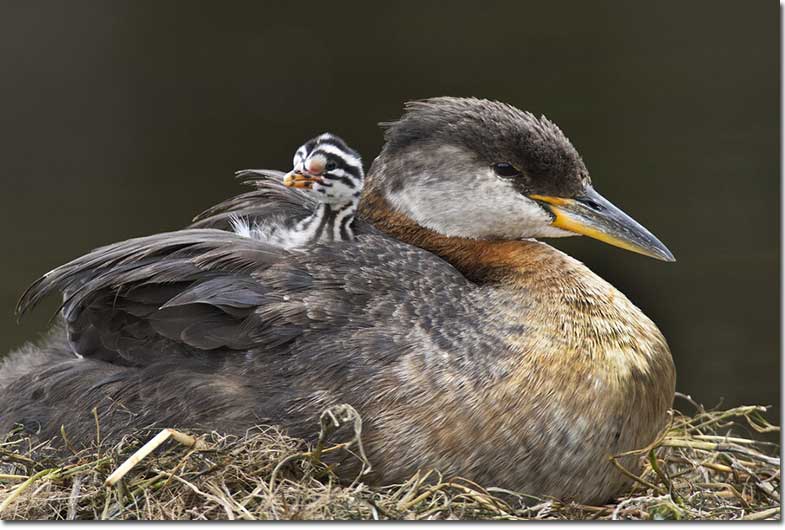
Home-sweet-home. Photograph © Alan Wilson.
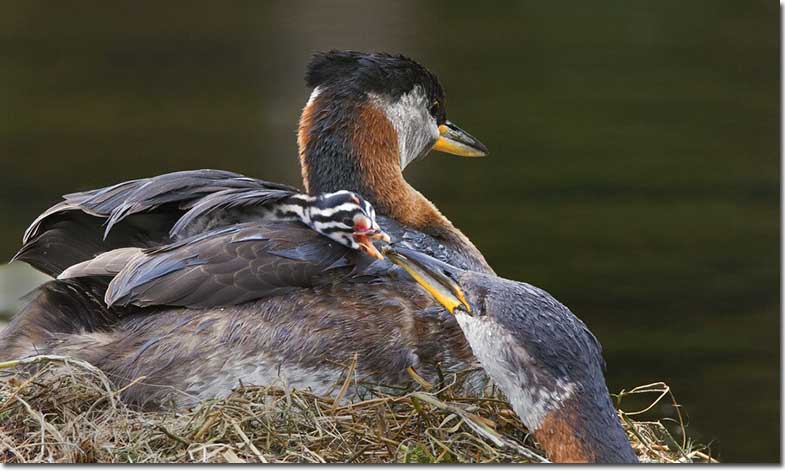
Dinner time. Photograph © Elaine Wilson.
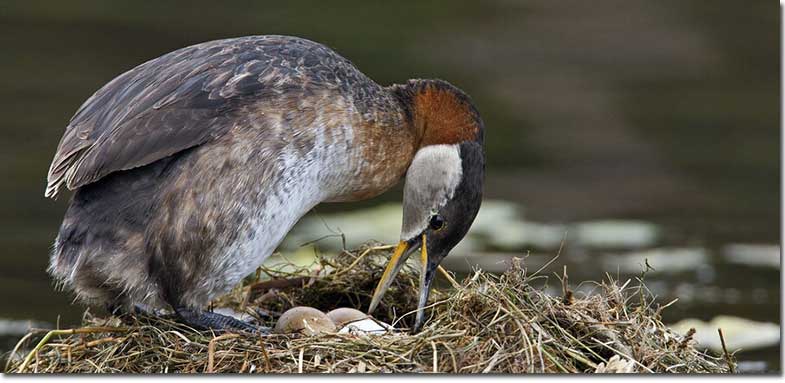
Typical with grebes, legs are well back on the body, great for swimming. Photograph © Alan Wilson.
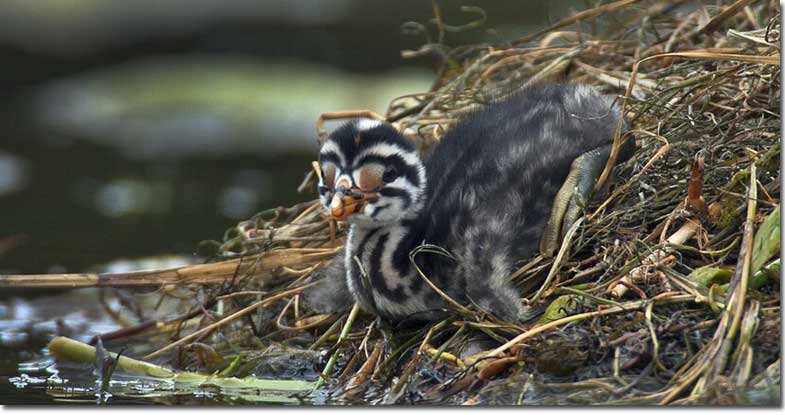
Juveniles have black and white stripes on the face even when older than this alien-looking baby grebe. Photograph © Alan Wilson.
Red-throated Loon (Gavia stellata)
The smallest of the world’s five loon species, the Red-throated Loon is a high-arctic breeder but winters along the east and west coasts of North America. Migration usually takes place in small groups and at a low elevation above the water or land. Red-throated Loons propel themselves underwater with their feet.
Gooselike cackling is given in flight.
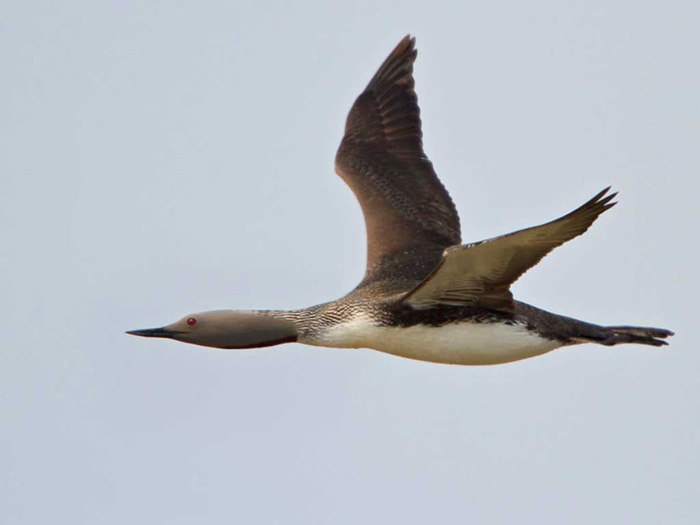
Photograph © Glenn Bartley
The nest is a pile of vegetation.
- Number: 2.
- Color: Olive with darker markings.
Incubation and fledging:
– Young hatch at 24-29 days.
– Young fledge (leave the nest) in a day after hatching but remain with the adults for some time.
One-fourth or more of Red-throated Loons may fail to breed in a given year, often due to inclement weather at their northern breeding latitudes. Once nesting, storms can cause water or ice to destroy nests. Red-throated Loons have been known to live over 23 years in the wild.
The Red-throated Loon is a small loon with a thin bill that is often held up at a slight angle.
Breeding male plumage:
– Reddish throat.
– Gray head.
– Brownish upperparts.
Winter birds have white throats and cheeks, and white markings on a dark back. Breeds From Alaska to Greenland and winters along the east and west coasts of North America. Also occurs in Russia and Europe.
Fun Facts
The Red-throated Loon is the smallest loon in the world, although there are only five species of loons worldwide.
Unlike other loons, Red-throated Loons are capable of taking off from land.
Similar Species
Pacific Loons have rounder heads and dark upperparts in winter.
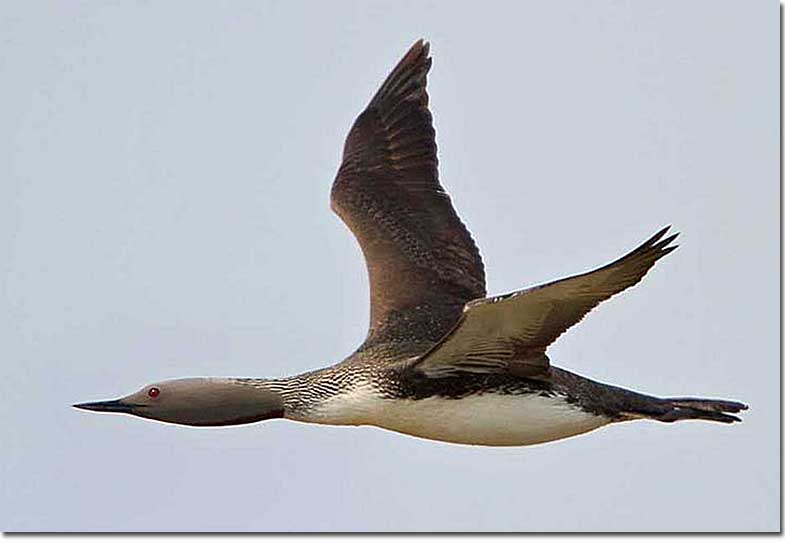
The red in the throat can be difficult to see when the bird is in flight or seen at a distance. Wing beats are strong and fast. Photograph © Glenn Bartley.
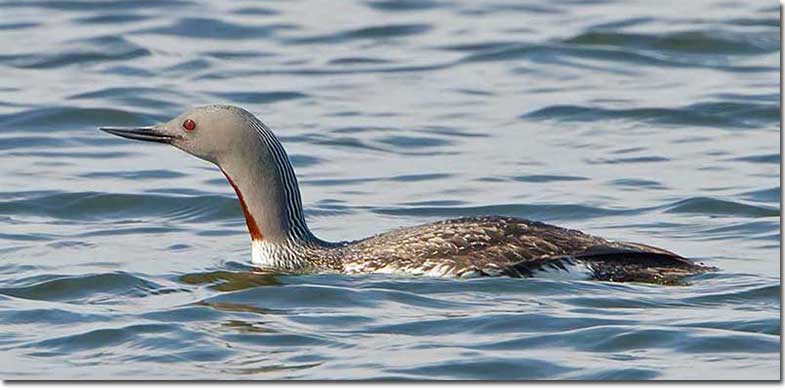
Compare this loon in full breeding plumage with the molting loon below. Photograph © Glenn Bartley.
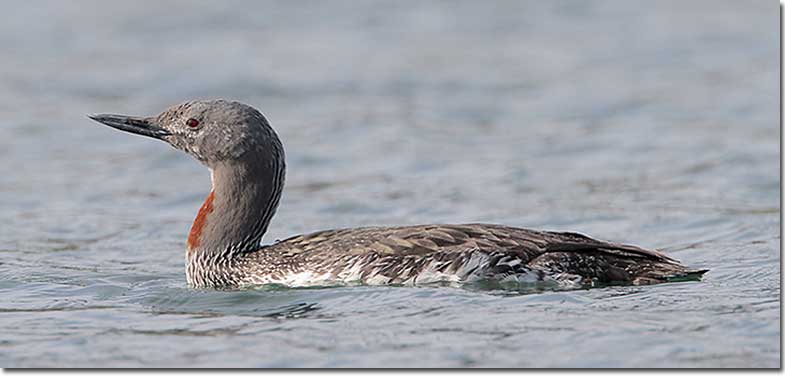
Molting adult. Photograph © Greg Lavaty.
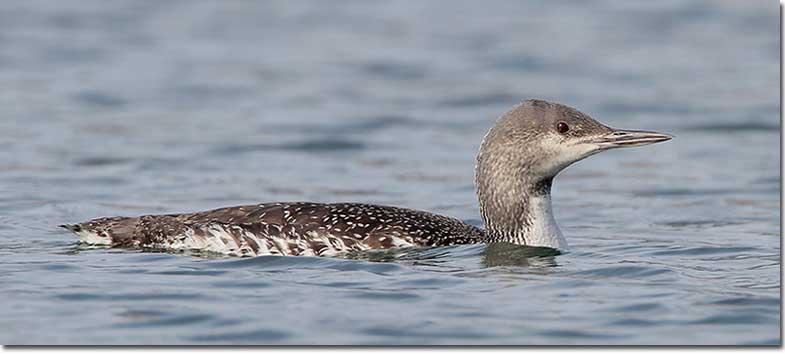
Winter birds have white throats and cheeks, and white markings on a dark back. The back is speckled with white. Adults in non-breeding plumage have white necks. Young birds have gray on the side of the neck. Greg Lavaty.
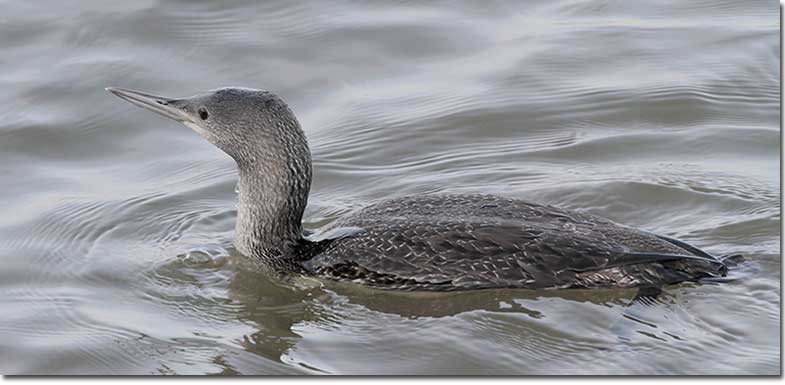
Young Red-throated Loon. Greg Lavaty.
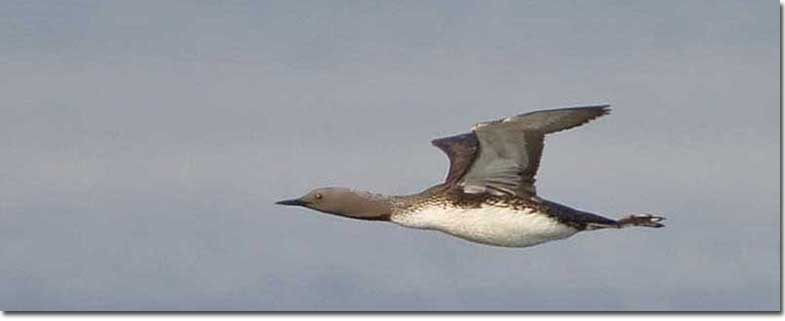
Long, thin lines in flight. White belly and chest. Photograph © Glenn Bartley.
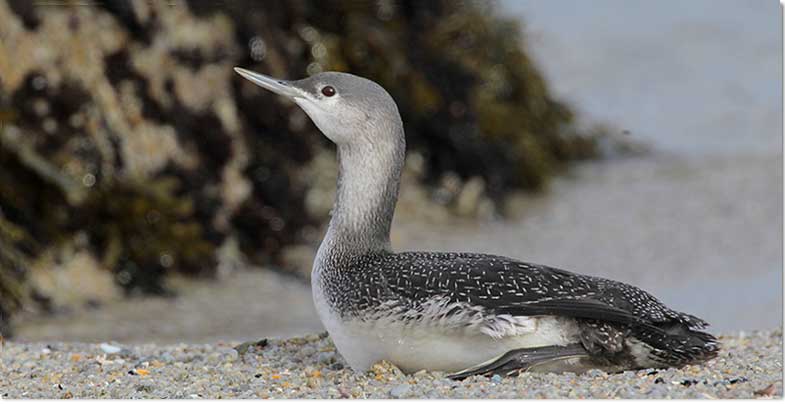
Loons are seldom seen on the ground. Note how far back on the body the feet are located. Photograph © Greg Lavaty.
Pacific Loon (Gavia pacifica)
Despite its abundance, the Pacific Loon is only occasionally seen inland south of Alaska, and it largely sticks to its northern breeding range and Pacific Coast wintering range. Large inland lakes occasionally attract one or more Pacific Loons during the winter months. Pacific Loon migration takes place during the day.
Pacific Loons are not capable of taking off directly from the water or from land. They must have up to 50 meters of open water on which to get a paddling start.
There, they eat fish, crustaceans, and insects.
Pacific Loons are thought to begin breeding at age three, although this aspect of their lives is poorly understood.
A variety of squawks and yodels are given on the breeding grounds.
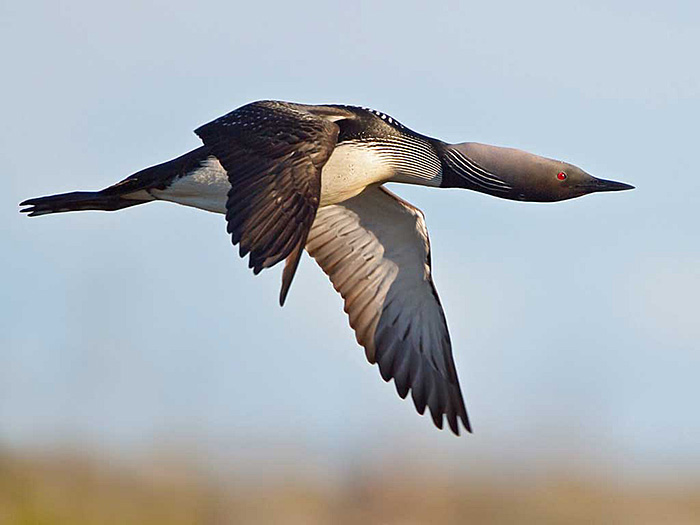
Photograph © Glenn Bartley
The nest is a pile of vegetation.
Number: 2.
Color: Buff with darker markings.
Incubation and fledging:
– Young hatch at 23-25 days.
– Young fledge (leave the nest) shortly after hatching but remain with the adults for some time.
Breeding plumage:
- Pale gray head and nape.
- White stripes on sides of neck.
- Dark upperparts with much white.
- Purple color on throat usually appears black.
Breeding male plumage:
- Pale gray head and nape.
- White stripes on sides of neck.
- Dark upperparts with much white.
Winter birds are grayish-brown above with whitish underparts. May show dark chin strap.
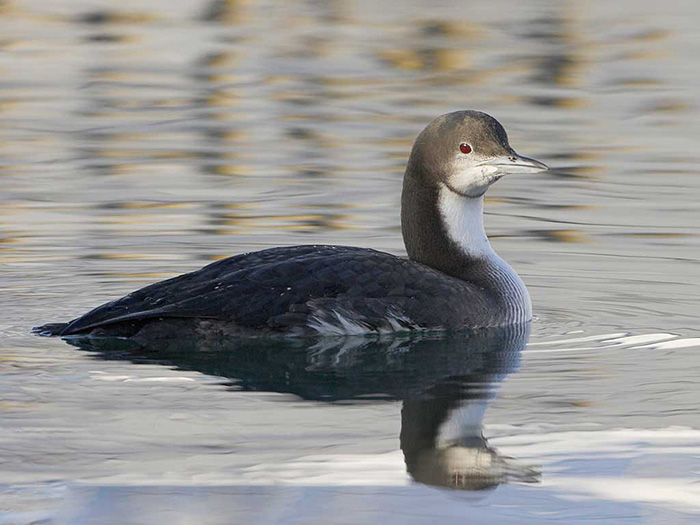
Photograph © Glenn Bartley
Fun Facts
Pacific Loons travel very poorly on land and seldom move more than 100 meters.
During winter, Pacific Loons can occur singly, or in small flocks.
Similar Species
Arctic Loons have white flank patches.
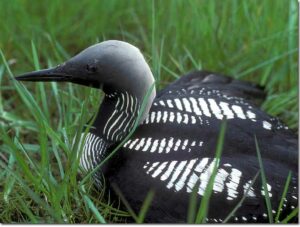
Arctic loon
Photos of Pacific Loon
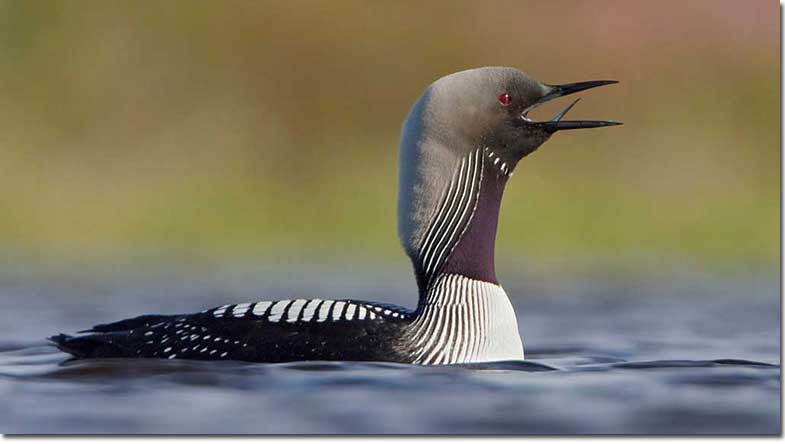
No white on the rear flanks. Similar Arctic Loon shows white mark on the rear flank. Photograph © Glenn Bartley.
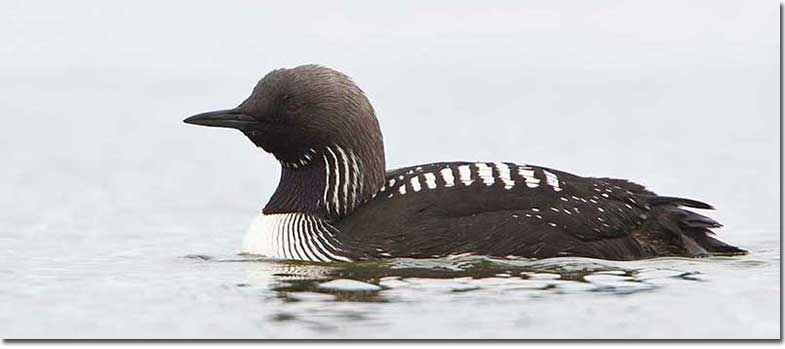
The typical look of a dark throat. Photograph © Glenn Bartley.
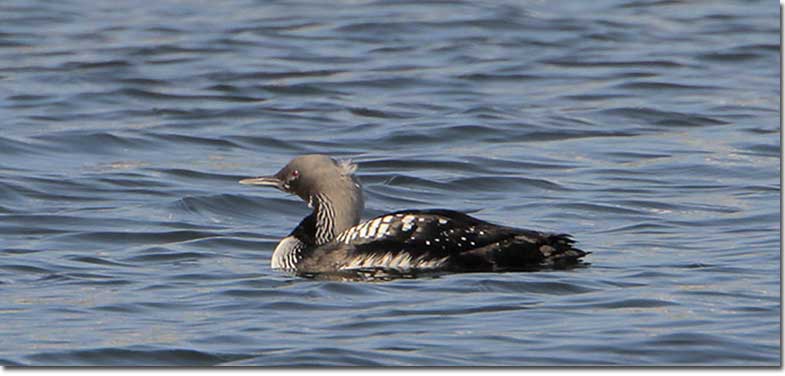
Molting Pacific Loon. Photograph © Greg Lavaty.
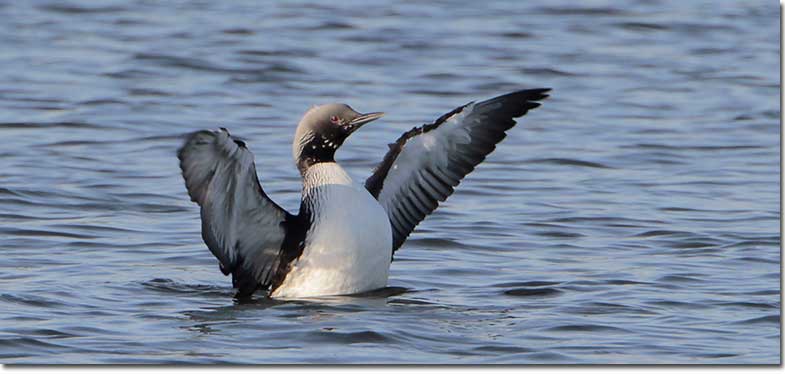
Note the pale under wing linings. Photograph © Greg Lavaty.
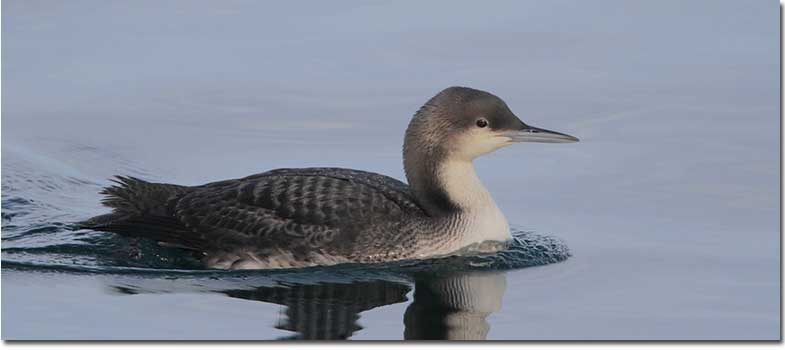
Winter birds are grayish-brown above with whitish underparts. Back is generally darker than other loons in winter plumage. Juveniles very similar. Photograph © Greg Lavaty.
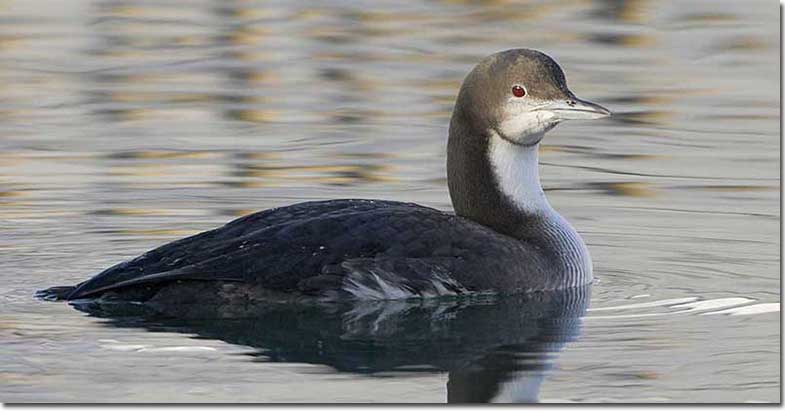
Most adults in winter plumage will show a narrow dark ring across the throat. Photograph © Glenn Bartley.
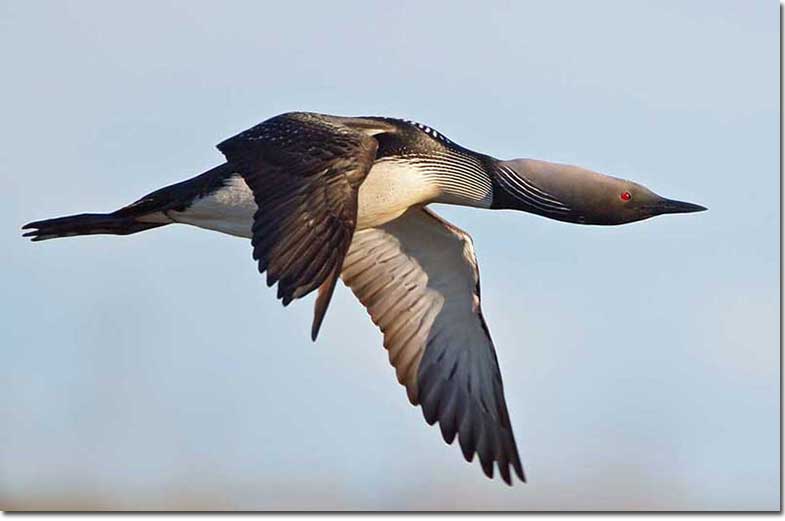
Can show a hump-backed appearance in flight. Photograph © Glenn Bartley.
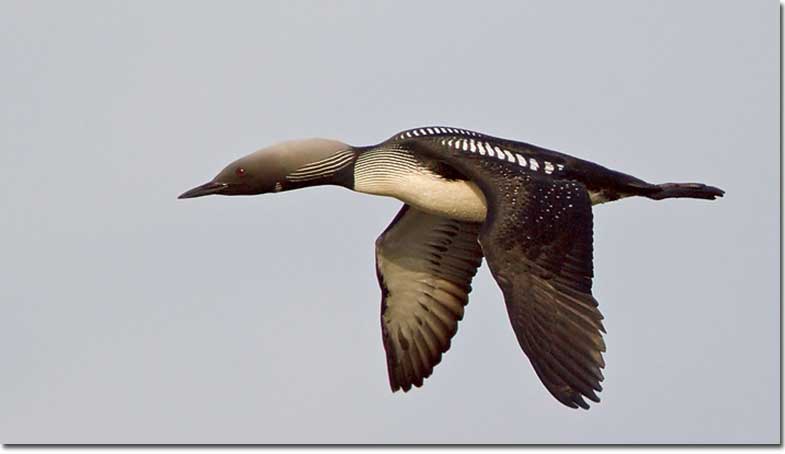
Wings mostly a uniform black. Note the white markings on the back. Photograph © Glenn Bartley.
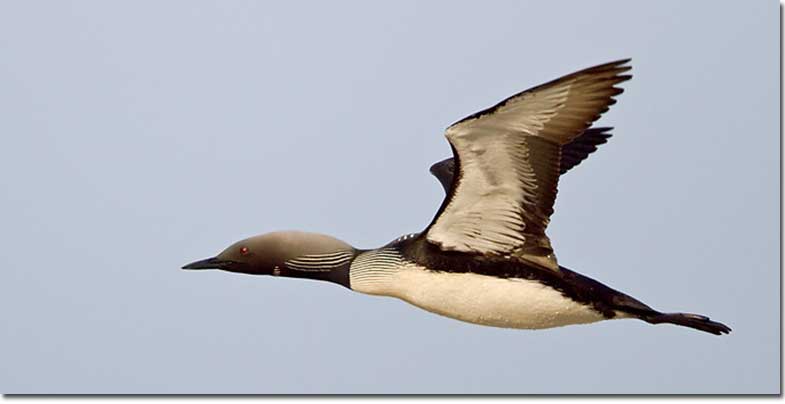
Note the dark trailing edge to the wings. Photograph © Glenn Bartley.
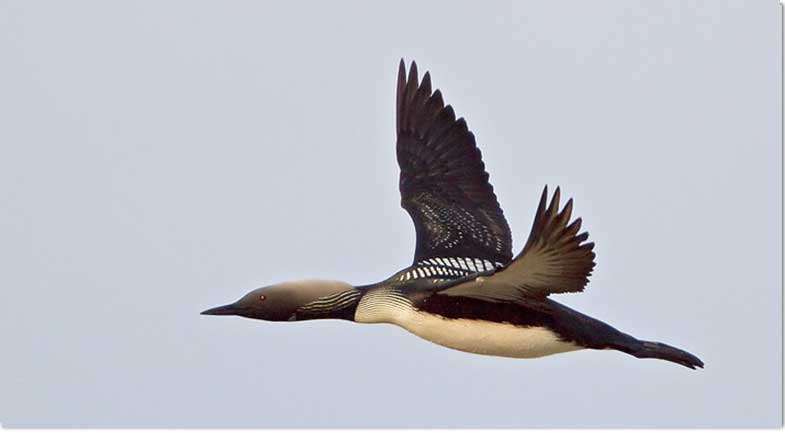
Photograph © Glenn Bartley.
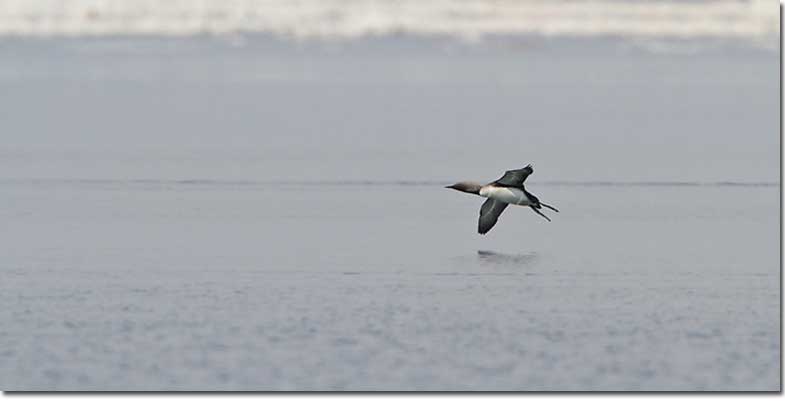
© Glenn Bartley.
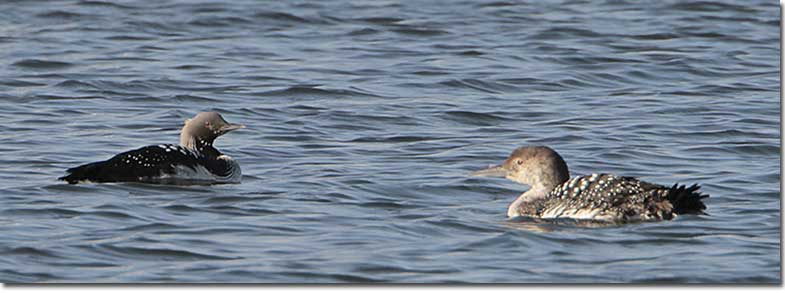
The Pacific Loon (left) in this photograph is in near, full breeding plumage. It is smaller and has a smaller bill than the Common Loon on the right. Photograph © Greg Lavaty.
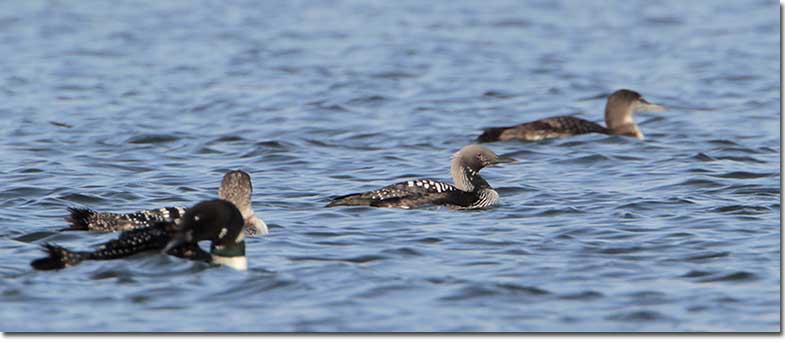
Pacifc Loon with Common Loons. The Common Loon on the front left is in breeding plumage. Photograph © Greg Lavaty.