

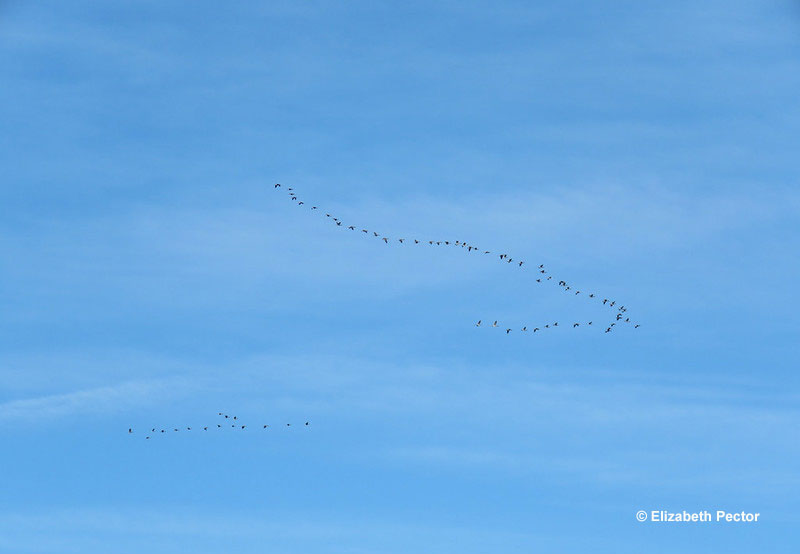
Birds fly together in a variety of ways. Go birding during migration, and you might see one of the most impressive flight behaviors: the “V” formation!
When I see flocks of honking geese and bugling cranes fly overhead, I feel like the flock’s V formations are living, moving works of natural art.
It’s a beautiful sight to behold, but why do birds really fly like that?
Key takeaways:
- Most birds migrate in groups, but the large V shapes stand out; these are usually larger birds, namely geese and swans.
- V formations help birds stay safe and control their energy.
- There is usually a leader who leads the flock and makes sure there are no predators ahead.
The Art Of Sticking Together
Birds fly together for several very good reasons. Social bird species probably feel less stressed and better overall when they flock with each other. However, the main reasons for flocking have everything to do with survival.
Related: Murder, parliament, and other collective names for birds
The saying “there’s strength in numbers” holds true, even for birds. Whether sparrows or birds as big as Canada Geese, flicking helps a bird survive in a number of ways. Flying in V formation is no exception, especially for geese and other big birds.

Protection
The main reason birds flock together is for protection. Similar to how deer and other herding animals stick together for protection, birds do the same thing. The more birds in a flock, the more likely one of those birds will notice a predator.
Flocking together also makes it difficult for predators to focus in on just one target.
Guidance
Birds might also flock with each other for guidance. Although most species probably detect magnetic fields and other factors for orientation, some also take the lead from other birds in the flock.
For geese and cranes, older, experienced members of the flock can lead younger birds to the best wintering grounds.
Saving Energy
When geese and other large birds fly in a V formation, they do it to save energy. Studies have shown that birds don’t need to fly as hard when they position themselves behind and off to the side of the bird ahead of them.
The bird in front makes air currents by flapping its wings, which, in turn, gives the bird behind them a bit more lift. The trailing birds adjust their wing flapping sequences to take full advantage of those air currents, and when a leading bird gets tired, others in the flock routinely switch places with it.
This strategy ends up saving all members of the flock a lot more energy than flying on their own.
Do All Species Migrate In V Formations?
Flying in V formation is such an excellent energy-saving strategy; one would expect all birds to do it. However, some birds fly in Vs, others in tight flocks, and many on their own.
The birds more likely to fly in a V formation are big waterbirds that flock together. These include pelicans, geese, ibises, some ducks, some shorebird species, cranes, cormorants, and storks.
If a goose or one of those other birds has to fly for a long distance on its own, it would use a lot more energy and become much more tired than flying with other birds in a V.
Oddly enough, although Turkey Vultures are also big and migrate for thousands of miles, they don’t fly in a V. Vultures still migrate together but that’s just because each individual is taking advantage of the same wings and warm air currents for lift. In addition, vultures and hawks might not need to fly in a V because they are more aerodynamic and lighter than birds like geese.
Small birds fly in tight flocks for protection because they might be too small to take advantage of V-formation flying. Many small migrants also migrate on their own and in the dark of the night!

Migration Facts
- Birds that migrate in V formation usually have broad wings and can be heavier than other birds.
- The benefits of V formation flying come from updrafts created by steady flapping of big, broad or long wings.
- Small birds don’t benefit from V formation flying because it’s too hard for the birds in the flock to take advantage of complex and unreliable air currents caused by their fast flapping rate.
- Aircraft can also fly in V formation because it increases fuel efficiency!
- The main reasons why birds fly in V formation were discovered in studies of migrating Northern Bald Ibises. Data loggers placed on each bird showed its speed, heading, and position, several times a second.
- By flying in V formation, birds can increase their range by 71%!
- Young birds learn to fly in V formation by watching others in their flock, and probably realizing that it’s easier to fly off to the side and behind other birds than directly behind them.
- Many small birds migrate high overhead at night to avoid predators and take advantage of cooler, more comfortable air.
Frequently Asked Questions
Do birds always fly in a V?
No, birds don’t always fly in a V. Geese, cranes, pelicans, and other big birds with broad wings fly in a V, but smaller birds do not.
What is it called when birds fly in a V?
When birds fly in a V, it is called a “skein”, “wedge”, or “echelon”.
Why do birds fly in a V instead of a straight line?
Birds fly in a V instead of a straight line because flying in a V helps all birds in the flock save a lot more energy than flying in a straight line.
How do geese decide who leads the V?
Geese decide who leads the V by switching places when the lead bird gets tired.