


Cardinals are such gorgeous birds! In the dead of winter, their bright red plumage lends a welcome touch to snow-covered backyards. I also love how Cardinals entertain with cheerful, whistled songs, and can nest right next to the house.
Northern Cardinals are much appreciated and fantastic birds but are they the only cardinals we can see? How many other cardinals are there? Do they look like the familiar cardinals that come to feeders?
Let’s learn more about the members of the cardinal family!
The Cardinal Family
For most folks, cardinals are the beautiful red and black, crested birds we see in local parks and backyards. However, Northern Cardinals are just one of many beautiful songbirds in the Cardinal family.
According to the Cornell Lab of Ornithology Birds of the World, 51 members of the Cardinalidae family range from southern Canada to Argentina! Many of these beautiful birds live in tropical habitats, although several also breed in North America and migrate to Central and South America for the winter.
Such migrant “cardinals” include Scarlet, Western, and Summer Tanagers, buntings, and the Dickcissel. North American grosbeak species are also members of the cardinal family, and are more closely related to Northern Cardinals than other species.
The Cardinalidae family includes some of the more recently evolved bird species. They are also more related to the New World Warbler and Tanager families than to other avian families. My favorite way of spotting a cardinal is to look at their beaks and tails – cardinals have larger, more finch-like beaks and usually have tails with rounded tips.
The Cardinalis Genus
Northern Cardinal
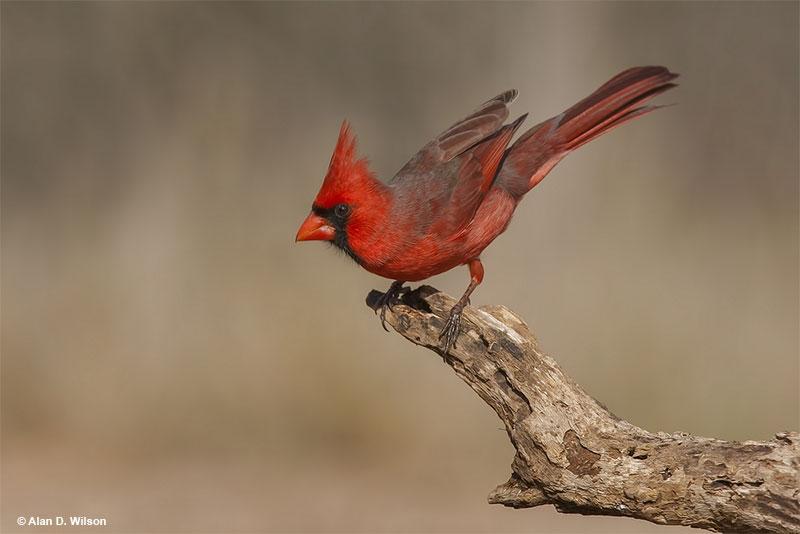
Northern Cardinals are the classic “cardinals” that most folks know and love. Of all the birds in North America, the male Northern Cardinal just might be the easiest one to identify.
No other bird species has a perky crest, big orange-red beak, bright red plumage, and jet black on its face. Take a closer look and we can also see that male Northern Cardinals have some dusky red on their back and tail.
Female cardinals look like a pale brown version of male birds with some red in their crest, wings, and tail. When I see these birds in flight, one of the things I also notice is that their longish tails have a slightly rounded tip.
These distinctive birds use their big, conical beaks to crack open seeds, eat berries, and catch beetles and other insects. They usually forage on or near the ground, are frequent at feeders, and can nest in backyard bushes.
We find Northern Cardinals in light woodland and brushy habitats in southeastern Canada, the eastern USA, Texas, New Mexico, and Arizona. They also live in Mexico and northern Belize.
Northern Cardinals in southwestern Mexico look noticeably different. The first time I saw one in Oaxaca, I understood right away why some folks call it the “Long-crested Cardinal” and consider it to be separate species!
Pyrrhuloxia
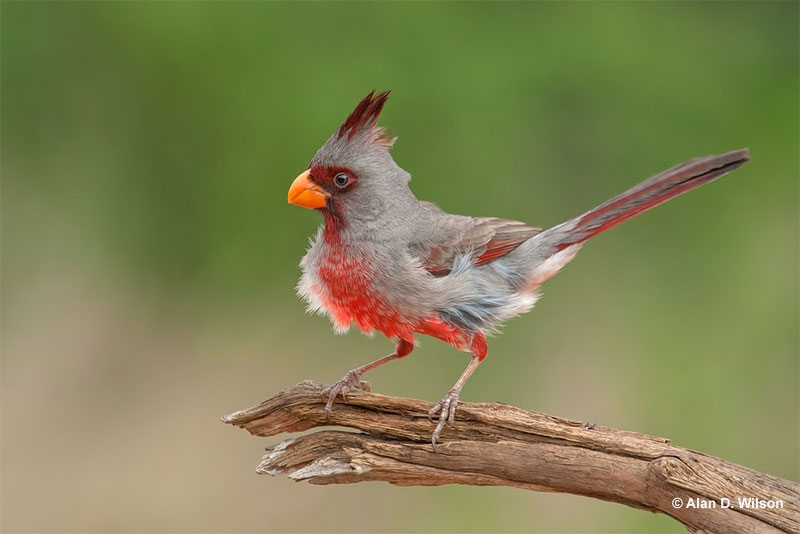
Pyrrhuloxias have such a unique and odd-sounding name, a lot of folks just call them, “Desert Cardinals”. That name’s a good one! Indeed, Pyrrhuloxias show their colors in deserts and other arid habitats.
Males are gray with red on the tip of their pointed crest, and on their wings, face, and tail. They also have red going down the front center part of their body, and a stout, rounded, yellow beak. In certain lighting they remind me of ashes in a firepit and glowing embers.
Female Pyrrhuloxias are more brownish-gray and only have a bit of red on their crest, face, wings, and tail. They also have paler yellowish beaks.
These pretty cardinals usually occur as pairs that forage for seeds and insects in brushy growth. However, in winter, they form flocks, some of which can number 1,000 birds!
Pyrrhuloxias mostly live in open, arid, brushy habitats, including mesquite grasslands. Although we can find them in some of the same places as Northern Cardinals, Pyrrhuloxias prefer more open vegetation. They can also come to feeders and live in southern and western Texas, New Mexico, Arizona, and much of the northern half of Mexico.
Vermilion Cardinal

Vermilion Cardinals are fancy birds that resemble Northern Cardinals. Like that familiar species, male Vermilion Cardinals are red, have a crest, and some black on their face.
However, Vermilion Cardinals are a brighter shade of red, have a spikier crest, and much less black on their face. I also identify them by their stout grayish beak and range.
Female Vermilion Cardinals look like female Northern Cardinals but have grayer heads with some white on their face, and the same spikey crest and stout grayish beak as their male counterparts.
While this unique cardinal looks a bit like the ones we see in North American backyards, you’ll never see these two cardinal species in the same place. Vermilion Cardinals are special birds restricted to arid habitats in parts of northern Venezuela and northwestern Colombia.
They especially like desert habitats where males can sing from the top of tall cacti and dense bushes. Like the other two members of the Cardinalis genus, Vermilion Cardinals use their rounded wings for brief, undulating flight, and forage down low for seeds and insects.
They occur as pairs and, sadly, are affected by habitat destruction and capture for the cagebird trade.
Other “Cardinals” And Relatives
Blue Grosbeak
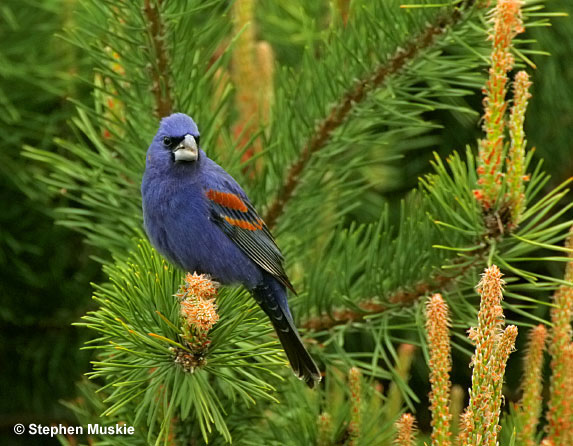
Blue Grosbeaks are beautiful, finch-like birds that live in brushy fields, and other similar open habitats. They might not look like a Northern Cardinal, but do belong to the same family, and have a few similarities.
Like that common bird, Blue Grosbeaks also have a stout, conical beak, a hint of a crest, and a bit of black on their face.
It’s easy to recognize male Blue Grosbeaks. They are a gorgeous shade of blue, have a grayish beak, and two chestnut bars and edging in their wings. Female Blue Grosbeaks are trickier with their rich brown plumage with some blue highlights, chestnut edging in their wings, and two brown wing bars.
These pretty “cardinals” are common in brushy habitats from the Great Plains and the southern USA to Costa Rica. I usually notice Blue Grosbeaks after hearing their sharp “Pink!” calls, or when a male sings its pleasant warbling song.
Indigo Bunting
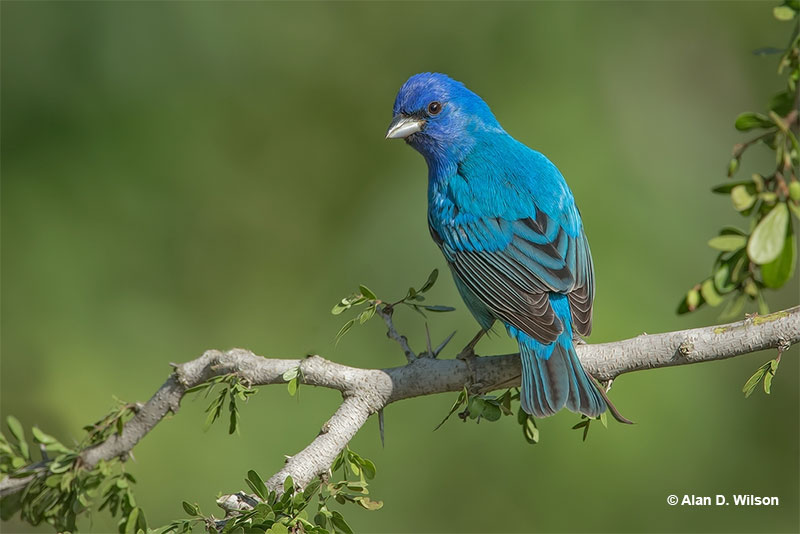
Indigo Buntings are small, sparrow-sized “cardinals”. Like Northern Cardinals, they have a finch-like beak and can show a tiny crest but differ in other ways. Males are beautiful dark blue birds with black highlights on their face, wings, and tail.
In certain lighting, they can also look entirely black! The first one I ever saw was like that. I heard a bird calling at the edge of a Pennsylvania woodland, and when it popped into view, I focused in on a small black bird in dim, early morning light.
I wondered what it was until the mystery bird moved into a shaft of sunlight. At that moment, it suddenly glowed sapphire blue and I knew I was looking at an Indigo Bunting!
Females look more like plain brown sparrows with some blurry streaking on their underparts. Pairs and small flocks often forage together in brushy fields and second growth.
Painted Bunting
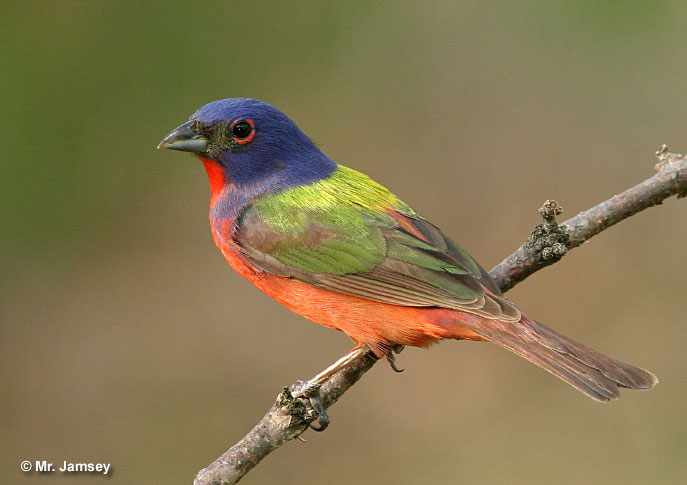
Some of the most beautiful birds in North America are in the Cardinalidae family. Plumaged in different shades of blue, red, yellow, and orange, these fantastic birds are meant to be admired!
However, even in a family replete with beautiful birds, the Painted Bunting might be the most colorful one of all. Males have a red eyering and underparts, purple-blue head, and a lime-green and red back!
Females aren’t so colorful but are still pretty, green birds with yellow-green underparts, and a narrow, pale eyering.
We usually see Painted Buntings in pairs and small flocks that forage on and near the ground. They like brushy areas, especially habitats with scattered trees where they feed on seeds, insects, and fruit.
In summer, we can watch Painted Buntings from southeastern Kansas south to Texas and Louisiana, and in some coastal areas of the southeastern USA. In winter, Painted Buntings live in Florida, parts of the Caribbean, Mexico, and Central America.
Dickcissel

Dickcissels are unique, sparrow-like members of the Cardinalidae. These little cardinals are gray with some streaks on their back, chestnut on their wings, and yellow markings on their face and chest. Males also have a white chin and a black throat.
Females and wintering Dickcissels look like males but are plainer and don’t have any black on their throats.
Dickcissels are named after their simple “tick tick sue sue sue” song. Go birding on their breeding grounds in spring and summer and you should hear them! They like to perch on top of fences, tall grass, and other elevated spots as they sing over and over.
Watch for singing Dickcissels foraging on grass seeds and insects in weedy meadows and grassland habitats in the Great Plains east to Ohio, and south to Texas. In fall, big flocks of Dickcissels migrate to marshes and rice fields from Mexico to Venezuela.
In Costa Rica, I like to listen for Dickcissels migrating overhead at night. During fall months, If I listen close, I can usually hear their distinctive raspy call quietly punctuate the night sky.
Summer Tanager
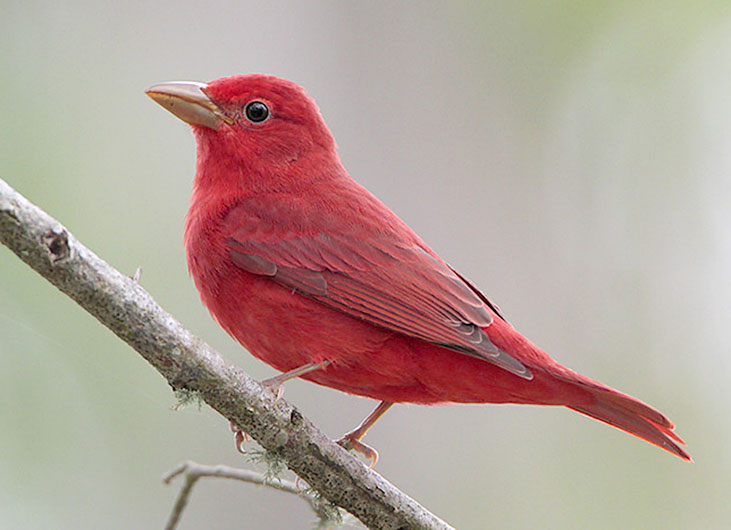
Beautiful Summer Tanagers are cardinals too! Their beaks are thick instead of being conical but they can show a hint of a crest, and males are bold and beautiful.
Male Summer Tanagers are warmly-colored, entirely rose-red birds with a pale beak while females are yellowish or orange-yellow with slightly darker wings. Both sexes also have long wings typical of birds that migrate long distances.
These beautiful cardinal species breed in oak woodlands and other deciduous forest habitats in the southern USA north to Illinois and New Jersey. Some also range into the southwestern states, and all migrate south for the winter.
They can migrate as far as Bolivia but most winter in Mexico, the Caribbean, and Central America. In Costa Rica, Summer Tanagers are one of our common wintering birds! I often see them eating papaya at fruit feeders.
Whether in summer or winter, Summer Tanagers forage for bees, wasps, other bugs, and small fruits. Find them at bee nests and by listening for their distinctive “chicky-tuck-tuck” call!
Scarlet Tanager
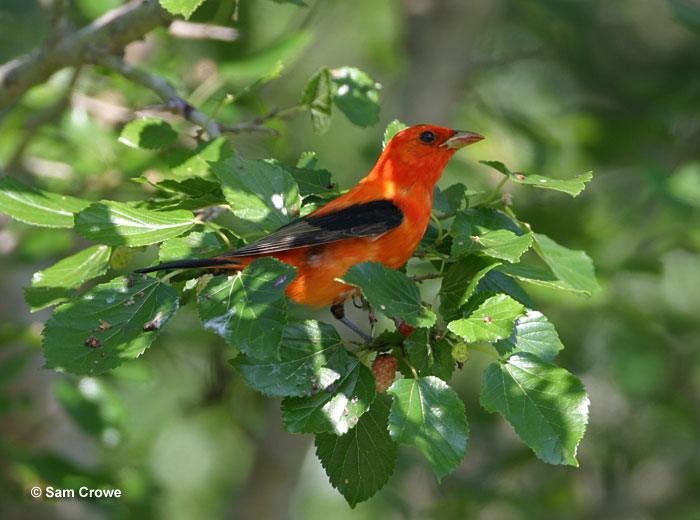
Scarlet Tanagers are one of the brighter colored birds in the USA. These cardinal species might lack a crest but their red plumage rivals or even surpasses that of the Northern Cardinal!
I’ll never forget the first time I saw one. It was like a miniature red stop light against a deep green backdrop.
Breeding male Scarlet Tanagers are gorgeous scarlet birds with longish, velvet black wings, and a medium-length, velvet black tail. Females are yellow-olive with dusky wings and a dusky tail. Both sexes have thick, pale bills they use to feed on arthropods, caterpillars, and fruit.
Scarlet Tanagers breed in deciduous and mixed forests in southeastern Canada and the eastern USA south to northern Georgia and Arkansas. On its breeding grounds, one good way to find this beauty is by listening for a bird that sings like a raspy or “burry” sounding American Robin.
In fall, male Scarlet Tanagers change their red colors for olive plumage. Both sexes spend the winter in forests from Panama to Peru and Bolivia.
Frequently Asked Questions
Are cardinals territorial?
Cardinals are very territorial. During the breeding season, cardinal pairs often drive other cardinals away from their territory.
Are cardinals grosbeaks?
No, cardinals are not grosbeaks. However, since cardinals and grosbeaks are members of the Cardinalidae family, it’s almost better to say that grosbeaks are a type of cardinal.
How rare is it to see a female cardinal?
It’s not rare to see a female cardinal. Although female cardinals can be a bit harder to see when nesting, they are just as common as the males.
Do cardinals migrate?
No, cardinals do not migrate. At least Northern Cardinals don’t. However, other Cardinalidae species such as tanagers and grosbeaks do migrate south for the winter.
Are tanagers related to cardinals?
North American tanagers are related to cardinals. However, tanagers that live in the Caribbean and from Mexico to Argentina are in another bird family.
Do all cardinals have the signature crest?
Not all cardinals have the signature crest. Birds known as “cardinals” in North America have that perky crest, but other types of cardinals do not.
Is the Red-crested Cardinal a true cardinal?
No, the Red-crested Cardinal is not a true cardinal. Despite their appearance, Red-crested Cardinals are actually a type of tanager and belong to the Thraupidae family!