

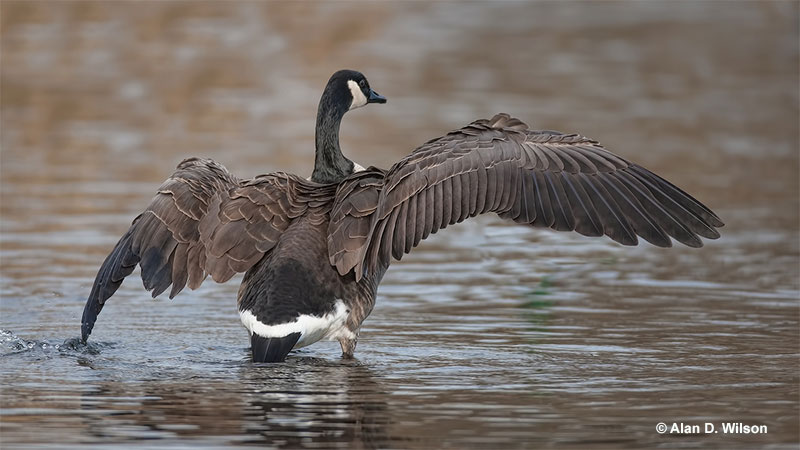
Wild & Domesticated Species
Geese, the largest waterfowls alongside swans, are medium- to large-sized birds, known for their sociable nature and flying in a V-shape during migration.
Despite being waterfowl, they spend most of their time on land. Most of them form long-term monogamous bonds and are very protective of their nests.
Let’s meet the geese of North America!
The Goose Family
Most birds with “goose” in their name belong to the Anatidae family, which also includes ducks and swans. Swans and geese share similar body structures, such as longer necks and larger bodies, compared to ducks, which are generally smaller with shorter necks and more varied plumage and feeding habits.
Within this family, geese are most closely associated with the genera Anser (grey and white geese) and Branta (black geese).
Known for their strong migratory habits, most geese travel long distances between breeding and wintering grounds, flying in V-shaped formations to reduce wind resistance and conserve energy. However, some populations are year-round residents.
Wild geese are generally monogamous and often mate for life. They build simple nests on the ground, with the female incubating the eggs while the male stands guard. The downy young are nearly independent from birth but remain with their parents throughout the first summer.
Interestingly, goslings bond with the first moving object they see—whether it’s a goose, a person, or even an inanimate object—and remain dedicated to it as their surrogate “parent” for life.
Barnacle Goose

Scientific name: Branta leucopsis
Range: Breeds throughout coastal tundra regions from northeastern Greenland to Siberia, migrates to coastal northwestern Europe for the winter. May occasionally visit northeastern North America.
Length: 22-28 inches
The Barnacle Goose is a compact black-and-white goose with a very short bill. Its head and neck are black with a stark white face, contrasting elegantly with its silver-gray black-barred upperside and pale underside. This unique coloration makes it easily distinguishable from other geese.
Their name originates from a medieval myth. People once believed that these geese hatched from barnacles, as they never saw the birds nesting; the truth is that the geese were breeding in the remote Arctic regions, far from human observation.
These geese are also noted for their dramatic cliff-nesting habits, with goslings making a perilous leap from high ledges to jump into the ocean shortly after hatching and swim to shore. They then hike for 6-15 miles with their parents to a safe place to grow up at. Despite the dangers, this behavior helps protect them from predators.
Brant
Scientific name: Branta bernicla
Range: Breeds in the Arctic regions of North America, Europe, and Siberia. Winters in more temperate coastal regions.
Length: 22-26 inches
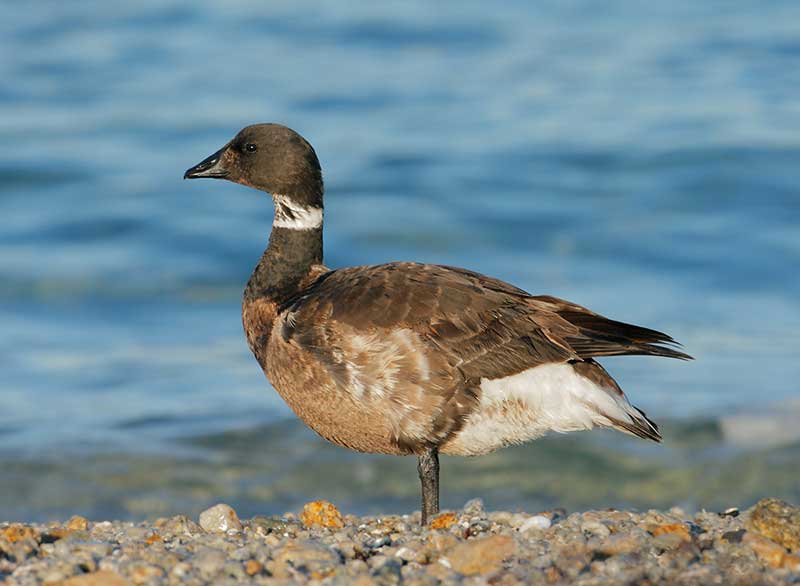
Small for a goose, the Brant is an overall dark bird with pale flanks, white undertail, and a darkish head and neck with a broken white collar. Its name is derived from the Norse word “brandgás,” which means “burnt” goose, likely referring to its dark coloration.
The species has three subspecies with different plumage and an additional fourth morph. Dark-bellied and Black Brants look fairly similar, but the former has a gray back and gray belly whereas the latter has darker sooty-brown back and belly.
Pale-bellied Brants have a brownish back and a pale belly with dark barring. The last morph, the Gray-bellied Brant is a mix between the Black and Pale-bellied Brant. It has brown upperparts and a pale belly with dark barring.
Brants are adept foragers. During winter, they are strictly coastal and rely on eelgrass and sea lettuce to survive. However, the inclusion of sea lettuce is a recent adaptation brought about by a blight on eelgrass in 1931, which almost resulted in the extinction of the species. The geese that managed to survive were the ones to expand their diet and include sea lettuce.
Cackling Goose
Scientific name: Branta hutchinsii
Range: Breeds in the Arctic tundra regions of northern North America and winters in more temperate areas of the United States, as well as parts of Mexico.
Length: 24.8-25.6 inches
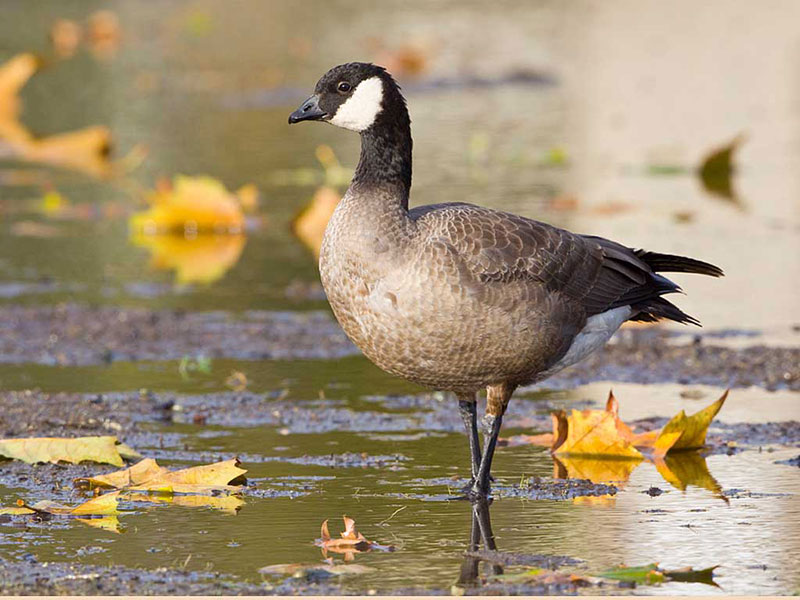
The Cackling Goose bears a striking resemblance to its larger relative, the Canada Goose, though it is notably smaller in size and has a unique cackling call. Its plumage is a mix of browns with a white chinstrap that sharply contrasts its black head and neck, giving it a refined and recognizable appearance.
As many other goose species, Cackling Geese often mate for life. They reinforce that pair bond by putting on a display. This includes the mates standing close to each other, stretching out their necks, partly spreading their wings, and calling out.
They are highly territorial during the breeding season and chase off or even attack any potential rivals, predators, or intruders. This aggression may carry over to wintering areas if there are disputes over food.
Generally speaking, family groups are dominant over single geese. If two family groups clash over food, it is usually resolved with displays, although it may sometimes escalate into physical fights.
Canada Goose
Scientific name: Branta canadensis
Range: Resident to long-distance migrant across North America and northern parts of Mexico.
Length: 30-43 inches
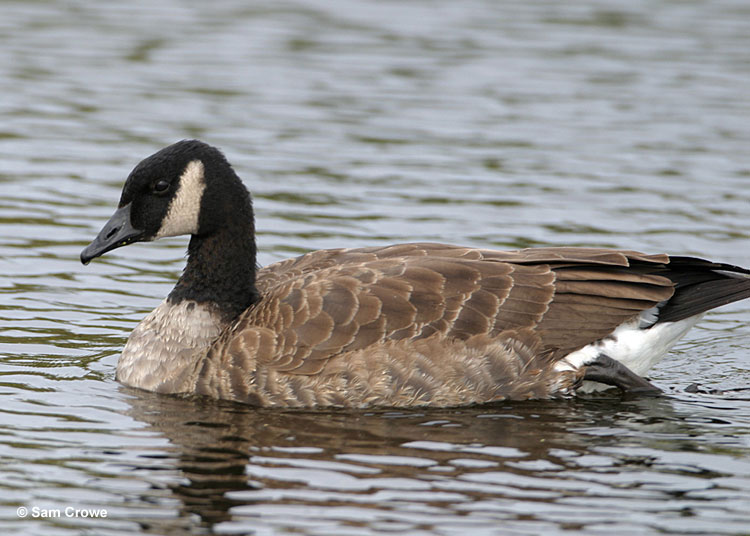
The Canada Goose is an iconic bird, easily recognized by its black head and neck with a distinctive white chinstrap that contrasts sharply against its rich brown body and pale underparts.
With at least 11 subspecies varying in size and color, they generally get smaller toward the northern and darker toward the western part of their range.
Canada Geese often mate for life. They choose partners that are similar to them in size and form strong family bonds.
This, coupled with the fact that they are widespread, can become a nuisance in urban and suburban areas due to their protective nature, leading them to extend their necks, hiss, and spread their wings when they feel that they or their family is threatened. This has earned them the nickname ‘cobra chickens’.
Interestingly, goslings may form larger “gang broods,” where multiple broods travel, feed, and rest together, always accompanied by at least one adult.
Emperor Goose
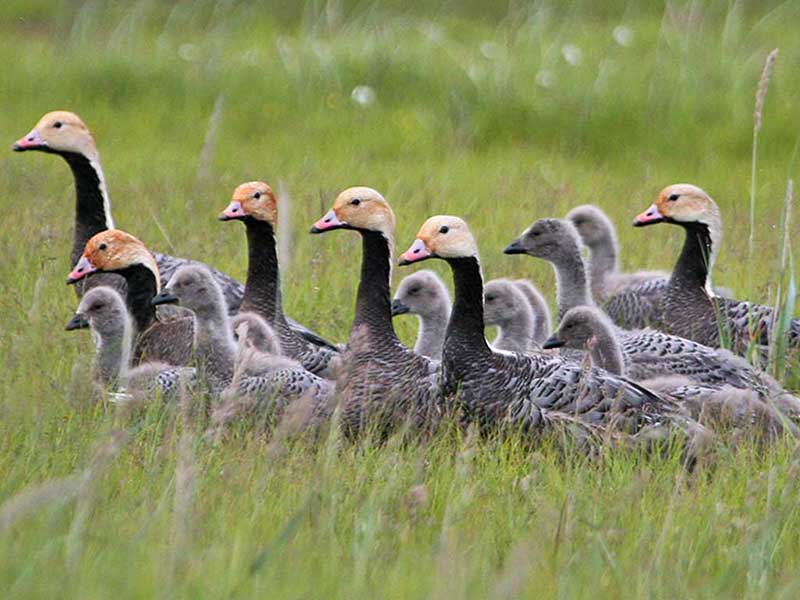
Scientific name: Anser canagicus
Range: Along the Bering Sea with main breeding populations in Arctic and subarctic Alaska, parts of Canada, and northeast Russia. Most migrate to the Aleutian Islands for the winter.
Length: 26-28 inches
The Emperor Goose is a striking and rare waterfowl known for its beautiful plumage. They have distinctive silvery scaly-looking body feathers and a pure white head and nape that contrasts sharply with its black throat and front of the neck. In fact, their name comes from their white crown and hindneck which reminded early explorers of the ermine trim on a royal cloak. However, that white can stain rusty red in the summer when they feed in iron-rich substrates.
Emperor Geese tend to fly lower than many other arctic-nesting geese, usually below 90 feet and often just above the ground or water surface. Unlike some arctic geese that migrate thousands of miles, Emperor Geese only migrate a few hundred miles between their breeding grounds in western Alaska and wintering areas in the Aleutian Islands.
Relate: Why do some birds migrate, but others do not?
During non-migration seasons, they prefer to swim or walk rather than fly. They are also the most solitary species in the goose family and generally only interact with members of the family flock.
Greater White-fronted Goose
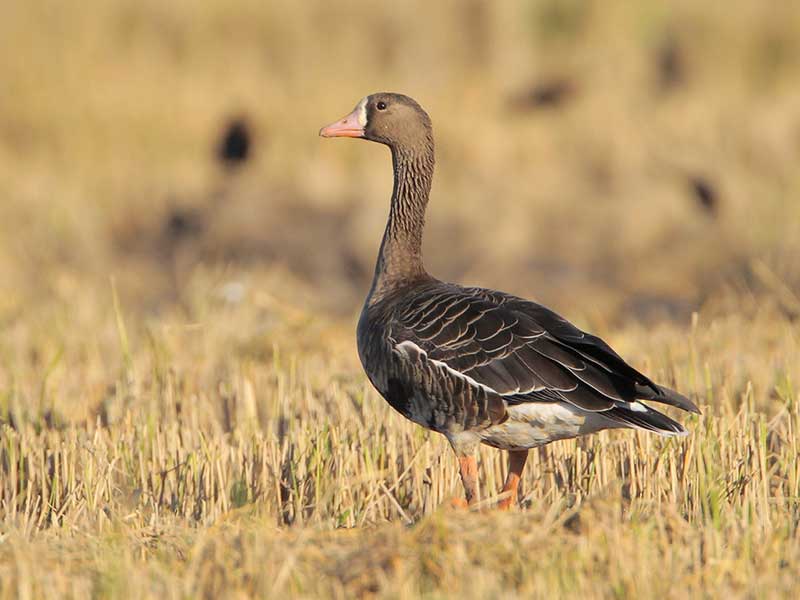
Scientific name: Anser albifrons
Range: Can be found in both Palearctic and Nearctic. In the Americas, they are in northern Alaska and northwestern Canada during the summer. Their wintering grounds are along the western coast of the US and parts of Mexico and coastal southern US.
Length: 25-32 inches
The Greater White-fronted Goose is easily recognizable by its distinctive white patch at the front of its head, which gives the species its name. Adults are brown overall, with black barring on the belly and a white vent.
These geese are highly social and are often heard before they are seen, thanks to their loud, high-pitched calls. Offspring stay with their family groups until they reach their breeding age at around two and a half years old. They help defend the nest, if the occasion arises. Parents and siblings may remember each other throughout their lives!
Hawaiian Goose
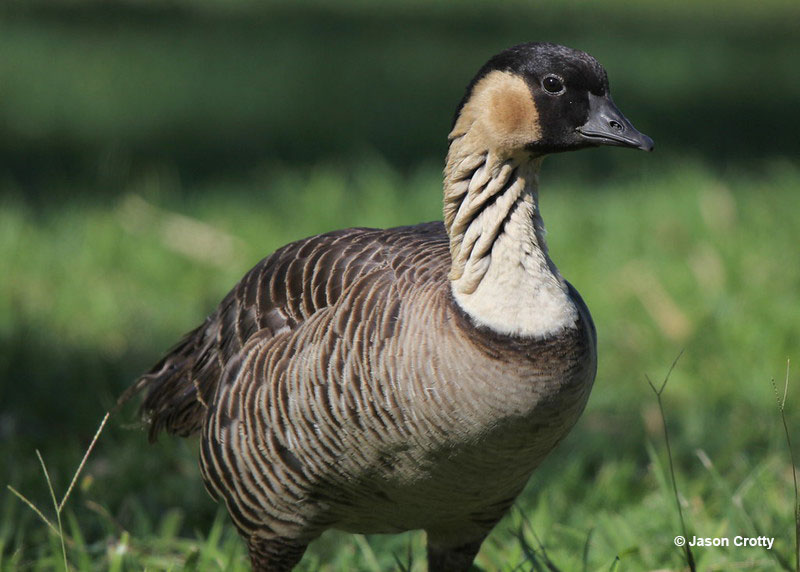
Scientific name: Branta sandvicensis
Range: Resident across the Hawaiian Islands.
Length: 24.8-27.2 inches
The Hawaiian Goose, also known as the Nene, is a species uniquely adapted to the Hawaiian Islands. Despite having the smallest range among all goose species, it displays remarkable resilience by thriving in various habitats across the islands, including those altered by human activity. The species is also recognized as the official state bird of Hawaii.
Due to their small range, the Hawaiian Goose is also the rarest goose species in the world. They are listed as near threatened on the IUCN Red List and, thankfully, have an increasing population of about 1,700-2,200 mature individuals.
However, the species went nearly extinct in the 20th century due to habitat destruction, hunting, and introduced predators. They were saved by habitat management, predator-proofing fences, and invasive predator control.
Ross’s Goose
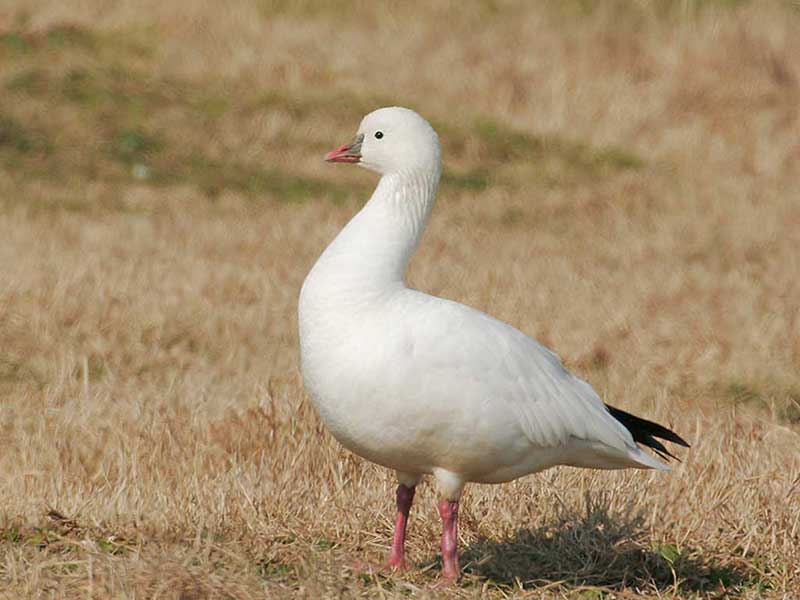
Photograph © Tom Grey
Scientific name: Anser rossii
Range: Breeds in the Arctic Canada and is patchily distributed in the southern US and northern Mexico in winter.
Length: 23-25 inches
Ross’s Geese are beautiful pure white birds with black wingtips, black eyes, and pink stubby bills and sturdy feet. There is also a very rare blue morph that is dark gray overall with a white head and upperwing patch. Their young also come in two colors – yellow and gray. However, these are not related to the white and blue adult morphs and more often than not they grow into white adults.
Ross’s Geese are one of the more social species. They nest in dense colonies and although they still attack anyone who intrudes or threatens their nest, then they are generally peaceful and non-aggressive. So unless you want to get whacked, do not disturb their nests.
Snow Goose
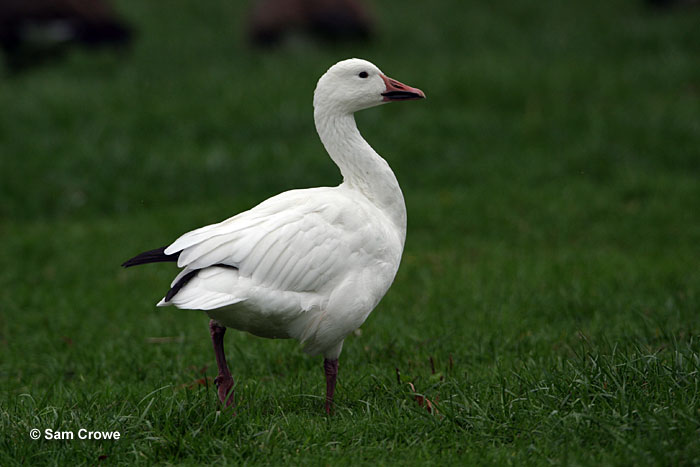
Scientific name: Anser caerulescens
Range: Breeds in parts of Arctic coastal Greenland, Canada, Alaska, and the northeastern tip of Siberia, and spend winters in warm parts of North America from southwestern British Columbia through parts of the United States to Mexico.
Length: 27-33 inches
Snow Geese come in two distinct color morphs: white and blue. White morph birds are brilliant, snowy white with black wingtips, while the blue morph individuals have a dark body with a white head and neck.
The dark morph gene is partially dominant over the white morph gene, so if two white geese mate, they will have only white offspring, but if dark geese mate, they may have a few white offspring as well. Color also plays an important role in mate selection. They generally go for individuals of the same color morph that the birds in their family had.
Snow Geese are strong fliers who migrate between the northernmost parts of North America and southern North America for the breeding and wintering seasons, respectively.
During the non-migratory periods, they spend their time on feeding and resting on the ground rather than flying around. They are fast and able to outrun many predators if need be.
Domestic Species
Bar-headed Goose
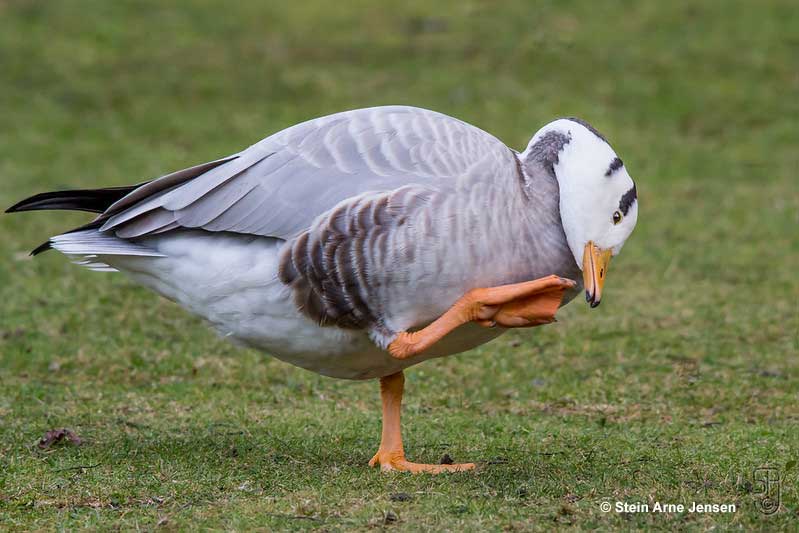
Scientific name: Anser indicus
Range: Breeds in Central Asia and winters in South Asia
Length: 28-30 inches
The Bar-headed Goose is a remarkable bird known for its extraordinary high-altitude flights over the Himalayas during migration, with recorded heights reaching up to 23,920 feet. Some have even reported seeing them flying across Mount Makalu and Mount Everest, but those stories are not verified.
This feat makes it one of the highest-flying birds in the world, often navigating at altitudes where oxygen levels are perilously low and temperatures are freezing.
Bar-headed Geese are not only powerful fliers, but also beautiful to look at. They have gray bodies and white heads with black bars across it. This has prompted humans to try and domesticate them.
They are not fully domesticated as of now, but they have a docile nature, breed readily in captivity, and easily mix with other species, making them easy to maintain even for beginners.
Egyptian Goose
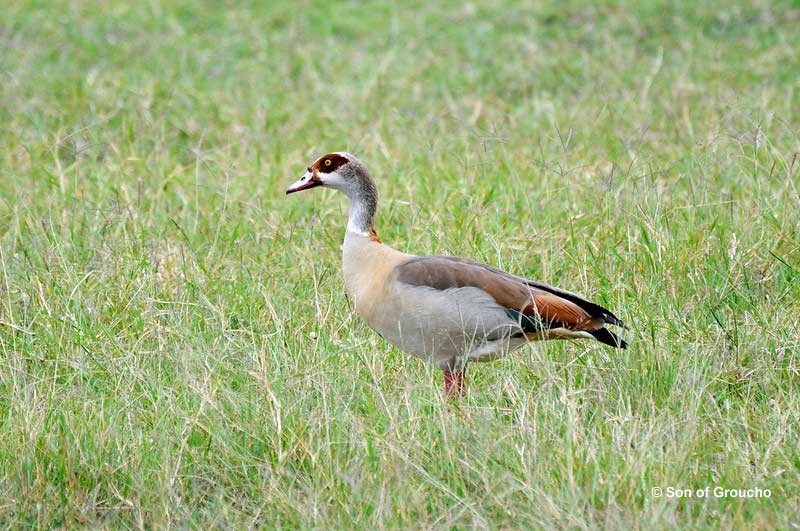
Scientific name: Alopochen aegyptiaca
Range: Sub-Saharan Africa and the Nile Valley
Length: 25-29 inches
The Egyptian Goose may look a bit menacing due to the dark brown patch surrounding its yellow eye. Their overall plumage varies greatly in tone, with some geese appearing greyer and others browner, although this variation is not linked to sex or age.
Originally from Africa, the Egyptian Goose has been introduced to Europe, North America, and other regions as an ornamental bird.
They are fairly docile in nature and can become very tame and accustomed to human presence. However, during the breeding season, they, including captive individuals, are fiercely territorial and aggressive towards anyone near their nest, which may be problematic if your flock has other birds as well.
In nature, this manifests itself as the geese attacking any intruders and even drones who enter their territory. Additionally, neighboring pairs may engage in brutal tactics to ensure their offspring’s survival, including killing the offspring of other pairs to reduce competition for resources.
Greylag Goose
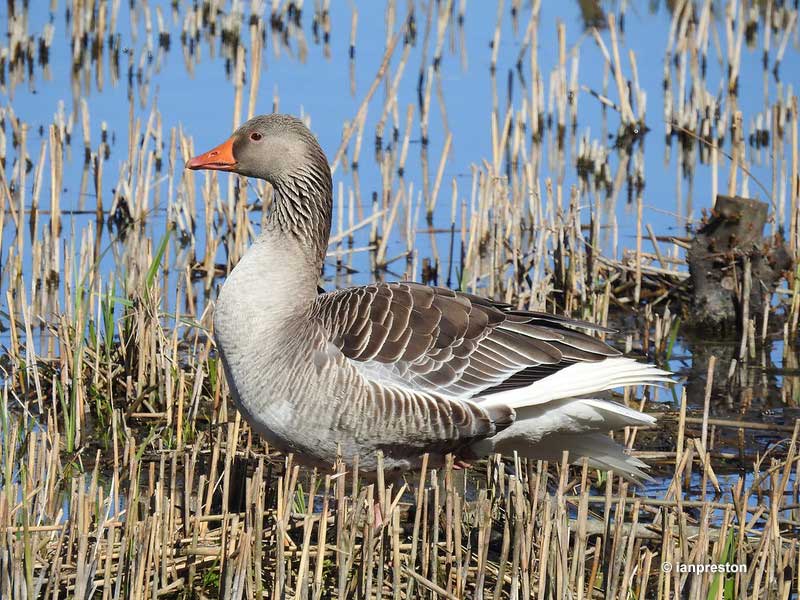
Scientific name: Anser anser
Range: Widely distributed across Europe and Asia, with populations extending from Iceland and the British Isles to eastern Siberia, and migratory groups reaching as far south as North Africa and India.
Length: 29-36 inches
The Greylag Goose is the ancestor of most domestic goose breeds, including the Graylag Geese found in the United States. They are also the largest and bulkiest of the gray goose genus. Their plumage is grayish brown overall, with a paler chest and head and a white rump and undertail.
Greylag Geese are highly social and gregarious, often forming large flocks. These flocks have a well-established hierarchy, with the top-ranking birds acting as sentinels while the others forage.
If a predator approaches, the entire flock will band together, with adults forming a protective circle around the goslings while others confront the intruder.
Swan Goose
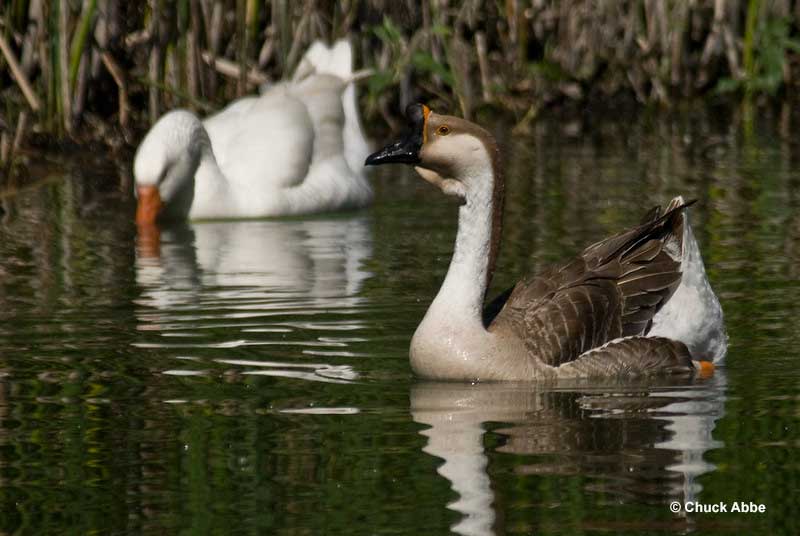
Scientific name: Anser cygnoides
Range: Native to Eastern Asia
Length: 32-37 inches
With a mix of rich brown, white, and grey feathers, a characteristic dark stripe running from its crown down the back of its neck, and a mean black bill, the Swan Goose stands out in any flock.
Unfortunately, those beautiful birds are currently endangered, with only an estimated 36,000-43,500 mature individuals remaining in the wild, with the main threat being the degradation of wetlands.
While rare in the wild, its domesticated descendants can be found across the world both in captivity and possibly in the wild as feral populations.
Two breeds, the Chinese Goose and the African Goose, are direct descendants of the Swan Goose. Their domestication occurred since at least the mid-18th century, perhaps even earlier in China. They differ significantly from their wild ancestor in appearance, temperament, and their ability to produce eggs and meat.
Frequently Asked Questions
How many goose species are there in the U.S.?
There are 8 goose species that breed in the United States and an additional 2 species that occasionally show up as vagrants. There may also be additional domesticated goose breeds that have escaped captivity and roam around.
Which goose species is the most common?
The most common goose species in North America is the Canada Goose.
Are domestic geese related to the wild ones?
Domestic geese are descended from and closely related to certain wild goose species.
Do Europe and Asia have the same goose species?
While there is some overlap, Europe and Asia mainly have goose species exclusive to that area.
Do geese live in Africa?
There are several species of wild geese native to Africa.
Do geese live in South America?
There are several species of wild geese native to South America.
