

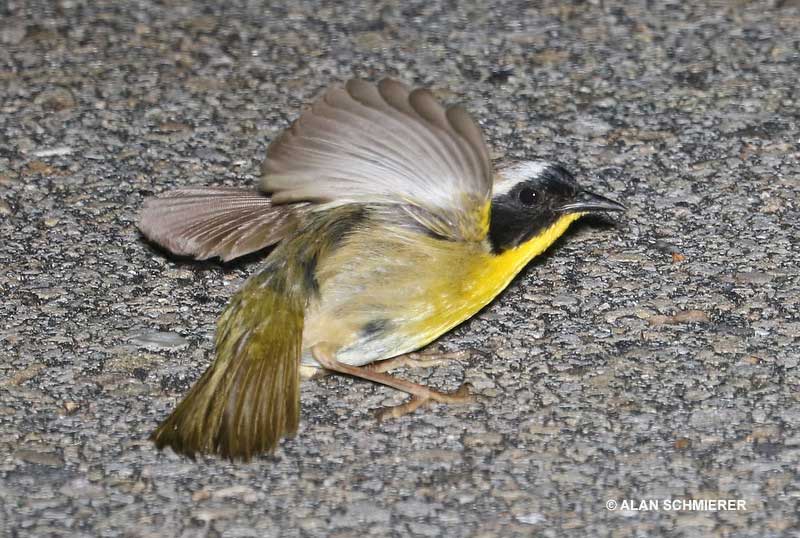
All nature lovers and bird fanciers I know feel a deep need to help injured birds.
If you notice an injured bird, you will probably feel the need to help it. However, you need to do it right. Improper rescue techniques can do more harm than good!
Here are the proper steps to take when you find an injured bird.
What To Do When You Find An Injured Bird?
Injured birds often seem stunned. And who’s to blame them? They might have a concussion, or the situation might be more severe. Unfortunately, we can’t see inside the birds, so the outcome is never certain.
A small disclaimer: if you encounter an injured or trapped bird of prey like an eagle, falcon, or owl, or a large wading bird like a heron, egret, or stork, do not try to capture them. These birds can inflict severe injuries with their beaks and talons, even if they look weak. Instead, call your local wildlife authority or bird conservation organization.
Step 1: Prepare the container for the injured bird
If you plan to help the bird, you’ll need to transfer it to a rescue center or vet’s office. Even if that kind of help is not available in your area, stunted birds also need to be in a confined, dark environment to recover, after which you can try releasing them.
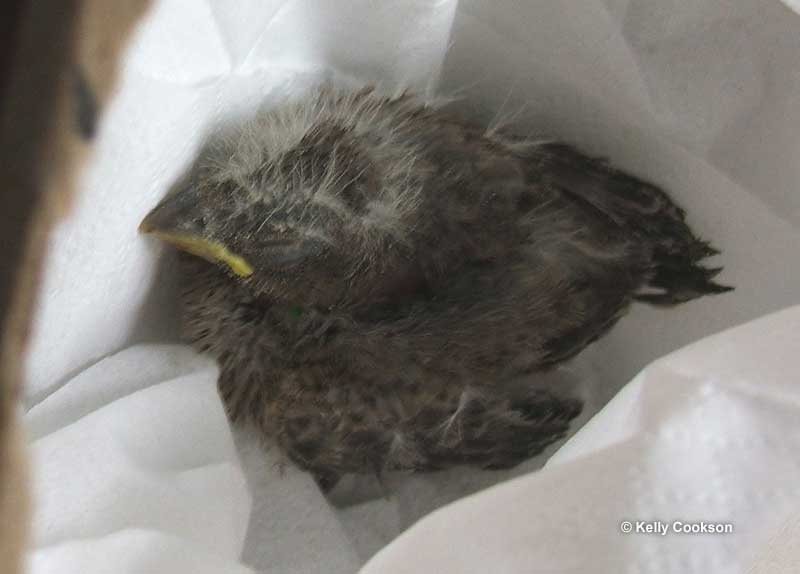
If possible, prepare the container in advance. The best options are an unwaxed brown paper bag or a cardboard box (with no plastic lining) with flat paper towels laid in the bottom. If you are unsure about ventilation in a box, poke small holes at the top of it (just not with the bird inside!).
Injured birds also need to be warm, so in cold weather, you can add a bottle of hot water wrapped in a rag or a towel (make sure it can’t roll around) or a reptile heat pack into the container. The best temperature for a stunned or injured bird is 85-90 degrees F. Providing a heat source can be life-saving for a bird experiencing shock.
Step 2: Catching the injured bird
If you are squeamish about picking up the bird directly with your hands, you can cover it with a towel or a blanket and gently pick it up with it. How exactly you’ll approach the injured bird depends on its current state and movement ability.
Let’s go through the most common scenarios.
The bird can’t fly and is immobile on the ground…
Approach quietly from behind, reach down quickly, and pick it up by holding its wings folded against its body. You can pick up small birds the size of a sparrow with one hand. For medium-sized birds, you’ll need to use two hands to cup both wings. The squeeze should be gentle but firm, and the entire body should be securely in your hands. Never pick up the bird by its legs.
Related: How to make your windows visible for birds?
The bird can fly only a bit or can’t fly, but can walk, run, or hop…
Try to drive the bird into a corner or against the wall. Call one or two people for help if necessary. It would be ideal if you could try throwing a blanket or (better) a bird net over the bird.
If you keep failing in the daytime, try again in the early evening when it’s almost dark. Don’t try for more than three or four times in a row because birds are extremely prone to stress and can literally die just from all the catching attempts. Sometimes, waiting for a day makes sense because the injured bird will weaken from the injuries and thus be easier to catch.
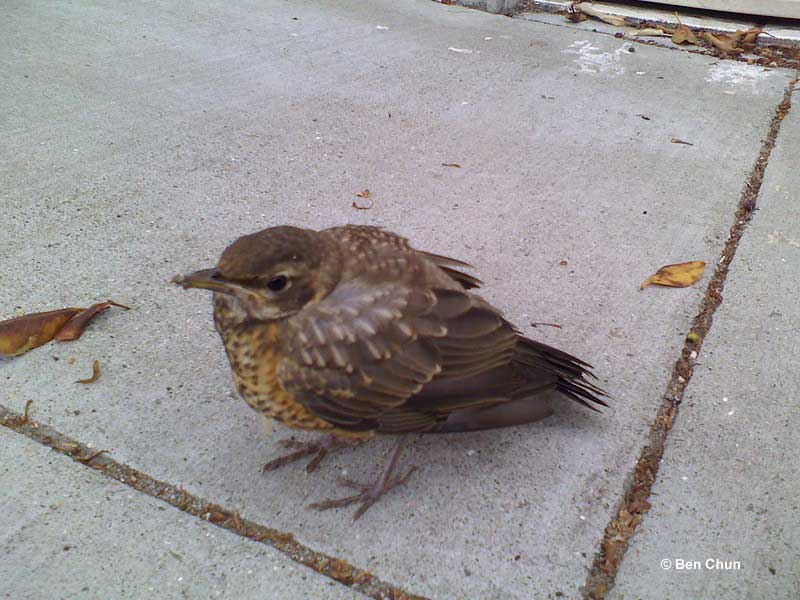
The bird is flying well but has a visible injury…
Trying to catch it may cause more harm than good due to stress. You can try luring it into a pet carrier with some food and closing the door in time. The carrier trapping strategy works best for ground feeders like pigeons, doves, chickens, or pheasants.
The bird is caught in a fence or the mouth of a cat or a dog…
Extract the bird carefully and as quickly as possible without pulling on it hard. If you are removing it from your pet’s mouth, try opening the animal’s mouth before trying to get the bird out. If the cat is feral and you can’t approach it, chasing it and stalking it for long enough can cause it to drop its prey.
Bird entangled itself in netting, strings, or fishing lines…
Catch the bird if you can, and cut distal strings while holding it to cut the bird loose. Do not try to cut the string wrapping the body itself first, but rather the last.
Read more: Why is bird netting dangerous to birds & alternatives
If the strings wrap really tightly around the bird’s body, this should be handled by a vet – trying to remove it yourself may cause additional injuries. You can find additional information on types of entanglement here.
Step 3: Place the bird in the container
Swiftly place the bird in the container you’ve prepared and secure the top. For paper bags, fold the top of the bag a couple of inches down and secure it with a paper clip or a piece of tape. For boxes, tape the lid. If you have not prepared the container in advance, do not poke the holes in the box when the bird is already inside!
Step 4: Call your local wildlife rescue or bird conservation organization
Most countries and areas have organizations that specialize in treating injured wild birds. Contact your nearest Audubon Society or American Bird Conservation chapter if you are unsure who is in charge in your area. In Europe, there may be government institutions that take injured wild birds into their care.
Take the bird directly to the vet clinic only if the above options are not viable where you live or if your bird is a common feral pigeon or a pet bird (most wild bird conservation organizations won’t bother with them). Avoid bird keepers (again, unless you found a common pigeon) or individuals claiming they’re experienced bird rehabilitators but do not have a wildlife rehabilitator license.
What Not To Do?
Although motivated by the best intentions, people take many wrong actions when handling birds in need. Please do not do the following.
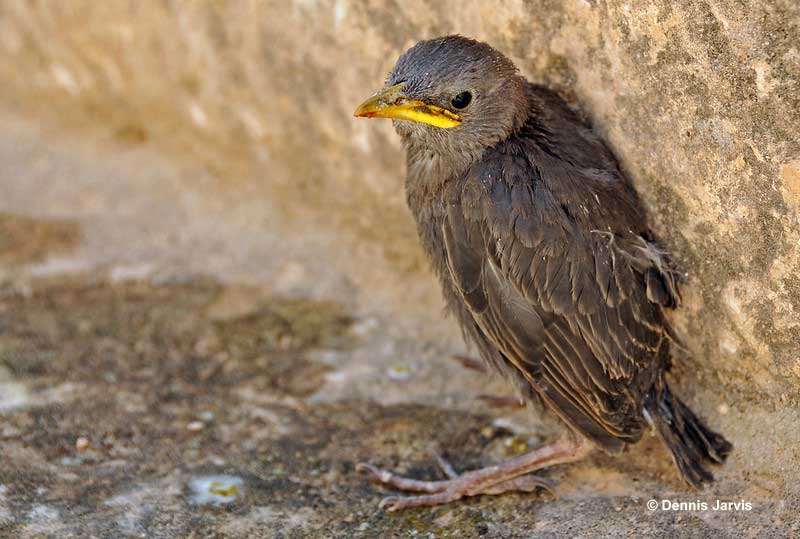
Do not give the bird food or water.
Stunned or shocked birds can suffocate from food or water. Even if the bird is dehydrated, making it drink before it recovers from shock can be deadly.
Do not pet the bird or try to “comfort” it.
Human touch, loud voices, playing music, or “nature sounds” on your phone – the injured bird doesn’t need any of it. On the contrary, while recovering or traveling to a vet, the bird needs to be in a quiet, dark place.
Do not put the bird in a cage or a glass tank.
Stunted or injured birds benefit from the darkness of a non-transparent paper bag or a box – it aids their recovery. On the other hand, a cage or a terrarium will stress it out because they can see the alien, unnatural environment; also, they may hurt themselves by hitting glass or metal bars.
Do not leave the injured bird in a room out in the open.
The injured bird needs to be confined in a dark, ventilated, and warm container while it is recovering. Leaving it in a room on its own may cause it to injure itself if it attempts to escape. This is especially true if the room has windows; a bird’s mind cannot register glass, so it may try to fly through it repeatedly.
Do not keep the bird in the same room with pets or small children.
No matter how well secured, never leave the injured bird in a room with a cat or a dog. A predator’s sights, sounds, or smells are sure to cause additional stress. Kids, despite their best intentions, can be too excited and loud for an injured bird.
Do not open the container to check on the bird.
The injured bird will only get additionally stressed or may attempt to escape if you open the container repeatedly. You can do nothing much for your rescue anyway while traveling to licensed helpers. Ensuring sufficient airflow before putting the bird into the box will put your mind at ease.
This video, which has over 3 million views, shows everything YOU SHOULDN’T DO when a bird is stunted or hurt. Petting the bird, making it drink water, putting it in a glass terrarium with irritating sawdust, leaving it unsecured in a room with a cat (!), and stressing it with to re-capturing are all very ill-informed and irresponsible decisions (is googling that hard when you’re a Youtuber?)
Are Injuries Fatal to Birds?
Bird injuries are a complex matter. Sometimes, a seemingly minor injury, like a tiny cat bite, can lead to a deadly infection.
On the other hand, injuries that look very dramatic, like subcutaneous emphysema (air leaking from the lungs) or shotgun pellet wounds, can heal great with professional treatment. The same is true for broken bones (including wings), but no one can certainly predict if the bird will be able to fly again.
Bill fractures are among the most hopeless injuries. These birds aren’t able to feed or drink, so sometimes the most humane thing to do with such a bird is, unfortunately, to humanely euthanize it. However, there are examples of beak prosthetics that we hope will be more available in the future.
Related: Can you keep a wild bird as a pet?
One thing is certain – the bird has the best chance of surviving any injury if you can get professional help in time.
Poisoning
Bird poisoning is a major issue in some parts of the world. These incidents happen when birds ingest poisoned prey or feed.
There are two types of poisoning: deliberate, with baits, in countries where predatory birds and vultures are considered pests or nuisances, and accidental, usually in agricultural fields treated with pesticides and rodent baits.
Poisoned birds usually lie motionless with wings slightly spread. Also, they display characteristically clasped, cramped feet. Contact your local bird protection organization, veterinary inspection, or wildlife crime patrol if you find a bird you believe was poisoned – dead or alive.
With treatment, some poisoned birds found in time are able to recover from their injuries.
What To Do When You Find A Baby Bird
What you do when you find a baby bird depends on its age.
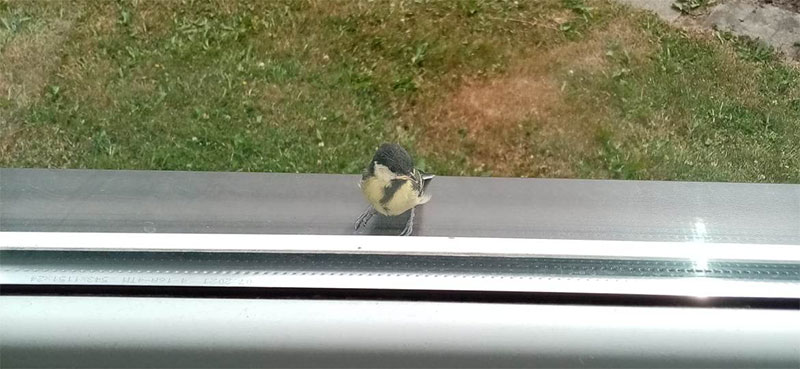
If the bird is a fledgling – a young chick that has grown adult flying feathers (not necessarily all adult feathers), leaving it where it is if the spot seems relatively safe or taking it to the nearest shrub or a small tree is the best course of action. Flegelings practice flying and getting around on their own, but their parents still feed them and guard them (even if you can’t see them at the moment).
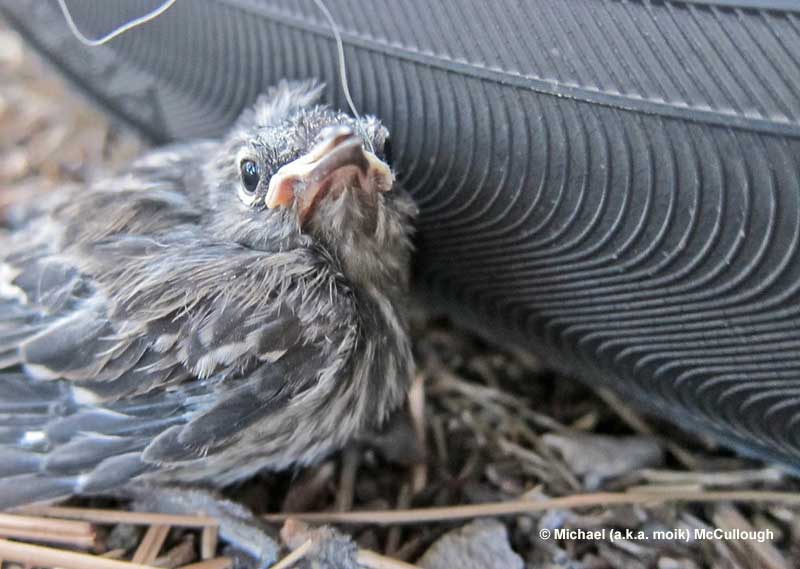
If the chick is a nestling – small and underdeveloped, unable to move around efficiently – try locating the nest and putting it back, if possible. Only if you can’t do that, contact your local ornithologists in a bird protection organization or wildlife rescue. Consider rescue options for fledglings only if you are sure they seem completely abandoned and they keep making begging calls for food in vain.
Frequently Asked Questions
Can birds recover on their own?
Yes, but it depends on the type of accident. Some birds that hit windows are only temporarily stunted and have no injuries. However, glass collisions can also be deadly if the bird suffers a bill fracture or has internal bleeding.
Do birds feel pain?
Birds have an advanced nervous system and definitely feel pain like we do. That means that injuries hurt and cause additional stress.
How to tell if a bird is in shock?
The bird that is in shock is unnaturally motionless. Usually, it will not try to escape when you approach it. It may also display general weakness, irregular breathing patterns, and ruffled feathers.
What happens on the inside is that the bird’s heart and cardiovascular system start to work poorly. The blood cannot circulate properly, blood pressure drops, and vital organs become oxygen-deprived.
Keeping the bird safely confined and warmed and reaching out for professional help if it doesn’t recover in 4-6 hours is the best course of action.
What happens to a bird when it’s stunned?
Getting stunned from a glass collision is not cartoonishly fun for birds, let alone harmless. Depending on the force of the crash, the bird can die, get severely injured, or just be stunned for a while.
Stunned birds are in trouble even if they’re not severely injured. Because it usually takes time for them to recover and be able to fly again, they become “sitting ducks” at risk from predators, human feet, or vehicle tires. That is why it is important to take the stunned bird out of the situation until it gets active again.
Can a bird recover from being caught by a cat?
A bird can recover from a cat attack, provided you take it to a vet for antibiotic treatment. For their tiny prey, cat bite is effectively venomous due to bacteria in the feline mouth. Even a slight puncture by cat teeth in bird skin can lead to a deadly blood infection. That is why a wildlife vet must administer antibiotics for birds injured by cats to facilitate recovery.
Many cat owners make the mistake of immediately releasing the bird caught by their pet cat if it seems well and can fly. Many of these “saved” birds die later for the above reasons. Prevention is always better than cure, and the best way to prevent your cat from destroying wildlife is to keep it happy indoors.
How common is it for a bird to hit a window?
Window collisions are one of the top reasons for bird deaths caused by humans (cats are also in the mix). Up to 1 billion birds die in the United States only for this reason. Birds hit windows a lot because they cannot see the glass. Night migrations in areas with lit glass towers and tall buildings are deadliest.
While we’re waiting for the contractors and architects to apply collision prevention solutions en masse, we can all try to prevent glass crashes individually.
How to help a bird that hit the window?
The bird that has just hit the glass is stunned, but you may not be instantly able to see if it is injured. First, carefully pick it up, put it in an unwaxed paper bag or cardboard box, and leave it in a quiet and pleasantly warm place. Do not give the bird water or food, as it can suffocate from drinking or eating while in shock.
Do not open the container to ensure the bird is recovering – but listen. You’ll be able to hear energetic movement and fluttering if the bird has successfully recovered. If you get a sense that the bird is alive and active, you can release it in a nearby park or forest.
Unfortunately, many birds that hit the glass and manage to “recover” enough to fly away can die later from various internal injuries. That is why the best course of action is to take it to a well-equipped wildlife rescue center.
While glass collision injuries can be serious and life-threatening, specialized veterinarians can successfully treat many of them. If you are unsure where to go, contact your nearest bird conservation organization or wildlife rescue.
How long is a bird stunned after hitting a window?
The bird will usually come to its senses a few minutes after the collision, but it can also take an hour or two. If the bird is experiencing shock, recovery may take 4-6 hours. Unfortunately, some birds never recover from glass collisions, especially if they have internal bleeding or severe head trauma. Research says that 50-70% of glass collisions are fatal for birds.
Read next: How to help birds out of your house

miss B PYE
Tuesday 16th of July 2024
hi can any one help in any way at all please ??, i received a call about a injured bird as people that know me know i spent a long time wanting a parrot so learnt all i could about them including how to hand rear i saved up to take a year out of work so i could dedicate all my time to my precious girl misty , who is 36 this year and is as naughty as ever . i have alot of rescues in the past rooks ravens crows magpie small garden birds sparrows robins ect . this is my first pigeon , it is in a very bad way , i caught it very easily and covered it its now in my separate room in the dark and silence on a water bottle at 85 degrees f. rspb rspca and vet not interested in helping.,the rescues ive rang cant help either apparently its just a common wood bird . i went into it twenty mins ago had a check at all the sights it appeared to be bleeding from ive managed to stop the bleeding in the worst wound by using coagulating powder it seems to be holding ok . the wing is definitely broken but i will attempt one thing at a time with intervals so to as cause as little stress as possible .i wont attempt food or water untill im positive the shock has subsided . its a very young bird has flight feathers just , looks like a fledgeling... ive all ready looked up that the ideal way to help is to see if bird can feed its self .and researched the best wat to mimic parent bird in feeding as pigeon are very different to other birds so is diet . i got all that coverd in best health options for age of bird . any advice by someone that has good knowledge of how to proceed forward with this would be so appreciated . i cant drive so not a option to seek help and the ovious places have already told me they wont bother . gutted is a understatement . so as long as this little one is fighting for life i want to fight with him her . id be so greatful for any knowledge at all please . thank you for taking time to read this im so very grateful . im aware the chances ce of survival is slim but in the case of un able to fly i will accommodate him in a flight i have spare for the rest of his her days . thanks again THe crazy bird lady xx
Patrick O'Donnell
Tuesday 16th of July 2024
@Miss- For injured birds, the best thing to do is get them to an official wildlife rehabilitator. Maybe one can come pick the bird up? It sounds like you may have tried that, and sadly, none are interested in helping. If that continues to be the case, it sounds like you are doing all you really can do. One idea is seeing what pigeon food or formulas pigeon breeders use. Wishing you the best of luck and that bird gets better!