


African Jacanas, dubbed Jesus birds for their ability to seemingly walk on water, are smaller to medium-sized wading birds. They have long legs and long toes. Sometimes, it may look like they have too many of them! But how come?
The Mystery of the Multi-legged Creatures
At a glance, African Jacanas are fairly regular wading birds. They have predominantly brown plumage with a white head and upper chest, a black stripe through the eye, a black back of the head, and a distinctive blue bill.
Their most remarkable features are their legs and feet. African Jacanas possess extraordinarily long legs and even longer toes, which enable them to skillfully navigate and walk on the surface of floating vegetation, such as water lilies and other aquatic plants with large leaves.
But that’s not all. Sometimes males may appear to have multiple sets of legs. This is due to their parenting behavior. They gather their chicks under their wings and carry them around. It helps the father protect the chicks and transport them from one location to another.
How long do the babies stay like this?
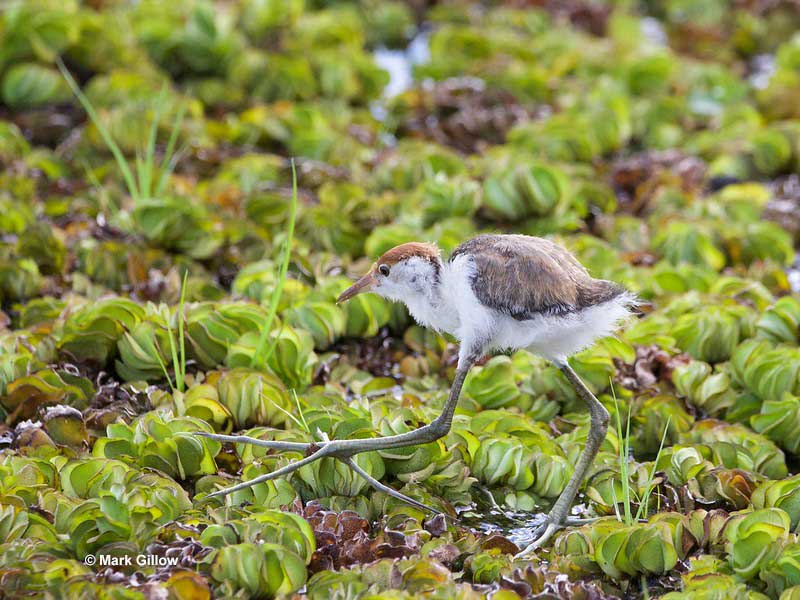
African Jacana chicks are fairly independent, like many other waterfowl chicks. They forage food themselves, carefully navigating over the large leaves of aquatic plants with their oversized feet while being guarded by their attentive father.
If he senses danger, he will call his offspring to him, gather them up, conceal them under his wings, and walk them away from the danger. This is why you have pictures of African Jacanas looking like they walked right out of Chornobyl.
Related: Weirdest bird behaviors
Another way to evade danger is by swimming and diving. Male African Jacanas teach their offspring to dive underwater or, if they are capable, to fly away. The chicks fledge at around 35 days of age and stay near their father for about another month.
African Jacana’s Nesting Behavior
The breeding pattern of African Jacanas depends on their environment. They breed seasonally in regions with dry seasons but can breed year-round where dry seasons do not occur. Males construct semi-submerged floating rafts for nests generally at the deep end of a lake under a shade using aquatic vegetation such as lily pads.
Jacanas practice a fascinating form of polyandry where one female mates with multiple males, and the males alone care for the chicks. The female lays around four eggs in the male’s nest and then takes off to seek another male, leaving the former to incubate the clutch she just laid.
During incubation, which takes around 26 days, the males are fortunately not locked onto the nest, as the natural environmental heat allows them to take breaks to go find food and stretch their legs.
This kind of breeding system contrasts sharply with typical bird breeding patterns, where males often mate with multiple females, take off, and leave all the incubating and child-rearing responsibilities on the female.
The strategy evolved partly due to the jacana’s resource- and food-rich habitat and partly because both sexes can technically incubate and raise the young. This means that the energy used to form and lay eggs by the female can be easily replenished and the limiting factor on reproduction is how long it takes for males to raise the current clutch.
Other Baby Carriers
Carrying their young provides several benefits, including thermoregulation and protection from predators. Some birds do not return to fixed nest locations, so carrying the chicks serves as a mobile base, enabling them to travel faster and further in search of more food.
This behavior is documented in various bird families, especially those living near or on water, such as ducks, swans, rails, various shorebirds, and grebes. They mostly carry their chicks on their backs, though, instead of under their wings.

Swans are perhaps more known to carry their babies. This helps protect them from various dangers.
Aerial carrying, although less researched, has been reported in species like woodcocks, chacalacas, and certain cuckoo species. However, it remains unclear whether these sightings represent unique circumstances or regular behavior patterns within these bird populations.
Fun Facts About Jacanas
- African Jacanas are known as “Jesus Birds” because their long toes and feet allow them to appear to “walk on water” as they traverse floating vegetation.
- Surviving is not simple for the African Jacana nor their babies. They are preyed on by snakes, birds of prey and other bird species, crocodiles, otters, water mongooses, and even large fish and turtles, and more. Their survival is dependent on a high reproduction rate.
- A female may lay up to 30 clutches each year.
- African Jacanas inhabit swamps, marshes, and lagoons with floating vegetation such as lily pads. They are non-migratory but highly nomadic.
- Female African Jacanas are larger and more aggressive than males. They defend territories against other females, have harems of males, and may even intrude on other females’ territories and kill their young.

Frequently Asked Questions
What kinds of birds are African Jacanas?
African Jacanas are tropical wading birds belonging to the Jacanidae family.
Why do African Jacanas carry their babies?
African Jacanas carry their babies to protect them from predators and to keep chicks warm and dry.
What do female jacanas do?
Female African Jacanas compete for and mate with as many males as they can. However, they provide no parental care.
Where do jacanas live?
African Jacanas live in the swamps, lagoons, and marshes of South Africa.
