


Oklahoma is a great place to see hawks – they soar over open fields, perch on fence posts, and even hunt in suburban backyards.
Some hawks in Oklahoma are migrants, while others live in the state all year long. But which species are common? How can you identify them?
Most Common Hawks In Oklahoma
In Oklahoma, 14 species of hawks have occurred. One of those, the Gray Hawk, is a rare vagrant, but most other species are common birds.
To figure out which hawks in Oklahoma were the most common, we made a list of hawks based on recent eBird data. We arranged those hawk species from most common to least common, and also included key field marks and information about their behavior.
We hope this list helps with your hawk-watching in Oklahoma!
Red-tailed Hawk
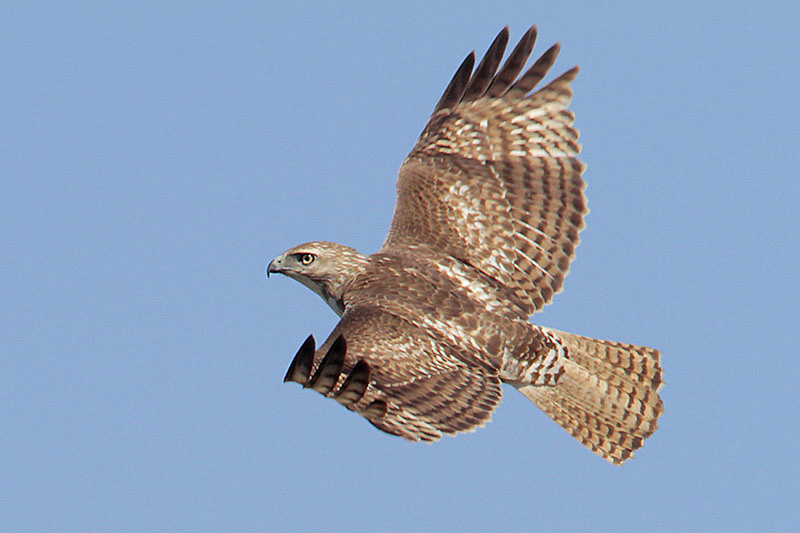
Red-Tailed hawk (Juvenile) © Greg Lavaty.
Scientific name: Buteo jamaicensis
Speed: 20-40 miles per hour
Length & Weight: 19 inches, 2.4 pounds
Wingspan: 49 inches
Call: “keeeyah!”
The Red-tailed Hawk is a big and bulky hawk with dark brown upperparts and long, broad wings. Adults have a broad reddish tail and both sexes are similar (although females are larger than males).
In the east, adults have pale underparts with dark marks on their belly, but western birds can be dark brown, buff, or reddish-brown below. Young birds have brown tails with darks barring.
In flight, all Red-tailed Hawks show a large, somewhat square-shaped, pale area near the tips of their wings.
This species preys on a variety of small animals, including squirrels, rats, snakes, and birds. It catches prey by swooping down from a perch or from soaring flight.
They use a wide range of habitats, and Oklahoma is no exception.
Key Identifications:
- Large, hefty hawk with a reddish tail and dark marks on its pale belly.
- Preys on small mammals, snakes, and birds.
- Builds a bulky stick nest high in a tree.
- Makes loud, jay-like, ringing calls, “keeeyah!”.
Red-shouldered Hawk
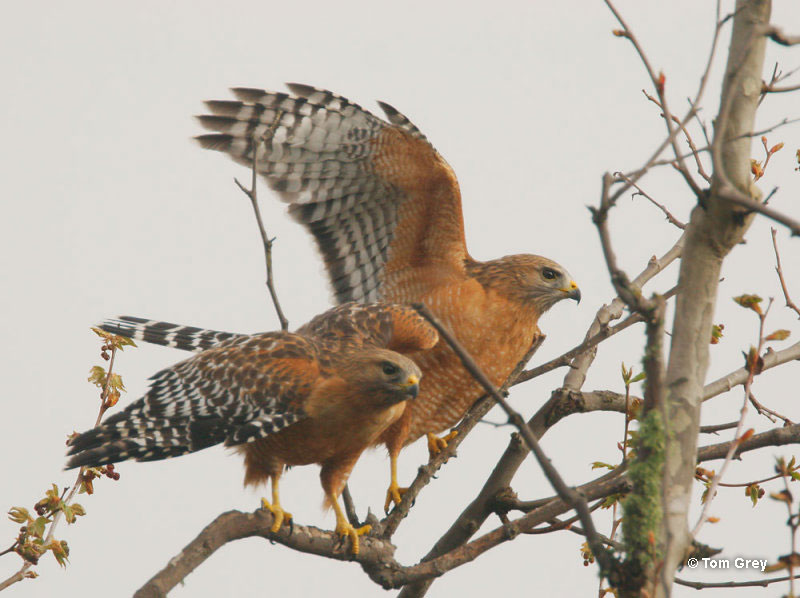
© Tom Grey
Scientific name: Buteo lineatus
Speed: 18-34 miles per hour
Length & Weight: 17 inches, 1.4 pounds
Wingspan: 40 inches
Call: “keer keer keer keer keer!”
The Red-shouldered Hawk is one of the most common hawks in Oklahoma. It is a medium-sized hawk with reddish-orange underparts and shoulder, and black and white on its wings and tail.
Both sexes are similar but as with most raptors, females are larger than males. Young birds are brown above and have dark streaks on pale underparts.
In flight, all ages of this hawk species are best recognized by their longish, black and white tail and long wings with a pale crescent-shaped mark near the tip of the wing.
Red-shouldered Hawks prey on snakes, frogs, and other small animals. They forage by waiting on a perch and then swooping down to catch the animal on the ground.
The Red-shouldered Hawk lives in a variety of woodland habitats. If you’re lucky, you can see them year-round!
Key Identifications:
- Medium-sized, colorful hawk with reddish-orange underparts and shoulder, and black and white upperparts and tail.
- Forages for snakes and other small animals on the ground in woodland habitats.
- Builds a bulky stick nest high in a tree.
- Makes loud, jay-like, ringing calls, “keer keer keer keer keer!”
Cooper’s Hawk
Scientific name: Accipiter cooperii
Speed: 21-55 miles per hour
Length & Weight: 16.5 inches, 1 pound
Wingspan: 31 inches
Call: “kek kek kek kek kek!”
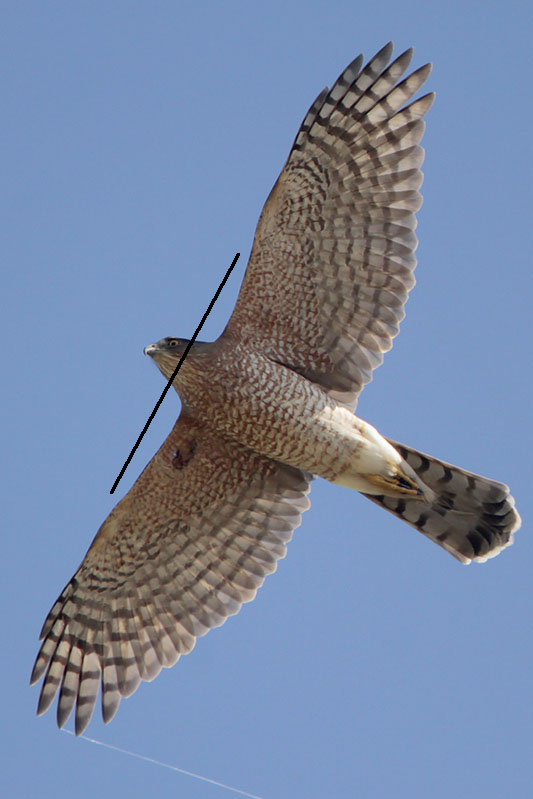
The Cooper’s Hawk is a fair-sized hawk with a long, rounded tail and a blocky, square-shaped head. Adults are blue-gray above and have orange barring below.
Both sexes look similar although females are larger. They also often show a dark cap, have pale grayish on their face and side of the neck, and dark banding on their tail.
Young birds are shaped like adults but are dark brown above, have paler brown on the head, and fine dark streaking on pale underparts.
In flight, this species uses its rounded wings to make a few deep flaps followed by a brief glide.
The Cooper’s Hawk preys on doves and other medium-sized birds, and small mammals. It usually catches them on the ground and frequently attacks birds at feeders.
This species lives in a variety of wooded and semi-wooded habitats; you can see them throughout the year.
Key Identifications:
- Fair-sized hawk with orange barring below, blue gray above, and a long rounded tail.
- Preys on small mammals and starlings and dove-sized birds in woodlands, parks, and towns.
- Builds a bulky stick nest high in a tree.
- Usually quiet but when breeding, it makes a loud barking call, “kek kek kek kek kek!”
Northern Harrier
Scientific name: Circus hudsonius
Speed: 21-38 miles per hour
Length & Weight: 18 inches, 15 ounces
Wingspan: 43 inches
Call: “che che che che che che”
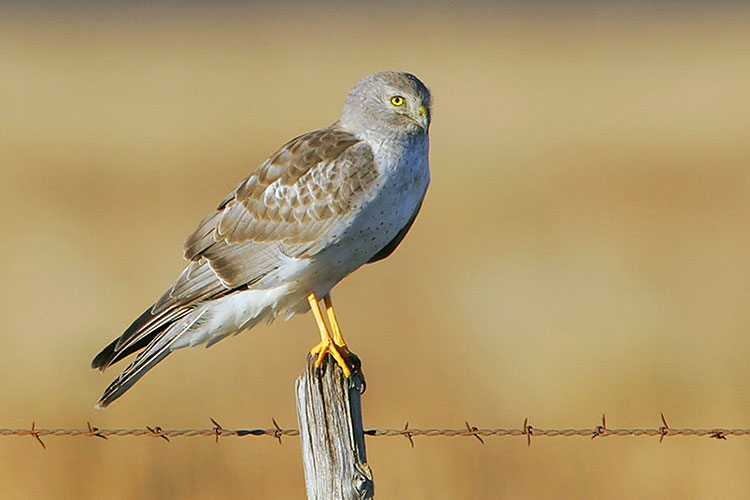
The Northern Harrier is a fair-sized, unique hawk with long wings, a long tail, and a white rump. Adult males have gray upperparts, head, and breast. They also have some pale brown spotting on their underparts and black tips on their wings.
Females are dark brown above and have dark brown streaks on pale underparts. Young birds are also dark brown above but have deep orange-buff underparts.
All Northern Harriers have a white rump and glide low over the ground on long wings held in a “V” shape.
This species preys on small animals caught on the ground, sometimes after hovering.
Northern Harriers breed in grasslands and other open habitats in the north, but from September to May, you can see them in Oklahoma.
Key Identifications:
- Distinctive long-winged, long-tailed hawk with a white rump.
- Glides low over the ground to catch rodents and other small animals in marshes and other open grassy habitats.
- Builds.
- Makes a repetitive, woodpecker-like call, “che che che che che che”
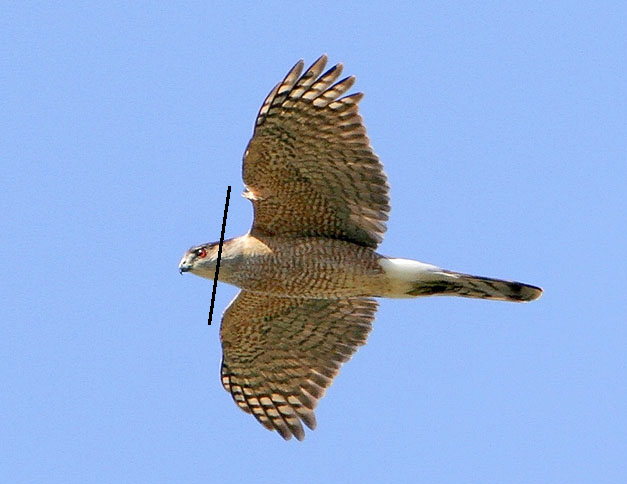
Sharp-shinned Hawk
Scientific name: Accipiter striatus
Speed: 16-60 miles per hour
Length & Weight: 11 inches, 5 ounces
Wingspan: 23 inches
Call: “kew kew kew kew kew kew kew kew”
The Sharp-shinned Hawk is a small hawk with a long, rectangular tail and rounded wings. Adults have blue-gray upperparts, orange barring on their underparts, and dark bands on their tail.
Females are larger than males and young birds are dark brown above with thick brown streaks on pale underparts.
This species flies with several quick wing beats followed by brief glides. When flying, its head doesn’t stick out as much as a Cooper’s Hawk and it shows a square-tipped tail.
The Sharp-shinned Hawk preys on small birds up to the size of an American Robin. It mostly catches birds around the same size as sparrows, warblers, and vireos by quickly flying and catching them in vegetation.
Sharp-shinned Hawks do not breed in Oklahoma, but you can usually see them from September to April.
Key Identifications:
- Small hawk with rounded wings and a long, rectangular tail.
- Preys on small birds in woodland habitats.
- Builds bulky stick nest high in a conifer.
- Usually quiet but on breeding grounds makes falcon-like, repeated ringing calls “kew kew kew kew kew kew kew kew”.
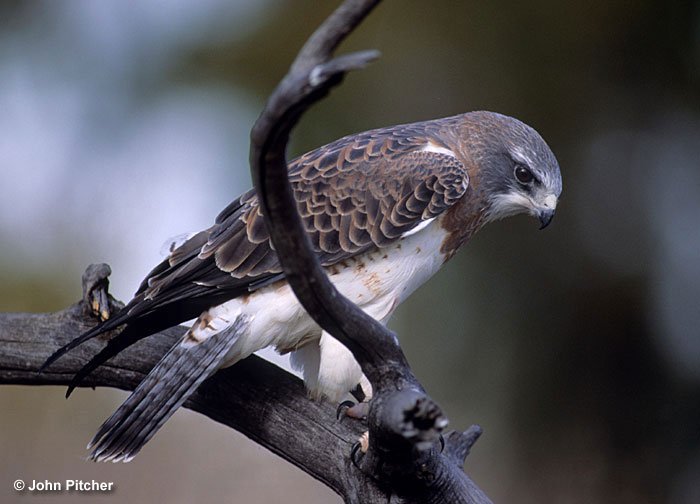
Swainson’s Hawk
Scientific name: Buteo swainsoni
Speed: 15-60 miles per hour
Length & Weight: 19 inches, 1.9 pounds
Wingspan: 51 inches
Call: “eeeah!”
The Swainson’s Hawk is a big hawk with dark-brown upperparts, long, pointed wings with dark flight feathers, and a broad tail with fine dark barring and a dark tip. Males and females are similar, although females are larger.
Adults can have a white throat, front, wing linings, and underparts with a red-brown breast. They can also have a white throat and front, and reddish brown underparts and wing linings, or be entirely dark brown.
Young birds can have dark markings on pale underparts or be mostly dark below.
This species catches grasshoppers and small animals on the ground. It forages by soaring and then swooping down or walking on the ground.
Swainson’s Hawks breed in grasslands, meadows, and other open habitats and Oklahoma is no exception. However, they migrate further south for winter.
Key Identifications:
- Large, long-winged hawk with dark flight feathers and a broad tail with fine dark banding and a dark tip.
- Feeds on insects and small animals in prairies and other open habitats.
- Builds a bulky stick nest in a tree.
- Makes a loud, descending, single note, “eeeah!”.
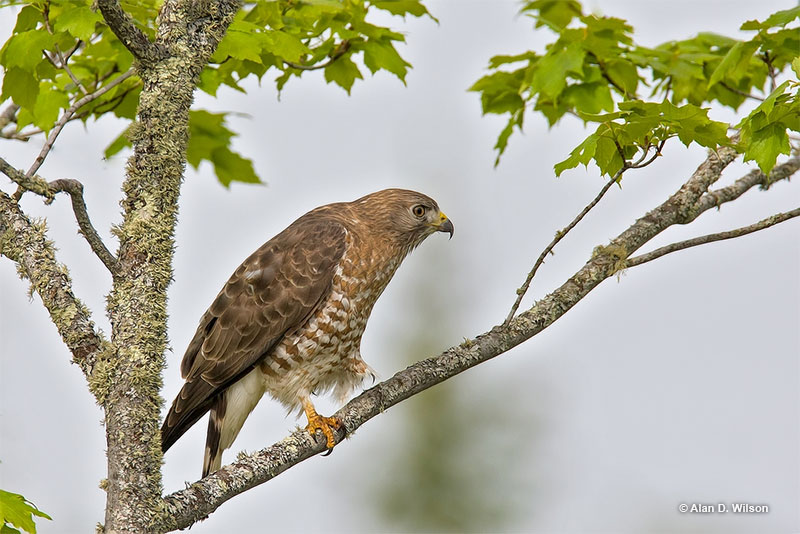
Broad-winged Hawk
Scientific name: Buteo platypterus
Speed: 20-40 miles per hour
Length & Weight: 15 inches, 14 ounces
Wingspan: 34 inches
Call: “sipeeeeeeeee”
The Broad-winged Hawk is a smallish raptor around the same size as a crow. Adults are dark brown above, have dark, reddish-brown barring below, and a broad tail with a few wide, white bands.
Both sexes look the same and also have a thick dark mark on each side of their throat although females are larger. Young birds have dark brown streaks on pale underparts.
In flight, this species often soars, shows a broad black and white tail, and has long wings shaped like a “paring knife” that also have a dark trailing edge.
This raptor preys on voles, frogs, insects, and other small animals. It catches food by waiting on a perch and then quickly swooping down to the ground.
This small hawk breeds in forest habitats. You can only see them in the summer.
Key Identifications:
- Chunky, smallish, crow-sized hawk with a few white bands on its tail and underparts with brown barring or streaks.
- Preys on insects and small animals in woodland habitats.
- Builds a bulky nest high in a tree.
- Makes a high-pitched call, “sipeeeeeeeee”
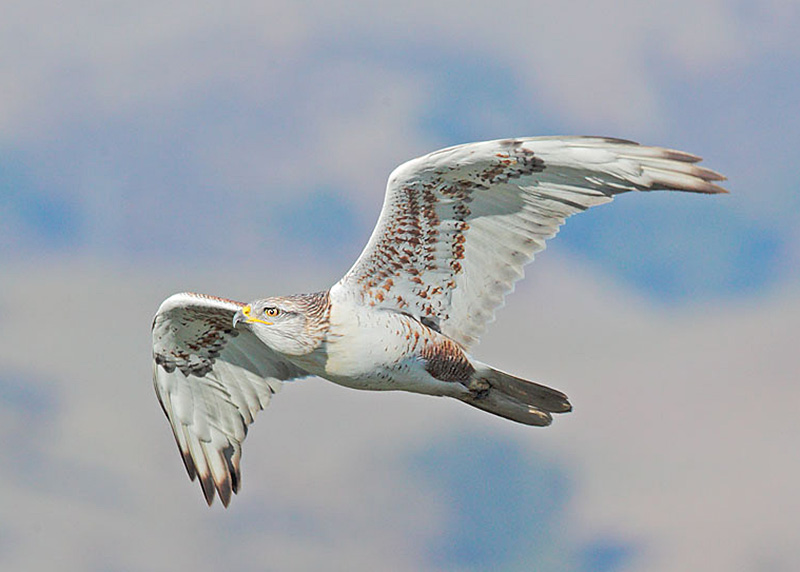
Ferruginous Hawk
Photograph © Tom Grey.
Scientific name: Buteo regalis
Speed: up to 150 miles per hour
Length & Weight: 23 inches, 2.3 pounds
Wingspan: 55 inches
Call: “reeaaaauh!”
The Ferruginous Hawk is a big hawk with a pale tail, long wings, and feathered legs. There are two color morphs.
Adults can be white below with red-brown on their wing linings and flanks. They also have reddish-brown legs and are reddish-brown and pale gray above. Dark morphs are dark brown with a pale tail and pale flight feathers.
Juveniles are paler below and lack reddish-brown colors.
In flight, it soars with wings held in a shallow “V.” Pale primary patches are also visible on the upper sides of each wing.
The Ferruginous Hawk preys on prairie dogs and other mammals but can also catch waterfowl. It waits on the ground, low perch, or flying low and then snatching prey with its talons.
Ferruginous Hawks live in Oklahoma year-round.
Key Identifications:
- Big pale or dark hawk with long wings and a pale tail.
- Preys on prairie dogs, other mammals, and waterfowl in wide open habitats.
- Builds a big and bulky stick nest in an isolated tree or other structure.
- Makes a hoarse, descending call, “reeaaaauh!”.
Rough-legged Hawk
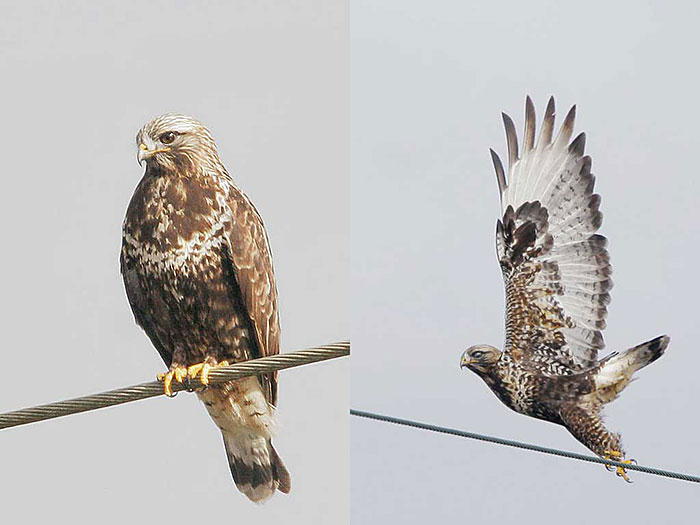
Photograph © Tom Grey
Scientific name: Buteo lagopus
Speed: 22-28 miles per hour
Length & Weight: 22 inches, 1.3 to 3.6 pounds
Wingspan: 53 inches
Call: “reeaaaauh!”
The Rough-legged Hawk is a long-winged hawk with a black and white tail. There are two color morphs; both with broad white patches near dark wing tips, and a longish pale tail with a broad black tip.
Pale females and juveniles are pale gray-brown with a black belly and black “wrists” in their wings. Pale adult males are more cold gray, have less black on their belly, and heavily streaked breasts.
Dark females and juveniles are dark brown except for their tail and flight feathers. Dark adult males are black except for their flight feathers and tail.
In flight, this species holds its wings in a shallow “V.”
Rough-legged Hawks soar and hover over open fields where they prey on voles and other small animals.
The Rough-legged Hawk breeds in tundra, but some birds winter in Oklahoma! You are most likely to see them from November to March.
Key Identifications:
- Big hawk with a longish black and white tail, and long wings with broad white patches near the dark wing tips.
- Preys on rodents and other small animals in wide open habitats.
- Builds a big, bulky nest on cliffs and rocky outcroppings in tundra.
- Makes a loud, clear descending call, “reeaaaauh!”.
Zone-tailed Hawk
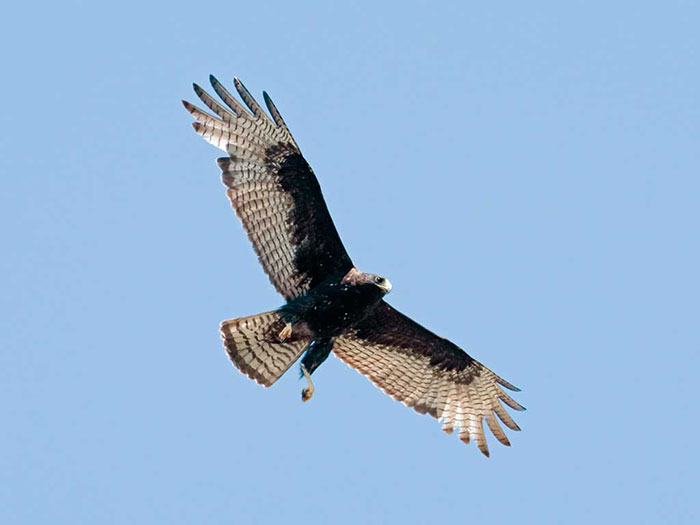
Scientific name: Buteo albonotatus
Speed: around 22 to 28 miles per hour
Length & Weight: 20 inches, 2 pounds
Wingspan: 50 inches
Call: “reeeeyah!”
The Zone-tailed Hawk is a medium to large, slender, black hawk with long wings and a longish, black and white tail. Both sexes are similar but females are larger. Their wings also have grayish, barred flight feathers and a dark trailing edge, and they have a black and yellow beak.
Young birds look like adults but have grayer flight feathers and fine black banding in their tail.
This raptor species soars on long wings held in a “V” shape and often flies with the similar Turkey Vulture.
Zone-tailed Hawks prey on small mammals, birds, and small reptiles. They forage by mimicking a Turkey Vulture so they can sneak up on and catch animals in vegetation and on the ground.
The Zone-tailed Hawk lives in shrubby and forested habitats, you can usually start seeing them in April.
Key Identifications:
- Black, slender raptor that flies like a Turkey Vulture and has long wings and a longish, black and white tail.
- Catches birds and other small animals on the ground and in the tops of bushes and trees.
- Builds a stick nest on a cliff or in a tall tree.
- Makes a long, drawn out, somewhat hoarse, “reeeeyah!”.
Harris’s Hawk
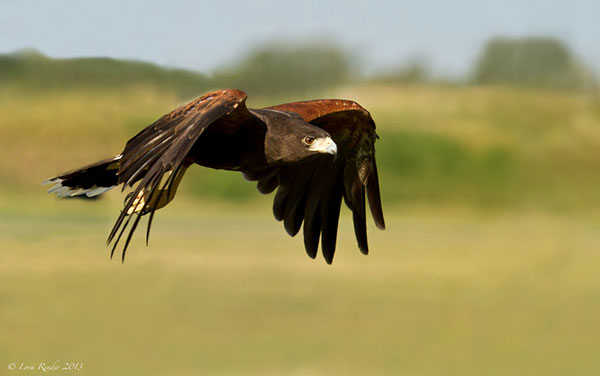
Scientific name: Parabuteo unicinctus
Speed: 22-28 miles per hour
Length & Weight: 20 inches, 1.5 pounds
Wingspan: 44 inches
Call: “kleeah, klee, klee, klee, klee”
The Harris’s Hawk is a large, dark brown and reddish-brown hawk with a long black and white tail, and much yellow on the base of its beak. Males and females look alike although females are larger.
This raptor species is dark brown with reddish-brown on its shoulders and thighs, has a white undertail, and a longish, black and white tail.
Young birds are like adults but have a paler tail, paler flight feathers, and dark streaks on their underparts.
This hawk soars and makes slow, deep flaps on fairly long, broad wings.
This species feeds on a variety of medium-sized mammals, reptiles, and birds. It catches them by swooping down from a perch or from low flight.
Harris’s Hawks live in the desert and subtropical habitats, but sometimes make their way over to Oklahoma.
Key Identifications:
- Large, dark brown and reddish-brown hawk with a long black and white tail.
- Preys on rabbits and other small animals and birds.
- Builds a bulky stick nest in a large cactus or other sturdy structure.
- Makes ringing, rather high-pitched calls, “kleeah, klee, klee, klee, klee”.
Common Black Hawk
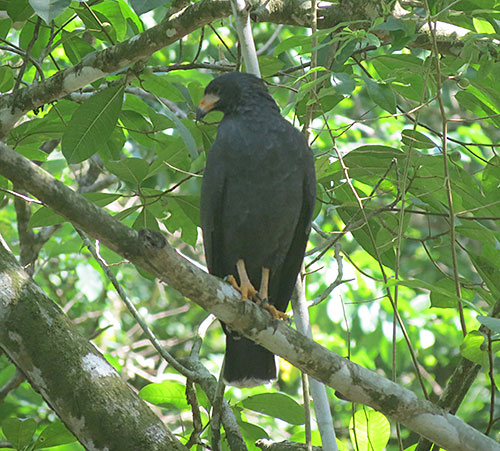
Scientific name: Buteogallus anthracinus
Speed: around 22 to 28 miles per hour
Length & Weight: 19 inches, 2.1 pounds
Wingspan: 50 inches
Call: “klick kee kee keep kickakip”
The Common Black Hawk is a bulky black hawk that has a short, broad tail with one wide white band and a narrow white tip. Males and females look similar but females are larger.
Young birds are dark brown above and have dark brown streaks on buff underparts. They also have a buff face with a dark line through each eye, a dark brown mark on each side of their throat, and a pale tail with fine black barring.
This bird soars on broad wings with a dark outline and a pale “crescent” on the base of the primaries. Young birds have a large pale patch near their wing tips.
This raptor catches fish, insects, and other small animals on the ground, in and near streams and other wetlands.
The Common Black Hawk lives in gallery forest in parts of Arizona and near lowland wetland habitats in Mexico, Central America, and northern South America, so it’s pretty rare in Oklahoma.
Key Identifications:
- Big, bulky black hawk with a short, broad, black and white tail.
- Preys on fish, crustaceans, insects, and many other small animals.
- Builds a bulky stick nest in a tree.
- Makes repeated, high-pitched whistled calls, “klick kee kee keep kickakip”.
Frequently Asked Questions
Are hawks common in Oklahoma?
Yes, hawks are common in Oklahoma. 14 species of hawks have been found in the state!
What is the biggest hawk in Oklahoma?
The biggest hawk in Oklahoma is the Ferruginous Hawk. This big hawk is 23 inches long and has a wingspan of 4.6 feet.
Do hawks stay in Oklahoma for winter?
Yes, several hawks stay in Oklahoma for winter.
Are hawks protected in Oklahoma?
Yes, hawks in Oklahoma are protected by the Migratory Bird Treaty Act.
What do Oklahoma hawks eat?
Oklahoma hawks eat a variety of small animals including rodents, rabbits, birds, and snakes.
More in Oklahoma: Most common birds | Owls | Woodpeckers | State bird