


I will always remember the first time I saw Harpy Eagles at close range. I was working in the Peruvian Amazon and was checking out a possible Harpy Eagle nest with other guides.
Upon reaching the site, the massive birds paid us no mind as they passed sticks to each other. It was mesmerizing, but the raptors were so big, I had this instinctive urge to put some distance between me and those birds!
One of their stand-out features is their fatal claws; but how dangerous are they exactly?
Powerful Grasping Mechanisms
If you take a closer look at the legs of eagles, namely their talons, they look pretty dangerous. If you let an eagle lock its talons into you, oh yeah, it would cause some serious damage. Fortunately, eagles don’t attack people, at least as long as you don’t climb to their nest!
To avoid serious injury, researchers studying the nests of Harpy Eagles and other eagle species use a Kevlar helmet and vest. Those precautions protect them from the eagle sinking its talons into you and clutching them.
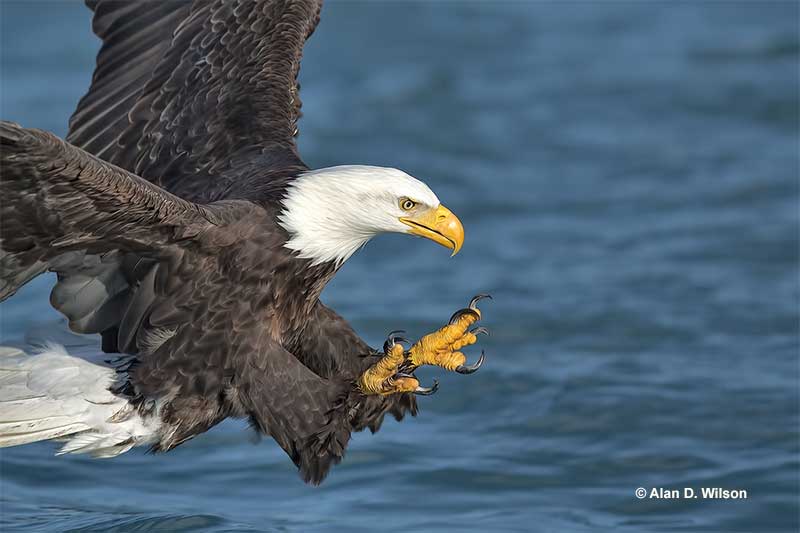
That grip strength can be ten times stronger than a person’s, and is what makes their talons especially dangerous.
Eagle grip strength varies by species but it’s always much more than the firmest handshake. For example, Bald Eagles have a grip strength of 400 psi, while the grip of Golden Eagles, Harpy Eagles, and other large eagles can be well over 500 psi!
That strong grip also helps them hold onto and carry prey in flight. Most eagles rarely carry animals that weigh more than half their own weight. However, on occasion, they can carry larger prey for short distances. Harpy Eagles routinely carry sloths and monkeys that weigh 13 pounds, and the similar Crowned Eagle of Africa also carries monkeys.
How Long Are Their Talons?
Eagle talons are long, slightly curved, and shaped somewhat like a sickle. However, instead of having a sharp edge, they have needled-like tips to penetrate the bodies of their prey. The longest talon is the one on the rear toe or “hallux”, and, on Bald Eagles, the second longest is the talon on the inner toe.
That long inner toe talon is an adaptation to help them catch fish. The talons of Bald Eagles and other fish-eating eagles are also more curved so they can get a better grip on their slippery prey.
Talon length varies among eagles but, they are pretty long! Bald Eagles usually have talons that measure 1.8 inches but some big females have reach 2.1 inch long talons.
Golden Eagles and several other eagle species have similarly-sized, long, sharp talons. However, the talons for two of the largest eagle species are exceptionally large.
To help the Philippine Eagle catch large squirrels, occasional monkeys, and other mammals, this large raptor has talons that can measure four inches long. Those are long and lethal talons but the biggest belong to the Harpy Eagle.
This rainforest raptor of southern Mexico, and Central and South America has big, thick, sickle-like talons that can be 3.4 to 5 inches long!
Hunting Techniques
Eagles have several hunting techniques. In general, the strategy they use depends on how open or forested the habitat is, and the type of prey they are targeting.
Hunting from a perch
This simple and effective strategy is one of the most common ways most eagles hunt. While waiting on a perch, the eagle watches for prey to show itself, often on the ground or in the water. When it spots a suitable animal, the eagle takes off and flies straight towards its prey, often flying near the ground or using vegetation to conceal its approach.
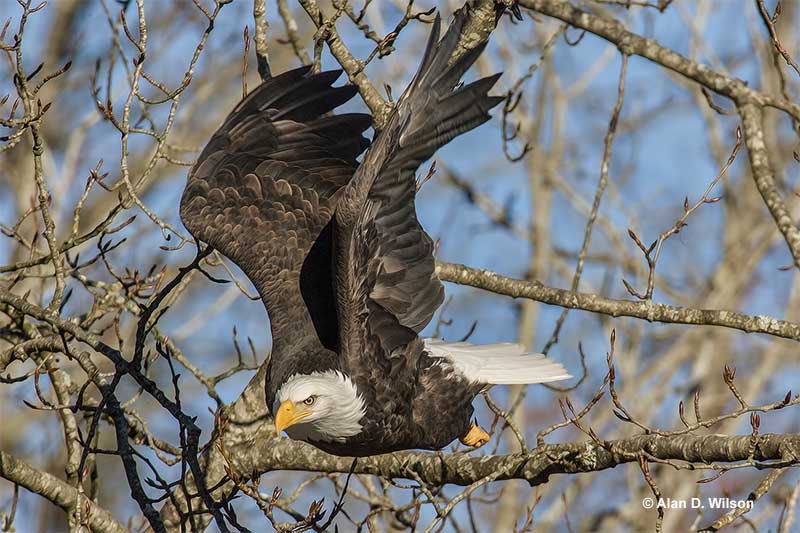
Upon reaching the animal, the eagle extends its long legs to hit and immediately clutch it with its talons. The powerful grip usually kills the animal right away and the eagle flies off with it shortly after.
Diving onto prey
Eagles can also soar high in the air and then dive down on an animal. While soaring, they watch for prey below. For some eagle species, this includes medium and large birds that they can catch in vegetation, on the ground, or even in flight.
The Black-and-white Hawk-Eagle hunts over rainforest in this manner. Their pale plumage helps them blend into the bright sky and helps them dive down and catch parrots, guans, Cattle Egrets, and other large birds by surprise!
After an eagle dives on its prey, it reaches out with its feet to grasp the animal with its talons. If it catches a large bird like a Canada Goose or crane, it might hold onto the bird while “riding” it to the ground.
Grabbing prey on the ground
Some eagle species can also simply walk on the ground and grab their prey! Golden Eagles and other eagle species in Asia use this method to hunt ground-squirrels and other, similar ground-dwelling rodents.
The hunting bird stands in or near a colony of rodents and waits to catch them by surprise. When it sees its chance, the bird uses its sharp talons to quickly catch and kill the small animal.
Attacking prey from behind
Some eagles use this method to kill large prey like monkeys, foxes, and even antelopes! If an eagle can catch an animal by surprise, it probably doesn’t matter too much if it attacks the animals from the front, above, or behind.
However, eagles are at an advantage if they can sneak up on good-sized prey from behind. That way, in addition to catching the animal by surprise, the eagle also can also use its talons to attack the animal in the best spot.
Powerful Crowned Eagles can use this strategy to catch large monkeys in Africa. After attaching from the rear, they use their long hind talon (hallux) to pierce the base of the primate’s skull. By killing the primate instantly, they also avoid being injured by their prey.
This species and Golden Eagles use a similar strategy with antelopes and other ungulates. They sneak in and sink their talons into the animal’s back.
Catching fish
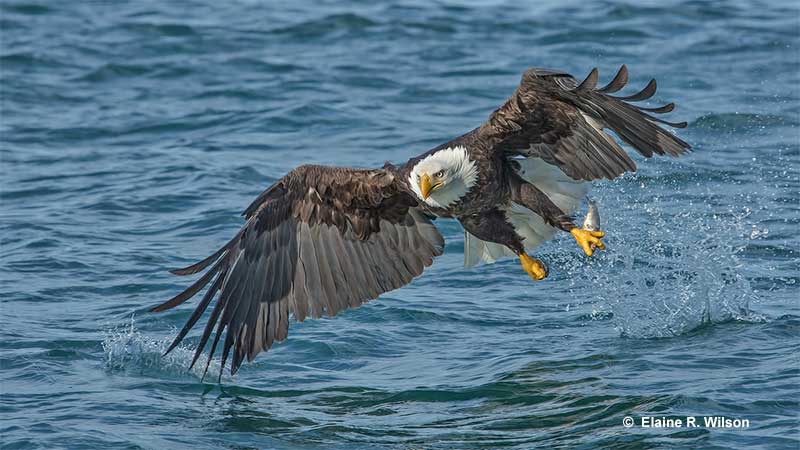
Bald Eagles and related fish-eating eagles in Africa, Asia, and Australia also use their talons to catch fish. They typically hunt by perching next to a river, lake, or other wetland and watching for fish to come to the surface.
After spotting prey, they glide down, extend their legs, and then quickly reach down to snatch the fish with their talons. With their feet tightly gripped on their prey, they fly away with their catch to eat it on a favorite perch.
Stealing prey from other birds
Bald Eagles and some other eagle species also steal or “pirate” prey from Ospreys, other raptors, and gulls. Upon seeing another bird with a fish or other tasty prey item, the eagle flies out and pursues the bird.
It tries to snag the fish with its talons or harasses the bird until it drops its catch.
Frequently Asked Questions
Why are eagle talons so strong?
Eagle talons are so strong because they have special tendons and muscles that give them a tight, strong grip. They need strong talons to help them catch, quickly kill, and hold onto the animals they prey on.
How strong is a Bald Eagles grip?
A Bald Eagle’s grip is as strong as 400 psi. This is ten times stronger than a person’s grip.
How much weight can eagles carry?
Eagles can carry more than half their body weight. They usually carry less than half of their body weight but, on rare occasions, eagles have been documented carrying animals that weight just as much as the eagle!