

Who doesn’t love owls? I know I do! Mysterious, unique, and tough to see, when I started birding as a kid, I was anxious to see my first owl. It took a while but the wait was worth it.
My first owl happened in a woodland punctuated with tall conifers, somewhere in upstate New York. While looking for birds, I noticed a suspicious dark brown lump about three-fourths of the way up a big White Pine.
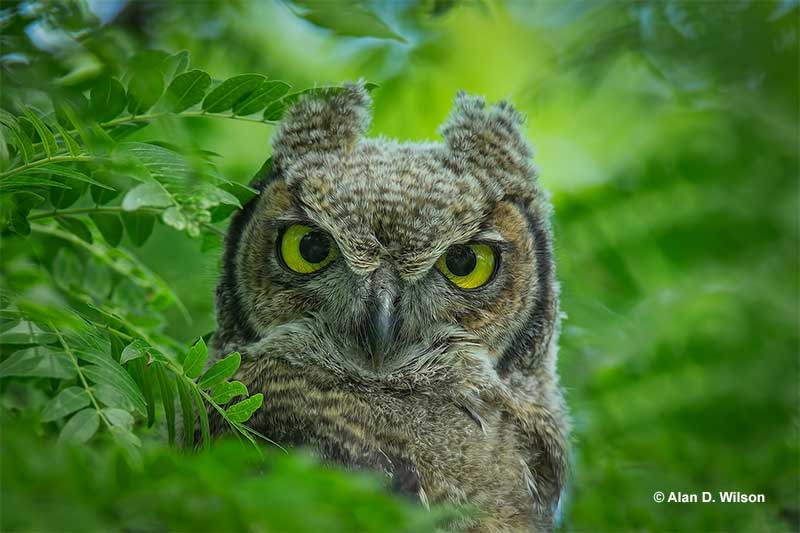
As I focused on it with my binoculars, the top part of “the lump” suddenly moved, and I found myself staring into the big yellow eyes of a Great Horned Owl! The bird looked incredible; I could even see its claw-like talons. However, they still weren’t as impressive as the bird’s mesmerizing eyes.
Owls have beautiful eyes but do they also have good eyesight? Can they see just as well during the day as in the night?
The Eyesight Of Owls
Many owls are nocturnal, but unlike bats, they have excellent eyesight. Although owls can have trouble with close objects, they can still see small animals pretty far away. Most of all, their night vision is fantastic.
We know that owls have excellent night vision because their eyes have a high density of rod cells and a reflective layer on their retina known as the “tapetum lucidum.” Rods and cones are the main photoreceptor cells in eyes with rods being sensitive to light.
While humans have 20 rods for every cone, owls have 30 rods per cone. That’s enough for some good night vision, but the tapetum lucidum really kicks it up a notch.
If you’ve ever seen how a cat’s eyes reflect bright green when you a shine a light on them in the dark, you have seen the effects of their tapetum lucidum.
This adaptation helps cats, owls, and other animals see much better in the dark by reflecting even more light onto their rod cells.
Not to mention, owl eyes are huge! They are quite a bit larger than those of most birds and actually have a tubular shape. These attributes help their eyes gather as much light as possible as well as notice the slightest movement.
Nocturnal And Diurnal Owls
The eyes of nocturnal and diurnal owls are pretty similar. Both have big, tubular eyes (2.2 times larger than other birds), have good night vision, and see movement very well.
However, more diurnal owl species like the Snowy Owl and the Short-eared Owl can probably see further in the day than the Barred Owl, Barn Owl, and other highly nocturnal owl. Studies have shown that Short-eared Owls may be able to see prey as far away as 3,000 feet!
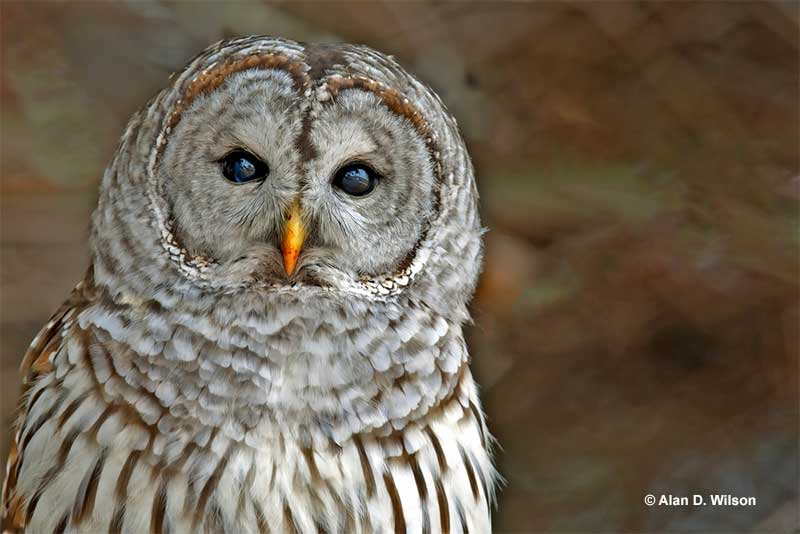
Diurnal and nocturnal owls see prey and other features in the same way. However, diurnal species might have higher concentrations of rods and cones in their eyes. On the other hand, nocturnal owls can see better in the dark. They probably have more rods and their dark eyes (instead of yellow ones) might also help.
Owls can also see well in the day, even nocturnal species in bright conditions. Like us, they limit the amount of light entering their eyes by diminishing the size of their pupils. Even so, I bet that Barn Owls and other highly nocturnal owl species much prefer dark places in the day.
At least it seems that way when I find them roosting in holes and other dark places.
Hunting And Eyesight
Owls are well known for using highly sensitive hearing to catch prey. All owls use hearing to hunt prey to some degree (especially Barn, Great Gray, and other nocturnal species), but their eyesight is important too.
Vision is even more important for diurnal owls such as pygmy-owls, Snowy Owls, Burrowing Owls, Northern Hawk-Owls, and Short-eared Owls. Although these owls are considered diurnal because they can hunt in the day, it’s worth mentioning that they can also be active at night.
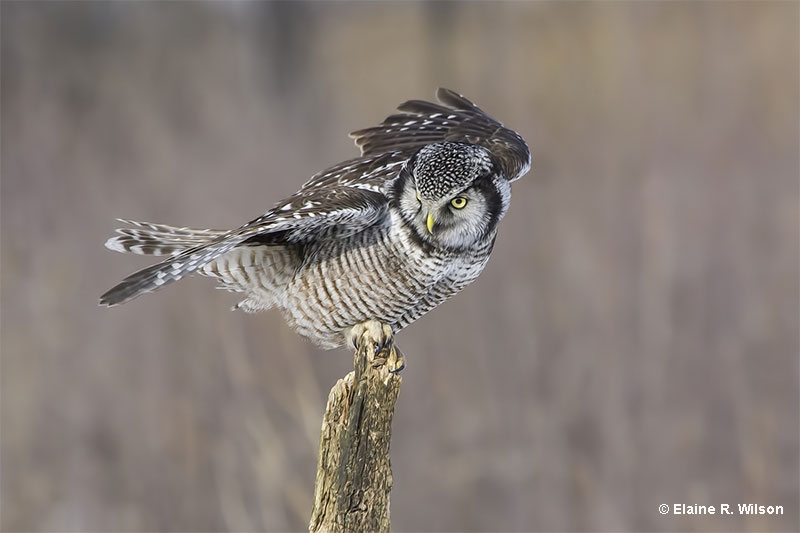
They hunt in daylight by watching for prey from a good perch (sometimes hidden). When the owl notices a mouse or small, unwary bird, it flies in to catch the animal with its talons. Short-eared Owls also watch and listen for rodents but they hunt while flying over open fields.
Barn Owls also hunt during flight over open habitats but they mostly locate rodents with their hearing. Even so, they also use their eyesight, especially on moonlit nights and even in the day. During the nesting season, Barn Owls can also hunt in daylight.
I have seen Barn Owls do this in Costa Rica on more than one occasion. With so much light available, I’m sure they were looking for rodents just as much as listening for them.
Field Of View
Field of view is another factor that helps owls catch prey. The field of view is how much area eyes can see. This includes the field of view your eyes focus on, and the peripheral field of view (what you see out of the “corner of your eye”).
Technically, we humans have a greater field of view than owls! Ironically, even though owls can see further, better at night, and detect movement much easier than we can, their eyes cover a smaller area.
However, having a limited field of view isn’t necessarily a disadvantage. For owls, it probably works in their favor by helping these raptors focus on their prey. Owls have such a focused field of view because they have forward-looking eyes that give them binocular vision, and they can’t move their eyes at all!

They need large eyes so they can have good night vision and excellent eyesight in general. The downside is lacking extra room in their skull to move their eyes around. Despite those immobile eyes, instead of being limited, owls increase their field of view by moving their head.
Their necks are so flexible, owls can move their head to look up 90 degrees, look down, and turn their head 270 degrees!
Read More: Smallest Owls in the World – How Are They Adapted?
Frequently Asked Questions
Do owls have good eyesight?
Yes, owls have quite good eyesight. They can see much better than people, especially in low-light conditions.
How far can owls see?
Some owls can see as far as 1,200 feet. Short-eared and Snowy Owls can see much further, potentially as far as 4,000 feet.
Can owls see during the day?
Yes, owls can see during the day.
Can owls see colors?
No, owls can’t see colors. Owls might only have eyes adapted to seeing gray, brown, white, and black.
Do owls have a third eyelid?
Just like cats, owls have a third eyelid. They have a nictating membrane that gives their eyes some extra protection from animals they prey on, vegetation, and dust.