

Hybrid animals have always sparked human curiosity. It’s easy to see this if you look at world mythology – the Sphinx, Chimera, and other creatures of imagination have deeply impacted our collective memory and global culture.
However, animal hybrids are not all myth – surprisingly, many animals can successfully breed with genetic relatives of different species and have healthy offspring. We might not know it, but bird hybrids are present all around us, both in wild and captive environments.
Since these unusual birds raise high interest in bird enthusiasts because of their rarity, peculiarity, and elusive nature, here’s an entire article dedicated to them.
The Baselines Of Crossbreeding
As Berkley’s definition states, “The biological species concept defines a species as members of populations that actually or potentially interbreed in nature, not according to similarity of appearance.”
Most of us know, ever since our school days, that an animal species is made up of genetically similar individuals able to create fertile, viable offspring by breeding other members of their species. Thus, in theory, only intraspecific breeding – within the same species – can do the job of passing the genes onto the next generations.
If only nature were that simple! Don’t get me wrong – the rule is mostly true. However, sometimes, two related species whose genetic makeup is similar enough can interbreed and have babies.
There are some special terms used for hybridization (which will probably make this piece a bit easier to read).
- Hybrid – An individual whose parents come from two different biological species.
- Hybridization – Mating and reproduction by members of biologically different species (same as crossbreeding and interbreeding).
- Crossbreeding – Breeding between members of two different species, breeds, or races.
- Interspecific – An occurrence between members of different species.
- Intraspecific – An occurrence between members of the same species.
- Interbreeding – See “Crossbreeding”. When used after the verb Can (e.g., “the two species can interbreed”), it usually means that the two species can create fertile offspring.
- Backcrossing or backbreeding – “Breeding in reverse,” an individual is reproducing with its ancestor species or breed.
- Viable offspring – Fertile offspring that can have babies of their own
- Sterile or infertile offspring – Offspring that cannot reproduce and pass on their genes.
What is a Bird Hybrid?
A bird hybrid is the offspring of two different bird species. The hybrid bird can show a mix of traits from the parent species, ranging from closely resembling either of the parents, showing a blend of characteristics from both, or (unusually) displaying new traits. Most often, the crossbreds display features of both species involved (meet-me-in-the-genetic-middle).
The common assumption (primarily based on best-known mammalian crossbreeding examples like the mule and the liger) is that the hybrid animal is infertile – but that’s not always the case.
In some cases, the hybrid offspring will be viable – able to have their own babies. It all depends on the combination of species. But what comes next? Because of their rarity, it is improbable for two hybrid birds to pair up and mate.
What usually happens is that the fertile hybrid will backcross to a partner belonging to either of the parental species, resulting in a new generation that looks mostly like the purebred parent’s species.
Most Common And Interesting Bird Hybrids
Here’s a short list of interesting avian crossbreedings.
The choice was tough because there are many, many more hybrids out there. If you’re interested in more, check out this slightly outdated but extensive bird hybrid list.
Ducks: Mallard x … 40 species (!)
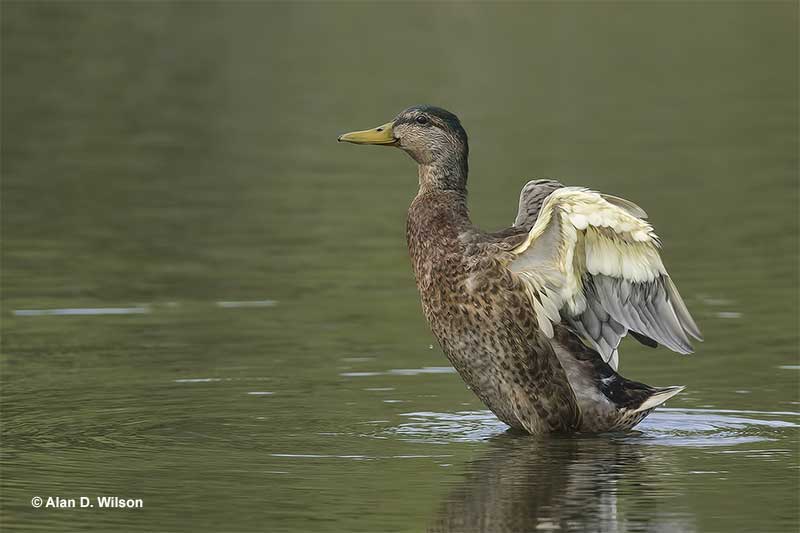
The Mallard is a bird with the most interbreeding on its (criminal?) record. This cosmopolitan species with a peculiar intimate life is known to crossbreed with at least 40 related waterfowl species! It is no wonder all domesticated duck breeds (except one) originate from the adventurous Mallard.
The most common Mallard interbreedings occur with related (same-genus) monochromatic species – where males and females have the same coloration. This includes the Black Duck, Mottled Duck, and the Spot-billed Duck.

Although these crosses are really common, and some result in fertile offspring, the Mallard genes don’t seem to have a strong influence on the said species’ populations.
Note that the crossbreeding doesn’t have to include a wild Mallard parent – any of the Mallard-based domestic duck breeds also counts as a carrier of Mallard genes.
On the other hand, Mallard will also mate with less related waterfowl. Remember I mentioned that there is only one species of domesticated duck whose origins have anything to do with the Mallard? That is the Muschovy duck (Cairina moschata). However, it still couldn’t completely escape the Mallard influence – because the two species can crossbreed to create the “Mule duck” or the “Mulard.” As the nickname suggests, the hybrid is sterile.
Parrots: Macaws
Macaws are one of the few bird groups that interbreed and produce viable, fertile offspring. Macaw hybridization can occur both in nature and in captivity, although the latter is more common because the pet trade is always hungry for unusual birds.
The 19 species of Macaws can all interbreed. Moreover, the hybrids themselves can produce up to 3 generations of mixed-origin offspring, and possibly more – but the sterility rates rise drastically after the third (F3) generation.

The two best-known macaw hybrids are the Catalina or Rainbow Macaw (Scarlet Macaw x Blue-and-yellow Macaw) and the Harlequin Macaw (Green-winged Macaw x Blue-and-yellow Macaw). Besides interesting color patterns, both hybrids are said to exhibit good temperaments and increased training abilities, although these qualities vary in each bird.
Still, hybridizing highly endangered macaws like the Spix’s Macaw (yes, it’s the parrot from Rio) is unethical because it can permanently spoil a sensitive species’s genetic uniqueness due to a small number of existing birds.
Hummingbirds: Pink-throated Brilliant x Rufous-webbed Brilliant
Recently, ornithologists were puzzled by their discovery of a hummingbird individual with a brilliant golden throat when, by all other species traits, it should have been bright pink.
At first, they thought they discovered a new species. However, the DNA sample held a surprise – it matched not one but two existing species – the Pink-throated Brilliant hummingbird and the Rufous-webbed Brilliant hummingbird.
It is one of those rare cases when a hybrid exhibits completely unique traits. You’ll also find such distinctive hybrid iridescence in our next crossbred bird.
Black Grouse x Capercaillie
In the wilderness of the Old World, the Black Grouse and the Eurasian Capercaillie can create a distinct hybrid called Rackelhahn in Northern Europe.
The viable parental combination includes a male Black Grouse and a female Capercaillie. The resulting hybrid males are fertile (although they likely have poor sperm quality), and females are considered sterile.
Daughters inherit a color pattern of the Black Grouse females, while sons are an unusual combo. They have bodies that are narrower than in Capercaillies and plumage features that are in between the two species. The tail feathers are shorter than the Black Grouse, but the offspring will still have the Dad’s characteristic white wing bars missing in Capercaillie.
Interestingly, Rackelhan has a unique purple iridescence on its neck and chest. Both parent species have green iridescence in the same spot.
Despite the mentioned low fertility, molecular studies of wild birds show that hybrids can backcross with one or both species, meaning they’re actually viable.
White Stork x Black Stork
Last year in Germany, the world’s first documented mixed Stork pair, consisting of a female Black Stork and a male White Stork, successfully raised the very first hybrid stork chicks on the record.
The two chicks that hatched had different color patterns. One of them had black stork features but with a lighter head and neck, while the other looked like a White Stork with dark streaks on the upper side of the body.
What’s unusual is that, despite being related, the two Stork species have very different ecologies (or lifestyles, if you want), resulting in some parental disagreements. For example, the mom Black Stork lined the nest with moss, but the dad White Stork removed it and used grass instead. Likewise, mom fed the chicks fish while dad brought mice and other small animals.
Currently, it is unknown what happened to this unusual family after fledging and migration.
Falcon Crossbreeding (Controversial)
Raptor hybrids occur naturally from time to time but are exceedingly rare. However, falconers have been hybridizing various raptor species in captivity for ages now. Thus, they are among the more common bird hybrids when you count in the captive bird population.
Gyrfalcon x Peregrine Falcon is probably the most favored raptor hybrid among falconers. It combines the Gyr’s agility and strength with the calmer temperament of a Peregrine, leading to excellent training and hunting results.
Still, the practice is controversial and is often deemed irresponsible by ornithologists. BirdLife first raised the issue of possible gene pollution by falcon hybrid escapees, which can happen if the hybrid is fertile.
On the other hand, the International Association for Falconry claims that no nesting attempts between hybrids and pure wild birds have been recorded in previous years.
FAQs
How often do birds crossbreed?
Bird hybrids are much more common than you think – but the exact rate is still uncertain. Between 10 and 20 percent of bird species can hybridize. The frequency of hybrids occurring in the wild is trickier to estimate.
A recent public data review analyzed the U.S. eBird data and concluded that there are only 0.064% of bird hybrids in their sample. Still, the team noted that the figure is likely an underestimate because bird hybrids are sometimes tough to recognize, especially by citizen scientists.
Can hybrids have offspring?
It depends on the hybrid, but some hybrid birds can definitely produce offspring. A generalized rule is that the more closely hybridizing two species are, the greater the chances of fertile offspring; also, the mixed species offspring is more likely to be fertile if the two species belong to the same genus.
Ducks from the genus Anas (and led by the infamously horny Mallard) can produce viable hybrids. Macaws, parakeets, and lorikeets can all viably crossbreed within their respective genera, a feature that the pet industry widely exploits. Thus, most crossbreeding happens in captivity.
Can crows and ravens crossbreed?
Biologically speaking, American crows and ravens can crossbreed. There have been documented cases of crows and ravens forming pairs and successfully raising young. Such babies are called “cravens”.
However, raven-crow hybridization is very rare. In most cases, crows and ravens do not form couples or even hang out together – in fact, they become grave competitors in nesting time.
However, there are bird keepers that purposefully create raven-crow hybrids in captivity. Like in the case of falcons (see above), this practice can be considered careless from the standpoint of safeguarding natural genetic traits and diversity.
Can parakeets breed with other birds?
Parrots are probably best known for producing viable hybrids. The list of parakeet hybrids is quite long, and most crossbreeding happens in captivity. The most common combination is the Ring-necked parakeets and the Alexandrine parakeets.
Breeders mostly resort to hybridization to induce new mutations, although the responsible ones stress that you should never try crossbreeding without a grounded purpose. Responsibility is especially critical because the hybrids aren’t always infertile and could influence the wild parakeet gene pool if they escape into nearby free populations.
Can a turkey and chicken crossbreed?
There are no living turkey-chicken crosses, and they cannot crossbreed naturally. Some hybridization experiments have shown that it’s possible to fertilize turkey hen eggs with male chicken sperm; only male embryos could develop, but up to a point – no eggs ever hatched.
Turkeys have nine chromosomes, and chickens have only six, so this is a possible genetic deal-breaker for the hybridization.
However, many people wrongly think an old chicken breed called Naked Neck or Turken is a chicken-turkey hybrid. The mutation that makes these chickens’ necks featherless has nothing to do with turkeys.
