

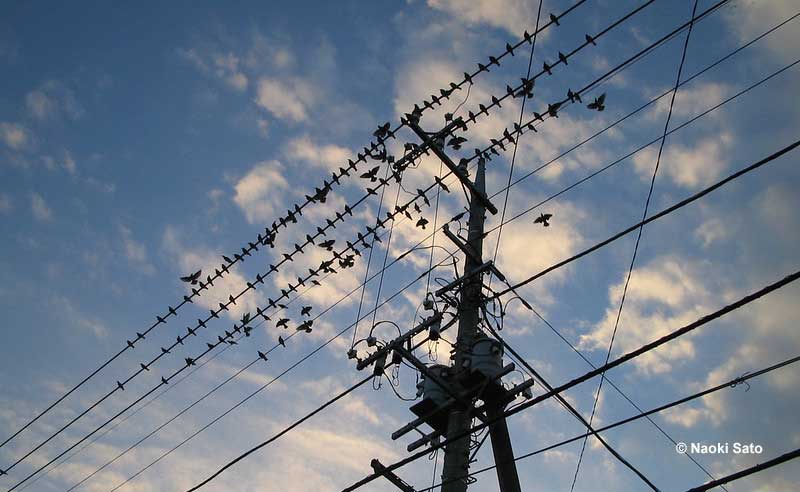
Birds don’t just sit on trees. As we all know, birds also love to perch on power lines!
Whether I go for a walk in my neighborhood or drive on country roads, I’m always surprised at the number of birds perched on power lines. Hawks, crows, kingbirds, rows of Barn Swallows, and even vultures!
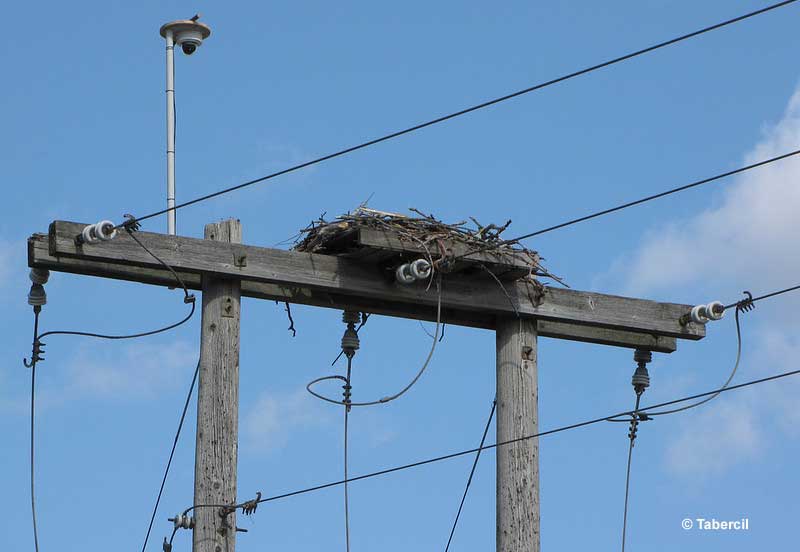
I’m surprised because I don’t know how they avoid being electrocuted. Some even nest on power line towers!
Why can birds perch on power lines? How do they avoid electrocution?
How Do Birds Not Get Electrocuted?
Power lines are dangerous! Electricity is vital for modern life, but everyone knows that you have to give power lines a wide berth. The “danger” signs remind us to keep our distance and with good reason. The high voltage required to power our televisions, appliances, and charge our phones is absolutely lethal.

We know to keep our distance, but birds obviously don’t, and maybe they don’t need to. I see lots of birds happily perched on deadly power lines all the time! So how do they do it? Do their feathers have special protection from electricity?
The truth is that when it comes to electricity, birds aren’t any more special than people. They can indeed die from high voltage, and many actually do get electrocuted!
However, the majority don’t, and that can be explained by how electricity works. Electricity flows from an area with a negative charge to an area with a positive charge.
Electrons are definitely flowing through the power lines that birds sit on but they automatically pick the easiest route. In this case, that would be a highly conductive copper wire connected to other conductive wires. By nature, electrons would rather stick to the copper wire than travel through the bird.
Are power lines insulated?
When we see a Red-tailed Hawk perched on a power line, it’s easy to jump to the conclusion that the line must be insulated. Of course, that has to be why the bird doesn’t get shocked. After all, doesn’t the line have a black coating that insulates it?
While that line of reasoning seems to make sense, there’s one big problem. It’s simply not true! Although power lines might seem insulated, nope, they aren’t insulated at all! Since it would be terribly expensive to insulate existing power lines, most power companies just don’t do it. Burying them works, but the ones that birds perch on aren’t insulated at all.
That means that, yes, just like the danger signs indicate, those birds are sitting on live wires. It also means that if you see a downed wire, even though it might have a black rubber coating and isn’t throwing off sparks, don’t touch it!
You can still get electrocuted because when you touch the wire, you automatically provide those electrons with a better circuit. They’ll immediately take it, and you’ll probably receive a lethal shock. The same thing happens to birds; read on to see why and how often this happens.
Can They Get Electrocuted?
Lots of birds perch on power lines, but they are certainly susceptible to being electrocuted. Perched birds avoid getting shocked because they are only touching one wire. However, if they do something that gives electricity an easier, more conductive circuit, the voltage will flow through the bird and electrocute it.
This happens if they are perched on a live wire and then touch another wire with a different voltage or a grounding wire.
When a bird stretches its wings and accidentally touches a second wire or a metal pole, it acts as a bridge for electrons. As electricity does, it flows through that easier route and ends up electrocuting the bird.
The degree of electrocution depends on how much voltage is flowing through the power line, and how long the current flows through the bird. It’s the same situation for other animals and people.
Since birds are usually electrocuted when their wings touch two wires or a wire and a pole, this usually happens to big birds rather than swallows and other small bird species. Raptors, storks, ravens, and other big birds tend to be affected more than smaller species.
These big birds can also be electrocuted when they nest on power line towers.
How many birds are killed by power lines yearly?
Cats, glass windows, pesticides, and habitat loss kills lots more birds than power lines. Even so, electrocution still kills far too many, especially large birds.
According to several studies, electrocution from power lines kill 0.9 to 11.6 million birds in the USA every year! A high percentage of those birds are eagles and other raptors. According to a study that looked at electrocuted raptors from 2000 to 2015, 80% were Bald and Golden Eagles.
These big birds are especially susceptible because they like to nest on power line towers. Stick in their big nests can easily touch two wires, or a wire and a metal pole, and their huge wings can do the same.
Although many birds die from electrocution, even more die after flying into thick power lines. The same studies that investigated bird electrocution found that 12 to 64 million birds are killed by collisions with power lines every year!
Read more: What kills the most birds?
Such collisions are a serious threat to several raptors and other large birds and are one of the main factors driving the Great Indian Bustard and Steppe Eagles to extinction.
Fortunately, we can make power lines more visible and thus reduce the risk by installing brightly colored mobile devices on them.
Frequently Asked Questions
Why do birds not get electrocuted when they sit on power lines?
Birds don’t get electrocuted when they sit on power lines because they aren’t as conductive for electricity as the wire itself. However, if they are perched on a wire and touch a second one, they can be electrocuted.
Can humans sit on power lines?
Technically, humans can sit on power lines. However, this is extremely dangerous because the moment you touch another wire, pole, or the ground, you’ll probably be electrocuted.
Do birds feel the electricity on power lines?
No, birds don’t feel the electricity on power lines. The electricity moves through the wire instead of moving through the bird.
How to stop birds from sitting on wires?
To stop birds from sitting on wires, install a decoy of an owl or other predator, or place reflective tape near them.
Read next: Bird Facts & Statistics