


Although the main hummingbird species in Virginia is the Ruby-throated Hummingbird, some interesting hummer species have made their way to Virginia over the years.
So, which ones can you see?
Common & Rarer Hummingbird Species in Virginia
In order to get the best overview of Virginia’s hummingbirds, we used eBird data. While it’s true that there is just one species that breeds in Virginia (Ruby-throated Hummingbird), there are some rare vagrants. When it comes to vagrants, Rufous Hummingbirds are the most common option. But let’s take a closer look at them!
Ruby-throated Hummingbird
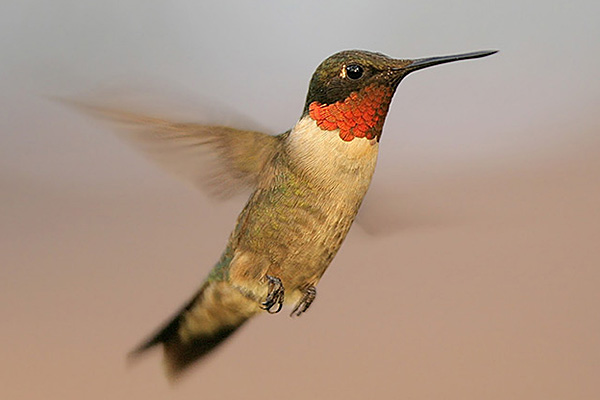
Photograph © Greg Lavaty.
Scientific name: Archilochus colubris
Length: 3.75 inches
Wingspan: 4.5 inches
The Ruby-throated Hummingbird is the common, small hummingbird of eastern North America. Although other, rare species can occasionally occur, at eastern feeders, this species is the de-facto hummingbird.
Males are green above, have some olive on their belly, a white chest and semi-collar, and a tiny white spot behind each eye. True to their name, they also have a beautiful, ruby-red throat. However, as with most hummingbirds, those colors only show in certain lighting.
They also have a dark, slightly forked tail, and a long, needle-like beak. Female Ruby-throated Hummingbirds look quite different from their male counterparts! They are also green above but have a grayish throat, and white tips on their tail.
Ruby-throated Hummingbirds are common in woods, second growth, and gardens near woods from central and southern Canada to Florida and Texas. Although they feed on their own, several can congregate at feeders, especially during migration! They also feed from a wide variety of small flowers.
Key identifications:
- Red throat and white semi-collar.
- Dark, slightly forked tail.
- Females have a white spot behind their eyes, a hint of a dusky mask, and the tail of perched birds is longer than their wingtips.
Rufous Hummingbird (rare)
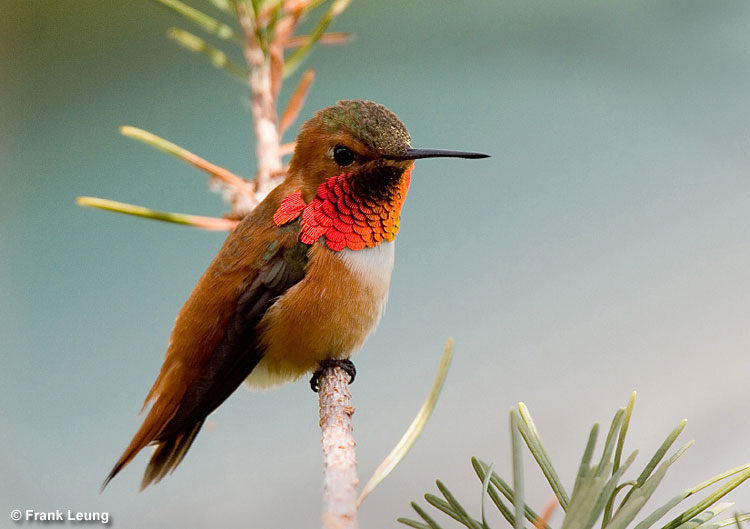
Scientific name: Selasphorus rufus
Length: 3.75 inches
Wingspan: 4.5 inches
Rufous Hummingbirds breed in the coniferous forests of the Pacific Northwest and then fly to central Mexico for the winter. Some even breed as far north as southern Alaska!
Males are pretty, pumpkin orange hummingbirds with white on the upper part of their chest, and an orange-red throat. Some males also have green on their back and crown.
Female Rufous Hummingbirds are green above and white below with pale rufous highlights on their underparts. They also have rufous on the base of their tail, and white tips on their outer tail feathers.
This species often visits feeders but they can also forage at any number of small tubular flowers. Although they are common birds from the Rocky Mountains west to California, several Rufous Hummingbirds also migrate to feeders in various parts of the eastern USA.
Happily, they have become regular at feeders and flowering bushes in coastal areas from Texas to Florida.
Key identifications:
- Pumpkin orange plumage, especially on the back and head.
- Orange-red throat.
- Rufous on the base of their tail and rump, and broad outer tail feathers.
Even Rarer Visitors
Anna’s Hummingbird
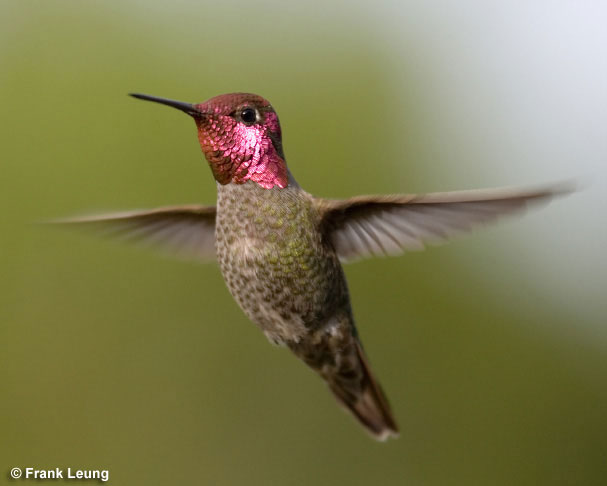
Scientific name: Calypte anna
Length: 4 inches
Wingspan: 5.25 inches
Anna’s Hummingbirds are one of the most common hummingbirds on the west coast. These little beauties live in parks, gardens, and similar habitats from British Columbia to northern Mexico.
Ornamental plantings and gardens have also helped this little bird expand to many parts of Arizona. Anna’s Hummingbirds are dusky green, have straight beaks, and a bit of white above their eyes.
Although females are fairly dull, male Anna’s Hummingbirds have shining fuchsia pink-red on their throat and head. This species is pretty common and easy to see in most of its range; however, they are pretty rare in Virginia.
Allen’s Hummingbird
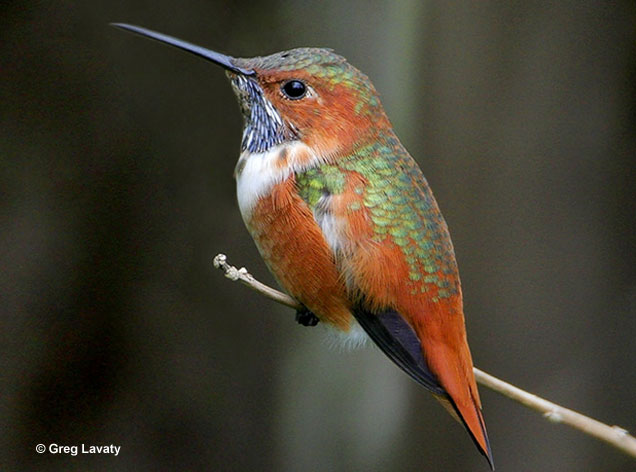
Scientific name: Selasphorus sasin
Length: 3.75 inches
Wingspan: 4.25 inches
The Allen’s Hummingbird is one of the key hummingbird species of California. Except for a small part of Oregon, this pretty little bird mostly breeds in coastal scrub in The Golden State.
In addition to their breeding range, we can recognize Allen’s Hummingbirds by their orange underparts and tail, and green upperparts. Males have a beautiful red-orange throat patch while females have bits of red-orange and green spotting on their throat.
Females also have orange on their rump and the base of their tail. Both sexes have a pale spot behind their eyes, white chest, and a slightly curved beak.
In their breeding range, Allen’s Hummingbirds are pretty easy to see, but not in Virginia. However, there have been some rare spottings over the years, so it’s not completely impossible!
Black-chinned Hummingbird
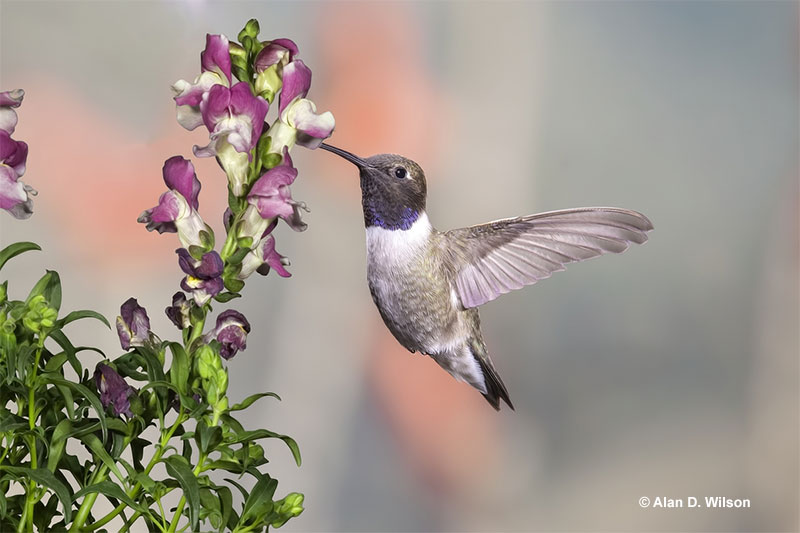
Scientific name: Archilocus alexandri
Length: 3.75 inches
Wingspan: 4.75 inches
Black-chinned Hummingbirds replace the Ruby-throated Hummingbird west of the Rocky Mountains and in parts of central and southern Texas. They are green above and dusky gray below with a white semi-collar and small pale spot behind their eyes.
Males have a beautiful dark purple throat with a black chin, and a black, slightly forked tail. Females have a dusky gray throat, grayish crown, hint of a dark mask, and a slightly forked tail with white tips on the outer tail feathers.
Black-chinned Hummingbirds usually breed in western areas, but once in a while, some of them mate their way to eastern states.
Buff-bellied Hummingbird
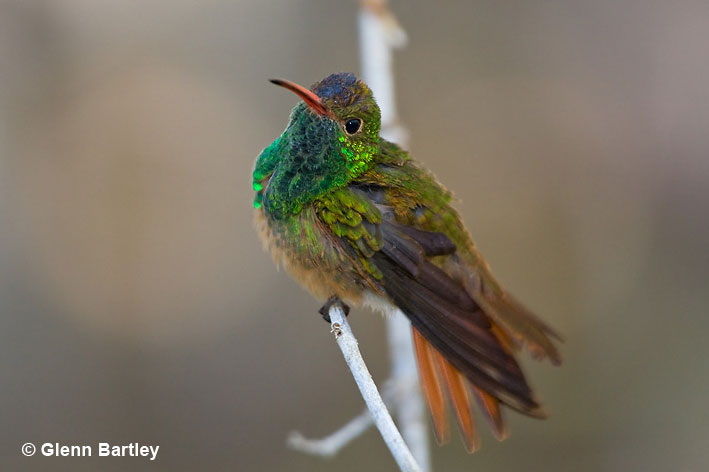
Scientific name: Amazilia yucatensis
Length: 4.25 inches
Wingspan: 5.75 inches
The Buff-bellied Hummingbird is a Mexican species that barely extends into the southern tip of Texas. It’s a common bird of subtropical woodlands and gardens, and also visits feeders. Their range has expanded to some parts of Florida, but they are extremely rare in northern areas.
Buff-bellied hummingbirds are medium-sized hummingbirds with green upperparts, a green head and throat, and a buff belly. Both sexes look pretty similar and also have red-brown tails, and a slightly curved red beak with a dark tip.
Calliope Hummingbird
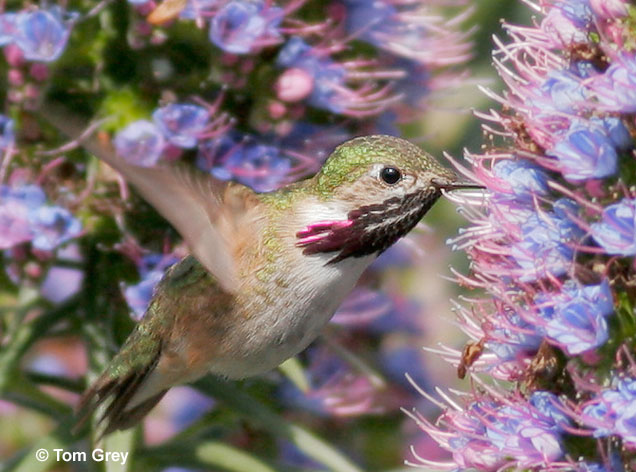
Scientific name: Selasphorus calliope
Length: 3.25 inches
Wingspan: 4.25 inches
Calliope Hummingbirds are the smallest birds in North America. These feathered sprites are green above, pale buffy or pale greenish below, and have a short, squared tail.
They also have shorter, straighter beaks than other hummingbirds and a pale mark behind each eye. Male Calliopes have rose-red streaks on their throats while females have fine, dark streaking.
Calliope Hummingbirds breed in open coniferous woodlands from British Columbia to Utah and parts of central California. During summer and migration to and from Mexico, we can see Calliope Hummingbirds at flowering bushes and feeders.
While they are pretty common in the west, they bless us with their presence in eastern areas from time to time.
Frequently Asked Questions
Do hummingbirds live in Virginia?
Yes, hummingbirds live in Virginia. Ten hummingbird species have been identified in the state. However, nine of those species are rare visitors.
What time of year are hummingbirds in Virginia?
Hummingbirds are mostly in Virginia during the summer months although some are also present in fall and winter.
How do you attract hummingbirds in Virginia?
You attract hummingbirds in Virginia by planting Bee Balm, Cardinal Flowers, Coral Bells, and other plants that have small, colorful, tubular flowers. You can also attract hummingbirds with nectar feeders.
Do hummingbirds stay in Virginia in winter?
Yes, some hummingbirds stay in Virginia in the winter. However, the majority migrate south for the winter.
What month do hummingbirds leave Virginia?
Hummingbirds leave Virginia in September and October.
More in Virginia: Most common birds | Hawks | Owls | Woodpeckers | State bird