

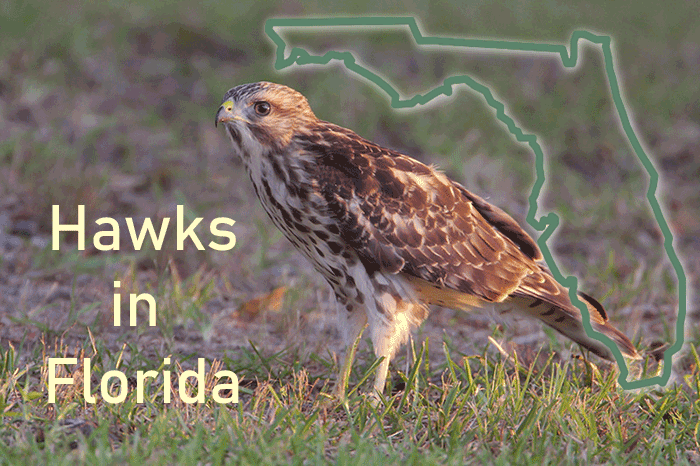
Florida provides diverse habitats for raptors, from pine forests and cypress swamps to coastal wetlands and open grasslands.
Among these birds of prey, hawks are some of the most frequently encountered and play an important role in controlling small animal populations.
The following eight species represent the hawks most often seen in the state, ranging from widespread residents to less common seasonal visitors.
Do you see hawks in your Florida backyard? Visiting Florida soon? Learn all about hawks of Florida in this article!
Most Common Hawks in Florida
According to eBird data in 2022-2023, these eight species of hawks in Florida were seen. Fortunately, most are common in Florida’s tropical habitats. Even so, anyone who has watched hawks knows that they aren’t the easiest of birds to identify!
Hawks can fly away quicker than you think, it can be tough to see colors and details when they soar high overhead, and most look kind of similar.
To cut through the confusion and help you recognize the hawks of Florida, we made a list with up-to-date information for each species.
Based on eBird sightings, we arranged the most common ones first and the least common ones last.
Red-Shouldered Hawk
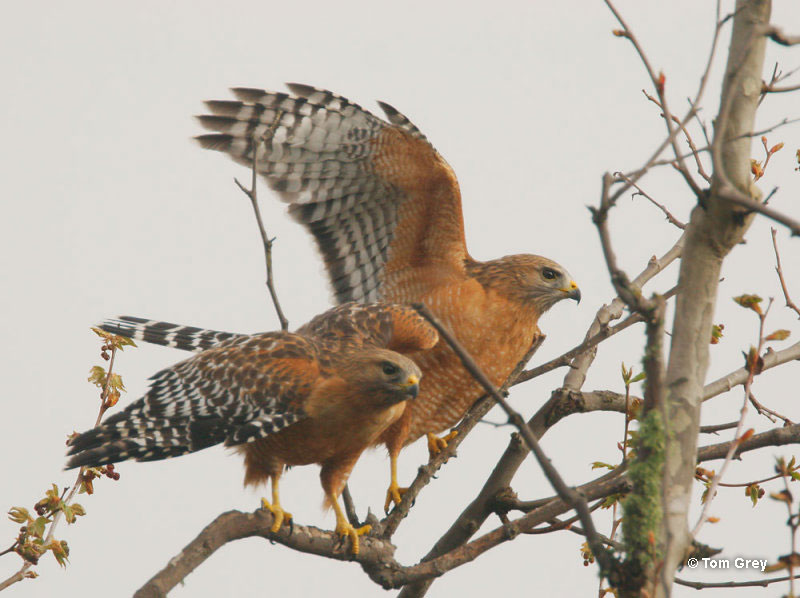
© Tom Grey
Scientific name: Buteo lineatus
Speed: 18-34 miles per hour
Length & Weight: 17 inches, 1.4 pounds
Wingspan: 40 inches
Call: “keer keer keer keer keer!”
The Red-shouldered Hawk is a year-round resident of Florida and is particularly associated with wooded habitats near rivers, wetlands, and swamps.
Adults are medium-sized, measuring 17–24 inches long with a wingspan of 37–43 inches, and weigh between 1–1.5 pounds.
Their reddish underparts, black-and-white banded tails, and piercing “kee-aah” calls make them distinctive.
This species typically hunts from low perches, dropping onto small mammals, reptiles, amphibians, and large insects.
Unlike some other buteos, it shows considerable agility in navigating wooded habitats. Nests are built high in mature trees, often reused across years, with clutches usually containing 2–4 eggs.
Florida populations are stable, aided by their tolerance of suburban landscapes with nearby wetlands.
- Medium-sized, colorful hawk with reddish-orange underparts and shoulder, and black and white upperparts and tail.
- Forages for snakes and other small animals on the ground in woodland habitats.
- Builds a bulky stick nest high in a tree.
- Makes loud, jay-like, ringing calls, “keer keer keer keer keer!”
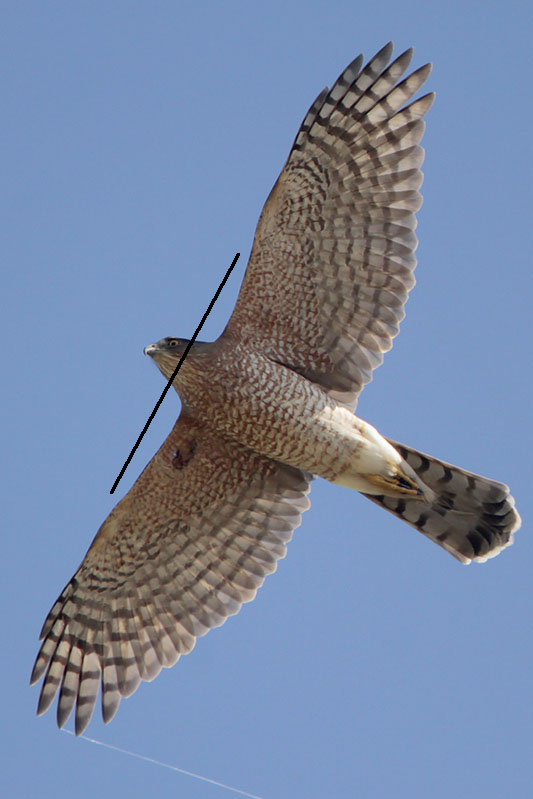
Cooper’s Hawk
Scientific name: Accipiter cooperii
Speed: 21-55 miles per hour
Length & Weight: 16.5 inches, 1 pound
Wingspan: 31 inches
Call: “kek kek kek kek kek!”
The Cooper’s Hawk is a medium-sized accipiter, adapted for hunting birds in dense forests and wooded suburban areas.
Adults range from 14–20 inches long, with wingspans of 24–36 inches. They are recognized by their long, rounded tails, short wings, and orange barring on the chest.
Their flight style, consisting of rapid wingbeats followed by short glides, allows them to maneuver quickly through trees in pursuit of prey.
Small- to medium-sized birds form the bulk of their diet, although squirrels and chipmunks are also taken.
Nests are built in tall trees, often reused, and clutch sizes average 3–5 eggs. In Florida, Cooper’s Hawks can be found year-round, but winter numbers increase with the arrival of northern migrants.
- Fair-sized hawk with orange barring below, blue gray above, and a long rounded tail.
- Preys on small mammals and starlings and dove-sized birds in woodlands, parks, and towns.
- Builds a bulky stick nest high in a tree.
- Usually quiet but when breeding, it makes a loud barking call, “kek kek kek kek kek!”
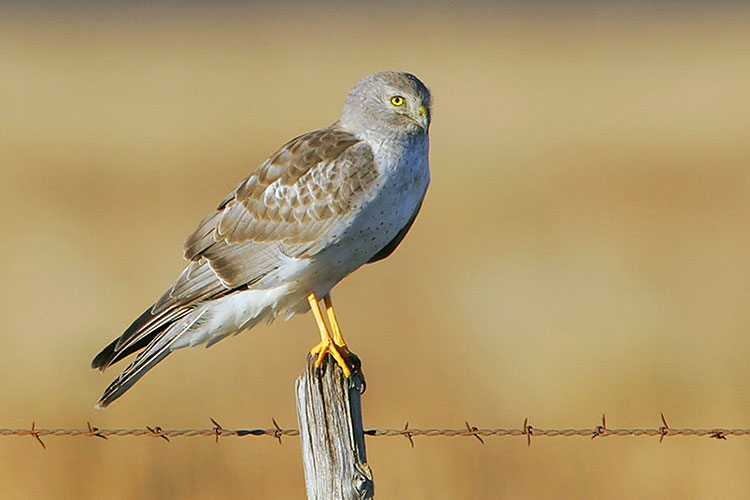
Northern Harrier
Scientific name: Circus hudsonius
Speed: 21-38 miles per hour
Length & Weight: 18 inches, 15 ounces
Wingspan: 43 inches
Call: “che che che che che che”
The Northern Harrier is a slender, long-winged hawk found in open grasslands, marshes, and agricultural fields.
Adults measure 18–20 inches long with wingspans of 40–46 inches. They are easily recognized by their low, gliding flight with wings held in a shallow “V” and their owl-like facial disks.
Unlike most hawks, Northern Harriers rely heavily on hearing as well as vision to detect prey, which consists of small mammals, birds, and amphibians.
In Florida, they are primarily winter visitors, though small numbers remain year-round in suitable habitats.
Nests are built on the ground in tall grasses or marsh vegetation, with clutches typically containing 4–5 eggs. Populations are influenced by wetland availability and are considered vulnerable to habitat loss.
- Distinctive long-winged, long-tailed hawk with a white rump.
- Glides low over the ground to catch rodents and other small animals in marshes and other open grassy habitats.
- Builds.
- Makes a repetitive, woodpecker-like call, “che che che che che che”
Red-Tailed Hawk
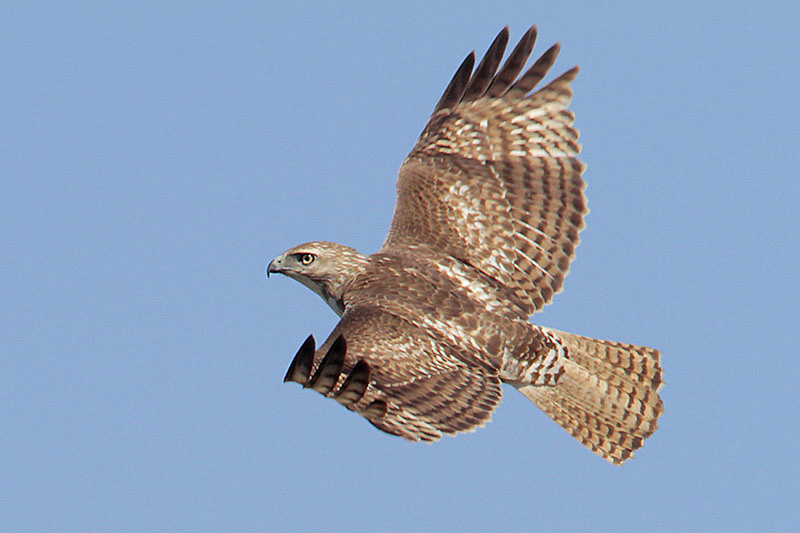
Red-Tailed hawk (Juvenile) © Greg Lavaty.
Scientific name: Buteo jamaicensis
Speed: 20-40 miles per hour
Length & Weight: 19 inches, 2.4 pounds
Wingspan: 49 inches
Call: “keeeyah!”
The Red-tailed Hawk is one of North America’s most familiar raptors and can be found throughout Florida.
Adults measure 18–26 inches in length, with a wingspan of 45–52 inches, and weigh 1.5–3.5 pounds. Their broad, rounded wings and brick-red tail (in adults) are key identification features.
This species prefers open country, fields, and roadside habitats, where it can be seen soaring on thermals or perched on utility poles.
Diets are dominated by rodents, but rabbits, snakes, and birds are also taken. Red-tailed Hawks nest on tall trees, cliffs, or human structures, laying 1–3 eggs per season.
In Florida, they are permanent residents, though northern populations may migrate south in winter, slightly increasing numbers in the state.
- Large, hefty hawk with a reddish tail and dark marks on its pale belly.
- Preys on small mammals, snakes, and birds.
- Builds a bulky stick nest high in a tree.
- Makes loud, jay-like, ringing calls, “keeeyah!”.
Short-Tailed Hawk
Scientific name: Buteo brachyurus
Speed: 20-40 miles per hour
Length & Weight: 16 inches, 15 ounces
Wingspan: 37 inches
Call: “reeeeeee!”
The Short-tailed Hawk is one of Florida’s more unusual raptors, as the species is rarely seen in most of North America.
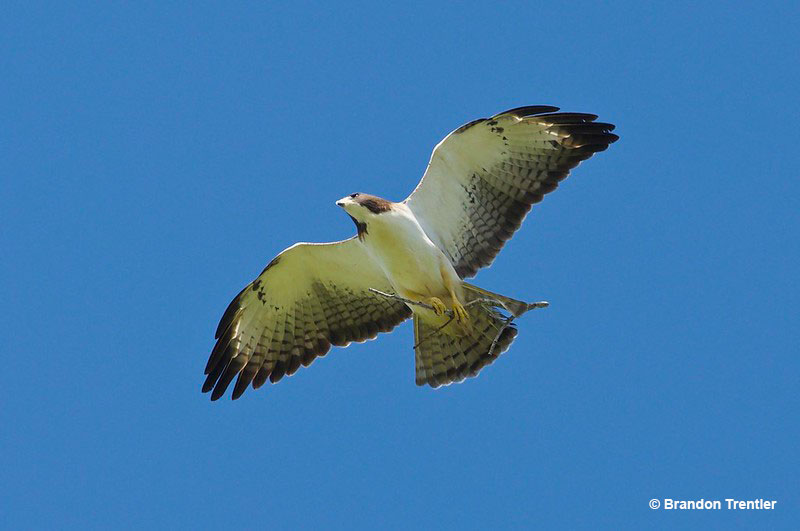
Adults are 15–17 inches long, with wingspans of 32–40 inches. Two color morphs exist: a light form with dark wings contrasting against a pale underside, and a dark form that appears almost entirely black.
This hawk specializes in hunting small birds, which it often captures by soaring high and then diving swiftly.
Its range in the U.S. is largely restricted to Florida, particularly the southern part of the peninsula, where it inhabits forests, swamps, and hammocks.
Nests are typically built high in trees, with 1–3 eggs laid per season. Because of its limited U.S. distribution, it is a sought-after species for birdwatchers.
Key Identifications:
- Small soaring hawk that is dark above and pale below or mostly black.
- Preys on small birds, lizards, and other small animals in various subtropical habitats of Florida.
- Builds a bulky stick next high in a tree.
- Makes a drawn out clear call, “reeeeeee!”, usually while soaring high overhead.
Sharp-Shinned Hawk
Scientific name: Accipiter striatus
Speed: 16-60 miles per hour
Length & Weight: 11 inches, 5 ounces
Wingspan: 23 inches
Call: “kew kew kew kew kew kew kew kew”
Smaller and less common than the Cooper’s Hawk, the Sharp-shinned Hawk is most often observed in Florida during migration and winter.
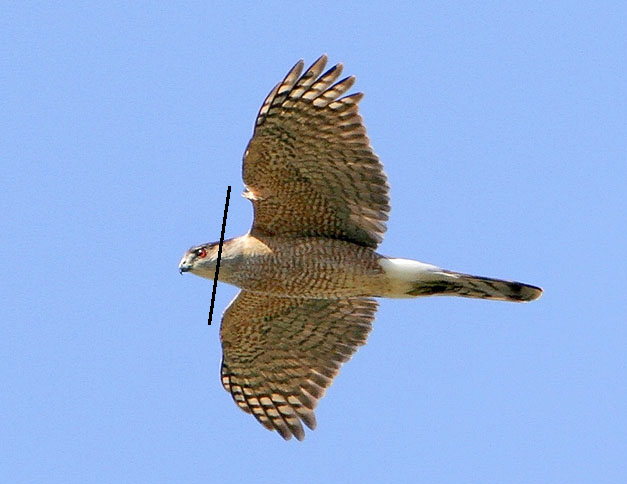
Adults are 9–13 inches long with wingspans of 16–22 inches, making them the smallest hawk species in North America.
These raptors specialize in hunting small songbirds, ambushing them with sudden bursts of speed.
They are difficult to distinguish from Cooper’s Hawks, though they tend to have thinner legs, squared tails, and smaller overall size.
Breeding occurs further north, but winter migrants are regularly spotted in Florida, particularly around backyard feeders where they prey on congregating birds.
Broad-winged Hawk
Scientific name: Buteo platypterus
Speed: 20-40 miles per hour
Length & Weight: 15 inches, 14 ounces
Wingspan: 34 inches
Call: “sipeeeeeeeee”
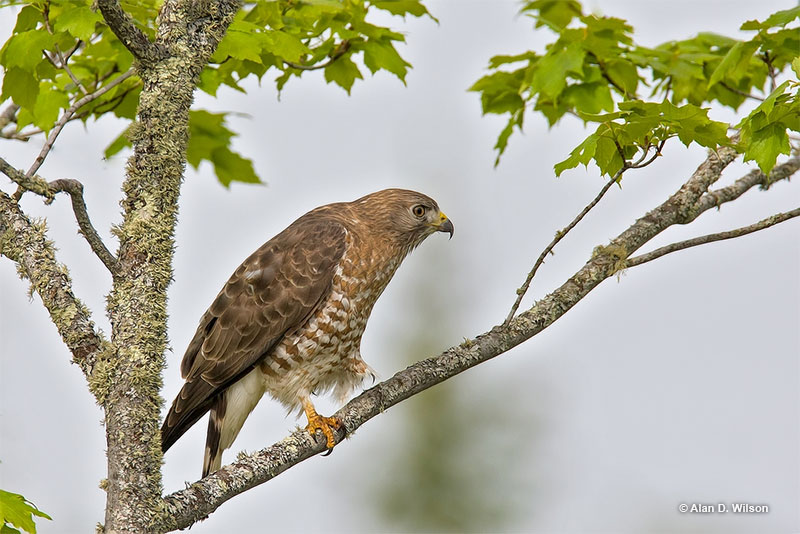
The Broad-winged Hawk is a small buteo, measuring 13–17 inches long with wingspans of 29–39 inches.
In Florida, it is mostly a migratory species, passing through in large numbers during fall migration. During these migrations, thousands may be seen soaring in “kettles” along ridgelines and coastal areas.
They prefer forested habitats during the breeding season, though nesting is more common in the northern U.S. and Canada than in Florida.
Their diet includes small mammals, amphibians, and insects. Nests are typically constructed in trees, with 2–3 eggs laid.
While only a few remain to breed in northern Florida, migration periods offer excellent opportunities to observe this species in large concentrations.
- Chunky, smallish, crow-sized hawk with a few white bands on its tail and underparts with brown barring or streaks.
- Preys on insects and small animals in woodland habitats.
- Builds a bulky nest high in a tree.
- Makes a high-pitched call, “sipeeeeeeeee”
Swainson’s Hawk (Very Rare)
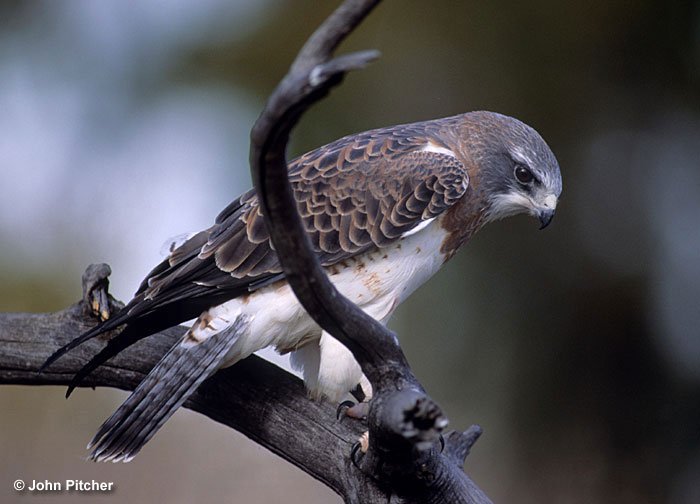
Scientific name: Buteo swainsoni
Speed: 15-60 miles per hour
Length & Weight: 19 inches, 1.9 pounds
Wingspan: 51 inches
Call: “eeeah!”
The Swainson’s Hawk is a rare visitor to Florida, most often seen during migration. Adults measure 18–22 inches long with wingspans of 46–54 inches.
They resemble Red-tailed Hawks but are slimmer, with longer wings and lighter underparts.
Their diet varies by season: during breeding in the western U.S. and Canada, they primarily hunt small mammals, but on migration and in wintering grounds, insects such as grasshoppers and dragonflies form the bulk of their food.
In Florida, they are most often observed in open fields and agricultural areas. Breeding does not occur in the state, but rare sightings during spring and fall migrations make this species notable for dedicated birdwatchers.
- Large, long-winged hawk with dark flight feathers and a broad tail with fine dark banding and a dark tip.
- Feeds on insects and small animals in prairies and other open habitats.
- Builds a bulky stick nest in a tree.
- Makes a loud, descending, single note, “eeeah!”.
How To Identify Hawks?
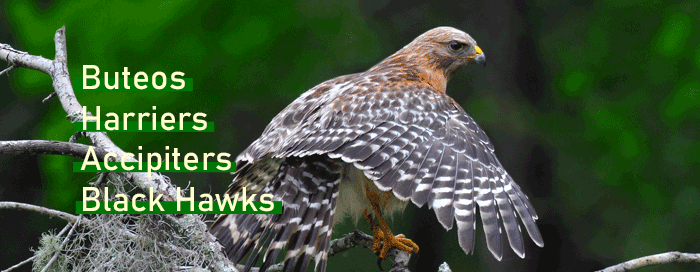
Hawks are easy to see but can be tough to identify! Don’t give up! With practice and knowing what to look for, recognizing hawks becomes easier than you think.
The first step is knowing how to recognize the four main groups of hawks. In flight, each of these types of hawks has a certain shape and way of flying. They are:
- Buteos and Buteo-like Hawks – Long, broad wings and a broad tail.
- Accipiters – Shorter, rounded wings and a long tail. They fly with quick flaps followed by brief glides.
- Harriers – Long wings, a long tail, and a white rump. They glide near the ground with their wings held in a “V”.
- Black-Hawks – Chunky, dark, tropical hawks with broad wings and a short, broad tail.
After we categorize a raptor in one of these groups, we can focus on other details like:
- The pattern on the tail and underparts.
- More details about its shape.
- The pattern in the wings.
- The habitat and location of the bird.
For example, if we see a hawk with a long tail and rounded wings, we know it’s an Accipiter. If it has a rounded tail, orange underparts, and blocky-head, we can call it a Cooper’s Hawk.
FAQ
How many hawk species can be spotted in Florida?
8 hawk species can be spotted in Florida. Including rare vagrants, 12 hawk species have been seen in Florida.
Are hawks protected in Florida?
Yes, all hawks are protected in Florida. They are protected by Florida state law and the Federal Migratory Bird Treaty Act.
What is the largest hawk in Florida?
The Red-tailed Hawk is the largest hawk in Florida. This big raptor can have a wingspan of 49 inches and weigh 2.4 pounds.
Discover more Florida (based on data): Common Birds | Owls | Woodpeckers | Ducks | Hummingbirds
Kristin Chapman
Tuesday 11th of June 2024
We live in Central Florida and there is a large bird with dark head, body, and wings with a white chest and belly. It has a very big wing span and we usually see it sitting in a florida pine next to a huge old oak tree at night. We live at least 60 miles from the ocean but do have many lakes around....Any ideas what it could be??
Kate Zon
Friday 28th of November 2025
@Patrick O'Donnell, Might I suggest she look at photos of ospreys? Ours look like roughnecks, but have a sweet little chirp.
Patrick O'Donnell
Tuesday 11th of June 2024
@Kristin- Sounds like an interesting bird! It's hard to say what that might be. If you can get a picture, please share it with us!