

Eagles are big and majestic birds of prey and sighting them often evokes respect and awe. But even those formidable hunters have to start small.
So, today we are looking at the nesting habits of eagles native to North America, namely the Bald Eagle and the Golden Eagle.
Where Do Eagles Nest?
Eagles typically build their nests in high, secluded places that provide a good vantage point and are relatively free from human disturbance. The specific locations can vary depending on the species of eagle and the geographical region.
Both eagle species breed in northern North America, but while Bald Eagles are resident across almost the rest of the continent, then Golden Eagles are limited to the western United States.
The latter prefers to live in open to semi-open areas near mountains, cliffs, and hills, such as grasslands, chaparral, and shrublands, but they avoid heavily forested areas.
Bald Eagles’ habitat selection, on the other hand, is largely influenced by the availability of prey, tall trees, and proximity to large bodies of open water. They are commonly found near lakes, rivers, and coastal regions where old-growth trees provide suitable nesting sites.

When it comes to specific nesting sites, then their choices are fairly similar. Golden Eagles typically build their nests on cliffs or steep slopes, taking advantage of the natural protection these locations offer. In some cases, they may nest in large trees or even on the ground if suitable cliffs are not available.
Bald Eagles, on the other hand, prefer to build their nests in the canopy of tall, mature coniferous trees. These nests are usually located near water sources, allowing easy access to their primary food source—fish.
In the southern parts of their range, they may also nest in mangroves. In some cases, particularly in areas with limited natural nesting sites, Bald Eagles may use artificial structures such as phone towers, electrical poles, or specially designed nesting platforms.
While some eagles may tolerate moderate levels of human activity if they are accustomed to it, they generally avoid areas with high levels of disturbance or frequent human presence during the nesting season. Both species opt for more secluded areas. Their tolerance of humans and human activity is largely dependent on their experience with human presence.
Nest materials and construction
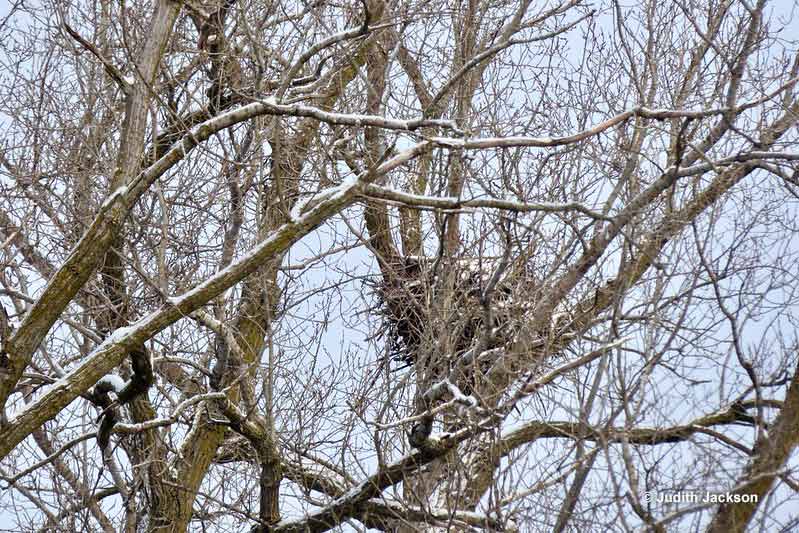
Golden Eagles and Bald Eagles construct impressively huge and bulky nests. They begin building them about one to three months before egg-laying, with both males and females contributing to the process, although the female typically does most of the actual construction. The nest appearance varies slightly depending on where it is built and can be a large platform or also a more conical construct.
Bald Eagles’ nests are between 5 to 6 feet in diameter and 2 to 4 feet tall on average.
The eagles build them using sticks and vegetation and line them with finer materials like moss, grass, lichen, and feathers for comfort. They usually choose tall, mature trees near water sources and often reuse and add to their nests each year, resulting in massive structures.
Golden Eagles create bulky platforms of similar dimensions, often 5 to 6 feet wide and 2 to 3 feet tall. They use sticks and vegetation, sometimes incorporating bones, antlers, and human-made objects like wire. The interior is lined with softer vegetation, including aromatic leaves that may deter insects. They often re-use the nests for several years.
Nesting Habits
Golden Eagles and Bald Eagles share a lot of nesting habits but also have several differences.
Both species produce one brood per year, show strong pair bonds, and may mate for life. They lay 1-3 eggs per clutch, but Bald Eagle eggs are white and unmarked, while Golden Eagle eggs are white to cream or pale pink with small brown blotches.
Related: How similar are Bald and Golden Eagles?
Bald Eagles incubate their eggs for 34-36 days, whereas Golden Eagles have a longer incubation period of 41-45 days. In both species, both parents share incubation duties, though the female takes a more active role.
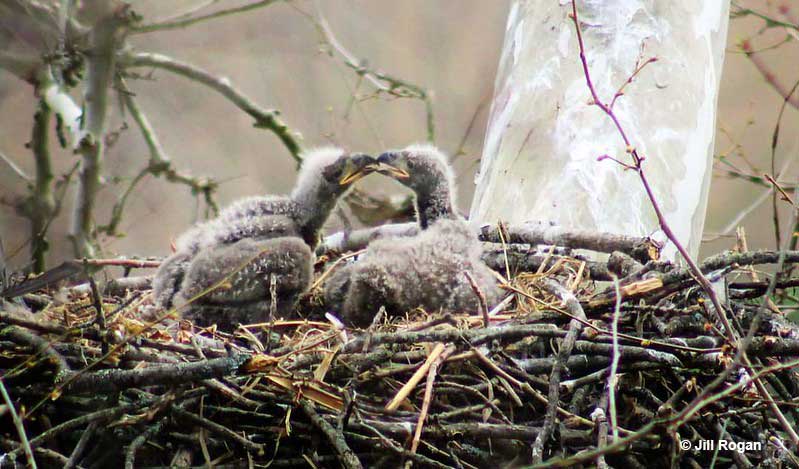
Chicks of both species hatch with light grayish down and are cared for by both parents. Initially, females stay with the young while the male does most of the hunting.
As the chicks grow, the female leaves the nest more often to bring more food. The parents start dropping food in the nest and let their offspring peck at it on their own, whereas in the beginning, the mother bird ripped up the prey and fed it to the young.
They grow and acquire new skills at about the same rate. Bald Eagle nestlings remain in the nest for about 11-13 weeks and begin flying at around the same time.
Young eagles become independent at about 18 weeks of age at the latest. Golden Eagle nestlings stay in the nest for about the same time as the Bald Eagle nestlings, but they may take a bit more time to reach full independence. Both species reach their breeding age at around the 4-5 year mark, along with acquiring their adult plumage, although Golden Eagles might take some more time.
Largest Nests And Other Fun Facts
- Eagle nests are commonly referred to as eyries and young eagles are called eaglets.
- The largest Golden Eagle nest on record weighed hundreds of pounds and measured 20 feet tall and 8.5 feet wide.
- Bald Eagles build the largest nests of any North American bird species. The largest nest on record also belongs to the Bald Eagle. It was found in Florida, estimated to weigh around 6,000 pounds, and measured 20 feet deep and 9.5 feet wide.
- Eagle eggs hatch a few days apart. That generally means that the oldest of them is larger and stronger. Newly hatched eagle nestlings can be very aggressive towards each other, especially if food is scarce, in which case the youngest usually starve or gets killed.
- Bald Eagle and Golden Eagles go through 4 distinct plumage molts before reaching the adult or definitive plumage at around 4-5 years of age.
See more: 15 facts about Bald Eagles everyone should know
Frequently Asked Questions
What is an eagle’s nest called?
An eagle’s nest is called an eyrie.
How does an eagle build its nest?
Eagles build their nests on cliffs or near the top of a large tree by weaving together large sticks and small branches to create the foundation and then line it with softer and finer materials like moss, grass, and feathers.
Do eagles build nests close to each other?
Eagles maintain territories and defend it from intrusions by other eagles. However, they may tolerate nests of other eagle pairs at certain distances. Some nests have been documented within as close as 700-800 feet of each other, but they generally stay a few miles away from each other.
Do eagles clean their nests?
Eagles try to cover up the mess rather than clean their nests by adding fresh materials.
Do eagles only lay eggs once a year?
Eagles generally lay eggs only once a year.
Do eagles come back to their nests?
Eagles often re-use their nests or may alternate between two or more nests between seasons.
