

Parrots are some of the most colorful birds on the planet. Plumaged in brilliant red, yellow, blue, and green, parrots are a feast for the senses!
Most parrot species have bright colors, but there are a few exceptions. One of those special “non-conformist” parrots is a bird that bucks the trend with dark plumage and a gothic look. Officially known as “Pesquet’s Parrot”, this unique bird also goes by another name: the “Dracula Parrot”!
What are Dracula Parrots, and how did they get that name? Do they really drink blood?
Pesquet’s Parrots a.k.a Dracula Parrots
Pesquet’s Parrots don’t look like other parrots. If anything, they resemble a scavenger or some odd, dark raptor! They could also be passed off as a Corvid, but despite their appearance and large size, these “Blood Ravens” are indeed members of the Old World Parrot family.
This means that, despite their Gothic looks, Pesquet’s Parrots are related to cute and colorful birds like Budgerigars and Ring-necked Parakeets. They just look radically different.

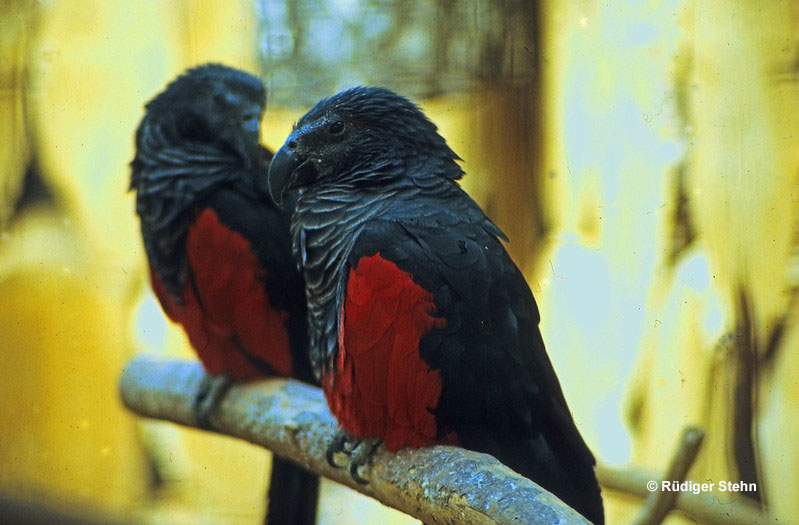
Pesquet’s Parrots are black with crimson on their wings and underparts. They also have scale-like chest feathers with gray edging, and a naked, dark face. These features and the bird’s longish, sharply hooked beak make it look a lot like a vulture.
In fact, Pesquet’s Parrot would probably be called “Vulturine Parrot” if another bird species didn’t already have that name! However, there was another, much more sinister-sounding name in store for this special bird.
Based on its appearance, this species is commonly known as the Dracula Parrot. Although they are happy to fly in the light of day, and are NOT nocturnal, this evocative name is still a good fit. Pesquet’s Parrots seem permanently dressed for Halloween, their sharp beaks are intimidating, and it looks like someone dipped the bird in blood.
Do They Drink Blood?
Pesquet’s Parrots might also be known as the Dracula Bird, but they don’t share the count’s taste for blood. Despite having a sharp, hooked beak and being as large as some hawks and owls, Dracula Parrots don’t even eat flesh.
The only thing these birds are biting into is fruit. Not just any fruit, either, but figs. Yes, like most parrots, the Dracula Bird is actually vegetarian, and a picky one too!
If they are hungry enough, it’s true that Pesquet’s Parrots will eat a variety of fruits. Like a lot of people, they don’t mind eating the occasional mango, either. However, it seems that these special birds prefer three types of figs.
In their native range, small flocks of Dracula Parrots routinely search out fruiting fig trees, especially fruits from Ficus sterrocarpa, F. hesperidiformis and F. baeuerlenii.
After landing in the tree, they put their sharp, vampiric looking beaks to the test by biting into and breaking open the tough-skinned fruits. Their beaks are also well suited for biting off small pieces of the figs and other types of fruit.
Pesquet’s Parrots don’t appear to eat anything other than fruit, but they probably get some protein by accidentally ingesting tiny bugs that live inside figs.
Where Do Pesquet’s Parrots Live?
Pesquet’s Parrots aren’t the easiest of birds to see. Like the fictional character, it’s named after, the Dracula Parrot is a very elusive bird that lives in remote areas far from people. To see one in the wild, you’ll have to travel to the island of New Guinea.
It would be an exciting trip with chances at Birds of Paradise and lots of other fantastic birds! However, it would be an adventurous one and you still might not see a Pesquet’s Parrot. Dracula Parrots only live in highland forests in New Guinea, and mostly between 1,500 and 6,000 feet.

They also need large areas of mature forest and can’t live in open, deforested places. It can also be tough to find Dracula Parrots because they wander around in search of their favorite fruiting figs. If there aren’t any fruiting trees around your nature lodge, sadly, you probably won’t see this unique bird.
Another reason why any day seeing a Pesquet’s Parrot is a lucky day is because there aren’t that many of them. Although no one really knows how many are out there, there might only be 40,000 to 50,000 Pesquet’s Parrots in the wild.
Sadly, the Dracula namesakes are threatened by deforestation and hunting, and listed as Vulnerable.
Can You Keep One As A Pet Bird?
A Dracula Parrot might seem like a cool pet to have, especially for folks into Gothic literature and films. However, even Dracula himself would have a tough time keeping this bird happy!
Some birds just aren’t meant to be kept in captivity, and the Pesquet’s Parrots is one of them. Since they are large birds that would spend a lot of time flying around, you would need a large, enclosed area where they could use their broad wings.
Like other parrot species, a pet Pesquet’s Parrot would also need lots of personal attention. In all likelihood, it would probably bond with you and want to be with you most of the time.
However, the biggest challenge would be feeding your Dracula Bird. Regardless of its appearance and name, it wouldn’t want blood! However, your companion bird would require a specialized diet that could somehow mimic the food they evolved to eat. Since that diet includes figs and other fruits native to New Guinea, it might be an impossible one to recreate.
Dracula Parrots aren’t meant to be pets, but for most people, getting one isn’t an option anyway. In the USA and most places, it’s illegal to keep this Vulnerable species.
Fun Facts About Pesquet’s Parrots
- Similarly to vultures, Pesquet’s Parrots have bare faces because that’s much easier to clean than feathers soiled by the bits of fruit and fruit juice that they feed on.
- The Pesquet’s Parrot is one of the three parrot species that have a bare face.
- Male Pesquet’s Parrots have a tiny, dusky red patch behind their eyes.
- In New Guinea, Dracula Parrots don’t live in the forest near villages. Unfortunately, their skins and feathers are highly valued among local cultures, and they are heavily hunted.
- This species is believed to be one of the more primitive types of parrots.
- The Dracula Parrot’s call matches the bird’s ominous appearance. They make loud, rasping and grating sounds.
- Pesquet’s Parrots might live for 20 to even 40 years of age.
- Like many other parrots, this species nests in tree cavities.