


Ducks are funny, unique, and beautiful birds. Part of their charm stems from their odd, flat beaks. They use them to eat vegetation, small creatures, and, when they can get it, bread.
As much as these waterbirds love that duck junk food, bread is actually really bad for them. No matter how much they quack for it, do them a favor and refuse to succumb to their pleas!
Instead, give ducks food that’s good for them and just let them feed on their own. Regarding good food for ducks, one of the most common questions is if ducks eat fish. It seems to make sense, after all, they do live in aquatic habitats.
However, the answer is a bit more complicated than a simple “yes” or “no.”
Tied With Water
Ducks are very much tied to water and get most of their food from ponds, lakes, rivers, and marshes. Some also feed in coastal waters, but ironically, rather few ducks eat fish!
At first, that might seem odd because aren’t waterways filled with fish? Healthy wetlands are, but water also has huge amounts of other life too. There are algae and aquatic plants, lots of mollusks and crustaceans, insects, and other small animals.
Instead of feeding on fish, a lot of ducks take advantage of these other food sources. For example, dabbling ducks like Mallards use their beaks to catch and filter out snails and other tiny creatures, and bits of vegetation. They probably won’t pass up a tiny fish if they can catch them, but they don’t make up a large part of their diet.
Diving ducks like scaups and Canvasbacks eat lots of mollusks and crustaceans, and Common Eiders frequently eat crabs and even Sea Urchins! Some of these ducks will eat fish too, but only occasionally. They are much more adapted to finding and eating aquatic creatures with hard shells.
Wigeons and some other ducks also graze grass and other vegetation, but only a small number of duck species specialize on fish.
How many of them eat fish?
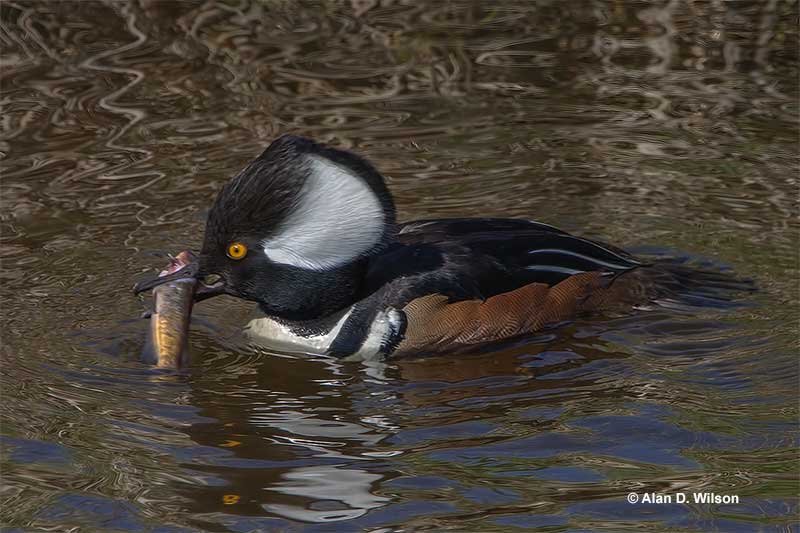
Several ducks occasionally catch small fish, but the six merganser species eat them all the time. In northern Eurasia, the “Smew” is a small species that uses its somewhat slender beak to catch small minnows and other similar fish as well as crustaceans.
In North America, this pint-sized duck is replaced by the beautiful Hooded Merganser. These crested ducks use their slender beaks to catch chubs, minnows, and other small, similar-sized fish. Like other merganser species, their beaks have sharp, tooth-like serrations that help them hold onto their slippery prey.

Look closely at this Common Merganser. Do you see the sharp serrations on its bill?
The Common Merganser and Red-breasted Merganser are a pair of larger species that forage for a wide variety of fish a bit bigger than ones caught by Smews and Hooded Mergansers. They use their serrated beaks to snatch everything from Perch to young trout and salmon, small Northern Pike, Herring, and various other fish species.
The other two merganser species are rare and endangered birds that require clean, remote waterways with plenty of fish. In Eastern Asia, Scaly-sided Mergansers catch minnows and other small fish, while Brazilian Mergansers hunt for small fish on a handful of rivers in Brazil and northern Argentina.
Hunting Techniques
Mergansers have several adaptations for their fish-heavy diet. All have slender, aerodynamic shapes suited for fast, agile swimming. To catch slippery prey, they also have sharp serrations on their long, slender beaks.
These special ducks also have excellent underwater vision. Although no one has tested how well Hooded Mergansers can see underwater, we do know that they can change the refractive capabilities of their eyes! In a sense, they may have natural, underwater goggles.
Mergansers typically forage by diving underwater, using their webbed feet to swim and pursue prey, and then catching it with their beaks.
Common and Red-breasted Mergansers also sometimes catch fish on the surface but get most of their prey during underwater dives.
These birds and the two rare merganser species often float their heads held just below the surface so they can watch for prey. When they spot a fish, the ducks dive down and snatch it, sometimes after an underwater chase. They also dive to the bottom and use their thin beaks to probe under stones.
After catching a fish, mergansers can eat it underwater but usually swim to the surface where they swallow it whole. Occasionally, Common and Red-breasted Mergansers also hunt for fish in flocks, including with other bird species.
Eating Habits And Other Fun Facts
- Mergansers are sometimes known as “sawbills” on account of their serrated beaks.
- Baby mergansers dive underwater to catch insects for the first 12 days before switching to eating tiny fish.
- Common Mergansers are so adept at catching fish that gulls and even Bald Eagles can follow them to steal their fish when the merganser comes to the surface.
- Each Red-breasted Merganser has to eat a minimum of 15 to 20 fish per day!
- Mergansers sometimes fish in small flocks so they can herd small fish into shallow water and easily catch them.
- Once in a while, Common Mergansers feed at night.
- Mergansers don’t dive as deep as many other ducks. They don’t usually dive deeper than 15 or 20 feet.
- Sadly, two species of mergansers are endangered with extinction, and one, the Aukland’s Island Merganser of New Zealand, went extinct in the early 20th century. This shows how sensitive these fish-eating ducks can be to changes made to their aquatic habitats.
Frequently Asked Questions
Are ducks predators?
Several ducks are predators. While many ducks eat vegetation, most also catch insects and other small aquatic creatures. Mergansers, in particular, are predatory ducks that mostly eat fish.
Do ducks eat any animals?
Ducks don’t necessarily eat animals, but they eat small living beings such as fish, crayfish, clams and other mollusks, and insects.
Do ducks eat snails?
Some ducks occasionally eat tiny snails and mollusks, but in general, their diet largely consists of different aquatic vegetation.
Do ducks eat other ducks?
No, ducks do not eat other ducks.