


Kingfishers are unmistakable! Many species live along rivers and other wetlands, but they can’t swim like ducks or grebes. Kingfishers also nest in burrows, have very short legs, and over-sized beaks.
These unique birds also come in a variety of colors. How many kingfishers are there, and where do they live? How many can you see in North America?
The Kingfisher Family
My first kingfisher was the same that most North American birders see. I was a kid watching out the window of my aunt’s car as we drove through northern Pennsylvania. While we parallelled a rocky river that ran through a beautiful blend of farms and forest, there it was: a fantastic Belted Kingfisher!
The bird hung in the air, hovering over the river. It was just for a second or two, but in that moment, my young eyes clearly saw its blue-gray plumage, chest bands, and big, crested head. What a bird it was!
Although we only have one main species of kingfisher in most of North America (plus some other rare visitors), 116 other kingfisher species plunge-dive and call from nearly every continent!
The only places where kingfishers don’t occur are Antarctica, high elevations, some deserts, and far northern Eurasia. Believe it or not, many are also incredibly colorful birds with coral-red beaks and vivid blue, jade-green, and chestnut plumage.
No matter where they roam, all kingfisher species belong to the same family, the Alcedinidae, even the Kookaburras. Despite their huge beaks and raucous laughing vocalizations, the four Kookaburra species of Australia and New Guinea are actually kingfishers!
Kingfishers You Can See In North America
Belted Kingfisher
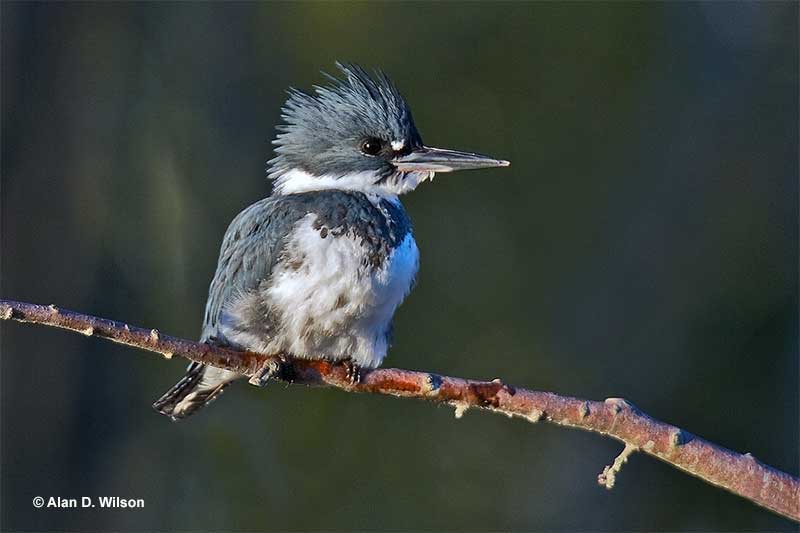
Scientific name: Megaceryle alcyon
Belted Kingfishers are chunky, big-headed birds with a prominent double crest. They measure a bit more than a foot long, are blue-gray above, mostly white below, and have a white collar. These unmistakable birds also have long, sharp beak, and a white patch on each of their long wings.
Males have a blue-gray chest band while females have one blue-gray chest band and a second chestnut-colored band. This kingfisher species is pretty easy to recognize and, in most parts of its range, it also the only one present.
Related: What do kingfishers symbolize?
Belted Kingfishers sit on trees and other perches above lakes, rivers, and other wetlands. They can also hover in place before diving straight down to catch small fish, crayfish, and other small animals.
Although they are fairly common, Belted Kingfishers are also shy and don’t usually let you get too close before flying away. I often hear their loud, staccato, rattling call before seeing them.
Green Kingfisher

Scientific name: Chloroceryle americana
Green Kingfishers are around the same size as a Rose-breasted Grosbeak! These pint-sized kingfishers are dark jade-green above and white below with either two green chest bands (the female), or a rufous chest (the male).
They also have a short crest, white spots in their wings and tail, and a long, pointed beak.
South of the border, these handsome kingfishers have a huge range but in the USA, we only find them in Texas and southeastern Arizona. One of the best places to see Green Kingfishers in the USA is central Texas. Check streams in hilly areas and scan the edges of rivers and wetlands in southern Texas and you might see one!
Green Kingfishers often perch on rocks and branches over water, much lower than Belted Kingfishers. They usually occur in pairs, make ticking calls, and dive into shallow water for small fish and other small creatures.
Ringed Kingfisher
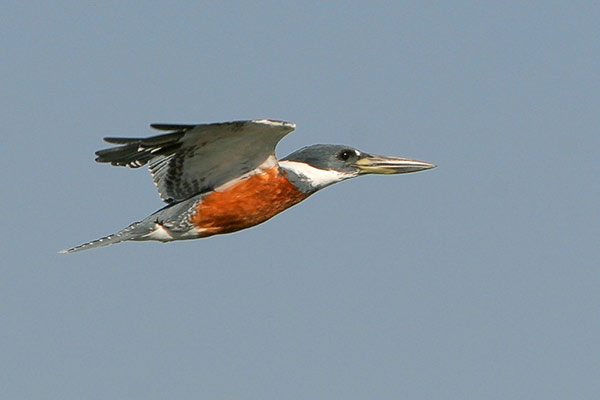
Scientific name: Megaceryle torquate
Ringed Kingfishers are quite a bit larger than Belted Kingfishers. These striking birds have huge pointed beaks with a buff base, and are nearly as big as a crow!
Like the much more common Belted Kingfisher, Ringed Kingfishers are blue-gray above, have a white collar, and, in flight, show a white patch on each of their wings. However, they are mostly rufous below and have a much shorter crest. Females also have a blue-gray chest band and rufous wing linings.
Like the Green Kingfisher, this big kingfisher mostly lives in tropical areas south of the border. In the USA, it only occurs in southern Texas, especially along the Rio Grande and some other waterways.
Ringed Kingfishers dive for fish, crustaceans, and other small animals. Birders often see them sitting on branches or other perches high above the water. I also see them in flight, usually hearing their loud “chack!” call before they fly into view.
Amazon Kingfisher
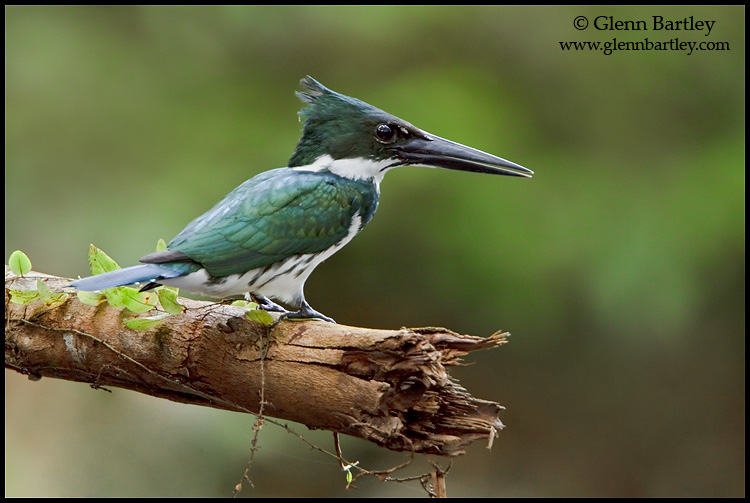
Scientific name: Chloroceryle amazona
There are three main kingfisher species in the USA. However, one other species has also been seen in southern Texas! This bird is the Amazon Kingfisher, a bird that normally frequents tropical waterways from Mexico to Argentina.
There have been a few sightings of this vagrant around Laredo and other sites in southernmost Texas, and there’s a good chance it will occur again.
Amazon Kingfishers look similar to Green Kingfishers but are nearly as big as a Belted Kingfisher. They are dark jade green above, have a white collar, and white below with a broken green chest bad (females), or a rufous chest band (males).
They also have a long, hefty dark beak, and a short crest. In addition to size, Amazon Kingfishers differ from Green Kingfishers by their plainer green wings (no white spots), and much less white in their tail.
Amazon Kingfishers dive for fish and other small creatures from perches above slow moving water.
Kingfisher Species Around The World
Common Kingfisher
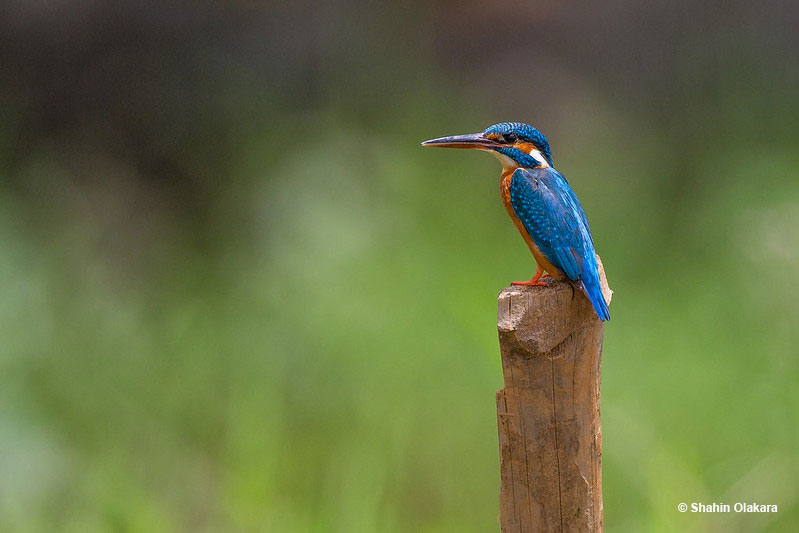
Scientific name: Alcedo atthis
This beautiful little bird is only a bit larger than a sparrow! It has beautiful greenish-blue upperparts with turquoise on its back, rump, and tail, and burnt-orange underparts.
It also has some white on its throat and head, and a bit of burnt-orange on its face. Females have some orange on their beaks while males have dark beaks.
The Common Kingfisher lives on rivers, streams, and other wetland habitats, and is the main kingfisher species in Europe and North Africa. It also occurs in many parts of southern and eastern Asia.
Woodland Kingfisher
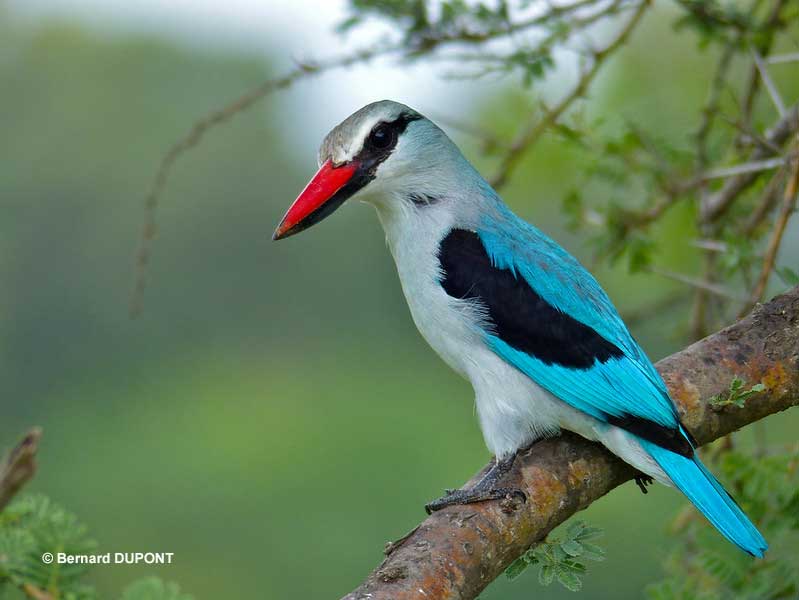
Scientific name: Halcyon senegalensis
Woodland Kingfishers are beautiful pale gray and blue kingfishers with red and black beaks. They also have blue backs, black and turquoise wings, and a turquoise tail!
They are around the same size as our robins, but these lovely kingfishers live in a variety of open forest and semi-wooded habitats in sub-Saharan Africa.
Unlike kingfishers in North America, Woodland Kingfishers don’t need water. Instead, they perch on branches before flying down to the ground to catch their prey. They eat lots of grasshoppers and other insects along with lizards and other small animals.
Kookaburra
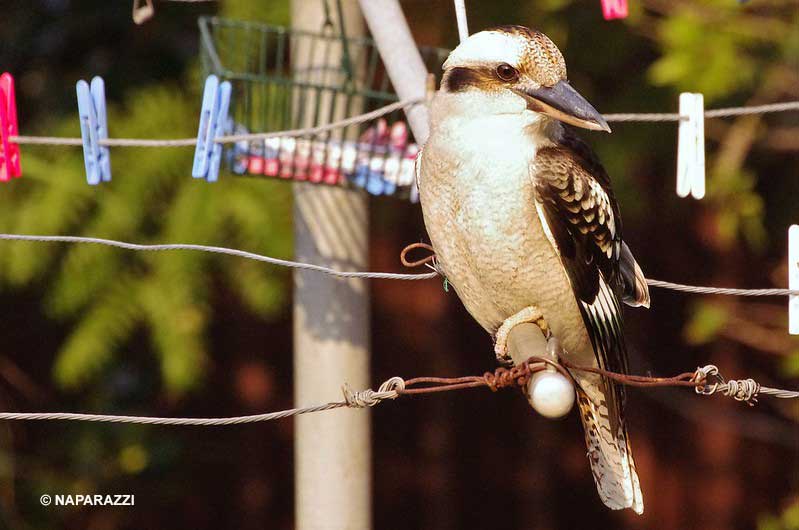
Scientific name: Dacelo novaeguineae
Laughing Kookaburras are hefty kingfishers with large, puffy heads and big, thick beaks. They have buff plumage with a dark brown back and wings, and a narrow dark mask.
This species also has pale blue in their wings and on their rump and rufous tails with black barring.
Laughing Kookaburras are common in woodlands, parks, and other habitats in eastern Australia. They get their name from their amazing, rattling, laughter-like vocalizations!
These crow-sized birds fly to catch prey on the ground. They eat lots of insects, along with lizards, snakes (up to three feet long!), and other small animals.
Black-backed Dwarf Kingfisher

Scientific name: Ceyx erithaca
This tiny kingfisher is one of the most beautiful members of its family. The Black-backed Dwarf Kingfisher is so colorful, its candy-colored plumage hardly seems real!
Around the same size as a warbler, it has an orange-red beak, butterscotch yellow underparts with a white throat, and a lilac-colored crown. It also has a bit of white and sapphire on its head, sapphire and black on its wings and tail, and lilac-violet on its rump and tail.
This little beauty lives near small bodies of water in forested habitats in southern Asia.
Crested Kingfisher
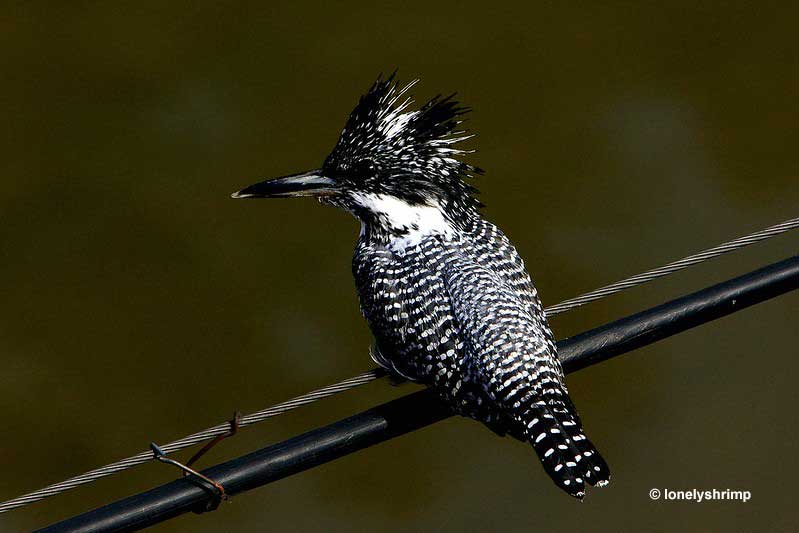
© lonelyshrimp
Scientific name: Megaceryle lugubris
Crested Kingfishers are the closest relatives of Ringed and Belted Kingfishers. These big, nearly crow-sized kingfishers have a spiky crest, and a big, sharp beak.
They have black and white plumage above, and are white below with black barring on their flanks. Crested Kingfishers also have a black and white chest band (males have some orange on it).
This species lives on rocky waterways in parts of the Himalayas, and eastern China and Japan south to Vietnam. It perches above the water and dives in at an angle to catch fish and other small creatures.
Pied Kingfisher

Scientific name: Ceryle rudis
Pied Kingfishers are striking, robin-sized kingfishers with black and white plumage. They have a crest, and black chest bands on white underparts (males have two, females have one broken band).
This species often hovers over streams and other waterways before plunge-diving for fish and other small animals. When a Pied Kingfisher hovers, it’s easy to see the big white patches on each wing.
Pied Kingfishers are the closest relatives of the Amazon and Green Kingfishers (and two other green-plumaged kingfishers that occur in the Americas).
They frequent a variety of wetland habitats in southern Asia and sub-Saharan Africa.