


Flamingos are some of the most unique birds on the planet. These tall and elegant wading birds entertain us with weird beaks and fantastic pink plumage!
It’s easy to see flamingos in a zoo, but where do they live in the wild?
- Flamingos Get Their Pink Color from Their Food
- There Are Six Species of Flamingo
- Flamingos are Hyper-Saline Specialists
- You Can’t Just See Them Anywhere
- Flamingos Feed Like Whales
- Flamingos are Very Social Birds
- Baby Flamingos Don’t Look Like Their Parents
- Female Flamingos Lay One Egg in a Mud Nest
- Both Flamingo Parents Feed Their Babies Crop Milk
- Flamingos Can Wander Far from Their Normal Range
- Flamingos Aren’t Related to Herons and Other Wading Birds
- They Stand on One Leg Because It’s Easier
- In Ancient Rome, Flamingos Were Gourmet Cuisine!
- An Important Bird for Many Cultures
- Male Flamingos are Larger than Females
Flamingos Get Their Pink Color from Their Food
Flamingos are known for having beautiful pink feathers. However, they don’t make those colors on their own. They get their unique pink plumage from beta-carotene pigments in their food.
Menu items for flamingos include blue-green algae, tiny brine shrimp, and various other small organisms. After feeding, liver enzymes break down the carotenoids in those food items to male pink and reddish pigments.
The flamingo species that eat more blue-green algae have darker pink plumage.
There Are Six Species of Flamingo
Six species of flamingos grace our planet! In southern Florida and the Caribbean, we have the beautiful, deep-pink American Flamingo. However, in South America, three more species occur.
These include the lovely Chilean Flamingo, and two local Andean species, the Andean Flamingo and the Jame’s Flamingo.
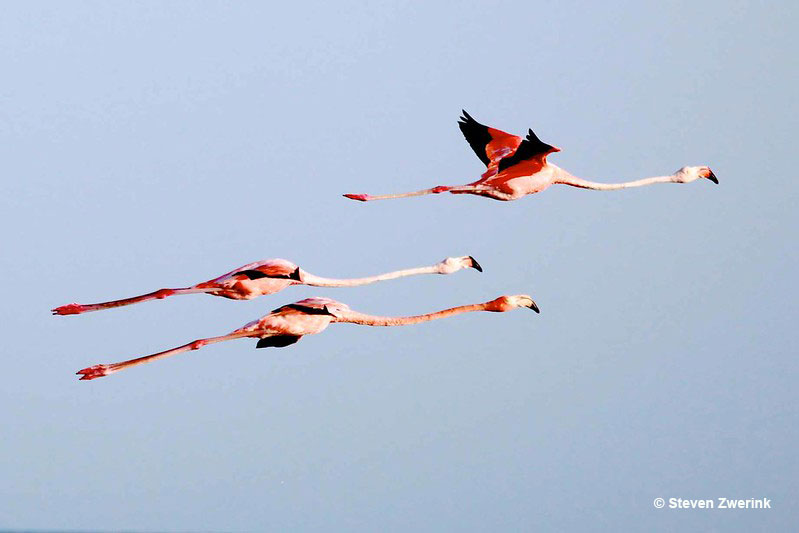
In Eurasia, the common Greater Flamingo occurs in the Mediterranean region, parts of central and southern Asia, and Africa. The sixth species, the Lesser Flamingo, also lives in Africa and India.
Flamingos are Hyper-Saline Specialists
In general, flamingos are local birds that only live in very specific habitats. Although flamingos do occur in wetlands, unlike sandpipers, storks, herons, and other wading birds, they can only live in one type of wetland.
Flamingos need shallow, hyper-saline water and are one of the only birds that can use such an extreme type of habitat! They are very much adapted to feeding on the tiny animals and algae that live in very salty water.
You Can’t Just See Them Anywhere
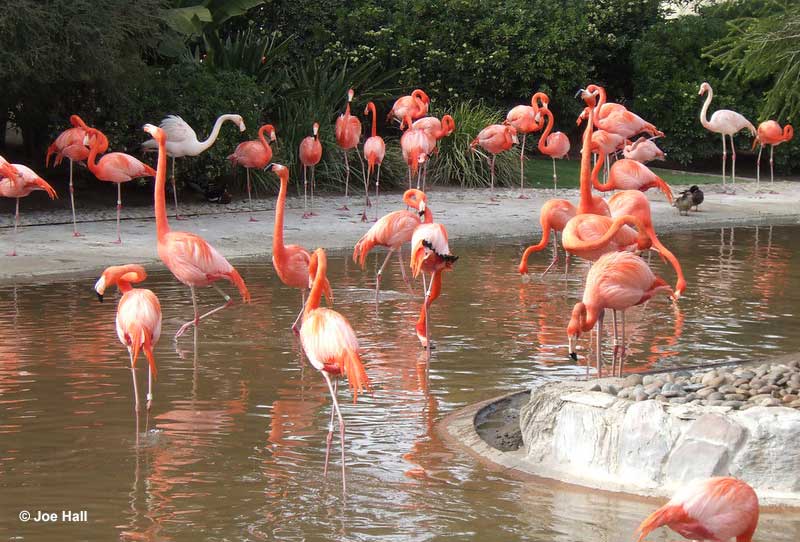
To see flamingos, you have to travel to specific spots. They occur in parts of southern Florida but some of the easiest places to see flamingos are in the northern Yucatan Peninsula, and on several Caribbean islands.
Other good places to watch flamingos are the Galapagos Islands, and high elevation salt lakes in Bolivia, Chile, and Argentina.
You can also see lots of flamingos on wetlands in the Mediterranean region, in western India, and many parts of Africa.
Flamingos Feed Like Whales
While sandpipers and other wading birds use their bills to pick food from mud, flamingos go another route. If you feel like their odd-looking beaks remind you of the head of a whale, that’s no coincidence.
These elegant birds feed a lot like some whales and even eat some similar types of food. When flamingos feed, they put their beaks into the water upside down, and then use baleen-like structures in their mouths to filter out algae and tiny creatures.
Flamingos are Very Social Birds
Flamingos are rarely seen on their own. These social birds live with lots of other flamingos from the moment they hatch until their final days.
Before nesting, groups of males and females often do synchronized courtship displays, and build mud nests in colonies. In many places, hundreds of flamingos nest and forage together. However, that’s nothing compared to Lesser Flamingo colonies in eastern Africa.
On some lakes, colonies can include more than a million birds!
Baby Flamingos Don’t Look Like Their Parents
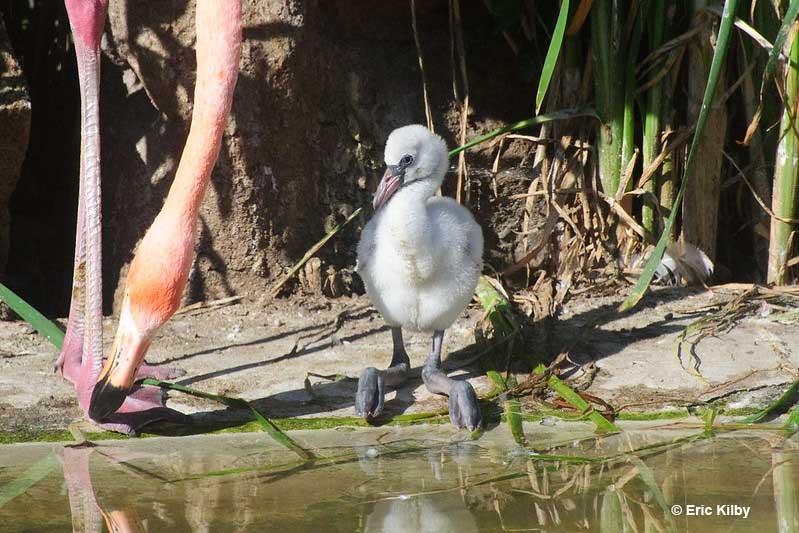
Baby flamingos don’t look anything like their parents. If you saw a baby flamingo on its own, you might wonder if it was a baby stork or heron, or might not have any idea what it was!
Unlike the elegant pink adults, baby flamingos have fuzzy, pale grayish feathers and thick, clumsy legs. They also have tiny wings and a bill that looks more like it belongs on some odd goose or duck than a flamingo.
Female Flamingos Lay One Egg in a Mud Nest
Flamingos only lay one egg each breeding season. After the female picks a nesting site in the colony, both she and her mate defend that favored spot from other flamingo pairs.
They usually nest on extensive mud flats or mud islands surrounded by the hyper-saline water they require. Both sexes help build their nest by forming a small raised “hill” out of mud. The female lays her egg in a shallow depression on top.
Both Flamingo Parents Feed Their Babies Crop Milk
Baby flamingos can’t feed on their own. Instead, their parents feed them a protein and fat-rich substance known as “crop milk”. Both parents regurgitate this red, nutrient-rich substance directly into the mouth of their baby.
Crop milk is their main food for four to six weeks of age. After that time, they start to forage for food but still get some crop milk from their parents until they are 10 to 12 weeks old.
Flamingos Can Wander Far from Their Normal Range
Flamingos only live in certain, specific areas. However, surprisingly, they can show up in odd places outside their normal range. In 2023, dozens of American Flamingos were seen in various parts of the USA, far north of their usual haunts.
These flamingos were pushed north by the fierce winds of Hurricane Idalia. Flamingos also wander in search of habitat and this might also explain why they have occurred in other places outside their expected range.
Flamingos Aren’t Related to Herons and Other Wading Birds
Flamingos have long legs and slender, elongated necks like many other wading birds. However, they aren’t related to them at all!
Although they don’t resemble grebes, DNA studies have shown that these highly aquatic birds are the closest relatives of flamingos.
Those same DNA studies also showed that flamingos and grebes are related to pigeons, doves, sandgrouse, and the Mesites, an avian family restricted to Madagascar.
They Stand on One Leg Because It’s Easier
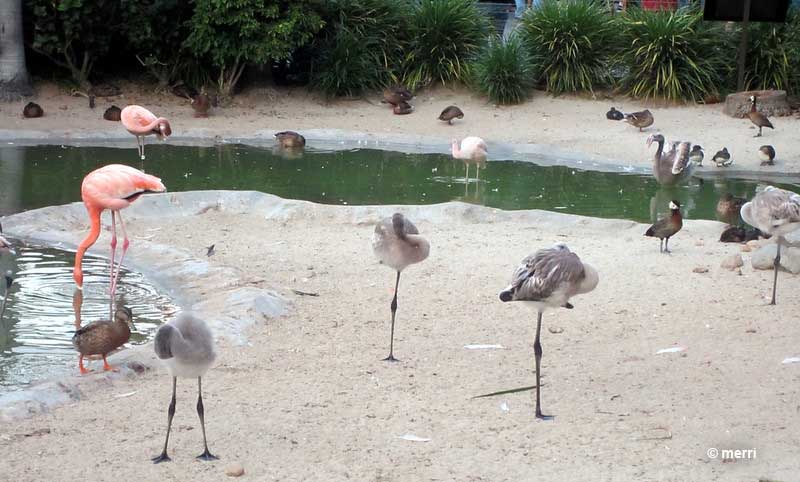
Flamingos frequently stand on one leg. People have often wondered if they do that to stay warm or save energy in some way.
As it turns out, flamingos stand on one leg because that’s just easier for them to do! Studies have shown that when a flamingo stands on just one leg, it doesn’t use any muscles to do it. They also have more stability on one leg than standing with two legs.
© merri
In Ancient Rome, Flamingos Were Gourmet Cuisine!
Flamingos have been admired by various cultures for their elegant appearance, pretty colors, and stomping their feet (or dancing) when they feed. However, in the past, some people also enjoyed dining on them!
Several writings from ancient Rome talk about recipes of flamingos and flamingos being served at important feasts. Along with many other birds, ancient Romans cooked flamingos whole. There are also some indications that flamingo tongues were a prized gourmet dish!
An Important Bird for Many Cultures
Flamingos have played important roles in many cultures. We can see them in ancient Egyptian art, including some works that show the Egyptian deity “Set” with the head of a flamingo.
They also appear in other works of art including cultures from ancient Peru. In modern times, flamingos are especially important for the Bahamas. The American Flamingo is the national bird of this island nation, and a large flamingo colony nests there.
Male Flamingos are Larger than Females
The first time I saw flamingos in the Yucatan, I noticed that some birds were taller than others. As it turns out, the tall birds were the males. Even though they look the same, female flamingos are around 20% smaller than males and have shorter legs.
They might have different sizes so each of the sexes can feed in different depths of water. Or, another possibility is that the size difference is related to courtship.