

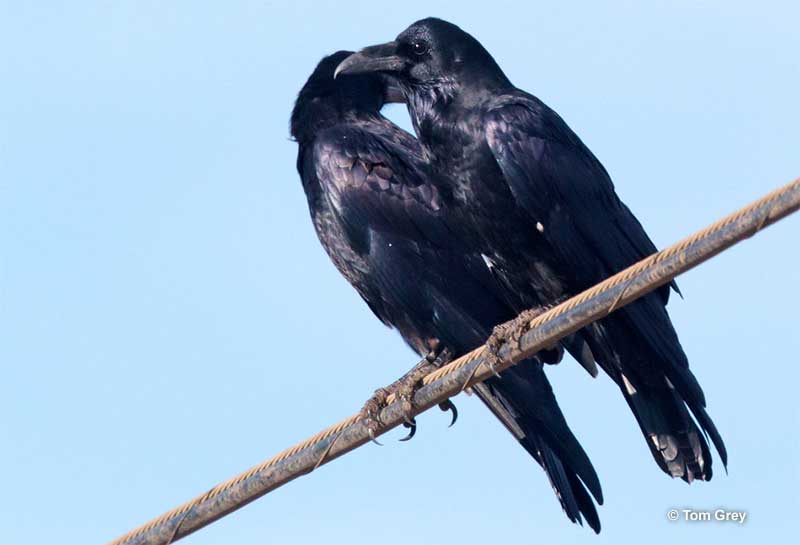
Crows are such interesting birds! They are incredibly smart, resourceful, and lend a lot of character to the local birding scene.
Watch crows and you’ll see them “talk” with each other, and use their intelligence to find all sorts of food. I also pay attention to their alarm calls; they have led me to hidden owls on more than one occasion!
- Crows can be as smart as a 7-year-old child
- Crows are too smart for scarecrows
- Crows use tools
- Crow funerals
- Four species of crows live in North America
- Several crow species only live on islands
- There are no crows in South America or Antarctica
- Crows are closely related to ravens
- American Crows can hold a grudge
- Crows can mimic speech
- Crows are adaptable omnivores
- Crows live in tight family groups
- Crows gang up on hawks and other predators
- Crows play with each other
- Crow nests are important avian real estate
Crows can be as smart as a 7-year-old child
Crows are some of the smartest birds in the world. Pay attention to crows, and it won’t take long to realize that their intelligence is a step above most other birds.
They share some traits with other intelligent animals, especially primates. Like monkeys and great apes, crows are very social omnivores with complex behaviors. Over the years, it has become common knowledge that they could be just as smart as a seven-year-old child!

Crows are too smart for scarecrows
Farmers have always had problems with crows. These intelligent birds are just too smart to pass up an easy feeding opportunity! They have probably been taking advantage of crops since the first fields were cultivated.
People throughout the ages have tried all sorts of things to frighten crows away from crops but it’s always an ongoing process. A scarecrow might work at first but crows quickly learn they aren’t dangerous and just ignore them.
Crows use tools
Most or all crow species also use tools! Some species dunk their food in water before eating it, and others have been seen using sharp sticks to pry out bits of food.
The New Caledonian Crow even uses small sticks to eat grubs. It pokes the stick into a hole and when a grub bites the stick, it pulls out its food. This extremely smart bird species can also make its own hook-like tools!
Crow funerals
American Crows also demonstrate their intelligence with complex cultural behaviors. One such shocking behavior is holding wakes and funerals!
When an American Crow finds a dead crow, it calls to alert other crows. The other crows show up and then all the birds make loud, agitated calls as they gather around the dead bird. Some researchers think the birds are learning about possible threats. I wonder if they are also expressing their fears and other emotions, maybe even mourning.
Four species of crows live in North America
In much of North America, the American Crow is the common crow species but it’s not the only one. Three other crow species also live in North America. Go birding in coastal habitats and wetlands in the eastern USA and you should hear the nasal calls of Fish Crows.
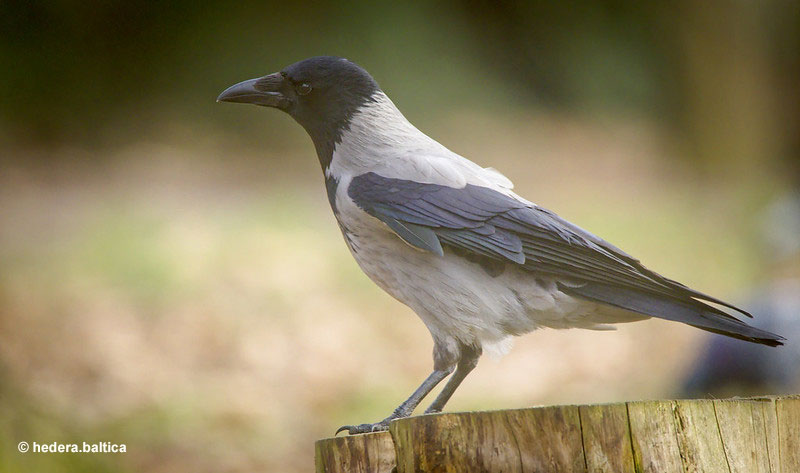
We have black crows, but in most of Europe, the most common species is the Hooded Crow.
Spend some time at the Brownsville, Texas dump and you might see the small Tamaulipas Crow. To connect with the Sinaloa Crow, you’ll have to go birding in western Mexico.
Several crow species only live on islands
Crows are adventurous birds! Several have spread to islands and evolved into different species restricted to small areas.
For example, several crow species live on different islands in Indonesia, and five crow species are restricted to islands in the Caribbean Sea.
Unfortunately, several of those unique crows are threatened. The Hawaiian Crow has even become extinct in the wild. To save the ‘Alalä, all remaining birds are held in captivity while conservationists work on restoring their habitat.
There are no crows in South America or Antarctica
Most then 40 species of crows, jackdaws, and ravens live in various parts of the globe! In addition to North America, and many islands, they also occur throughout Eurasia, Africa, and Australia.
Ironically, none live in the most avian-rich continent, South America.
You won’t see crows in Antarctica either. In those places, jay species, toucans, caracaras, and some other birds might fill some of the niches that crows use.
Crows are closely related to ravens
There are differences between crows and ravens, but these birds are closely related. All crows and ravens belong to the Corvus genus, and have fairly similar structures.
Both crows and ravens are also omnivores that eat a wide variety of food items, and most species have glossy black plumage. Crows and ravens are also very smart birds although crows might be more capable of identifying people and faces.
American Crows can hold a grudge
Make an American Crow your enemy and it won’t forget! It will probably also tell its crow family about you.
Incredibly, American Crows seem capable of remembering who their enemies are and transferring that information to other crows. Those crows might also transfer that important information to subsequent generations.
In a study where researchers used caveman masks, crows in the same area still became alarmed by people wearing those masks ten years after the experiment!
Crows can mimic speech
Crows aren’t just good at communicating with each other. These smart birds can also mimic a variety of sounds, human speech included!
Crows have been seen calling like Barred Owls and other birds. Captive ones have also been taught to say a number of words. Some have also learned to count to seven while others have learned more than 100 words as well as sentences!
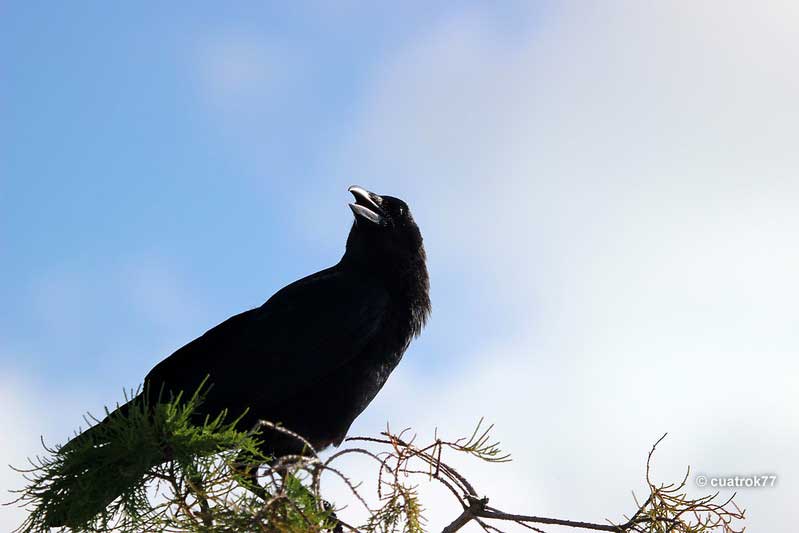
Crows are adaptable omnivores
One of the main reasons why so many crow species have become successful is because they can eat so many different things. That’s a pretty good adaptation for survival and partly explains why crows have become so common in different habitats as well as urban areas.
While crows eat lots of insects and berries like other birds, they also feed on small fish, mice, eggs, small birds, and even garbage.
Crows live in tight family groups
American Crows are very social birds that stick with the family, at least for part of the year. Crow families have anywhere from five to fifteen birds, including adults and young crows up to five years old.
The young birds also typically help the adult birds raise nestlings and fledglings! In winter, although crow families spend some time together, birds spend a lot more time foraging with other crows in large flocks.
Crows gang up on hawks and other predators
Crows might squabble with each other, but when they see a threat, they stick together. If a crow sees a hawk or an owl, that predator is in for some trouble!
The first crow to see the predator makes a special alarm call over and over to bring in as many other crows as possible. When the other crows arrive, they also make the same call and constantly harass the predator, usually until it moves away.
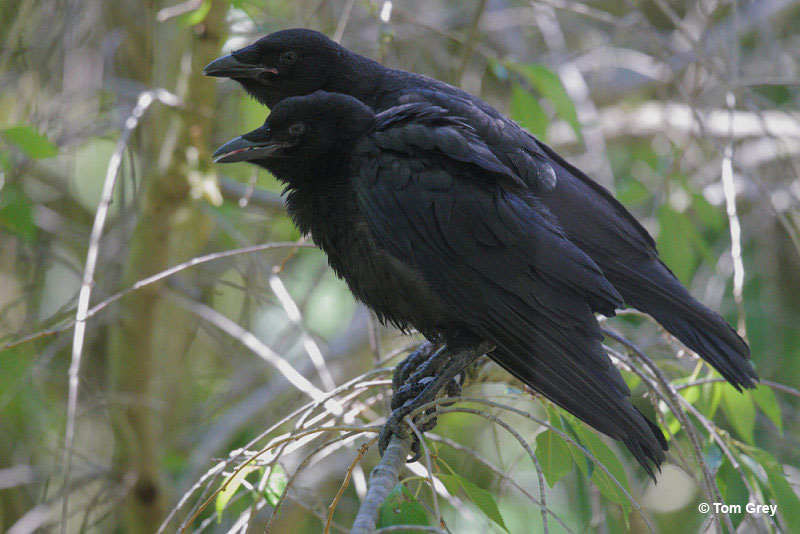
Crows play with each other
Since crows are so smart, it’s not all that surprising that they play with each other. I’ve seen crows do some acrobatic moves in flight and have even seen them hanging from branches! Other folks have also taken many videos of crows body sledding on snowy roofs and splashing each other.
They can also play pranks like pulling on another crow’s tail! Crows might play to learn how to find food and socialize, or maybe they just like having fun.
Crow nests are important avian real estate
Crows make big stick nests high in trees. While those nests are obviously important for crows, they play important roles for other birds too.
Several hawk and owl species use crow nests for their own nests. They might chase crows away from a nest they have built but usually just use old crow nests. So many raptors make use of crow nests, some species might not be able to nest as much without them.
Karen Bulow
Thursday 22nd of August 2024
How many babies do crows have? I have 9 crows that come to my yard everyday. I sometimes give them grapes or cherries and they love it. I garden a lot and they watch me. When I walk my dog they sometimes follow me. Am I reading into this too much? One of the crows lands on my back deck banister and watches me washing dishes. It's weird...
Patrick O'Donnell
Friday 23rd of August 2024
@Karen- On average, crows have four babies but live in family groups. It sounds like you've made friends with a family of crows! Those intelligent birds could follow you around and watch you because they trust you or, at least hope you'll give them more food.