

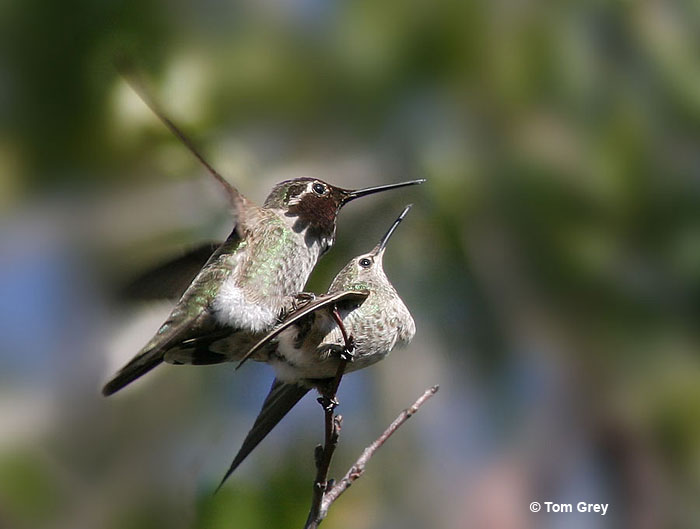
Have you ever seen one bird briefly jump onto another and wondered what was happening?
You may have witnessed birds mating.
For most birds, the actual act lasts only a few seconds. There is no pregnancy and most male birds don’t even have a penis. Instead, males and females briefly press openings called cloacas together to transfer sperm.
This is known as a cloacal kiss.
The mating itself is simple. What happens before and afterward can be much more interesting.
How Do Birds Mate?
Most birds mate by bringing their cloacas together.
The cloaca is an opening near the base of a bird’s tail. It is connected to the digestive, urinary and reproductive systems.
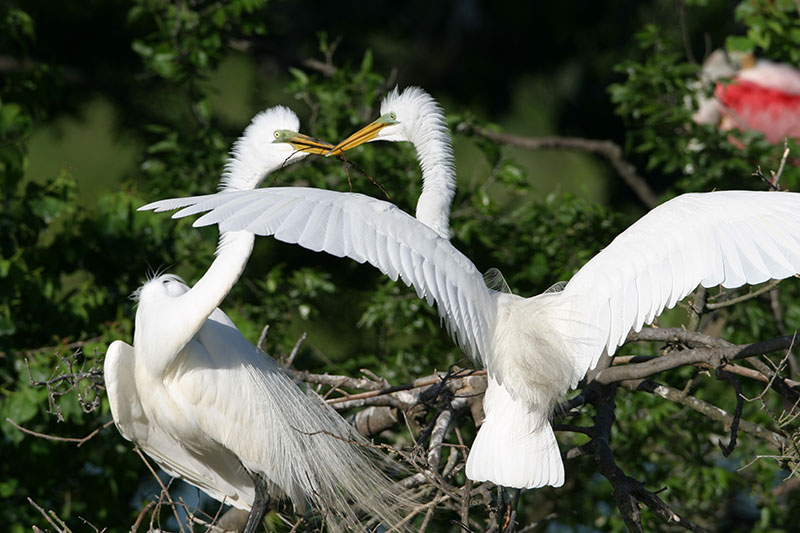
Great Egret Courtship
When a female is receptive to mating, she typically crouches and moves her tail to one side. The male climbs onto her back and balances while positioning his tail beneath hers.
The birds then briefly press their cloacas together.
Sperm passes from the male into the female’s reproductive tract during this contact. The entire process may be over within a few seconds.
The pair may mate repeatedly during the breeding season.
What Is a Cloacal Kiss?
The brief contact between a male and female bird’s cloacas is commonly called a cloacal kiss.
There isn’t much kissing involved.
The birds need to position themselves correctly so their cloacas make contact. This can look slightly awkward, especially when a male is trying to balance on the female’s back.
Once contact is made, sperm can be transferred to the female.
This is how the great majority of bird species mate.
Other interesting courting behaviors include mutual feeding and gift-giving observed in corvids and pigeons. The same goes for Magnificent Frigatebirds who have some interesting mating rituals.
Reproductive Anatomy
Birds have a reproductive anatomy much different from ours – it is more similar to reptiles than to mammals.
Related: Anatomy of Birds
Unlike mammals, birds do not possess external genitalia. Instead, they have a structure called a cloaca or a cloacal opening, also found in reptiles and amphibians. The cloacal opening serves various functions, including excretion and reproduction.
They also use this opening to discard their excrement.
Female Bird Reproductive Anatomy
Female birds have a two-part reproductive system. It consists of the ovary in which the eggs develop and the oviduct where the egg matures and fertilization happens.
Interestingly, only the left ovary and oviduct are developed and functional; the right pair is stunted during embryonic development. However, there have been examples where the left ovary-oviduct pair becomes damaged and non-functional, and the right pair subsequently develops enough to take over.
The oviduct has several sections, two of which serve to adorn the egg with a shell. The oviduct ends in the cloacal opening – that’s where the eggs come out during the laying process.

Male Bird Reproductive Anatomy
The act of mating is shorter than you’d expect. A large majority of birds lack a penis or any other copulatory structure that could directly insert the sperm into the female cloaca. Instead, most birds mate through a technique called “cloacal kiss.”
In this short maneuver, the male mounts the female. Then, the birds rub their swollen cloacal openings together, allowing the male to transfer his sperm. The cloacal kiss allows the female to control the situation well because she needs to tilt at just the right angle for the sperm transfer to succeed.
Only around 3% of bird species have males with penises. These include waterfowl – ducks, geese, and swans, and large, primitive flightless birds such as ostriches, emus, and rheas.
Extreme Example: Ducks
Ducks are an unusual example of bird reproductive anatomy. Not only that, the males have penises – they are also cork-screw shaped and can be as long as the male’s body in some species.
To make things even more awkward, male ducks often seek out females outside of their pair bonds and will even try to mate forcefully. Scientific observations show that up to 10 percent of female Mallards within a group die each year by drowning during these violent mating attempts.

The female duck‘s “vagina” – the modified oviduct – anatomically corresponds to these challenges: it is a long and winding structure.
From the natural selection point of view, it’s an evolutionary effort to control which males will father the ducklings after all the drama because female ducks seem to have a way of selecting and favoring particular sperm once it’s inside their system. Also, it is not uncommon that the ducklings in a single brood often come from different fathers.
In most other bird species, the breeding process is much swifter and less messy.
What Happens After Birds Mate?
Successful mating allows sperm to enter the female’s reproductive tract.
But an egg does not necessarily need to be fertilized immediately after mating.
Female birds can store sperm in specialized structures within their reproductive tract. Depending on the species, stored sperm can remain viable long enough to fertilize multiple eggs.
That means a pair doesn’t necessarily have to mate once for every egg the female lays.
As an ovum travels through the female’s oviduct, it can be fertilized by sperm. The developing egg then receives its albumen, membranes and finally its shell.
Once complete, the egg is laid through the cloaca.
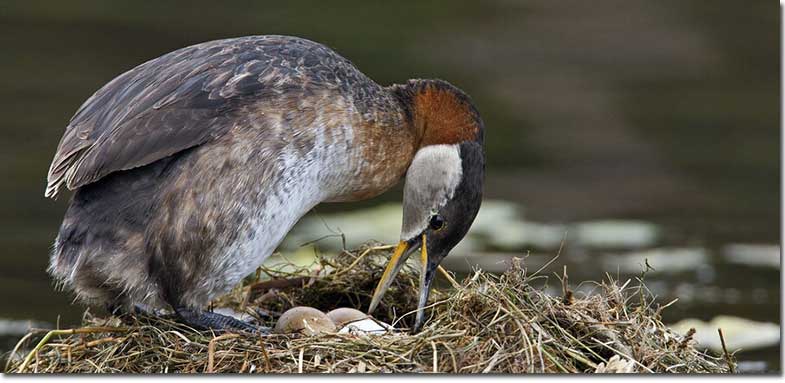
How Does a Bird Egg Get Fertilized?
Fertilization takes place inside the female.
The female releases an ovum from her ovary. If viable sperm is present, fertilization occurs in the upper part of the oviduct before the shell develops.
The egg then continues through the oviduct.
Different sections add the familiar parts of a bird egg, including the egg white, membranes and shell.
By the time you see an egg sitting in a nest, this process has already taken place.
When Do Birds Mate?
For many North American birds, mating happens during spring and early summer.
Longer daylight hours trigger hormonal changes that prepare birds for breeding.
But there isn’t one breeding season for every bird.
Food availability, rainfall, temperature and latitude can all affect timing.
Some species begin breeding surprisingly early. Great Horned Owls, for example, can begin nesting while much of their range is still experiencing winter conditions.
Other birds wait until spring insects or other important food sources become abundant.
Tropical birds may respond more strongly to rainfall and food availability than to changing day length.
How Often Do Birds Mate?
It varies by species.
A pair may mate multiple times during the period when the female is producing eggs. Repeated mating increases the likelihood that sufficient viable sperm is available for fertilization.
The mating itself remains extremely short in most birds.
You could easily watch a pair for an hour and miss it.
Do Birds Mate for Life?
Some birds form pair bonds that can last for years.
Swans, geese, albatrosses, eagles and several other groups are well known for long-term partnerships.
But “mate for life” doesn’t necessarily mean exactly what it sounds like.
Some birds form a pair for only one breeding season. Others remain together for several seasons and some stay together until one partner dies.
There is another complication.
A male and female can raise chicks together while some of those chicks were fathered by another male. Extra-pair mating occurs in numerous bird species.
A social partnership and genetic parenthood aren’t always the same thing.
You Might Also Ask
Can birds be pregnant?
No, birds don’t get “pregnant” like mammals do. The term “pregnancy” usually involves having a true uterus – an organ that carries and nurtures developing babies inside of the mother’s body. Also, pregnancy ends with the birth of live offspring.
Birds lack a uterus and do not give birth to young. Instead, they lay eggs that develop and get fertilized in their oviducts.
Do birds have to mate to reproduce?
In the large majority of cases, yes. Birds typically need to mate to reproduce and fertilize their eggs, as the male’s sperm is necessary for the fertilization. In rare cases, like a certain percentage of turkeys, females can reproduce parthenogenetically. Parthenogenesis is a process where fertile eggs develop without sperm fertilization, meaning the female doesn’t need a mate or mating.
Are male and female bird cloacas the same?
No – male and female bird cloacas are similar but not identical in structure. For example, in Passerines and other birds, the male cloaca points upwards or forwards and usually has a crease between the opening and the abdomen – all in all, it is “raised.” The female bird’s cloaca typically points backward, with no notable crease.
How do birds deliver sperm?
During mating, the cloacas of the male and female come into contact for the transfer of sperm. The slight anatomical differences between the male and female cloaca allow for a successful “cloacal kiss” for sperm transfer and egg fertilization. In both sexes, the cloaca is a joint opening for the reproductive, urinary, and digestive systems.
In the 3% of bird species whose males have a penis, copulation occurs.
Conclusion
From courtship rituals to nest building to intricate parental care, birds have a unique reproduction cycle. It has certainly contributed to their evolutionary success – the special reproductive anatomy allows birds to mate efficiently without wasting too much energy.
Contrastingly, most birds have to invest much energy into the next phase – raising their young from egg to maturity.
Each step of the journey requires total dedication from parent birds.
One thing is sure – each bird species has its own captivating story of courtship, parenthood, and survival. These tales and observations continue to fascinate and inspire bird enthusiasts and nature lovers worldwide.
