

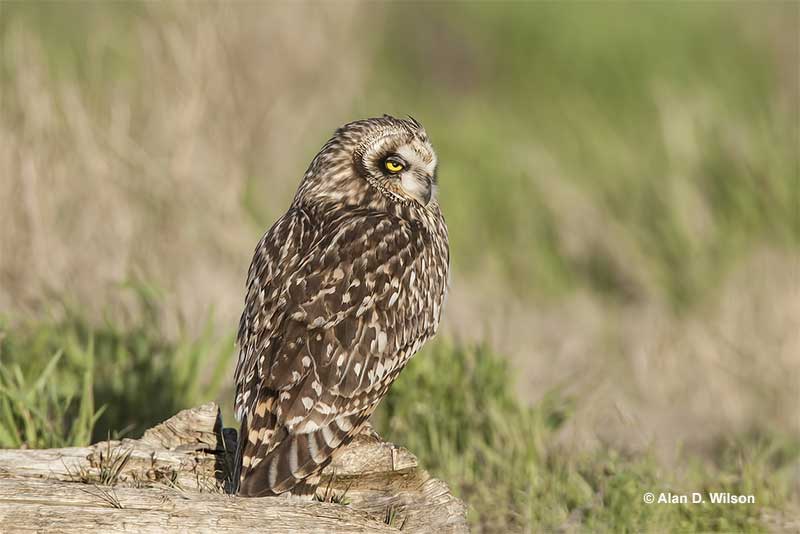
Although owls are not easy to see, they seem to really like Pennsylvania with its forests and woodlands.
Leaning on eBird data, we picked out seven common owl species you can see in Pennsylvania.
Let’s take a closer look at them!
Great Horned Owl
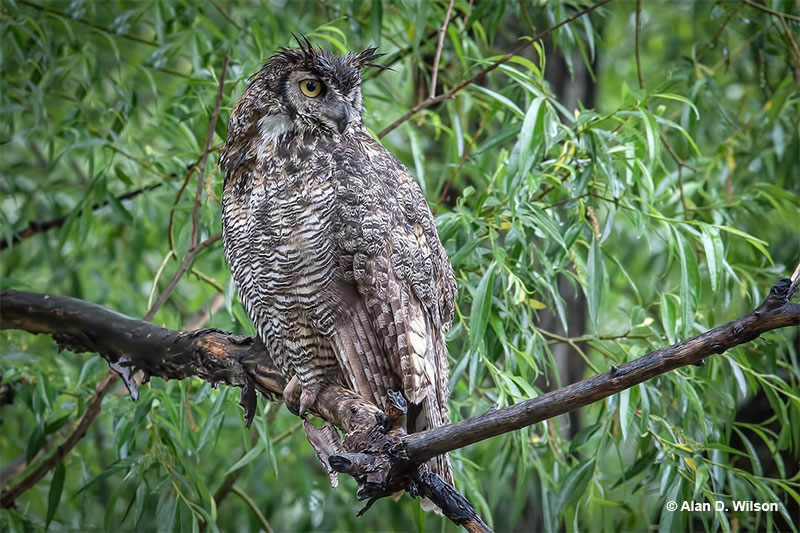
- Range: Permanent resident in much of Alaska, Canada, and the USA.
- Length: 22 inches
- Wingspan: 44 inches
- Call: Makes a low, gruff, “hooo, hoo hoo hoo hoooo”.
The Great Horned Owl is a big, bulky owl with big ear tufts and a black beak. It is mottled gray and brown, has a rufous or gray face, and fine black barring on its underparts. This owl also has a white throat and some dark marks on its breast.
Males and female Great Horned Owls look the same but females are larger. They also have a medium-length tail with dark bands, and long, broad wings.
This nocturnal owl species lives in every possible habitat, including urban areas.
Key Identifications:
- Big, bulky brown or gray owl with ear tufts and fine barring on its underparts.
- Nests in old stick nests of other large birds, on ledges, and in other situations.
- Watches from a perch or glides over open habitats at night, to catch mammals and some birds on the ground.
Barred Owl
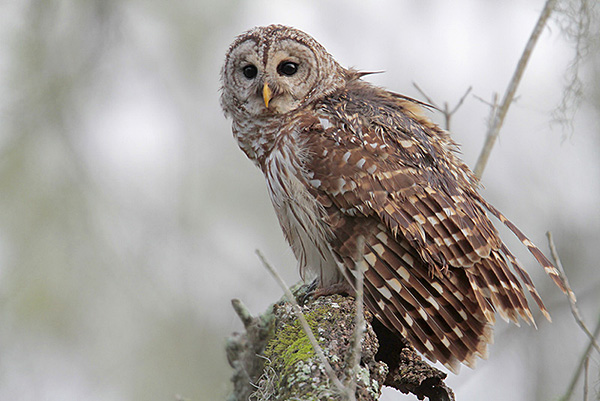
Photograph © Greg Lavaty.
- Range: A permanent resident in most forested areas in Canada, parts of some Pacific Northwestern states, and most of the eastern USA.
- Length: 21 inches
- Wingspan: 42 inches
- Call: Makes loud hooting and caterwalling sounds, “Who cooks for you?! Who cooks for youaaaal!”
The Barred Owl is a medium to large owl with a round head and a narrow black border on its pale gray face. It has dark brown upperparts with white markings, and dark brown streaks on its belly.
This species also has a yellowish beak and dark eyes. Both sexes look the same except that females are a bit larger than males.
The Barred Owl flaps and glides on big, broad wings. It also has a medium-length, broad tail with a few dark brown bands.
Key Identifications:
- Big owl with a round head that has white marks on dark brown upperparts, and dark brown streaks on pale underparts.
- Perches and swoops through wooded areas at night but can also be active in the day.
- Nests in tree cavities and in abandoned nests of crows and hawks.
- Catches a wide variety of small animals.
Eastern Screech-Owl
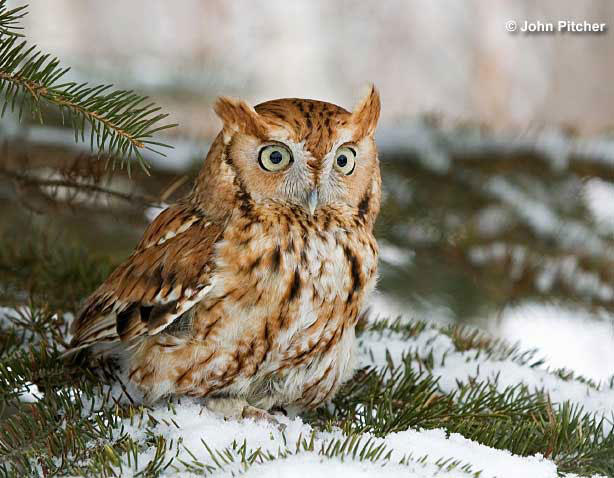
- Range: Permanent resident in parts of southeastern Canada, and in much of the eastern USA.
- Length: 8.5 inches
- Wingspan: 20 inches
- Call: Makes a rather high-pitched, descending whinny call, and a tremulous, vibrating call on the same pitch, “wududududududududududu”.
The Eastern Screech Owl is a small owl with ear tufts. It can be reddish, brown, or mostly gray, has “V”-shaped pale eyebrows, and some black on the edge of its face. It is also mottled above with some white spotting, and has pale underparts with dark barring and streaks.
Males and females look alike but females are a bit larger. This species also has yellow eyes, a pale yellow-gray beak, and some white bands on its broad tail.
Eastern Screech-Owls flap and glide on long, broad wings.
During the day, this owl hides in holes, or in dense vegetation.
Key Identifications:
- Small owl with ear tufts and mottled brown or gray plumage that lives east of the Rocky Mountains.
- Lives in a variety of wooded and park-like habitats.
- Nests in tree cavities and nest boxes.
- Swoops down to the ground catch a variety of small animals at night.
Northern Saw-whet Owl
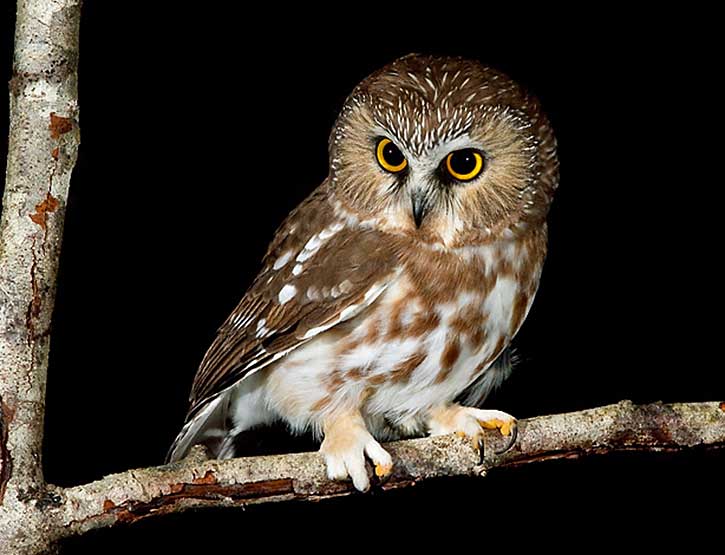
- Range: Lives in coniferous and mixed hardwood forests of Alaska, a large area of Canada, and parts of the northern and western USA.
- Length: 8 inches
- Wingspan: 17 inches
- Call: Makes a repeated tooting whistle call, over and over, “tu, tu, tu, tu, tu, tu, tu, tu, tu”.
The Northern Saw-whet Owl is a small, dark brown owl with a round head and brown streaks on white underparts. It also has some pale streaks on its head, a brown and white face, and some white spotting on its back.
Both sexes look the same but females are a bit larger. This species also has yellow eyes, a dark beak, longish, rounded wings, and a short, broad tail.
This nocturnal owl lives in forested habitats.
Key Identifications:
- Small, dark brown owl with a round head, broad white eyebrows, and thick dark streaks on pale underparts.
- Occurs in dense coniferous and mixed forest.
- Nests in old woodpecker holes and can use nest boxes.
- Swoops down to catch insects and small animals at night.
Barn Owl
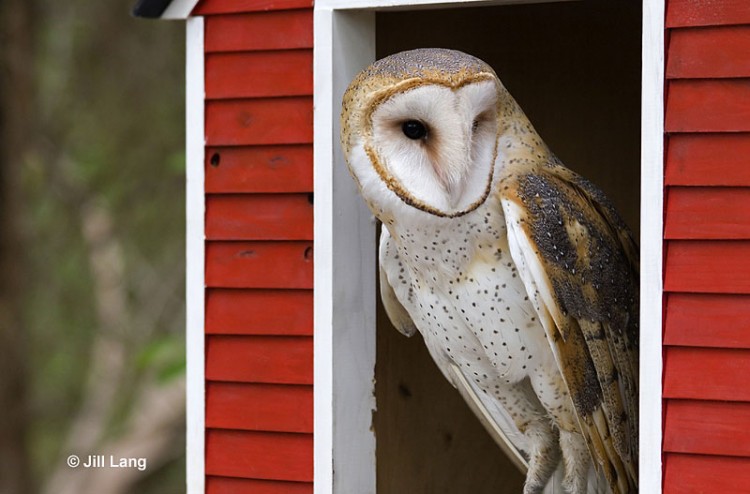
- Range: In Canada, occurs mostly in southwestern British Columbia. In the USA, they live in many areas but are absent from mountains and cold, northern regions. They range north to Washington, Nebraska, Iowa, and New York.
- Length: 16 inches
- Wingspan: 42 inches
- Call: A shrill, loud, hissing “shriiiiii!”
The Barn Owl is a medium to large, pale owl with golden tan and gray upperparts, and white underparts. It has a distinctive, white, heart-shaped face.
Both sexes are alike but females are a bit larger than males and have buff on their chest.
In flight, Barn Owls look like a large, pale, moth-like bird with a big, rounded head.
This owl hunts in grasslands, farms, and other open habitats.
Key Identifications:
- Large pale owl with a heart-shaped face.
- Glides and flutters over fields and other open areas at night.
- Nests in tree cavities, crevices in church steeples and other structures, and next boxes.
- Preys on rats and other small animals.
Short-eared Owl
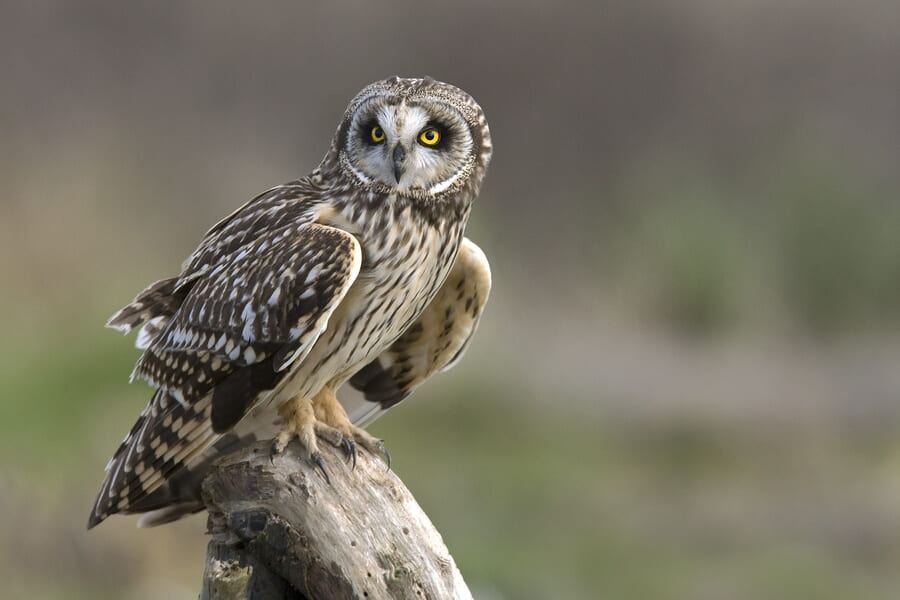
- Range: Summer resident in Alaska, Canada, and the western and central USA. Northern birds migrate to the USA, south to California and Texas.
- Length: 15 inches
- Wingspan: 38 inches
- Call: Makes a hoarse, raspy, cat-like call, “rehw”.
The Short-eared Owl is a medium-sized, pale brown owl with dark eye patches on a pale face. They have a dark breast and streaks on pale underparts. This species has long wings with buff wing patches.
Both sexes look similar but females are a bit larger and usually darker and buffier.
This owl is active day and night in open fields.
Key Identifications:
- Medium-sized pale brown and buffy owl with very short ear tufts.
- Dark eye patches on a pale face and long wings with buff patches near the wingtips.
- Nests on the ground in dense vegetation.
- Glides over open fields to catch small animals on the ground.
Long-eared Owl
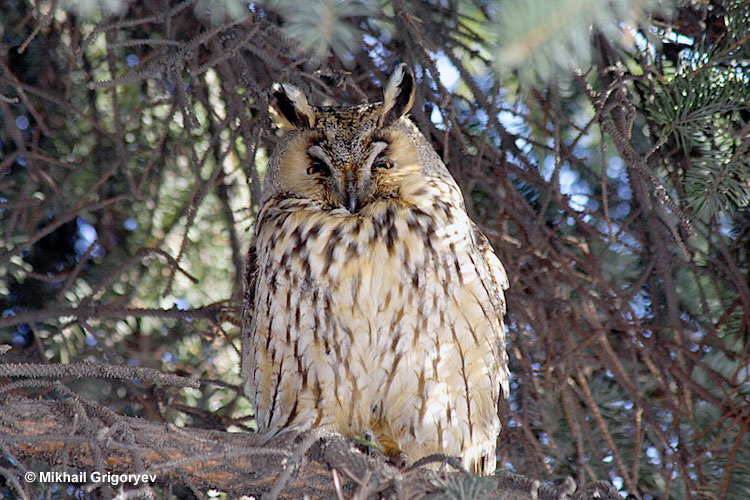
- Range: Migrant in southern Canada, resident and winters in much of the USA. Absent from parts of the Pacific Northwest and southeastern states.
- Length: 15 inches
- Wingspan: 36 inches
- Call: Makes a single, one second long “Hooo!” call at regular intervals.
The Long-eared Owl is a medium-sized, slender owl with long ear tufts. It has an orange face, is mottled gray above, and has dark brown streaks and marks on pale underparts. This owl also has long wings with a rufous patch in its primaries.
Male and female Long-eared Owls look similar but females are larger. This owl species also has yellow eyes, and some pale markings between its eyes and around its dark beak.
This nocturnal owl frequents coniferous woodlands near meadows.
Key Identifications:
- Medium-sized, slender owl species with long ear tufts, orange on its face, and long wings with an orange-brown patch near the wingtips.
- Occurs in coniferous and mixed forests near meadows, bogs, and other open areas.
- Nests in old crow, magpie, and hawk nests.
- Glides over open habitats near forest at night to catch small animals on the ground.
Frequently Asked Questions
What is the most common owl in PA?
The most common owl in Pennsylvania is the Great Horned Owl. According to eBird sightings, this owl species is heard and seen more than any other in the state.
Do owls live in Philadelphia?
Yes, owls live in Philadelphia. Great Horned Owls, Barred Owls, and Eastern Screech Owls can all occur in city parks.
Where can I see owls in PA?
You can see owls in forests and many other natural habitats in PA.
What’s the biggest owl in Pennsylvania?
The biggest owl in Pennsylvania is the Great Horned Owl. This big bird can be 22 inches long and has a 44-inch wingspan.
Does Pennsylvania have snow owls?
Yes, Pennsylvania has Snowy Owls. However, these spectacular birds are very rare winter visitors to the state.
Are Barn Owls native to Pennsylvania?
Yes, Barn Owls are native to Pennsylvania.
More in Pennsylvania: Most common birds | Hawks | Woodpeckers | State bird