


Scientific Name: Sitta pusilla
The Brown-headed Nuthatch is a tiny, active songbird found in the pine forests of the southeastern United States. Its blue-gray back, brown cap and high-pitched squeaky calls make it a distinctive bird, although it can be easy to overlook among the branches.
These social birds spend much of their time climbing up and down pine trunks in search of insects and seeds. They’re also among the few North American songbirds known to use tools to find food.
Identification
Brown-headed Nuthatches are small, compact songbirds with short tails, strong feet and straight, pointed bills. They often climb headfirst down tree trunks, a behavior that helps distinguish them from many other small woodland birds.
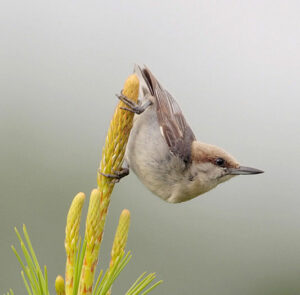
Adults measure around 4.3 to 4.7 inches (11 to 12 centimeters) long, with a wingspan of 6.7 to 7.5 inches (17 to 19 centimeters). They weigh approximately 0.3 to 0.4 ounces (8 to 11 grams).
Male
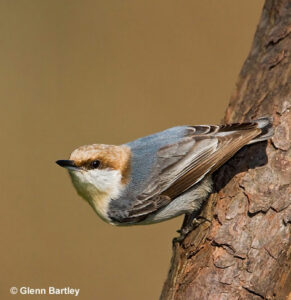
Male Brown-headed Nuthatches have a brown cap that extends down to the eye, a blue-gray back and wings, and pale underparts. A small white patch on the back of the neck is often visible.
Their bills are long and pointed, with a slightly curved appearance. Their short tails and compact bodies help them move easily along pine branches.
Female
Female Brown-headed Nuthatches look almost identical to males. The sexes are difficult to distinguish by appearance alone.
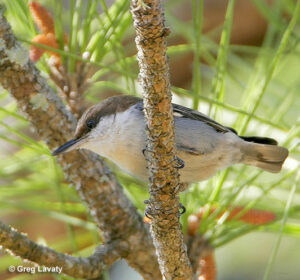
Both have the same brown cap, gray-blue upperparts, pale underside and white nape patch.
Juvenile
Young Brown-headed Nuthatches are generally duller than adults. They have a paler brown or tan head, less distinct facial markings and lighter gray underparts.
Their appearance gradually becomes more like that of adults as they mature.
Habitat
Brown-headed Nuthatches live in the southeastern United States, where they favor open, mature pine forests. They are especially associated with longleaf, loblolly, shortleaf and slash pines.
They can also be found in mixed pine and hardwood forests, particularly where mature trees and an open understory provide suitable feeding and nesting areas.
Dead standing trees are important to this species because they provide places to excavate nesting cavities. Brown-headed Nuthatches may also use old woodpecker holes or nest boxes.
Diet
Brown-headed Nuthatches eat insects, spiders and pine seeds. During warmer months, they search tree bark, branches and pine needles for beetle larvae, cockroaches, ants, spiders and other small invertebrates.
In winter, when insects are harder to find, pine seeds become a more important part of their diet.
They sometimes wedge seeds into tree bark or branches and hammer them open with their bills. They may also use small pieces of bark as tools to lift other pieces of bark and reach insects hiding underneath.
Behavior
Brown-headed Nuthatches are active birds that spend much of the day moving around tree trunks and branches. Unlike woodpeckers, they don’t use their tails as a prop when climbing. Instead, their strong feet help them grip the bark.
They are social and often travel in small family groups. In winter, they may join mixed-species flocks with chickadees, woodpeckers and Pine Warblers.
One of their most unusual behaviors is tool use. A Brown-headed Nuthatch may pick up a loose piece of bark and use it to pry away another piece, searching for insects underneath. Some individuals even carry a useful piece of bark from one tree to another.
Range (and seasonal changes)
Brown-headed Nuthatches are non-migratory birds that live in the southeastern United States throughout the year.
Their range extends from the Atlantic coastal region south through Florida and west into parts of Texas and the lower Mississippi Valley. They are also found in parts of the Bahamas, although the Bahama Nuthatch is now recognized as a separate species.
Unlike many North American songbirds, Brown-headed Nuthatches generally remain close to their breeding areas throughout the year. Their limited movements make the availability of suitable pine forest habitat especially important.
Wing shape
Brown-headed Nuthatches have short, rounded wings suited to quick flights between nearby trees and branches.
Their wingspan is approximately 6.7 to 7.5 inches (17 to 19 centimeters). They are not long-distance migrants and usually fly only short distances while moving around their woodland habitat.
Fun Facts
- They use tools: Brown-headed Nuthatches sometimes use pieces of bark to lift other bark and uncover insects. Tool use is unusual among birds.
- They have helpers: Some breeding pairs receive help from young males, often their offspring from an earlier year. These helpers may assist with nest excavation and feeding the female or young.
- They sound like a toy: Their high-pitched squeaks are often compared to the sound of a rubber duck or a squeaky dog toy.
- They climb headfirst: Like other nuthatches, they can move down tree trunks headfirst while searching for food.
- They nest in dead trees: Standing dead trees provide valuable nesting cavities. They may also excavate holes in soft, decaying wood.
- They sometimes sleep in tree holes: Brown-headed Nuthatches may spend the night in cavities or tucked among pine needles.
- They have a small range: Their distribution is largely restricted to the southeastern United States, making mature pine forests particularly important for their survival.
Call
The Brown-headed Nuthatch has a distinctive series of high-pitched squeaks and piping notes. Its calls are often compared to a rubber duck squeaking.
These birds are quite vocal, especially when moving around in family groups. Their calls help individuals stay in contact while they search for food among the branches.
Listen for repeated, short squeaky notes coming from the canopy of a mature pine forest. You may hear the birds before you manage to spot them.
Similar Species
Brown-headed Nuthatches can be confused with other small nuthatches, particularly the Pygmy Nuthatch and Red-breasted Nuthatch.
Pygmy Nuthatch
The Pygmy Nuthatch is very similar in size and general appearance. It also has a brownish cap, blue-gray upperparts and pale underparts.
However, the Pygmy Nuthatch lives mainly in western North America, while the Brown-headed Nuthatch is found in the Southeast. The Pygmy Nuthatch also lacks the distinct white nape patch of the Brown-headed Nuthatch.
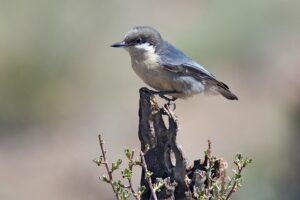
Pygmy Nuthatch, Cabin Lake Viewing Blinds, Deschutes National Forest, Near Fort Rock, Oregon
Red-breasted Nuthatch
The Red-breasted Nuthatch has a blue-gray back, a dark eye stripe and rusty-orange underparts. Its face pattern is much more contrasting than that of the Brown-headed Nuthatch.
It also has a broader range across North America and can be found in many types of coniferous forests.
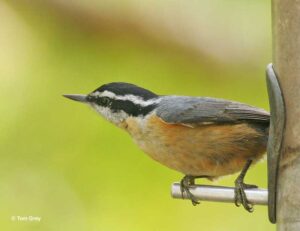
Male Red-breasted Nuthatch
White-breasted Nuthatch
The White-breasted Nuthatch is considerably larger, with a white face and underparts, blue-gray back and long, pointed bill.
It lacks the brown cap of the Brown-headed Nuthatch. White-breasted Nuthatches are also widespread across much of the United States.
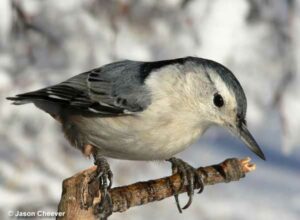
White-breasted Nuthatch
Frequently Asked Questions
Where do Brown-headed Nuthatches live?
Brown-headed Nuthatches live in the southeastern United States. They prefer open, mature pine forests, especially those with longleaf, loblolly, shortleaf or slash pines.
What do Brown-headed Nuthatches eat?
They mainly eat insects, spiders and pine seeds. They search tree bark and branches for insects and sometimes use pieces of bark as tools to uncover hidden food.
Do Brown-headed Nuthatches migrate?
No. Brown-headed Nuthatches are year-round residents and generally stay in the same region throughout the year.
What does a Brown-headed Nuthatch sound like?
Its call consists of high-pitched squeaks and piping notes, often compared to a rubber duck or squeaky toy.
How do you attract Brown-headed Nuthatches?
If you live within their range, you may attract them by providing suitable nesting habitat and food. Suet feeders can be useful, and nest boxes designed for the species may provide additional nesting opportunities.
Where do Brown-headed Nuthatches nest?
They nest in cavities in standing dead trees, often excavating their own holes in soft or decaying wood. They may also use abandoned woodpecker cavities and suitable nest boxes.
Do Brown-headed Nuthatches use tools?
Yes. They sometimes use small pieces of bark to pry up other pieces of bark and uncover insects. This is an unusual feeding behavior among birds.