

Texas is a haven for hundreds of bird species. We find fantastic birding in The Lone Star State because it harbors a wide variety of habitats. In addition to the northern limit of subtropical thorn forests in the lower Rio Grande Valley, other parts of the state have their own distinct habitats and birds.
Eastern Texas has cypress swamps and southern forests, western Texas harbors deserts, and we find juniper woodlands in the central part of the state. There are also prairies and important coastal habitats used by thousands of ducks and shorebirds.
- Most Common Birds of Texas
- Northern Cardinal
- Northern Mockingbird
- Mourning Dove
- White-winged Dove
- Carolina Chickadee
- Carolina Wren
- Blue Jay
- Turkey Vulture
- Great-tailed Grackle
- Great Egret
- American Crow
- Great Blue Heron
- Black Vulture
- House Sparrow
- Red-winged Blackbird
- House Finch
- Red-bellied Woodpecker
- European Starling
- Yellow-rumped Warbler
- Downy Woodpecker
- Black-crested Titmouse
- Barn Swallow
- Snowy Egret
- Ruby-crowned Kinglet
- Eastern Phoebe
- Killdeer
- White-eyed Vireo
- American Robin
- Tufted Titmouse
- Blue-gray Gnatcatcher
- Frequently Asked Questions
Not to mention, Texas has a hot climate with mild winters. All of these factors work together to give Texas an official bird list of 664 species, the second highest for any state. Based on breeding bird surveys, these are the most common backyard and wild birds in Texas.
Most Common Birds of Texas
According to eBird data for 2022-2023, these are the most common bird species in Texas. These beautiful birds can be found right in our own backyards as well as in wilder places.
Northern Cardinal
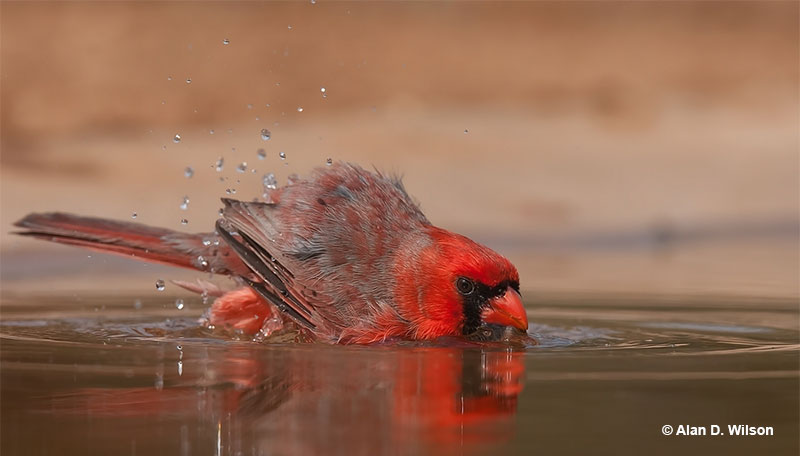
Northern Cardinals are the most common birds of Texas. Photograph © Alan D. Wilson
Scientific name: Cardinalis cardinalis
Length: 8.75 inches
Weight: 1.6 ounces
Wingspan: 12 inches
Song: “pichew-pichew-pichew, chew,chew,chew,chew,chew”
Northern Cardinals are medium-sized bright-red songbirds with a perky crest and big beak.
Female Northern Cardinals are duller in color, with some black on their face and throat. They also have red highlights in their crest, wings, and long, rounded tail.
This species has short, rounded wings and seems to bounce up and down as they move through the air. In flight, Northern Cardinals also make sharp chip notes.
The Northern Cardinal eats seeds, insects, and some fruit and is a regular visitor to bird feeders. They forage on and near the ground, but males sing from a prominent perch.
Key Identifications:
- Crested bird with a conical orange-red beak and a black face. Males are red, females are grayish-brown and buff.
- Forages for seeds and insects on and near the ground.
- Makes a cup-shaped nest in bushes and low trees.
- Sings a clear, whistled song of repeated notes. They can sound like “cheer, cheer, chew, chew, chew, chew” or a quick “birdee,birdee,birdee,birdee,birdee“. They also make loud, sharp chip notes.
Northern Cardinals are one of the most beautiful common birds in much of their range. It’s no wonder seven different states chose it to be their official bird. Another fun fact about this species is that female Northern Cardinals also sing. They sing while sitting on the nest and may do so to tell their mates to bring food or warn them about predators.
Northern Mockingbird
Scientific name: Mimus polyglottos
Length: 10 inches
Weight: 1.7 ounces
Wingspan: 14 inches
Song: “kerdee, kerdee, kerdee…jirdle,jirdle,jidrle…”
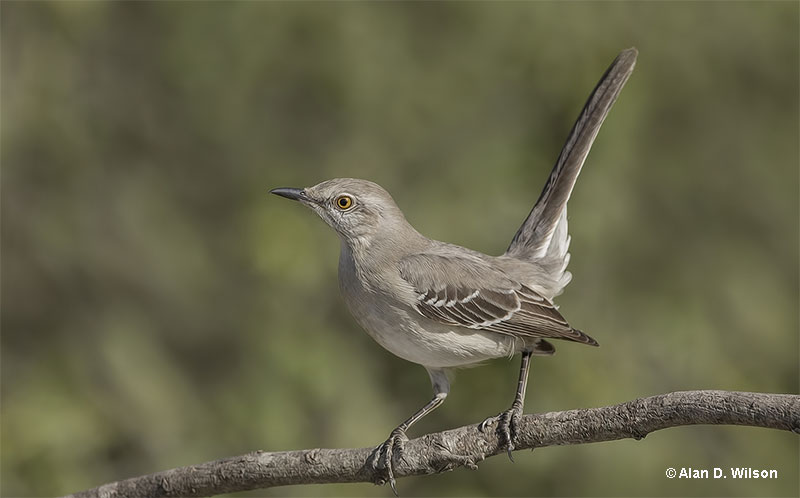
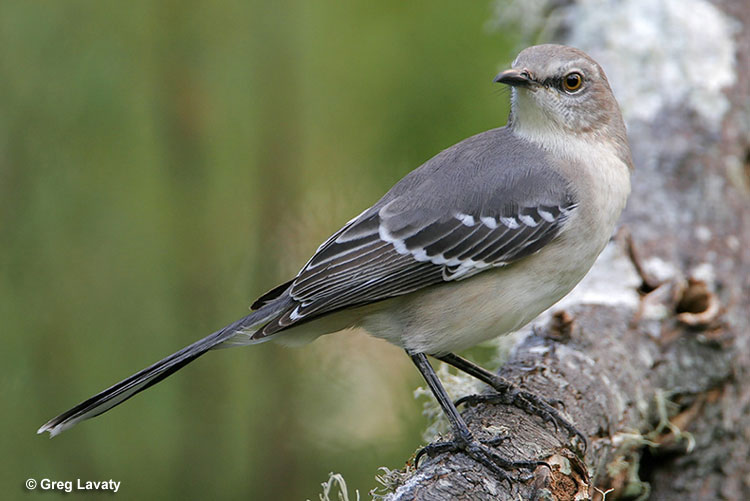
The Northern Mockingbird is a pale gray and white bird with a long tail. These birds have gray and white plumage and a short slender bill.
Both sexes look alike. In flight, this bird shows a blackish tail with white outer feathers and a big white wing patch.
Northern Mockingbirds feed on insects and berries. They forage in open grassy spots, on the ground. These animated birds run and pick bugs from the ground and fly up to catch insects in flight. During winter, they also perch in bushes to feast on berries.
The Northern Mockingbird lives in towns, parks, and other semi-open habitats, and builds cup nests in bushes and low trees. Northern Mockingbirds are one of the most common birds of Texas, and in the eastern and southern USA, southern Ontario, and Mexico.
They are not only one of the most common birds of Texas, but the Northern Mockingbird has the title of being the state bird of Texas.
Key Identifications:
- Vocal, gray and white bird with a small bill, white wing patches, and a long, black and white tail.
- Feeds on the ground in open areas and in bushes. Mostly eats insects and berries.
- Makes a cup nest in a bush or low tree.
- Very vocal. Sings many phrases and mimics many other birds. Some of the more regular phrases sound like, “kerdee, kerdee, kerdee…jirdle,jirdle,jidrle…“. These are interspered with the calls of Blue Jays, woodpeckers, Tufted Titmouse, and various other bird species.
This species can mimic the calls of 35 bird species as well as mechanical sounds. More than a century ago, these avian virtuosos were highly prized as a cagebird and were traded for large sums of money.
Mourning Dove
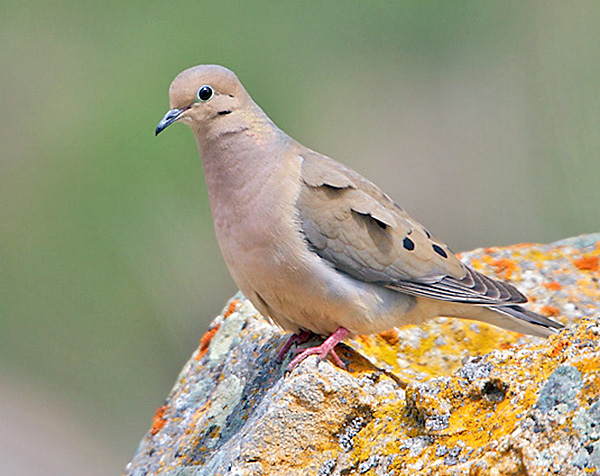
Photograph © Greg Lavaty.
Scientific name: Zenaida macroura
Length: 12 inches
Weight: 4.2 ounces
Wingspan: 18 inches
Song: “hooOOA, hoo, hoo, hoo”
Mourning Doves are medium-sized, grayish-brown doves with long tails. They have small black spots on their wings and a small head with a slender, dark beak.
Males and females also have narrow gray eyerings, a black mark on the face, and pale iridescent gold on the sides of their necks. They look alike except for males having more gray on the head and neck, and more iridescence.
This dove has fairly long wings and swift, direct flight. When flying, it shows black and white in its tail.
The Mourning Dove occurs in woodlands, gardens, on farms, and in urban areas. This common feeder visitor eats seeds and grains. It also forages in open situations, picking food from the ground.
This pleasant dove species can visit a feeder on its own or forage in small flocks. It builds an unkempt stick nest in bushes and trees and is very common throughout the USA, southern Canada, and Mexico.
Key Identifications:
- Plain brown and gray dove with a long, pointed tail.
- Feeds on seeds at feeders and on the ground in open areas.
- Makes a small, messy nest of sticks in trees.
- Sings a sad and owl-like “hooOOA, hoo, hoo, hoo”.
The Mourning Dove is the common garden dove in most of its range. It often visits feeders and its cooing song is commonly mistake for an owl. This species has a short lifespan with many adults only living for a couple of years or less.
White-winged Dove
Scientific name: Zenaida asiatica
Length: 121.5inches
Weight: 5 ounces
Wingspan: 19 inches
Song: “hrrHOOP, who, hroo”
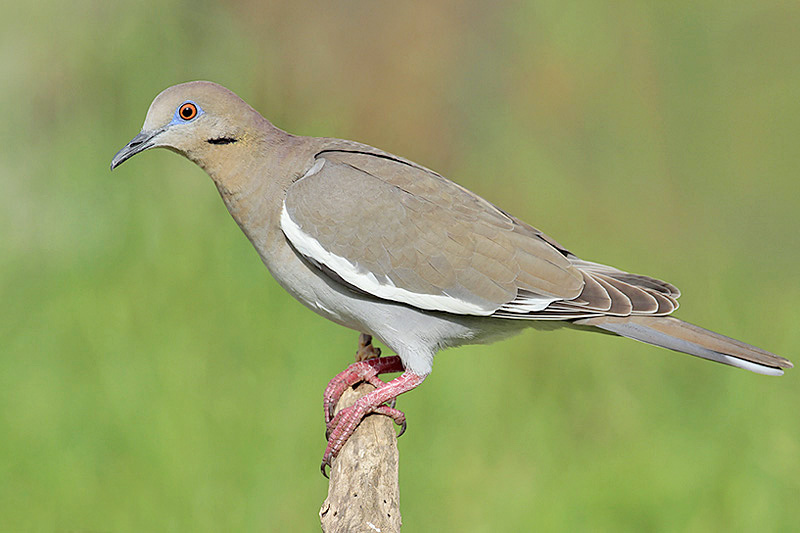
White-winged Doves are sandy brownish and gray doves with rectangular tails. They have a white patch in each wing, a white tail tip, and a dark, slender beak.
Males and females look similar and have blueish eyerings and orange-red eyes. They have a black mark on the lower side of the face and reddish legs and feet.
White-winged Doves have fairly long wings and can fly long distances in quick, direct flight. When flying and perched, the underside of its tail looks black with a broad white tip.
The White-winged Dove lives in gardens, urban areas, farmlands, and other semi-open habitats. It mostly feeds on seeds and grain that it picks up from the ground in farm fields and many other open situations.
This easily-seen dove species usually forages in groups and can form large flocks. They make messy stick nests in trees and, in the USA, are mostly found in Texas west to parts of southern California.
Key Identifications:
- Gray and pale brown dove with white in its wings and a rectangular tail with a black and white tip.
- Occurs in semi-open habitats where it forages on the ground for grain and seeds.
- Builds a small, messy stick nest in trees.
- Sings a classic, cooing dove song “hrrHOOP, who, hroo”.
The White-winged Dove is common, easily seen, and may be spreading north. It feeds on the ground and often occurs in flocks. This species gets most of its water from cactus fruits but, when needed, can fly 25 miles in search of a water source.
Carolina Chickadee
Scientific name: Poecile carolinensis
Length: 4.75 inches
Weight: .37 ounces
Wingspan: 7.5 inches
Song: “see-dee, see-dew”
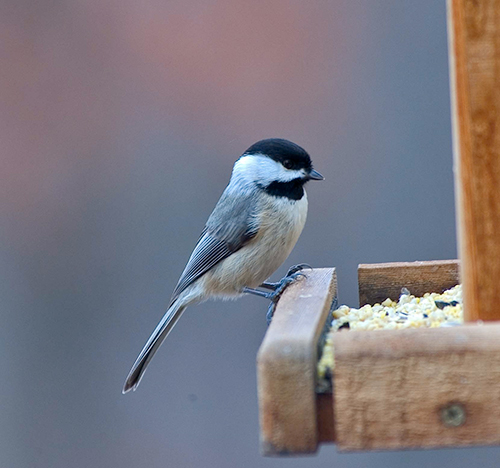
The Carolina Chickadee is a small, cute, grayish and buff bird with a black cap, black throat, and white face. Males and females look the same and have stubby black beaks, strong, blue-gray legs and feet, and some pale edging on the feathers in their wings and tails.
This small bird mostly feeds on insects and seeds. It finds food by foraging with flocks of other small birds and picking small bugs and other items from bark, foliage, and twigs.
Carolina Chickadees often hang upside down from twigs while foraging and are regular visitors to bird feeders. They are one of the most common birds of Texas.
These fun little birds nest in tree cavities and nest boxes, and live in parks, woodlands, and other habitats. As long as enough trees are present, they also commonly live in urban areas.
The Carolina Chickadee is a permanent resident from Maryland and Ohio west to Texas and south to northern Florida.
Key Identifications:
- The Carolina Chickadee is a small gray and buff bird with a smart black cap, black throat, and white face.
- Feeds on small insects and seeds. A regular visitor to bird feeders.
- Nests in tree cavities and nest boxes.
- Carolina Chickadees are vocal birds that make nasal “chick a dee dee dee” calls, and a high-pitched, “see-dee, see-dew”.
The Carolina Chickadee is a small grayish bird with a black cap and throat. They usually occur in small flocks that forage for insects and seeds as they chatter and move through woodlands and park-like habitats. This species uses its excellent memory to recall where it keeps hidden bits of food.
Carolina Wren
Scientific name: Thryothorus ludovicianus
Length: 5.5 inches
Weight: .74 ounces
Wingspan: 7.5 inches
Song: “teakettle, teakettle, teakettle”
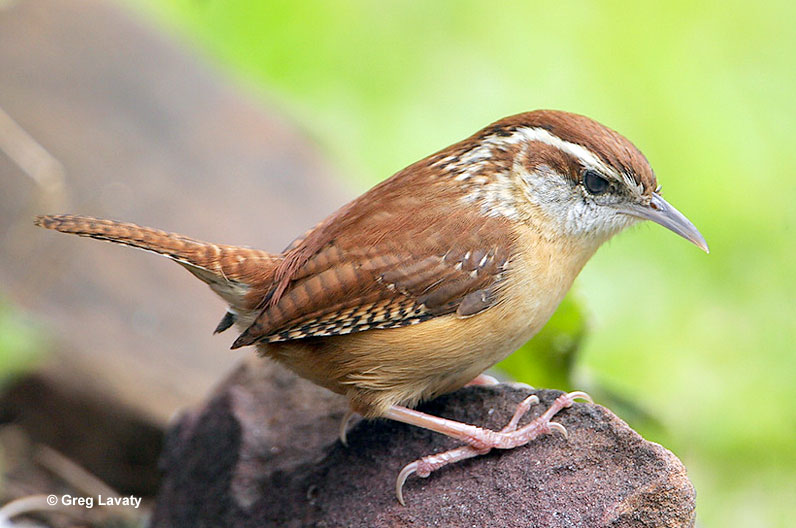
The Carolina Wren is a small, reddish-brown bird with a long, sharp, slightly decurved beak. It has a long, narrow, white eyebrow, a white throat, and some white mottling on its face. Males and females are similar and have black barring on their short wings, long tail, and under the tail.
Juveniles are similar but have paler underparts. This animated and vocal little bird forages for bugs in vine tangles and other dense vegetation. It usually occurs in pairs that can easily hide in the dense vegetation they prefer.
Carolina Wrens build a domed, cup nest made of sticks and soft vegetation. There is a side entrance, and it can be placed in cavities and crevices of stumps, bushes, trees, potted plants, and other structures.
The Carolina Wren lives in vegetated gardens, second growth, parks and similar habitats in much of the eastern USA, parts of southern Ontario, and parts of eastern Mexico.
Key Identifications:
- Small reddish-brown and buff bird with a long beak and long white eyebrows.
- Feeds on arthropods in dense, tangled vegetation.
- Makes a domed cup nest with a side entrance in crevices, tree cavities, and human-made structures.
- Carolina Wrens fill the garden with loud and melodious songs. One common song sounds like “teakettle, teakettle, teakettle“. They also make trilled sounds and harsh, nasal calls.
The Carolina Wren is a vocal species of gardens and second growth. Pairs use their long beaks to catch bugs and insects and aren’t shy about nesting near people. Many of these friendly birds have nested in such places as old shoes, potted plants, and abandoned cars.
Blue Jay
Photograph © Alan Wilson.
Scientific name: Cyanocitta cristata
Length: 11 inches
Weight: 3 ounces
Wingspan: 16 inches
Song: “Nyeah! Nyeah! Nyeah!”
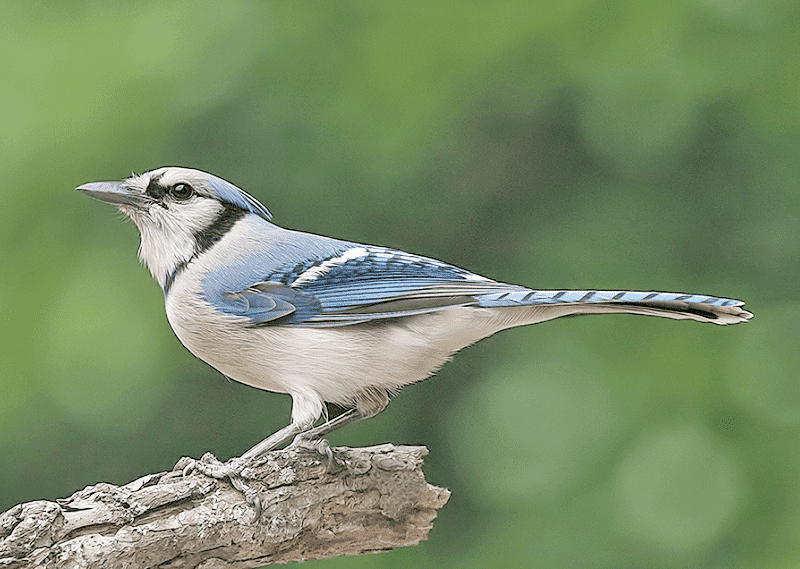
The Blue Jay is a fairly large, crested bird with a straight black bill. Both sexes look alike and are blue above and gray and white below. They also have some small black lines on their faces and a narrow black necklace that goes up to the side of their face and crest.
Blue Jays also have some white markings and black barring in their wings and on their tail. Young birds look like adults but are duller blue.
These social and intelligent birds feed on acorns, nuts, insects, and other small creatures. Like other members of the jay and crow family, they eat the eggs and nestlings of other birds.
The Blue Jay is a common bird of woodlands, forest, and towns east of the Rocky Mountains in the USA and central and southern Canada. They are one of the most common birds of Texas.
Key Identifications:
- Crested, fairly large bird with bright blue above and gray below.
- Feeds in trees and at feeders. Eats acorns, nuts, insects and many other food items.
- Makes a messy cup nest of sticks in a tree.
- Very vocal. In flight, Blue Jays often call as they swoop through the trees. They make a variety of sounds and mimic some other birds. Common calls include a nasal and complaining “Nyeah! Nyeah! Nyeah!” and various whistled calls.
The Blue Jay is a common, intelligent, and noisy bird. They make their presence known with their loud calls and can visit feeders. Ironically, when communicating with each other at close quarters, this species makes much softer and quieter calls. It’s almost as if they are talking with each other!
Turkey Vulture
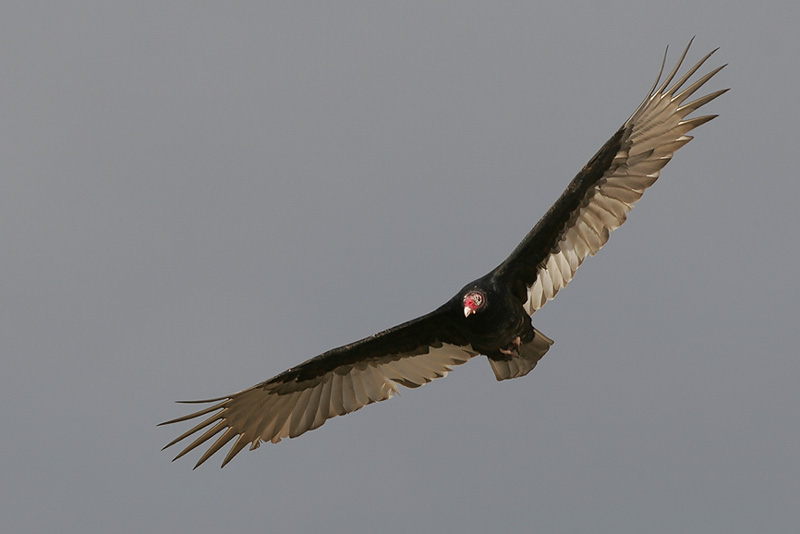
Scientific name: Cathartes aura
Length: 26 inches
Weight: 4 pounds
Wingspan: 67 inches
Song: “hisss”
The Turkey Vulture is a big, dark brownish-black raptor with a small red head and long, broad wings. Males and females look alike and also have a longish tail.
In flight, the way Turkey Vultures soar is one of the best ways to recognize them. They fly with their wings held in a “V” shape and, when gliding, often rock back and forth.
Their flight feathers are also paler than the rest of their wings, but they lack the Black Vulture’s white wing patch.
Turkey Vultures are scavengers, and most of their diet is carrion. They eat road kill and a wide variety of dead animals. This species forages over every type of habitat and can also fly over urban areas.
It lays two eggs on the ground in caves and hollow logs.
The Turkey Vulture lives in southern Canada and in most of the USA south to southern Argentina.
Key Identifications:
- Big, dark raptor with a small red head that soars with long wings held in a “V”.
- Feeds on dead animals.
- Nests on the ground in caves and hollow logs in secluded areas.
- Turkey Vultures rarely call and mostly make hissing sounds at their nest.
The Turkey Vulture is commonly seen flying over every type of habitat. They are often seen on their own but can occur in flocks, especially during migration. Unlike most other birds, this species uses its amazing sense of smell to find dead animals.
Great-tailed Grackle
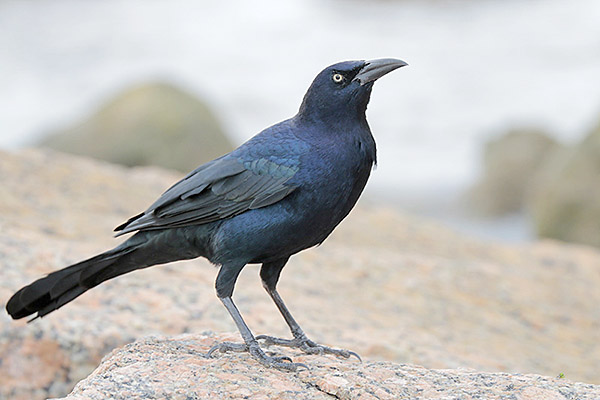
Photograph © Greg Lavaty.
Scientific name: Quiscalus mexicanus
Length: 15-18 inches
Weight: 3.7-7 ounces
Wingspan: 19-23 inches
Song: “fliirrr, klee!, klee! kek, kek, kikikikiki”
Great-tailed Grackles are big blackbirds with long, wedge-shaped tails, pale yellow eyes, and strong, stout beaks. Males are entirely black with metallic purple and dark blue highlights.
Female Great-tailed Grackles are noticeably smaller and are grayish brown with a pale, tawny- buff eyebrow and throat. They also have blackish wings, and a blackish tail and rump.
The Great-tailed Grackle has shallow, undulating flight and usually occurs in flocks. Large, very noisy groups can gather at roosting sites, especially early in the morning and late in the
Eats seeds, insects, small animals, and other food items that it finds on the ground afternoon.
This big blackbird species live in urban areas, wetlands, and on farms. They forage on the ground, picking up grubs, insects, grain, and other food items. This species also feeds on the eggs and nestlings of other bird species.
Great-tailed Grackles make messy stick nests in bushes and low trees and live in the American southwest, north to Kansas, and south to Central America. They are one of the most common birds of Texas.
Key Identifications:
- Large, glossy blackbird with a long, wedge-shaped tail and pale eyes. Females are grayish brown with a pale throat and eyebrows.. Also feeds on the eggs and nestlings of other bird species.
- Builds a messy stick nest in bushes.
- Makes loud whistled songs “fliirrr, klee!, klee! kek, kek, kikikikiki”, and “kek” calls.
The Great-tailed Grackle is a big, bold long-tailed bird that is hard to ignore. Small flocks of glossy purple-black males and gray-brown females forage on the ground for a variety of food items.
Great Egret
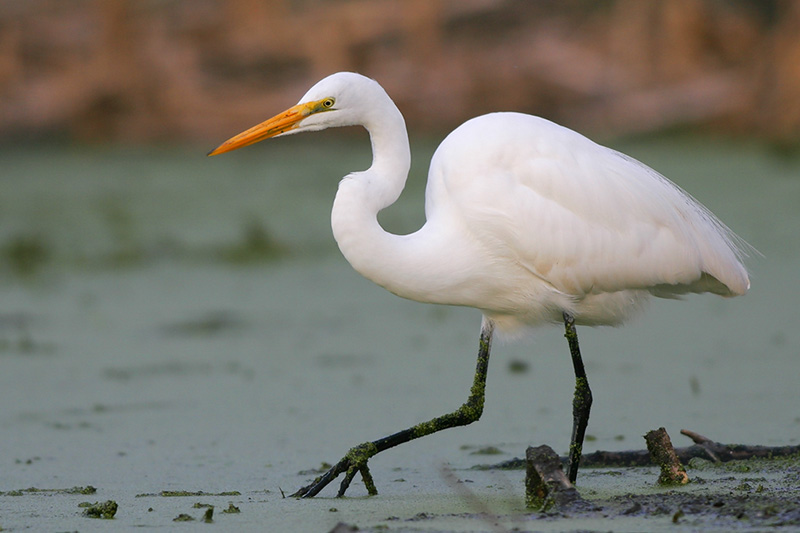
Photograph © Greg Lavaty.
Scientific name: Ardea alba
Length: 39 inches
Weight: 1.9 pounds
Wingspan: 51 inches
Song: “koorr”
The Great Egret is a big, white heron with a long neck, and long dark legs and feet. Both sexes look similar and have long, sharp yellow beaks, and pale eyes.
In breeding season, they have long, elegant white plumes on their backs, and greenish skin in front of their eyes.
In flight, this large waterbird shows long, broad wings and a short, broad tail. Its legs trail out behind it and the bird holds its neck tucked in.
Great Egrets feed on fish, frogs, snakes, and other small animals that venture too close, birds and rodents included. They wade in or near water and then wait until prey comes close. If the animal approaches within range, they quickly catch it with their long, sharp beak.
The Great Egret nests in colonies and builds a big, messy, stick nest. It is common in wetlands in much of the USA, parts of southern Canada, and many other parts of the world.
Key Identifications:
- Big white bird with a long neck, yellow beak, and dark legs and feet.
- Feeds in and near wetlands, on the ground. Catches fish and small animals with its long, sharp beak.
- Makes bulky stick nests in colonies.
- Great Egrets make deep, croaking sounds, especially when taking flight. “koorr…koorr“
This species is also the symbol of the Audubon Society. This organization was formed in 1905 to protect Great Egrets and other birds. At that time, in the USA, these large herons had been hunted to near extinction to supply elegant plumes for women’s hats.
American Crow
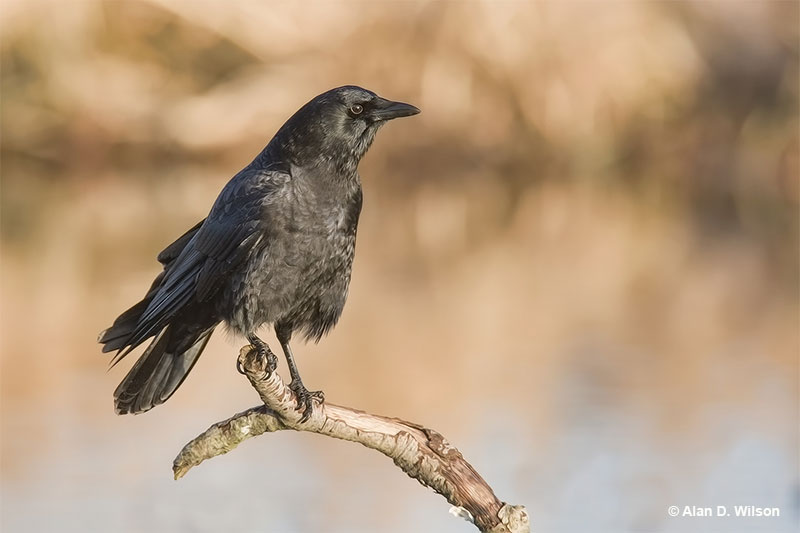
© Alan D. Wilson
Scientific name: Corvus brachyrhynchos
Length: 17.5 inches
Weight: 1 pound
Wingspan: 39 inches
Song: “Caw, Caw, Caw!”
The American Crow is a large, black bird with a stout, slightly hooked beak. In some lighting, this species is also highlighted with metallic blue and purple iridescence.
Male and female American Crows resemble each other, have feathers on part of their bills, long, broad wings, and a broad tail.
This big bird can fly for several miles with steady wing beats. These social and complex birds typically occur in flocks, and are very intelligent.
American Crows usually feed on the ground and are omnivores that will eat almost anything they find.
This varied diet can include everything from dead animals to nuts, fruit, carrion, insects, and small animals. As with other members of the Corvid family, crows won’t hesitate to feed on the eggs and nestlings of other birds.
It makes bulky stick nests in trees and occurs everywhere except in deserts and high elevations.
American Crows range from Alaska to Canada and south to Texas. They are one of the most common birds of Texas.
Key Identifications:
- Large, hefty, black bird with long, broad wing and a broad tail.
- An omnivore that feeds on carrion, seeds, insects, fruit, and small animals.
- Makes bulky stick nests.
- The American Crow is a loud and noisy bird. They are capable of making all sorts of sounds but their most frequent call is, “Caw! Caw! Caw!”.
American Crows are big, black birds with long, broad wings. They are social and easily seen in towns, on farms, and many other habitats. This species is very smart and can even be taught to mimic human speech.
Great Blue Heron
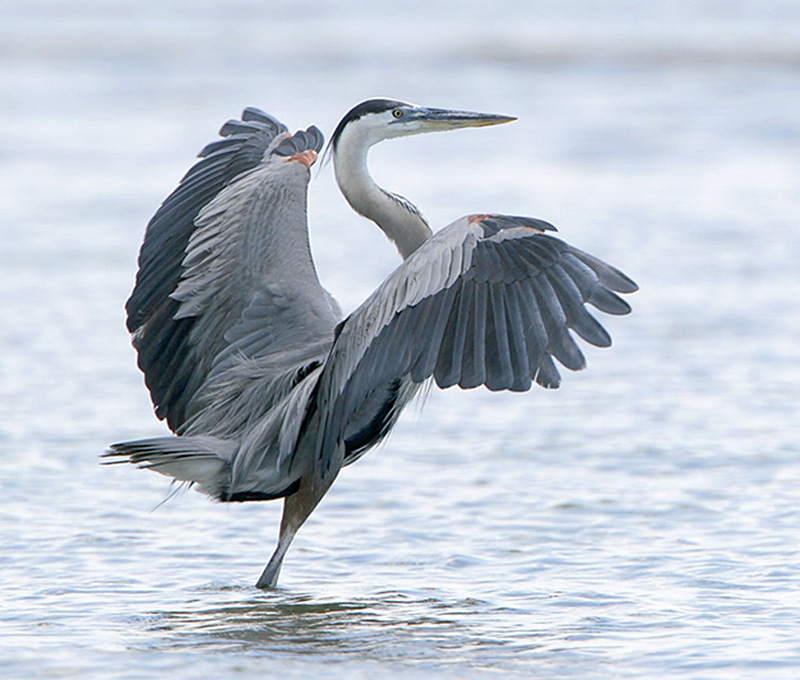
Photograph © Greg Lavaty.
Scientific name: Ardea herodias
Length: 46 inches
Weight: 5.3 pounds
Wingspan: 72 inches
Song: “Grunk! Grunk!”
The Great Blue Heron is a large, gray and pale brown heron with a long neck and legs. It has a strong, yellowish beak, black and white head with a wispy black crest, and rufous thighs.
Both sexes are alike and have pale bellies and black flanks. Juveniles have streaked underparts.
In flight, they make slow, deep flaps with long, broad gray and black wings. In Southern Florida and the Caribbean, Great Blue Herons are all white and sometimes considered a separate species, the “Great White Heron”.
These powerful herons feed on fish and small animals such as rats, snakes, and birds. They wade in and near water, wait, and then quickly catch prey with their sharp beaks.
Great Blue Herons build messy, stick nests and breed in colonies, often in swamps. They are one of the most common birds of Texas.
Key Identifications:
- Huge gray and pale brown wading bird with a thick, yellowish beak and a wispy crest. In southern Florida, it is all white but still has a crest and a strong yellowish beak.
- Stalks and preys on fish and small animals.
- Builds messy stick nests and breeds in colonies.
- Great Blue Herons aren’t all that vocal. When taking flight they make a croaking sound, “Grunk! Grunk!“.
As year-round residents, they occur on rivers, lakes, and many other wetlands. It stands still for long periods of time while waiting for prey to come within range of its sharp beak but is also, often seen in flight.
Black Vulture
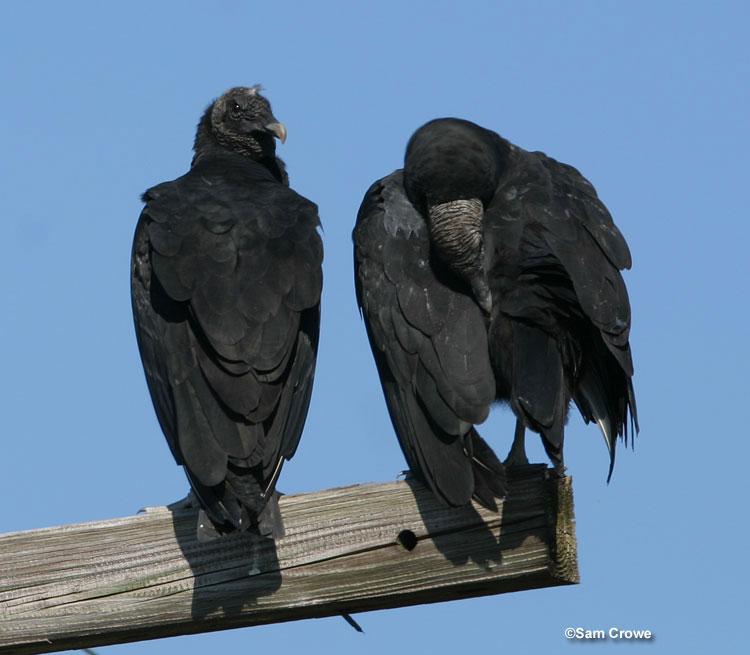
Scientific name: Coragyps atratus
Length: 25 inches
Weight: 4.4 pounds
Wingspan: 59 inches
Song: “whuf”
The Black Vulture is a big, bulky, black raptor with a naked, wrinkled black head and rather short, broad tail. It has a white patch near the tip of each of its long, broad wings, and a pale, slender beak with a hooked tip.
Male and female Black Vultures look alike and also have fairly long, blackish legs and feet. They fly with a few quick flaps followed by soaring with their wings held flat.
This species mostly feeds on carrion but it can also catch small animals when the opportunity presents itself. Black Vultures usually feed in flocks and find their food by soaring high overhead and watching for dead animals as well as following other vultures to food sources.
The Black Vulture lays eggs on the ground inside caves, abandoned buildings, hollow logs, or other dark and protected places. It uses a wide variety of habitats from southern New York west to Arizona and south to Argentina.
Key Identifications:
- Big, bulky black raptor with a black head, long, broad wings with a patch of white near the wingtip, and a short, broad tail.
- Feeds on freshly killed animals, and, occasionally, small animals.
- Lays eggs on the ground in caves, hollow logs, and other dark and protected places.
- Black Vultures are quiet birds. Once in a while, they make soft, muffled calls that sound like, “whuf”.
The Black Vulture is a large, mostly black raptor with broad wings and a short tail. Small groups often soar above wetlands, woodlands, residential areas, and other habitats. Surprisingly, their stomach acid is so strong, their droppings have little to no bacteria, viruses, or fungi.
House Sparrow
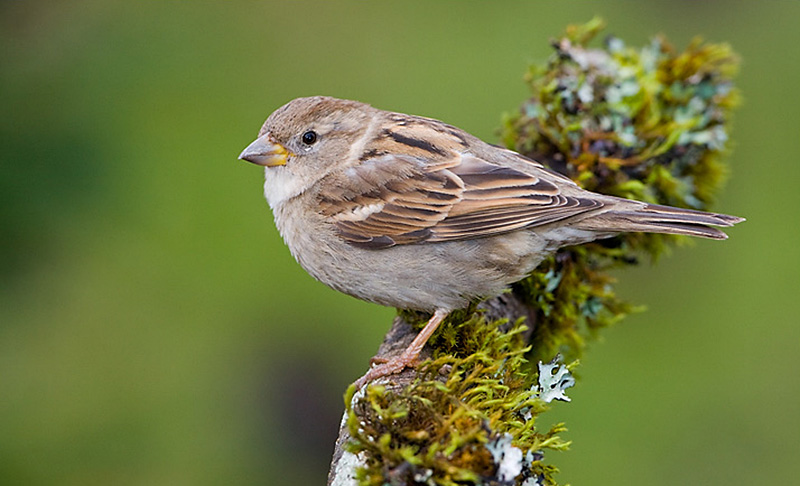
Scientific name: Passer domesticus
Length: 6.25 inches
Weight: .98 ounces
Wingspan: 9.5 inches
Song: “see,chirrup,see,chirrup,see,chirrup”
House Sparrows are small, plump gray and brown birds with conical, finch-like beaks. Males have a gray and rufous head with pale cheeks, and black near their eyes and on their throat.
The rest of their underparts are gray and they have brown, streaked backs with rufous highlights. They also have a white mark in the shoulder of each wing and a grayish rump and tail.
Females are plainer brown and buff, have paler beaks, and buff eyebrows.
These common backyard birds feed on seeds (such as sunflower seeds), grain, and insects. They are regular visitors to bird feeders and often dominate other smaller species. They also forage on the ground in farmlands, parks, urban areas, and other open situations.
The House Sparrow nests in cavities. When searching for suitable nesting sites, they can kill and remove the eggs and young of smaller species like Eastern Bluebirds.
House Sparrows usually live near people and occur in most of North America. They are one of the most common birds of Texas.
Key Identifications:
- Brown and gray sparrow with a bold pattern on its head.
- Feeds on seeds, grain, and insects at feeders and on the ground in urban areas and farmlands.
- Nests in tree cavities, including nest boxes.
- This species is vocal and often makes short chirping calls. Its song is a friendly series of chirping sounds, “see,chirrup,see,chirrup,see,chirrup”.
In many places, the House Sparrow is the common urban sparrow. It occurs in pairs and small groups that forage on sidewalks, in parking lots, farm fields, and other familiar places. This species is one of the very few birds that has evolved to live with people and digest the same grains that we eat.
Red-winged Blackbird
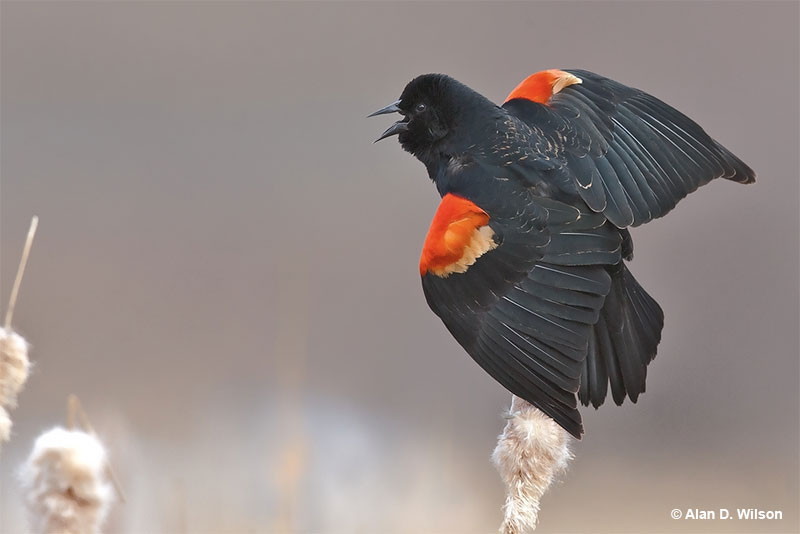
Scientific name: Agelaius phoeniceus
Length: 8.75 inches
Weight: 1.8 ounces
Wingspan: 13 inches
Song: “kan-keree!”
The Red-winged Blackbird is a medium-sized blackbird species with a sharp, all black bill. Males also have a scarlet patch with a pale yellow border on the shoulder of each wing.
Female Red-winged Blackbirds are dark, heavily streaked, brownish-gray birds with an orange-buff eyebrow and throat. She can also have a little bit of dingy red on her shoulder.
Red-winged Blackbirds often flock together and can form very large groups in the winter. They feed on seeds, grain, and insects found on lawns, in marshes, farm fields, and other open habitats.
This species builds a cup nest made of leaves and dead stems in a bush or other low vegetation in a marsh, park, or brushy field. Their nests are often parasitized by Brown-headed Cowbirds.
Red-winged Blackbirds are very common birds that live in all sorts of open habitats. We see them in parks, farming areas, and marshes in much of Canada, the USA, Mexico, and parts of the Central America.
Key Identifications:
- Males are medium-sized blackbirds with a bright red patch on their wings. Females are heavily streaked, have a sharp black beak, and buff on the head.
- Feeds on seeds, grain, and insects on the ground in many open habitats.
- Builds a cup nest in a bush or other low vegetation.
- Red-winged Blackbirds often call. Males sing a loud, “kan-keree!” and both sexes also make “check!” calls and a high-pitched whistle-like sound.
The Red-winged Blackbird is a common, social species easily seen in marshes and open habitats. In the winter, it can form huge flocks that feed in farm fields. This species can make a daily commute of 50 miles to and from roosting and feeding sites.
House Finch
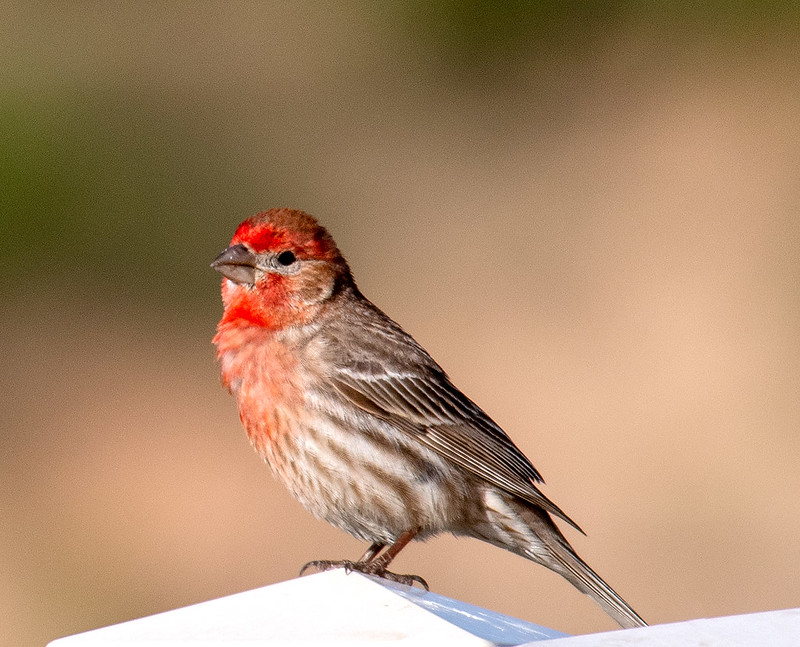
© John Hansen
Scientific name: Haemorhous mexicanus
Length: 6 inches
Weight: .88 ounces
Wingspan: 10 inches
Song: “chip,chip,chiprididip,ZREEYachip”
House Finches are sparrow-sized birds with dark, rounded beaks and fairly long wings. Males are orange-red or rose-red on their head, throat and breast, and have some red on their rump. They also have brownish streaks on their back, flanks, and white belly.
Like the male, female House Finches have two white wing bars on long, gray-brown wings. However, they lack red and are mostly streaked, dull brown-gray birds.
House Finches feed on seeds, buds, fruit, and flowers. They often visit feeders but also forage on the ground, and in bushes and trees.
We see these pretty birds in deserts and arid zones, and in parks, farmland, urban areas, and other semi-open habitats.
The House Finch makes a soft cup nest built on a tree, building ledge or other spot with some overhanging cover. They often occur in small groups and live in southern Canada, most of the USA, Mexico, and Hawaii.
Key Identifications:
- Reddish or plain gray-brown, streaked, sparrow-like bird.
- Eats seeds, flowers, buds, and fruit. Can visit feeders but also forages on the ground and in bushes and trees.
- Makes a soft cup nest in trees, on building ledges, and other places.
- The House Finch often makes a soft, “fidip” call. Males also sing a warbling song from prominent, high perches. It sounds like, “chip,chip,chiprididip,ZREEYachip”.
House Finches are sparrow-like, reddish or brownish, streaked birds. They live in arid zones as well as in parks and urban areas. All of the millions of House Finches that live east of the Rocky Mountains are descendants of birds released on Long Island in 1939.
Red-bellied Woodpecker
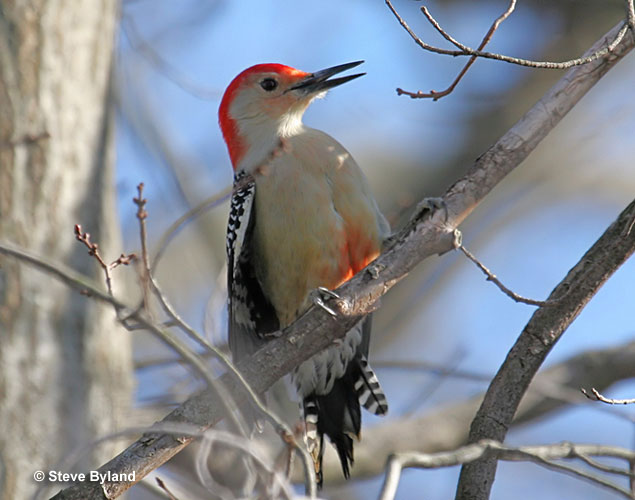
Red-bellied Woodpecker
Scientific name: Melanerpes carolinus
Length: 9.25 inches
Weight: 2.2 ounces
Wingspan: 16 inches
Song: “Qwerr!”
Red-bellied Woodpeckers are medium-sized with black and white barring on their back and wings. They have a long beak and pale gray underparts with a small red patch on the belly.
Males have red on the head from the bill to the back of the neck (the nape). Females have an orange-red spot above their bill and red on the back of their head. Both sexes have a mostly white rump and central tail feathers.
This woodpecker species has long wings and “undulating” flight where it moves up and down as it flies. In flight, Red-bellied Woodpeckers show a small white patch in their wings.
The Red-bellied Woodpecker lives in wooded habitats. It eats nuts, seeds, insects, fruit, and can attack nestlings of other species. It also visits bird feeders.
This striking woodpecker occurs in pairs and nests in tree cavities high above the ground. It is common in the eastern USA and parts of southern Ontario.
Key Identifications:
- Grayish woodpecker with black and white barring above, and red on the top of the head and back of the neck.
- Forages for seeds, nuts, insects and other food on trunks and branches.
- Nests in a tree cavity, high overhead.
- Makes a loud exclamation, “Qwerr!“. It also makes other, briefer and quieter “chug” calls.
Red-bellied Woodpeckers are common and adaptable birds. As long as big trees are present, we see them in urban areas as well as wilder places. They also visit feeders and have a very long tongue. When extended, it sticks out 2 inches past the tip of its bill!
European Starling
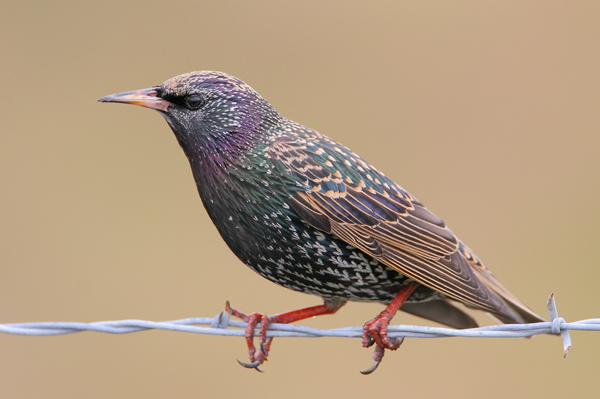
Photograph © Greg Lavaty.
Scientific name: Sturnus vulgaris
Length: 8.5 inches
Weight: 2.9 ounces
Wingspan: 16 inches
Song: “tiktiktitZHREEree..tiktiktik..ZHREE”
European Starlings are plump, short-tailed birds with long sharp beaks and longish, pointed wings. In summer, they have yellow beaks, glossy black plumage with purple and green highlights, and some small white spots.
Males and females are similar but males have less spotting and glossier plumage. In winter, they have black beaks, white spots, and more reddish colors in their wings. They are one of the most common birds of Texas.
Young starlings are shaped like adults but are grayish birds with a dark beak and a pale throat.
This species feeds on a variety of insects, fruit, and seeds. They can dominate bird feeders and are common species in urban areas, parks, farmlands, and other open habitats.
European Starlings flock with each other and blackbird species, especially during the winter. They live across a large part of Canada and the USA.
Key Identifications:
- Rotund, short-tailed bird with a long, sharp beak, and pointed wings. Glossy black with some spotting in the summer and blackish with heavy white spotting and streaking in the winter.
- Feeds on seeds, fruit, and insects. Visits feeders and forages on the ground in flocks.
- Builds a soft cup nest in nest boxes and other cavities.
- The European Starling makes a wide variety of mechanical and whistled sounds. They also mimic other birds and sounds in their environment. They sing long, jumbled mechanical-sounding songs, “tiktiktitZHREEree..tiktiktik..ZHREE”.
European Starlings are rounded, blackish birds with long, sharp beaks and short tails. They live in towns, cities, parks, on farms, and in other open habitats. This species forms large flocks called, “murmurations” that move in coordinated patterns.
Yellow-rumped Warbler
Scientific name: Setophaga coronata
Length: 5.5 inches
Weight: .42 ounces
Wingspan: 9.25 inches
Song: “si,sit,sit,sit,sit,sue,sue,sue”
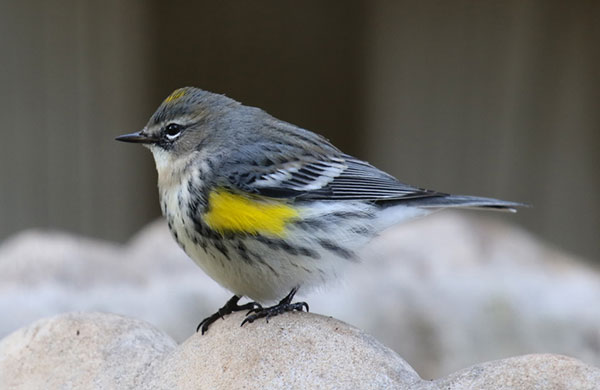
The Yellow-rumped Warbler is a small, blue-gray songbird with a yellow rump, crown, and yellow patches on each side of its breast. It also has two white wing bars, dark marks on the back, and white underparts with blackish markings on its breast and sides.
In summer, this species has a blackish face and white markings above and below the eyes. Females are like males but duller. In winter, both sexes of Yellow-rumped Warblers are duller and have more brownish plumage.
The western subspecies has a yellow throat and more white in the wings.
This species feeds on insects and small berries. It picks food from vegetation and briefly flies into the air to catch bugs in flight.
Yellow-rumped Warbler build small cup nests in conifers in Canada and the northeastern and western USA. They spend the winter in semi-open habitats from the southern USA to Central America.
Key Identifications:
- Small songbird with two pale wing bars and yellow patches on the rump, each side of its breast, and crown.
- Feeds on insects and small berries.
- Builds cup nests in conifers in northern and montane forests.
- The Yellow-rumped Warbler makes a sharp call note, “chup!”, and sings a brief and easy-going warbling song, “si,sit,sit,sit,sit,sue,sue,sue”.
Yellow-rumped Warblers are small, blue-gray or brownish songbirds with two pale wing bars, and yellow patches on the crown, sides of the breast, and rump. In winter, they occur in small flocks that feed on insects and berries in parks and other semi-open habitats. The eastern subspecies is known as the “Myrtle Warbler,” and the yellow-throated western subspecies is called, “Audubon’s Warbler”.
Downy Woodpecker
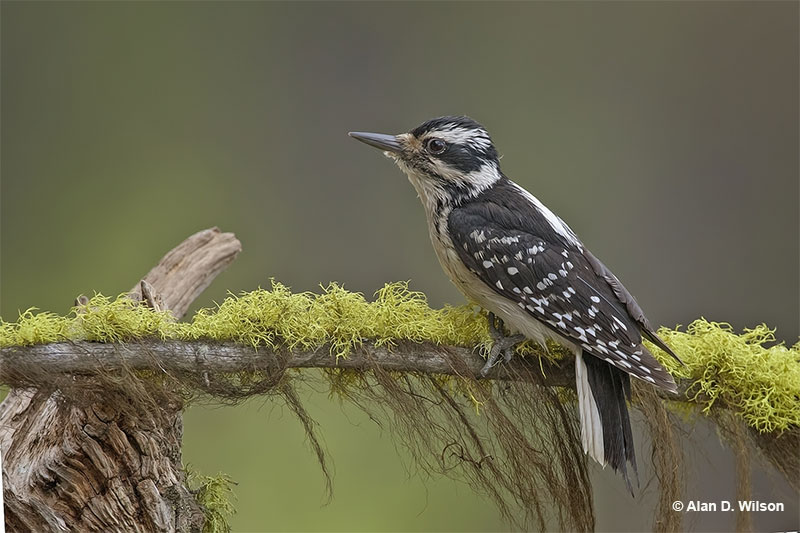
Scientific name: Dryobates pubescens
Length: 6.75 inches
Weight: .95 ounces
Wingspan: 12 inches
Song: “Pik! Ch,ch,ch,ch,ch,ch,ch!”
The Downy Woodpecker is a small black and white woodpecker with a short, black beak. They are patterned black and white above and have white backs and white underparts. Both sexes look alike except that males have a small, bright red patch on the top back part of their head.
Young birds look like adults but have a reddish patch on the top of their head. Downy Woodpeckers also have a few small black marks in their white outer tail feathers, and a small white tuft at the base of their beak.
This woodpecker eats insects, other small creatures, seeds, and small fruits. It pecks into live and dead wood and often forages on smaller branches and twigs. These friendly little woodpeckers are also common feeder birds.
They nest in tree cavities and live in gardens and a wide variety of woodlands. We see Downy Woodpeckers in much of Canada and the USA but not in arid habitats.
Key Identifications:
- Smallest woodpecker in North America. Mostly black and white with a short, black beak.
- Forages on trees, in bushes, and at feeders for insects, seeds, and suet.
- Nests in tree cavities.
- The Downy Woodpecker makes sharp “pik!” calls and also has a trilled call, “Ch,ch,ch,ch,ch,ch,ch!“.
Downy Woodpeckers are the smallest woodpecker species in North America and usually occur in pairs. They can also forage with other small birds and often visit feeders. This species takes advantage of its size to peck into the stems of weeds and other plants too small for larger woodpeckers to perch on.
Black-crested Titmouse
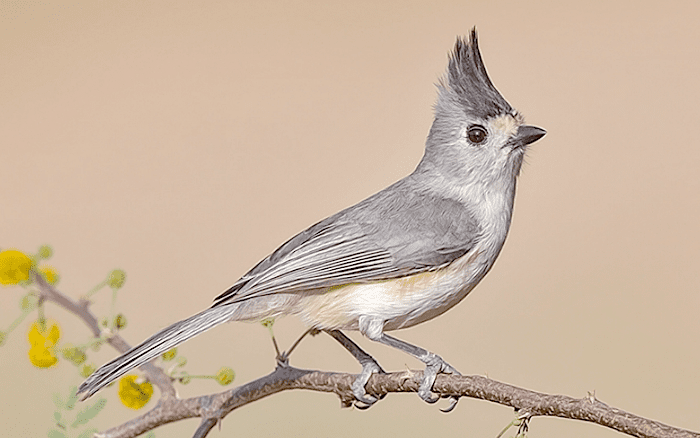
Photograph © Alan Wilson.
Scientific name: Baeolophus atricristatus
Length: 6.5 inches
Weight: .75 ounces
Wingspan: 9.75 inches
Song: “peter, peter, peter”
The Black-crested Titmouse is a small, blue-gray bird with black on the front part of its crest and a white face. Both sexes are alike and have a small white patch above their stubby black bill. These cute birds also have peach or burnt-orange flanks on pale underparts. Young birds have gray crests but still have the white patch above their beak.
This species moves around in small flocks that feed on insects and seeds in oak woodlands, dry habitats, and riparian vegetation. They forage by using their bills to pick food items from foliage and vegetation. Black-crested Titmouse also visit bird feeders.
This species nests in tree cavities made by woodpeckers, and also uses nest boxes. We often hear their calls before seeing the Black-crested Titmouse, and other small bird species frequently flock with them.
This bird only lives in central and southern Texas, a small part of Oklahoma, and northeastern Mexico.
Key Identifications:
- Small, blue-gray bird with a black crest, a white face, and pale underparts.
- Eats seeds, nuts, and insects. Also visits feeders.
- Nests in cavities in dead trees and nest boxes.
- The Black-crested Titmouse is very vocal. It has a whistled call given over and over, “peter peter peter“. Its song is similar to the related Tufted Titmouse but is higher pitched.
The Black-crested Titmouse is an easily seen and recognized species of open oak woodlands, arid habitats, and riparian zones. This species usually occurs in small flocks with other birds, visits feeders, and requires dead trees or nest boxes for breeding. DNA studies have shown that the Black-crested Titmouse separated from the closely related Tufted Titmouse 250,000 years ago.
Barn Swallow
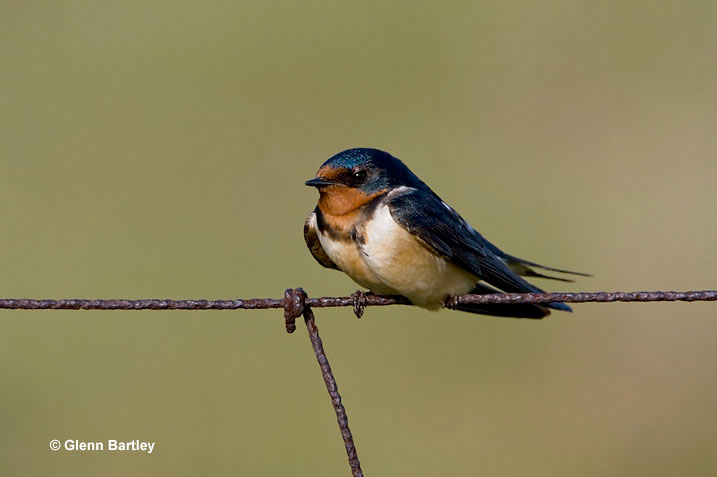
Scientific name: Hirundo rustica
Length: 6.75 inches
Weight: .67 ounces
Wingspan: 15 inches
Song: “chipchipfitfibitchipfibitfwip”
Barn Swallows are small to medium-sized swallows with long forked tails. They are dark, steel-blue above, peach-orange below, and have rich chestnut on the throat and above their bill. It also has some white in its tail.
Males and females look similar, but females are paler and have shorter tails. Young birds are like females but their tails are even shorter.
The Barn Swallow has long, pointed wings and fast flight. When flying, they often flap their wings a few times between brief glides.
Barn Swallows live in farming areas, meadows, parks, and other open habitats. They feed on insects as they fly through the air. Although they can fly high overhead, Barn Swallows often swoop low over the ground.
This handsome swallow builds a mud nest on the wall of a barn, bridge, or other structure. Barn Swallows live in large areas of Canada, the USA, Mexico, Europe, and Asia.
Key Identifications:
- Beautiful dark blue and orange swallow with a long, forked tail.
- Forages for insects in flight over fields and other open habitats.
- Constructs a cup nest out of the mud in barns and other structures.
- Often makes brief “fwip” calls in flight, and has a long, complex song, “chipchipfitfibitchipfibitfwip”.
The Barn Swallow is a common and easily species in most of its range, and the only swallow with a long, elegant tail. In summer, it is often seen flying low over the ground in open habitats. Barn Swallows are long-distance migrants, and some fly 5,000 miles – all the way to Argentina!
Snowy Egret
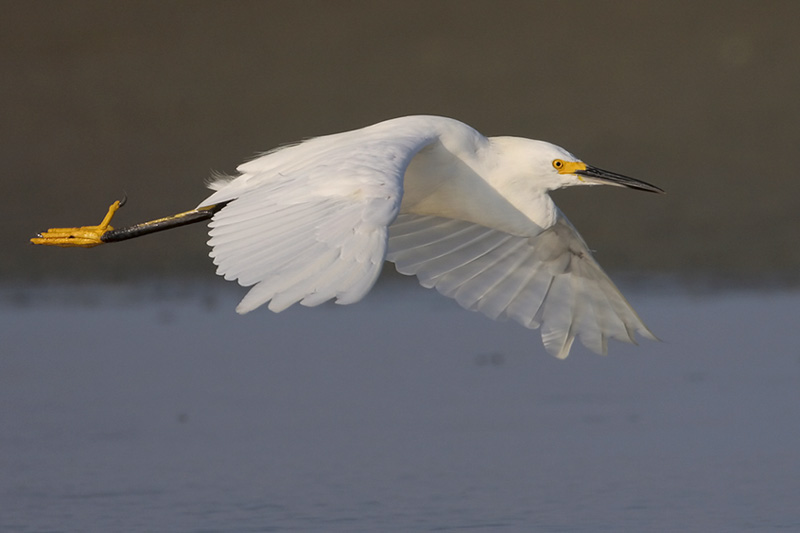
Snowy Egret
Scientific name: Egretta thula
Length: 39 inches
Weight: 1.9 pounds
Wingspan: 51 inches
Song: “rahh”
The Snowy Egret is a medium to large, elegant white bird with a long, slender black bill, and long black legs with yellow feet. Both sexes look alike and have some yellow skin in front of yellow eyes, a wispy white crest, and elegant plumes on their breast and lower back.
Snowy Egrets fly with long, broad wings, hold their necks tucked in, and have slow, deep wing beats.
This beautiful heron feeds on small fish, insects, and other small aquatic creatures. It catches food by wading in or near water, waiting until prey comes close, and quickly striking out with its long bill. In shallow water, it also briefly runs after small fish to catch them.
Snowy Egrets breed in colonies and make messy stick nests in trees and bushes. They live in coastal areas and along marshes, lakes, and rivers in much of the USA and Central and South America.
Key Identifications:
- Medium-sized elegant white heron with a long, black beak, and long black legs with yellow feet.
- Forages for small fish and other creatures by wading in or near shallow water and quickly snatching them with its beak.
- Breeds in colonies and makes a messy stick nest in trees and bushes, usually on islands or over water.
- Snowy Egrets are not very vocal birds. They usually make a croaking call when taking flight. It sounds like, “rahh”.
The Snowy Egret is a medium-sized, elegant white heron with a wispy crest, and “golden slippers”. Snowy Egrets catch prey in a number of ways including using one of their feet to stir up mud and flush food into the open.
Ruby-crowned Kinglet
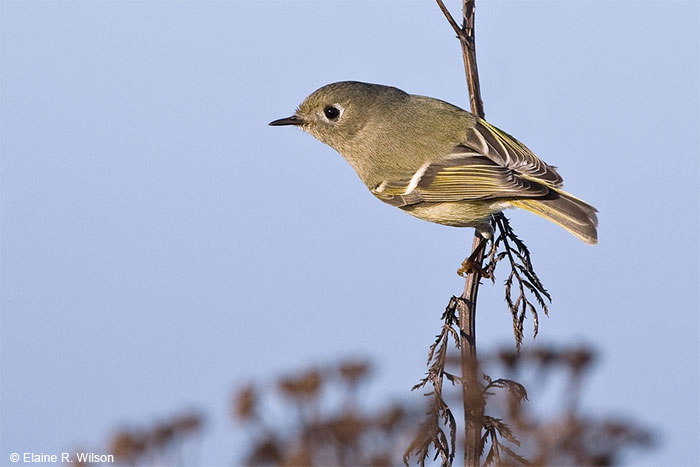
Scientific name: Corthylio calendula
Length: 4.25 inches
Weight: .23 ounces
Wingspan: 7.5 inches
Song: “seetseetseet, reardidehdidid, ridiDEEP,ridiDEEP,ridiDEEP!”
Ruby-crowned Kinglets are tiny, grayish-olive birds with small, slender beaks. They have a broken white eyering and dark wings with yellowish-white edging on their feathers.
Both sexes look very similar and also have two white wing bars, the lower wing bar much more obvious than the upper one. Males also have a hidden, bright red or orange crest revealed in displays and aggressive situations.
The Ruby-crowned Kinglet is an active bird that rarely sits still. It feeds on small bugs, spiders, and insect eggs that it finds in conifers, bushes, and trees. They can forage at any height, often hover to pick food off foliage, and usually occur in flocks with other small birds.
Ruby-crowned Kinglets breed in coniferous forests in Alaska, Canada, parts of the northern USA, and the western USA. They are one of the most common birds of Texas.
They spend the winter in parks and woodlands in much of the eastern, southern, and western USA, and Mexico.
Key Identifications:
- Tiny, grayish-olive bird with a broken eyering, two pale wing bars (the lower one more obvious), and a hidden red crest.
- Feeds on small arthropods and insect eggs in bushes and trees.
- Makes a small, rounded cup nest out of moss, lichens, and other soft materials high in a spruce or other conifer.
- Sings a cheerful and surprisingly loud, “seetseetseet, reardidehdidid, ridiDEEP,ridiDEEP,ridiDEEP!”.
The Ruby-crowned Kinglet is a tiny insectivorous bird that breeds in northern and montane coniferous forests, and winters in a variety of wooded habitats. It is very active and usually forages with other small birds. The female Ruby-crowned Kinglet can lay 12 eggs in one nest!
Eastern Phoebe
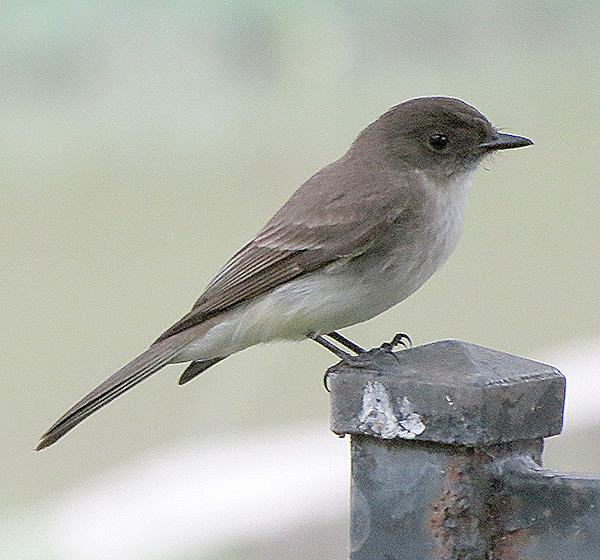
Photograph © Sam Crowe.
Scientific name: Sayornis phoebe
Length: 7 inches
Weight: .7 ounces
Wingspan: 10.5 inches
Song: “see-BEE! See BIDIT”
The Eastern Phoebe is a small to medium-sized, plain flycatcher that is dark, brownish gray above, and white below. It also has gray on its breast and a long, blackish tail that constantly wags up and down.
This bird also has a blackish head and some pale edging on long, dark wings. Males and females look alike, but young birds have pale yellow bellies.
This flycatcher uses its slender beak to snap up insects. It catches them by flying from a perch and snatching them in flight, from foliage while hovering, and from the ground.
We usually see Eastern Phoebes on their own, sitting on low or medium-height perches. They make cup nests of mud, moss, and leaves on rocky outcrops, and under bridges and other structures.
This species breeds in woodlands and parks in Canada and the eastern USA, and winters in similar habitats in the southeastern USA and Mexico.
Key Identifications:
- Plain, mid-sized flycatcher that is dark brownish-gray above and pale below with some gray on the breast.
- Perches low to mid-height in woodlands and flies out to catch insects. It also feeds on berries in winter.
- Makes a cup nest of mud and vegetation on structures and rocky outcrops.
- Sings a song that sounds like its name, “see-BEE! See BIDIT”.
The Eastern Phoebe is a featureless flycatcher with dark upperparts and pale underparts. It often wags its tail up and down and sallies from perches to catch insects.
In 1804, this species became the first bird to be banded in North America when John James Audubon put silvered thread on an Eastern Phoebe’s leg.
Killdeer
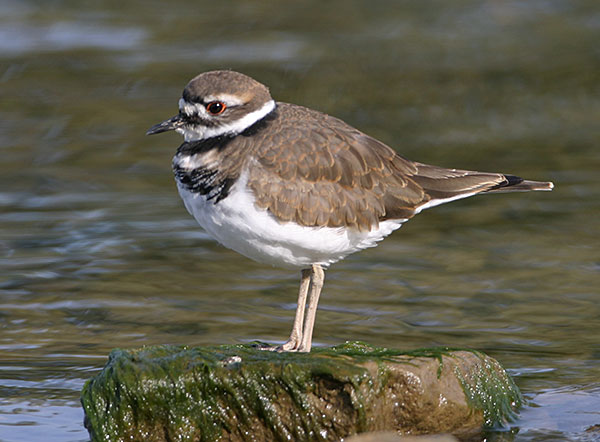
Scientific name: Charadrius vociferus
Length: 10.5 inches
Weight: 3.3 ounces
Wingspan: 24 inches
Song: “tideer, tideer, tideer, tideer”
The Killdeer is a fair-sized, slender plover that is dark brown above and white below. They have two black bands on their breast, a patterned, black, white, and dark brown face, and a longish, orange tail.
Both sexes look alike and also have a slender, black bill, narrow, red-orange eyerings, and long, pale legs. In flight, we can see a white stripe in each of their long, dark wings, and a black tip on their long, wedge-shaped, orange tail.
Killdeers often fly high overhead in fast, direct flight, but we usually see them foraging on the ground. They pick insects, other small creatures, and seeds from the edges of wetlands and other, open grassy areas.
This species lays its camouflaged eggs on the ground, in gravel and open fields. When people and pets approach too close, they give loud calls and pretend to have a broken wing.
The Killdeer lives in large parts of Canada, the USA, and Mexico.
Key Identifications:
- Fair-sized plover with two black breast bands and a wedge-shaped orange tail with a black tip.
- Picks seeds and small creatures from open ground.
- Lays camouflaged eggs on the ground, in gravel and open fields.
- Very vocal and sounds like it says its name, “tideer, tideer, tideer, tideer”.
The Killdeer is the most common and familiar shorebird in much of its range and occurs in many open habitats. It is the only plover in North America with two black breast bands and has a longish, orange tail with a black tip. To scare cows near their nests, Killdeers fluff themselves to look bigger, raise their tail over their head, and run at the large animal.
White-eyed Vireo
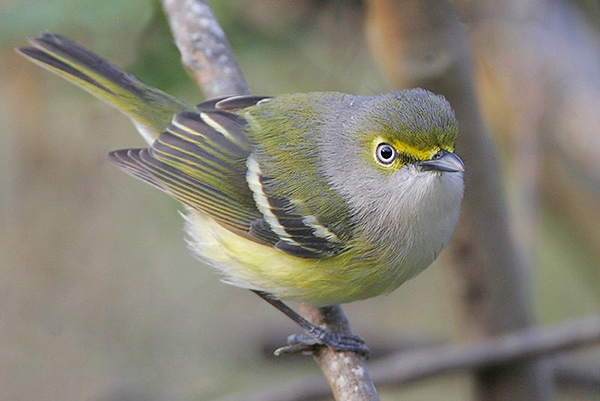
Scientific name: Vireo griseus
Length: 5 inches
Weight: .4 ounces
Wingspan: 7.5 inches
Song: “chick, perk-or-REEoCHICK!”
The White-eyed Vireo is a small, olive and gray bird with yellow spectacles and flanks. Males and females look alike, have a small dark mark in front of their white eyes, and two white wing bars.
Young birds resemble adults but have more gray on the head and can have white spectacles and dark eyes. Like adults and other vireo species, they also have thick, gray beaks with small hooked tips.
This bird feeds on caterpillars and other insects. It finds food by carefully moving through dense vegetation and picking items from foliage and twigs.
The White-eyed Vireo does not usually flock with other birds and uses spider webs and plant matter to build a cup nest that hangs below thin branches.
White-eyed Vireos breed in scrubby second growth in the eastern USA north to Ohio, and winter in similar habitats from the southeastern USA to northern Central America.
Key Identifications:
- Small olive and gray bird with yellow spectacles, white eyes, and pale underparts with yellow flanks.
- Forages for insects in scrubby second growth.
- Makes a cup nest of spider webs, lichen, and plant matter built underneath thin branches.
- Often sings an excited, “chick, perk-or-REEoCHICK!”.
The White-eyed Vireo is a small, pale bird with white eyes and yellow spectacles. In summer, its song is often heard from scrubby second growth in much of the eastern USA. Both sexes of the White-eyed Vireo sing on wintering grounds, but only males sing on their breeding grounds.
American Robin
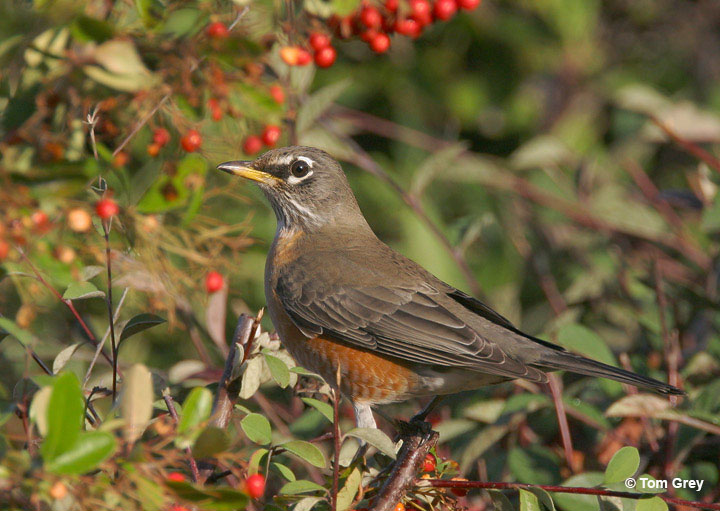
© Tom Grey
Scientific name: Turdus migratorius
Length: 10 inches
Weight: 2.7 ounces
Wingspan: 17 inches
Song: “cheery, cheery, cheery, cheery, cheer, cheer”
The American Robin is a familiar and common thrush that is dark gray above and brick red below. It also has an orange-yellow bill, a blackish head with white markings around the eyes and on the throat, and a white belly.
Both sexes of this thrush species are similar, but males are darker above and more reddish on the underparts. Young American Robins have more white marks on their faces and spotting on orange underparts.
In flight, this thrush also shows white corners in its outer tail feathers.
During summer, American Robins forage on the ground for worms, insects, snails, and other small creatures. In winter, these common birds flock together and perch in trees and bushes to eat berries and fruit.
The American Robin makes a cup nest in trees and lives in parks, woodlands, towns, and many other habitats. They are one of the most common birds of Texas.
Key Identifications:
- Fair-sized songbird that is dark gray above, and brick red and white below.
- Forages for worms and bugs on lawns and other open grassy areas, also flocks together to feed on fruiting trees in the winter.
- Makes a cup nest in trees.
- The American Robin is quite vocal and makes a loud, sharp, “yenk!” call and quieter “check,check,check” calls. It also has a lovely cheerful song of caroled phrases, “cheery, cheery, cheery, cheery, cheer, cheer”.
Populations of the American Robin have been estimated at 370,000,000; a number that gives this bird the distinction of being the most numerous landbird in North America.
Tufted Titmouse
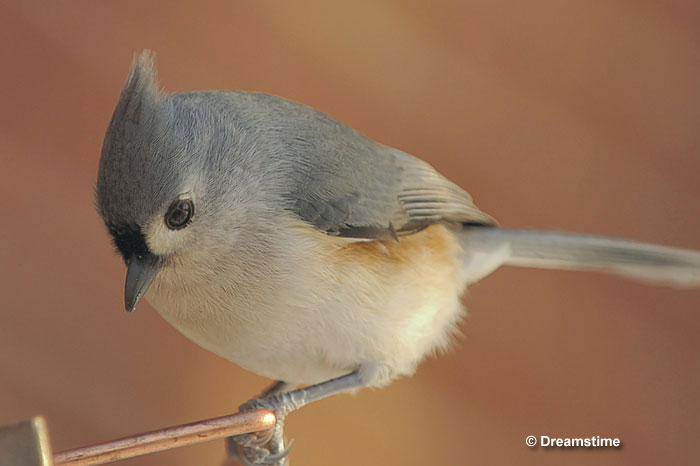
Scientific name: Baeolophus bicolor
Length: 6.5 inches
Weight: .75 ounces
Wingspan: 9.75 inches
Song: “peter peter peter”
The Tufted Titmouse is a small, crested, blue-gray bird with white cheeks. Males and females look the same and have a small black mark above their stubby black beak. They also have pale underparts with peach-orange flanks.
These cute little birds occur in small groups that forage for insects and seeds in parks and woodlands. They move through the trees and use their bills to pick food from leaves, bark, and branches. Tufted Titmouse are also regular visitors to bird feeders.
These small birds nest in woodpecker holes and other cavities in dead trees, and can also use nest boxes.
We find the Tufted Titmouse in hardwood forests and forested urban areas. They are often heard before they are seen, and flock with other small birds. When they see a predator, they are some of the first birds to harass it.
The Tufted Titmouse occurs in the eastern USA and some parts of southeastern Canada.
Key Identifications:
- Small, crested blue-gray bird with pale underparts and a white face.
- Feeds on seeds and insects and visits feeders.
- Nests in tree cavities and nest boxes.
- The Tufted Titmouse is a very vocal bird. It gives constant whistled calls over and over, “peter peter peter“.
The Tufted Titmouse is an easily recognized bird that lives in parks, gardens, and woodlands. It occurs in small flocks, often visits feeders, and needs dead trees or nest boxes to breed. This species lines its nest with mammal hair including fur from Raccoons, Opossums, and other animals.
Blue-gray Gnatcatcher
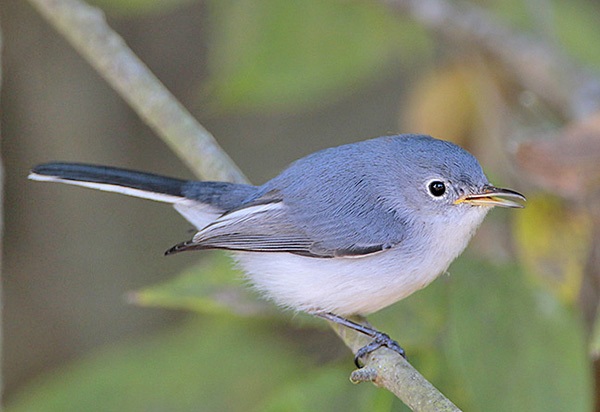
Photograph © Greg Lavaty.
Scientific name: Polioptila caerulea
Length: 4.5 inches
Weight: .21 ounces
Wingspan: 6 inches
Song: “nheah, sip, nheah”
The Blue-gray Gnatcatcher is a tiny, pale gray and white bird with a slender beak. They are blue-gray above and pale gray below with white eyering. They also have some white edging in their short wings and a longish, black and white tail.
Both sexes look similar, but males have a small black line above their eyes. This species feeds on small insects that it catches in bushes and deciduous trees.
It forages by quickly moving through vegetation and picking bugs from vegetation. They can also fly out to catch insects in flight.
Blue-gray Gnatcatchers make a small cup nest out of lichens and spider webs, usually high in a tree. They live in hardwood forests and are summer residents in parts of southeastern Canada, the eastern USA, and also live in some western states.
Blue-gray Gnatcatchers also breed in Mexico and winter from the southern USA to the Caribbean and Honduras. They are one of the most common birds of Texas.
Key Identifications:
- Tiny pale blue-gray and white bird with a slender beak and longish black and white tail.
- Actively forages for insects.
- Makes a small pale cup nest high in trees.
- Blue-gray Gnatcatchers are quite vocal and make nagging nasal calls. Their most common call sounds like, “nheah, sip, nheah”. They also sing a scratchy song with nasal and tinkling sounds.
The Blue-gray Gnatcatcher lives in hardwood forest habitats. Their nasal calls often reveal their presence as they forage in bushes and high overhead. The nests of these “mini mockingbirds” are so small and camouflaged, they look just like a pale lump on a branch.
Frequently Asked Questions
How many bird species are native to Texas?
In total, 664 bird species are native to Texas.
What is the most common bird in Texas?
The Northern Cardinal is the most common bird of Texas. Breeding bird surveys have found this beautiful bird to be the most numerous bird species in Texas.
What is the largest bird in Texas?
The largest bird in Texas is the American White Pelican. It is 62 inches long, has a 9-foot wingspan, and weighs 16.4 pounds. The heaviest bird in Texas is the 23-pound Trumpeter Swan, and the tallest bird is the 4 to 5 foot tall Whooping Crane.
Do ducks live in Texas?
Texas is known for its vast bird population, and ducks are no exception. There are nearly 40 recorded species, but some of them are rare vagrants too.
What is the smallest bird in Texas?
Calliope Hummingbirds are the smallest birds of Texas. They are is also the smallest hummingbirds in the USA. It is just 3.25 inches long and weighs a mere 0.1 ounces.
What is the fastest bird in Texas?
The Peregrine Falcon is the fastest bird in Texas and the fastest bird in the world. In power-dives, it can reach speeds of 200 miles per hour!
Discover more about Texas: Hawks | Owls | Woodpeckers | Ducks | Hummingbirds | State Bird
Scot Estep
Tuesday 11th of February 2025
Trying to identify a bird from the Austin area. Female, 4 inch body, 5 inch tail, grey with black fringe on the feathers, long tail feathers are black and white.
Thanks for you help.
Sam Crowe
Wednesday 12th of February 2025
Would you say the bird you saw had a thin, slightly curved beak? If not, let me know any other details, and I can refine the ID!
For me, it sounds like you might be describing a female Northern Mockingbird
Ali DeBellas
Friday 5th of January 2024
I am trying to find out if the bird population was lower last year. I moved here from Montana and am seeing few birds. I live in Temple.
Anion
Tuesday 9th of April 2024
@Ali DeBellas, Did you or do you have a water source in your yard? Last summer was so hot and dry that we saw fewer birds in the parks and woods, but plenty in our backyard where we kept the hose constantly dribbling into a small feeder/bath for them, in the center of a group of three trees. Sometimes that shady little oasis back there resembled a scene from Snow White, there were so many birds and squirrels gathered around! (They take turns! I watched a woodpecker politely wait for a female cardinal to get out of the water before he leapt in!)
Our feeders were busy, too, but the water really drew them during last year's awful heat dome summer. (Our water bills were horrendous, of course, sigh.)
Allison Grace
Saturday 2nd of December 2023
I enjoy your articles! I live in Southeast, Texas
Patrick O'Donnell
Monday 4th of December 2023
@Allison Grace- Glad to hear that! How fortunate to live in such a great place for birding.