


Baby ostriches, known as chicks, are the world’s largest bird hatchlings, emerging from the large eggs with a soft, fawn-colored down and a remarkable instinct for survival.
Within days, they begin exploring their surroundings, guided by their parents who teach them essential feeding behaviors and protect them from predators. Here are some interesting facts about them!
The Nesting Period
During the breeding season, ostriches form small groups led by a dominant pair – one male and one female – alongside several subordinate males and females.
The dominant male mates with multiple females within the group and takes on the task of preparing a communal nesting site. He digs a wide, shallow scrape in the ground, typically 12 to 24 inches deep and up to 10 feet across. This nest becomes the group’s communal egg-laying spot.
All females lay their eggs in this shared nest, but the dominant female claims the safest position at its center for her clutch.
The number of eggs each female contributes depends on her status in the group. Dominant females can lay up to 11 eggs, while others lay between 2 to 6.
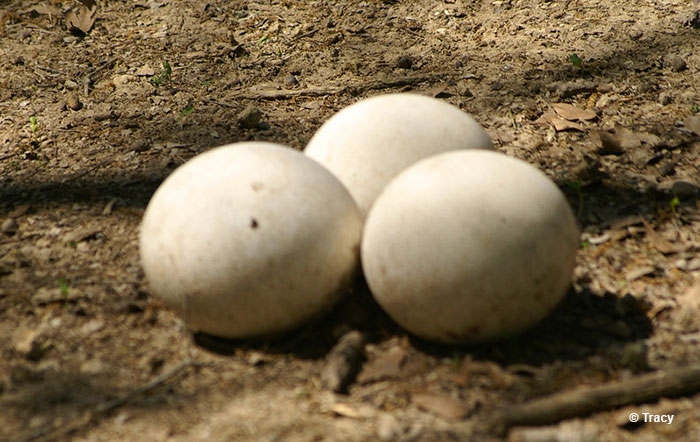
Ostrich eggs are impressively large – about 6 inches long, 5 inches wide, and weighing approximately 3 pounds. Their thick, cream-colored shells are covered with small pits, adding strength to protect the developing chicks inside.
Before the incubation begins, the dominant female discards extra eggs from other females, leaving about 20 of them.
Incubation is a cooperative effort, with mostly the dominant female taking the day shift, their sandy-colored feathers providing natural camouflage, while the dominant male incubates at night, blending into the dark with their black plumage.
After 35 to 45 days, the chicks hatch fully feathered and ready to run, with both parents – especially the males – actively defending and teaching their young survival skills.
What does a baby ostrich look like?
When baby ostriches hatch, they are covered in fawn-colored down speckled with dark brown spots, and their necks are marked by distinctive stripes. They are like miniature versions of adults with long necks and ovular bodies but measure only 10 inches tall and weigh 2 pounds. The chicks are often compared to hedgehogs due to their quill-like underdeveloped feathers.
Ostrich chicks grow rapidly and undergo several stages of development. By three months, they begin shedding their downy feathers in favor of juvenile plumage. At four to five months old, they are already half the size of an adult bird.
By one year, they have reached full adult height, and during their second year, their juvenile feathers gradually transition into the distinctive adult plumage. By 18 months, they achieve the full weight of their parents.
What does life look like for baby ostriches?
Baby ostriches can walk and run shortly after hatching. For about two months, the chicks will stay close to their parents. Although parents do not directly feed their offspring, they guide them to food sources using vocalizations and pecking demonstrations to encourage feeding.

They may also form communal creches that can contain 20 to 40 baby birds. These creches are guarded by a male or a pair of adults, who protect the chicks from predators and may also use their large wings to shield them from the sun.
Despite this care, survival is a challenge; fewer than 10% of nests survive the nine-week laying and incubation period, and of those that do, only about 15% of chicks reach their first year.
How to tell baby ostriches apart?
The sex of baby ostriches is impossible to tell by plumage alone as both males and females share the same drab brownish plumage.
It isn’t until they are at least one month old that their sex can be determined through vent sexing. This process involves carefully examining the chick’s cloaca (vent area) to identify which genitalia it has. However, vent sexing is a delicate procedure that requires professional expertise to avoid injuring the chick and should never be attempted on wild ostriches.
As they grow, both male and female ostriches maintain similar juvenile plumage, appearing in a drab brownish color. However, subtle differences begin to emerge as they approach maturity.
Female juveniles retain a lighter, brownish-beige feather color, while male juveniles undergo a gradual darkening process, transitioning into their distinctive black plumage – a transformation that typically takes about 1.5 years to complete. Males also grow larger than females as they mature.
Behavioral cues may offer additional hints, though they are not always reliable. Juvenile males might exhibit more dominant or territorial behaviors and make more speedy movements. Meanwhile, females tend to be more cooperative within the group and go about their day more calmly.
As they near adulthood, young males may begin practicing courtship displays, including bowing, crouching, and wing-stretching.
Although baby ostriches are quite distinctive, they can be confused with the chicks of other species like emu, rhea, and cassowary. However, range, habitat, size, and specific plumage patterns usually help distinguish these species from one another.

What do baby ostriches eat?
In their first few days after hatching, ostrich chicks draw nutrients from their yolk sac to sustain themselves. As they start exploring their surroundings, their diet quickly shifts.
In the wild, parents guide baby ostriches, teaching them essential feeding behaviors and viable food sources.
The chicks primarily eat plant matter, including leafy plants, grasses, fruits, berries, roots, seeds, and succulents. They also catch small insects and occasionally small animals, like lizards, adding valuable protein to their diet. To aid digestion, ostrich chicks, like their adult counterparts, ingest small stones and grit.
Domesticated baby ostriches follow a different dietary path due to human care. After relying on yolk sac nutrients, farm-raised chicks receive specially formulated starter feed within a week.
This feed, low in fiber and fat but rich in protein, lysine, and probiotics, supports their rapid early growth. As they grow, they start foraging for natural foods, such as leafy greens, grasses, and small insects.
By eight weeks, they switch to a grower feed, balanced with protein, fat, fiber, vitamins, and minerals, which ensures they continue to thrive as they approach maturity.
Frequently Asked Questions
What is a newborn ostrich called?
A newly hatched baby ostrich is called a chick.
Why do baby ostriches spin?
Baby ostriches spin when they are excited or happy.
How do ostriches treat their babies?
Ostriches protect, teach, and guide their chicks, with both parents actively involved in nurturing and defending them.
