


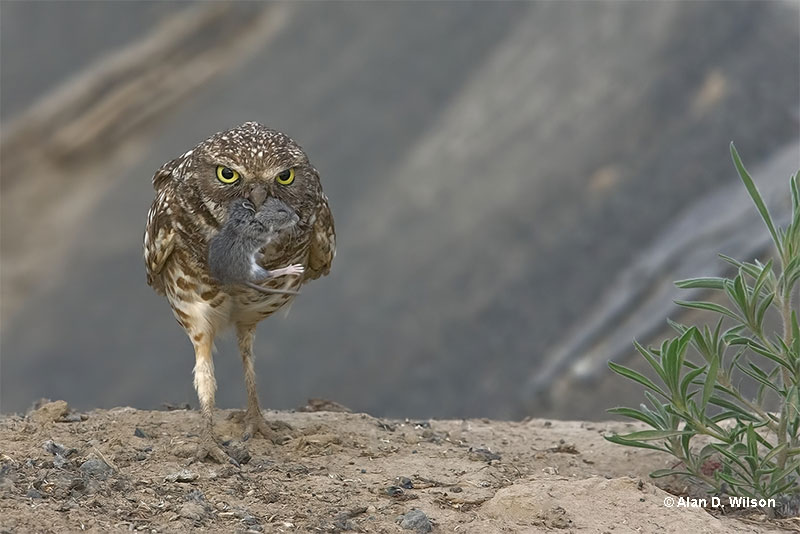
The legs of owls may seem unusually long, and they possess unique characteristics that make them well-suited for the owl’s way of life. They are not only vital for perching and walking but also play a crucial role in hunting, flying, and temperature regulation.
But have you ever wondered why owl legs are so long and what makes them different from other birds? If so, you’re in the right place!
Anatomy of Owl Legs
Contrary to popular belief, owls have really long legs. We don’t notice them because, in the majority of owl species, they’re hidden by the feathered “skirts.”
The owl’s leg anatomy reflects their needs as top predators that have to subdue small but feisty prey. Depending on their preferred habitat, different owl species have slightly different anatomies, but the basic “blueprint” is the same.
All owls have relatively short thighs (femurs) and elongated tibiotarsus (shin bones). The next bone, between the tibiotarsus and the foot, is called tarsometatarsus.
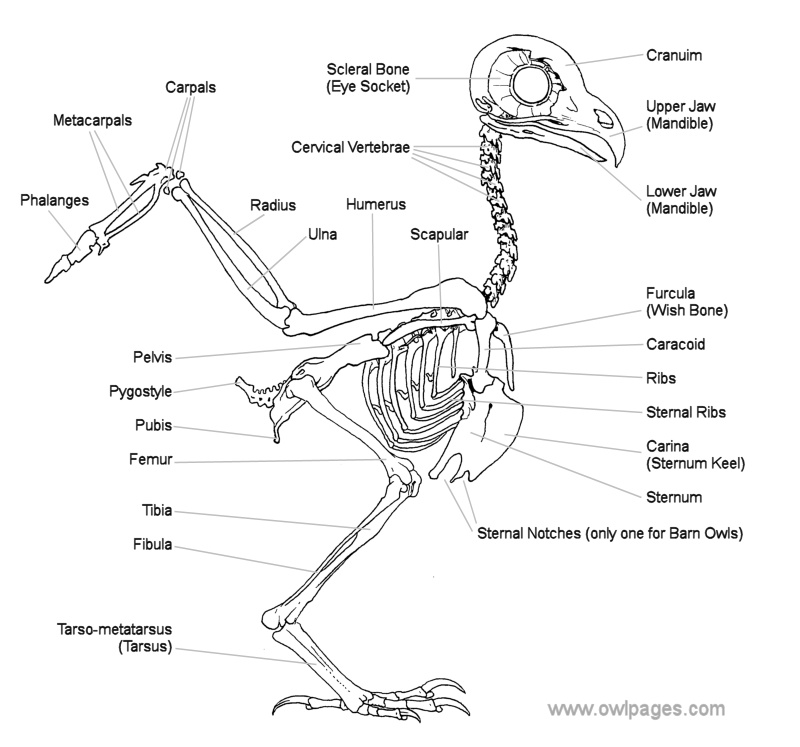
If we compare the tarsometatarsus to mammalian bone structures, it will match our tarsus (ankle bones) and metatarsal (foot) bones.
That is why when you look at an owl leg, you may believe that the main joint is the knee when, in reality, it is an ankle! Also, what seems to be a shin to a layman is actually the upper part of the foot. We find this specific anatomy only in birds and some dinosaurs.
The tarsometatarsus with digits make up the bird’s foot. If you haven’t concluded yourself, let me underline that avian feet are very elongated. That also makes the anatomy of bird feet very unusual – our feathery friends walk only on their toes.
Foot Anatomy
In avian anatomy, toes are called “digits.” Owls have four digits on each foot, and each has a single talon (sharp claw). Owl feet are their main weapon when hunting, but they also have other useful qualities.
When the owl is in flight, the three toes point forward, and one points backward – the pattern we see in most birds. However, when the owl clutches its prey or holds the branch while perching, the outer front toe can turn to the rear end of the foot. This is possible due to the unique, highly flexible joint.
Owls living in northern regions often have feathers on their entire feet for warmth. We assume that these feathers are also useful when dealing with prey – to protect against potential bites and increase the sense of touch when the bird is holding the unfortunate animal.
Still, all the specialized features of owl feet don’t end there. The skin on the underside of digits is rough and lumpy, which helps them perch safely and (you’ve guessed it) grab prey better. Fishing owls have an exceptionally rough sole structure because their prey is slippery.
Oh, and does anyone remember the switchblade comb? Some owls, like Barn Owls, have a serrated underside of the middle toe, which they use in grooming and subduing prey.
The Talons
Owl talons are sharp, curved, and relatively lengthy. Their physical characteristics vary depending on the owl species and the prey it specializes in. Generally, the larger the prey, the more curved the talons.
- Fishing owls have thicker and slightly curved talons.
- Insect and small mammal specialists have visibly less curved talons.
- Generalists and hunters of seasonal small mammals (hunting anything from reptiles to amphibians and more) have highly curved talons.
Whatever their shape, all owl claws are made of keratin that surrounds a living core with blood vessels and nerves – just like our nails. The color of the talons varies from black to pale bone color (ivory).
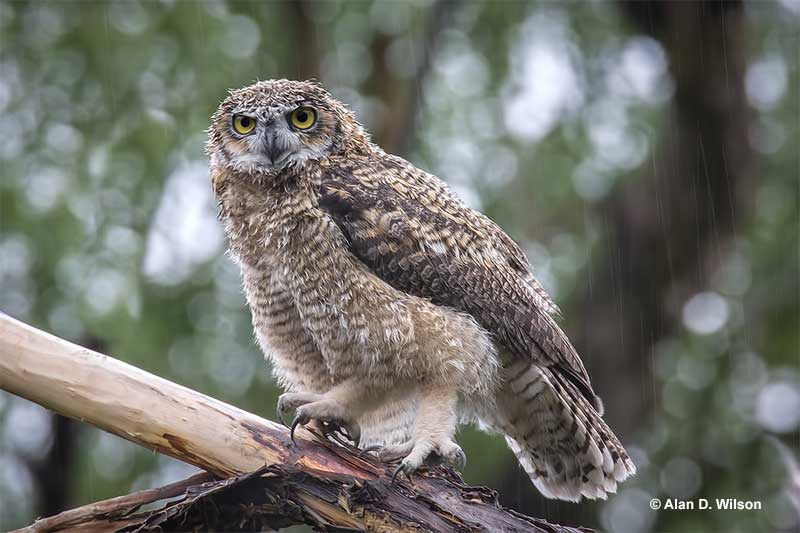
Like in other birds of prey, the strong and sharp talons have a key role in hunting. While the owl’s hearing, vision, and silent flight serve great in tracking down prey, talons actually make the kill – most owl prey dies from constriction, stabbing, or spine severing (the consequence of the previous two moves).
There is more to these killer feet than the sharp talons. The entire owl foot is muscular (especially when it comes to flexor muscles), with robust bones and strong tendons. Also, the feet have a locking mechanism that allows the bird to clamp down on its target without muscle exertion (active gripping).
How Do Owls Use Their Feet?
Hunting
Owls have evolved a unique set of adaptations that allow them to be successful predators. Among these adaptations are their feet, which play a crucial role in their survival. They use their feet for three main purposes: perching, walking, and catching prey.
The underside of an owl’s foot is covered with a rough and knobby surface that helps them grip surfaces and prey better. They have four toes, with two in the front, one in the back, and one that can be rotated to the front or back depending on their needs.
This ability to rotate their toes enables them to spread their razor-sharp talons wide apart, which increases their chances of successfully capturing prey. There is an interesting term for their toes – zygodactyl.
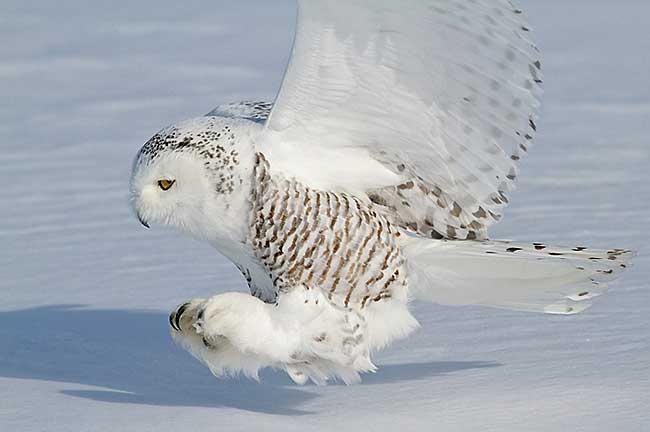
Snowy Owls, for example, have powerful legs, that they use in every aspect of their lives.
Another unique feature of owl feet is their “locking mechanism.” This mechanism allows them to lock their feet into place while perching and resting, without having to keep their muscles under tension. This adaptation helps them conserve energy and remain perched for extended periods.
In addition to perching and catching prey, owls also use their feet like hands. When in pursuit of prey, precision is vital. Owls use their talons to grip and manipulate food, guiding it into their bill for consumption. This skill allows them to eat a wide range of prey, from small rodents to larger birds.
Related: The Most Amazing Bird Statistics and Facts
Furthermore, some species of owls can use their feet to regulate their body temperature. They do this by radiating excess heat through the soles of their feet. Some owls also have feathers on their feet, which helps to keep them warm in colder climates. For example, Snowy Owls live primarily in tundra, and feathered feet protect them from frostbite.
Centralizing Their Bodies
To be able to fly, birds needed bodies with centralized and balanced weight. This means that there should be no extra weight (or any weight) on distal parts of the bird’s body. All the heavy parts (organs, muscles, etc) need to be close to the body center.
That is why flying birds have specific leg anatomy. The large upper leg muscles are compact and close to the body. Lower legs almost lack muscle – they are light, bony, and connected to the body with tendons. Compare that to humans, whose lower legs have solid muscles for long-distance running and walking (thus, no flying for you, human – sorry!)
If birds had muscular lower legs, they would act as weights that decentralize weight and, therefore, destabilize flight.
Large owls like the Snowy Owl also use their (centralized) body weight to pin down their prey. How convenient.
Regulating Body Heat
Besides being a weapon in hunting, owl legs have another cool trait. In some owl species, their feet help the bird regulate its body temperature. Extra blood vessels in the feet help the body radiate excessive heat through the soles.
The amount of feathering on legs and feet also plays an important role in temperature regulation.
I previously mentioned that northern owl species have feathery insulation all over their feet – including digits. In contrast, Burrowing Owls have very few leg feathers because they live in arid habitats.
Interestingly, male and female Burrowing Owls have non-identical leg morphology, partly because of different insulation needs. The female has slightly more leg feathering – due to brood care, she will likely spend more time in a burrow that is significantly cooler than its outer surroundings.
On the other hand, the male Burrowing Owl spends more time outside and digging around, so he benefits from having nearly bare legs.
A Form of Moving
Due to their ground-based lifestyle and open habitats with grasslands and deserts, Burrowing Owls have longer legs relative to their body size when compared to other owl species. These owls consume a lot of insects – they may make up for 80 or 90 percent of prey items.
They usually hunt ground invertebrates on foot – by walking, running, and even jumping at them. Young owls are primarily focused on invertebrate prey, so we can assume they spend quite a lot of time doing these amusing runs.
The owl also uses its feet to catch insects mid-air and, of course, to tackle other small prey like mice, voles, and todes when catching them from a perch. In contrast, owl species hunting in forests and other habitats with dense vegetation have shorter legs. Longer extremities would hurt their maneuvering abilities in tight spaces.
Besides quicker terrestrial movement, long Burrowing Owl legs allow better digging abilities – legs and feet also play an important role in burrow maintenance and modification.
Do All Owls Have Long Legs?
Compared to most birds, owls have relatively short thigh bones and long shin bones. Their knees are located near the top of their legs, close to the body, and are hidden under feathers. This means that you probably won’t even see them.
The bone structure is relatively close to mammals, owls still have joints and even ankles. Compared to humans, owls have short femurs and longer shins. Their ankle plays a huge part in stability and precision.
However, you may not see much of their legs at all, as they are often covered under feathers.
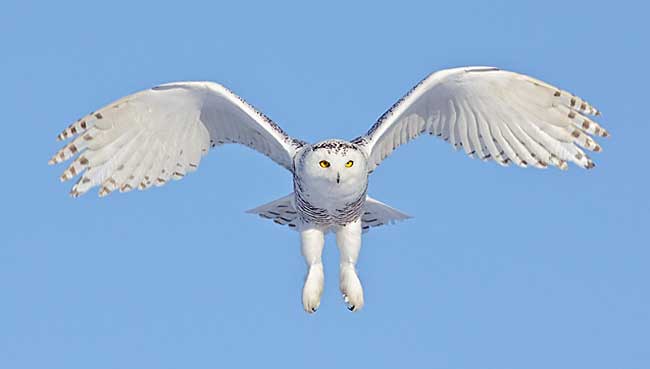
While all owls have this basic leg structure, the length of their legs can vary greatly depending on the species, their size, environment, and hunting methods. Smaller owl species, like Elf Owls tend to have shorter legs, while larger ones have longer ones. The environment in which an owl hunts can also influence the length of its legs.
So, Burrowing Owls, who hunt in open areas, such as grasslands or deserts, tend to have longer legs. This is because they need to be able to capture prey in tall grass or walk on the ground to find food.
In contrast, owls that hunt in forests and other dense habitats have shorter legs because longer ones would get in the way of their maneuverability.
Fun Facts About Owls & Their Legs
- The shortest owl legs are somewhere around 4 inches long, whereas the Eurasian Eagle-owl’s legs can be up to 15 inches long.
- Owls sometimes go fishing. It is rare, but they may perch or even lay near water, wait for the opportune moment, and snatch a fish into their talons.
- The Barn Owl has a sharp or serrated edge on the underside of their middle toe. This unique feature aids them in gripping prey and grooming.
- Owls have adaptations on their wings that enable them to fly silently, but their long legs also contribute to noise reduction. The length and bone structure of their legs help to absorb the shock of landing on trees and the ground, resulting in less noise and better sound dissipation.
- Once a Great Horned Owl clenches its impressive talons, it takes a force of 28 pounds to open them!
- Owls spread out their talons wide to increase their chance of a successful hunt. Here is where curved talons come in handy to “hook” larger prey
Frequently Asked Questions
Why are owl legs so long?
Owl legs are so long to reduce air resistance when flying, aid in maneuvering and hunting, and facilitate temperature regulation.
Do owls run?
It sounds weird, but owls can run – and fast! Their long legs allow them to do so. We mostly observe running in fledglings whose flying skills aren’t well-developed yet.
Ground-based owls like the Burrowing Owls run (and walk) more frequently than their woodland cousins, even using running in hunting. Also, owls in captivity run more frequently because they’re usually confined. However, most wild adult owls of forest species prefer flying and the safety of canopies.
Are owls able to walk?
Yes, owls can walk. An owl walk essentially looks like a slower version of owl running, so the same applies.
Which owl has the longest legs?
The Eurasian Eagle-owl has the longest legs of all owls and they can be as long as 15 inches.
How strong are owl feet?
Owl feet have a grip strength of 200-500 pounds per square inch, which is ten times stronger than the average human grip.
How long are the talons of owls?
Because there is more than one species of owl, the length of a talon depends on the species and can vary significantly. Also, it may vary from individual to individual. The Great Horned Owl is probably among the owls with the biggest talon length. Its fully-spread foot measures around ~8 in (20 cm) talon-to-talon.
How many claws do owls have?
In total, an owl has eight claws (or talons, to be more precise). All owls have one claw per toe and four toes per leg.
Are claws and talons the same thing?
Claws are curved, pointy appendages at the tips of animal digits. A talon is a specific type of claw – curved and sharply pointed. All birds of prey claws are called talons, but it is no mistake to call them “claws” either. Talon is just more descriptive and specific. Also, be aware that people commonly use the word “talon” to describe both the claw and the toe of an owl.
Up next: Top 15 Fun Owl Facts

