


White-headed Woodpeckers (Leuconotopicus albolarvatus) grace the mountain pine forests of western North America with their elegant presence.
They are quite unique and may only be mistaken for Acorn Woodpeckers from afar. Do you think you saw one and want to know more about them? Here is all you need to know and some fun facts for good measure!
Identification
White-headed Woodpeckers have a stocky and elongated look, which is typical of many other woodpeckers. They are on the smaller side, measuring 8.3-9.1 inches long with fairly long and broad wings and a long and stiff tail. Their eyes are dark, and their black bills are short and sharp.
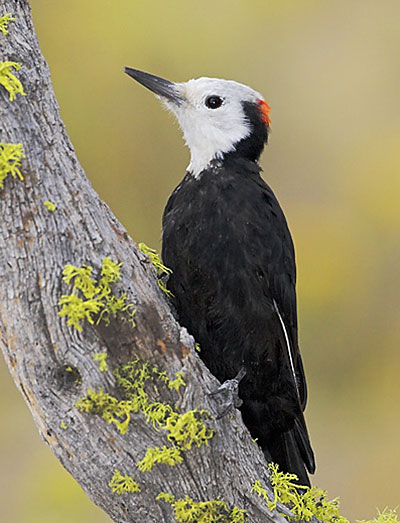
Male. If you look closely, you can see the red patch on the back of his head.
Male and female White-headed Woodpeckers look nearly identical. They are very dark birds with seemingly black bodies, a black nape, a white head, and white patches on their primary feathers. If their wings are folded, the white wing patch looks like a stripe running along the edge of their wings. In the right light, their plumage has an iridescent sheen.
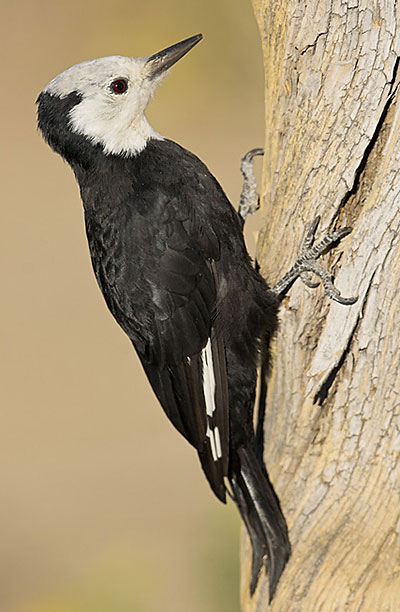
Female.
Males also have a small red patch at the back of their heads right above the black nape patch.
Juvenile White-headed Woodpeckers look fairly similar to adults and have a small red crown patch, although it might not be as well defined as in adult males.
Vocalizations
White-headed Woodpeckers are usually silent birds. They are most vocal during the breeding season before egg laying. Their most common call is a sharp high-pitched pee-kik or pee-dink or a longer pee-dee-dee-dink or pee-ki-kik. The notes are given very rapidly and have a squeaky quality. They also give rattling calls with similar sounds.
White-headed Woodpeckers drum rather loosely and slowly. The knocks are generally evenly paced and sound regular, although sometimes the series may be preceded by a separate knock. Pairs use it to communicate during the breeding season.
Food
White-headed Woodpeckers are omnivorous, although the specific makeup of their diet depends on the season and what is available. In general, they mostly feed on animal matter during the breeding season, whereas in the fall and winter, they focus more on plant matter.
The animal part of their diet is made up of adult and larval insects. This includes ants, beetles, cicadas, termites, and scale insects. The plant part of their diet is mostly made up of various pine seeds from ponderosa, sugar, Coulter, and Jeffrey pines and tree sap.
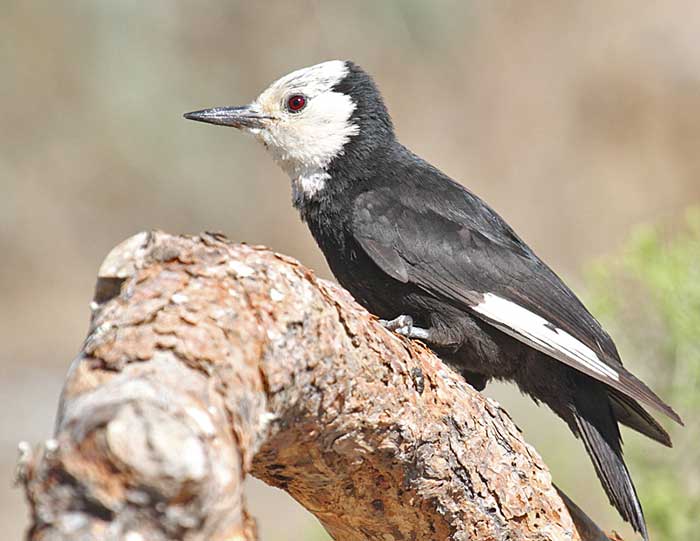
White-headed Woodpeckers feed on pine seeds by clinging to cones and then prying or hammering them open to get to the seeds. They sometimes eat it on the spot but in general, they pull the seed out and then fly to another location to eat it. Akin to a sapsucker, they also drill shallow holes in trees, mostly pine, and drink their sap.
These woodpeckers are relatively quiet foragers. Rather than drumming the tree to knock off pieces of bark, they gently pry them off to get to their next meal. They might not even resort to that and may just glean insects from the tree trunk, branches, and needle clusters.
Their foraging habits tend to change depending on the sex of the bird and the season, with males typically foraging higher and more actively than females. They may also look for food on the ground in low vegetation and visit bird feeders for suet.
Nesting and Eggs
White-headed Woodpeckers are monogamous during the breeding season and may mate for life and stay together year-round. Courtship displays include birds lowering and swinging their heads, raising their crests, spreading or flicking their wings, and a moth-like fluttering flight. These displays are also used during aggressive encounters as threat displays.
White-headed Woodpeckers nest in cavities in dead parts or fully dead coniferous trees, especially pine and fir, about 8 feet above the ground. Males choose the nesting site, but females join in excavating the cavity.
The entrance measures around 1.8 inches in diameter and the cavity is 8.3 inches deep and about 5 inches wide on average.
Females lay 2-9, usually 4-5 eggs in a clutch. White-headed Woodpecker eggs are white, although they may become stained by pine pitch, and measure 0.8-1 inches long and 0.7-0.8 inches wide. Incubation takes 14 days, and both members of the pair take turns. Males generally take the night shift while females incubate during the day.
Both parents tend to their offspring. The younglings leave the nest a little less than a month after hatching and become independent by fall.
Current Situation
White-headed Woodpeckers range throughout the mountains of western North America from British Columbia to southern California. They do not migrate and stay in the same area year-round, although some individuals may move to lower elevations come winter.
These woodpeckers inhabit mountain pine forests, preferring species that produce a lot of seeds or large cones, such as Jeffrey, Coulter, ponderosa, or sugar pines. They are rarely found in places that do not have pines, but may also forage in other conifers.
White-headed Woodpeckers are listed as a species of least concern on the IUCN Red List. Their population seems to be slightly increasing. However, they are threatened by various forestry practices that fragment or destroy old-growth pine forests or suitable nesting trees, such as logging, snag removal, even-age stand management, and fire suppression.
Facts About White-headed Woodpeckers
- White-headed Woodpeckers sometimes use staring contests to resolve conflicts. They chase rivals up tree trunks or along branches, then freeze, extend their necks, and stare them right in the eye in complete silence.
- White-headed Woodpeckers have developed an interesting way to forage to avoid getting tree sap on their feathers. They cling to the sides of the bottom of the pine cone, wedge seeds out of them, and then fly somewhere ‘safe’ to eat them.
- White-headed Woodpecker relationships are adorable. The pair shares incubation and child-rearing duties while also being very supportive and attentive to each other by softly drumming to each other.
- The oldest known White-headed Woodpecker on record lived to be at least 4 years and 1 month old.
Similar Species
White-headed Woodpeckers are a fairly unique species. Some species might appear similar from a distance, but they are always identifiable by their solid white head. Here is how to tell them apart.
Acorn Woodpecker
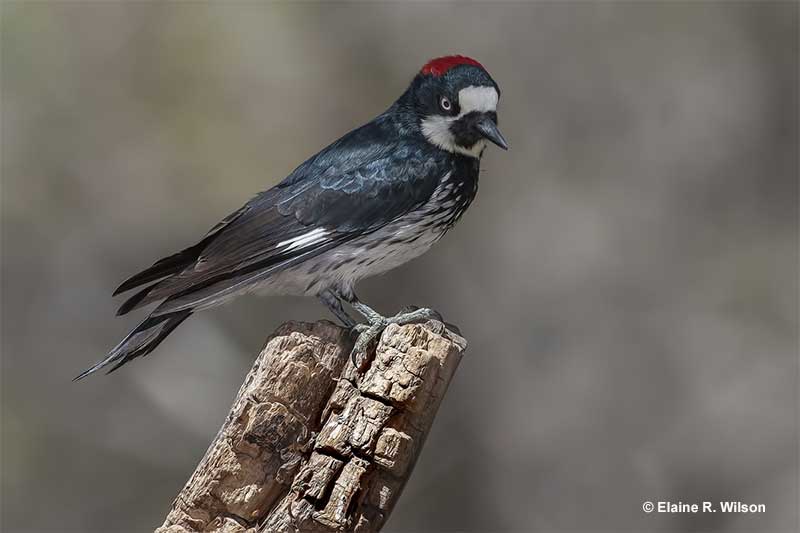
In North America, Acorn Woodpeckers are resident along the western coast of the United States, in eastern Arizona, and parts of New Mexico and Texas. They live in oak and mixed oak-conifer forests on mountains and mountain slopes, whereas the White-headed Woodpecker mostly prefers pines.
Adult Acorn Woodpeckers are black above and white below, with a black chest and black streaking on the underside. They have a black head with a white face mask and a red cap and whitish eyes. On the other hand, the White-headed Woodpecker is solid black below, has a white head, and dark eyes.
Frequently Asked Questions
Are White-headed Woodpeckers rare?
According to the ABA Checklist, the White-headed Woodpeckers are not rare, however, they may be rare in some parts of their range and may be difficult to meet casually due to their habitat preferences.
Where do White-headed Woodpeckers live?
White-headed Woodpeckers primarily live in pine forests in the mountainous regions of western North America.
Do White-headed Woodpeckers live only in pine forests?
Although White-headed Woodpeckers highly prefer pine forests, then they can rarely be seen in other conifers as well.
