
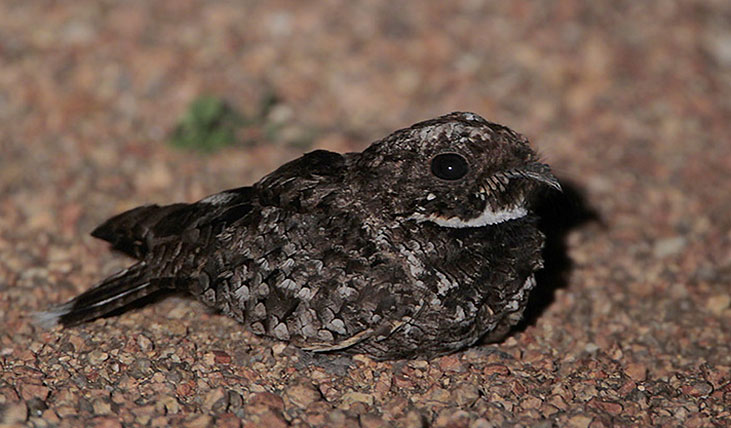

Common Poorwills (Phalaenoptilus nuttallii) are nocturnal birds native to western North America. They are the smallest nightjar species in North America and sport cryptic, mostly brown-and-gray plumage suitable for blending into its surroundings.
Listen for their whistled poor-will-ow calls at dusk and dawn if you want to find them.
Identification
Common Poorwills are nocturnal birds with a fascinating yet cryptic appearance that is perfect for camouflage. They are the smallest nightjars in North America, measuring 7-8 inches long with a wingspan of around 12 inches.
Their bodies are compact, wings short and rounded, and their tails are short as well. They have rounded heads that are rather big compared to their body size, big black eyes, and deceptively small, slightly downcurved bills. Those bills open up to cavernous mouths when they are hunting for food.
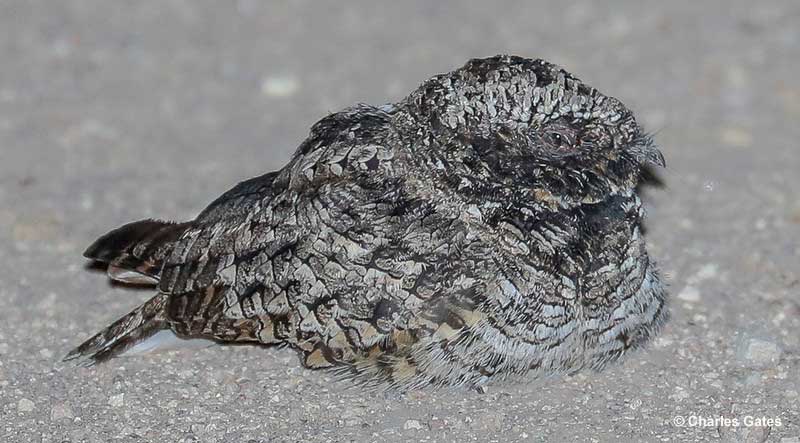
Male and female Common Poorwills have similar plumage. They are fairly dark birds, mottled in brown, gray, black, and buffy tones.
Their plumage helps them to blend into their surroundings, be it leaf litter, tree bark, or rocks.
They have a white band on their throat, but it may not be visible when the bird is roosting. In flight, they make a few moth-like flutters, which are followed by a short glide.
Try to also take a closer look at the tail of the bird. Male Common Poorwills have distinct white tail corners, whereas the females have buffy tail corners. Due to their overall coloration, the female’s tail tips are not as obvious.
Common Poorwills have six recognized subspecies, four of which can be met in North America. Specimen in western California tend to be duskier, darker, and browner than the nominate race, whereas poorwills in the deserts of southeast California and southwest Arizona are paler.
Common Poorwills in extreme southern Arizona and north Mexico, also known as Sonoran Poorwills, are paler and browner compared to the nominate race.
Vocalization
Common Poorwill’s most iconic song is a mellow, whistled three-syllable poor-will-low. The second syllable is higher-pitched than the first and the last syllable is lower, warbled, and quieter which is why you may often only hear poor-will, especially if the bird is further away from you. Males sing it during the breeding season to establish territories and attract females, but females may sing as well.
Common Poorwills also give chuck calls while in flight. If they are startled, they may growl, hiss, or bark and sometimes even clap their wingtips together.
Food
Common Poorwills have a specialized diet consisting exclusively of insects. They feed on a wide range of flying insects, with flying beetles from the order Coleoptera and moths from the order Lepidoptera making up at least 90% of their diet.
This includes moths, beetles, flying ants, flies, mosquitoes, grasshoppers, and other various nocturnal flying insects.
They seem to prefer prey that is at least 0.2 inches long – the bigger the better. This is either to maximize the energy they are getting from their food or because they just can’t detect insects smaller than this due to the hunting conditions.
Common Poorwills are nocturnal predators and hunt in low-light conditions. However, it seems that there is a minimum amount of light the poorwills need to see, since they are especially active at dusk, just before dawn, and during moonlit nights. Their large eyes are well-adapted for this, and if you happen to shine a light on them, they will show a red reflection.
These poorwills mostly forage by sitting on the ground or perching in very low vegetation, surveying the air for insects, and then flying up to snatch them.
Long sustained flights to chase prey are rare and generally last no longer than three seconds. They also pick insects from the ground. If they need to drink, they fly over a body of water and skim the surface with their bill open. The birds eject pellets containing undigested parts.
Nesting and Eggs
Very little is known about how Common Poorwills select their partners or their courtship behaviors.
They are monogamous throughout the breeding season with males establishing breeding territories and then singing to defend it and attract the attention of females. Southern populations breed from March to August whereas populations further north breed from May to September.
Common Poorwills nest on the ground. It is a simple scrape on sandy or stony ground on rocks, open soil, or gravel, sometimes on dead leaves or pine needles.
They prefer to hide their nests under some kind of shelter low over the ground, be it a shrub, an overhanging rock, or a fallen log. The same spot may be used in the next years as well.
This species has one to two broods in a year with two eggs in a clutch. Common Poorwill eggs are whitish to buff or pinkish with a few specks on occasion and measure around an inch long and 0.7-0.8 inches wide.
Incubation takes 20-21 days, with both parents taking turns incubating. Males are more likely to incubate during the daytime whereas females are more likely to brood the offspring during daytime. The young fledge at around 20-23 days after hatching.
Current Situation
Common Poorwills range throughout Baja California, northern Mexico, and western North America. They are resident throughout their range in Baja California, northern Mexico, and the southernmost western United States. Their breeding range extends further north throughout the western US to some southern parts of British Columbia and Saskatchewan in Canada.

Common Poorwills mostly inhabit dry and open areas, preferably with shrubs and short grasses at elevations between 1,000 and 7,000 feet. They can be found in various habitats, including deserts, rocky mesas, hills, pine forests, and grasslands.
According to the IUCN Red List, Common Poorwills are of least concern. Their population is relatively stable. The species benefits from some human activities that create open areas, such as cattle grazing or logging, whereas some activities, including urbanization, causes them harm.
Facts About Common Poorwills
- Common Poorwills often have favorite spots to roost during the day. Family groups may roost together!
- Common Poorwills have an interesting adaptation. During adverse weather, parent birds can enter a state of torpor, lowering their cloacal temperatures as they continue to incubate eggs, saving energy but potentially reducing egg viability and increasing nest abandonment rates.
- Common Poorwills try to stay as undetectable as possible during incubation, chick rearing, and roosting. Parents only switch each other out for incubation when it gets dark and remain completely immobile the rest of the time to avoid detection unless an intruder comes closer than three feet. They also move eggs and nestlings to increase their chances of remaining hidden.
- Common Poorwills are the only known bird species that goes into torpor for longer periods of time from weeks to even months, resembling hibernation. The Hopi Native Americans named this bird hölchoko, meaning ‘the sleeping one’.
Similar Species
Common Poorwills have several very similar species, all from the nightjar family. They have some minor differences in body shape, proportions, and markings, so be very observant. Here is an overview of the three most similar species and how to tell them apart.
Common Nighthawk
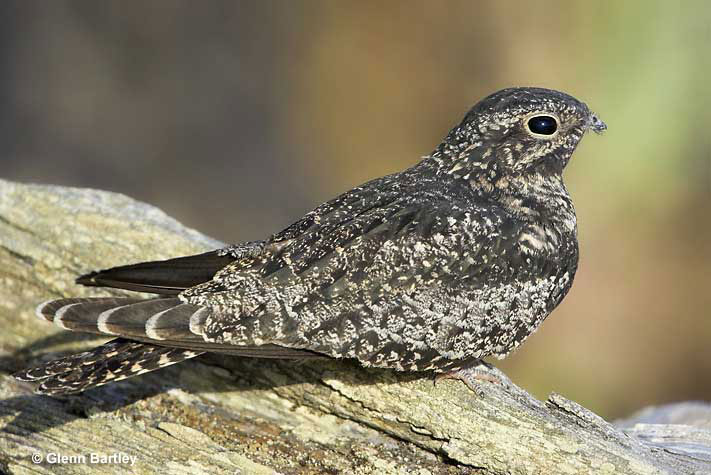
Common Nighthawks breed across most of North America, in parts of Central America, and winter in South America. Adults have cryptic plumage mottled in buff, gray, black, and white, and a white throat patch.
In flight, they have long, narrow, and pointed wings, white patches near the tips of their wings, and a forked tail. When they are perched, they have small white patches on the lower edge of the wing.
In comparison, Common Poorwills lack wing patches and a fork in their tail, and they have rounded wings instead of slender pointed ones.
Common Pauraque
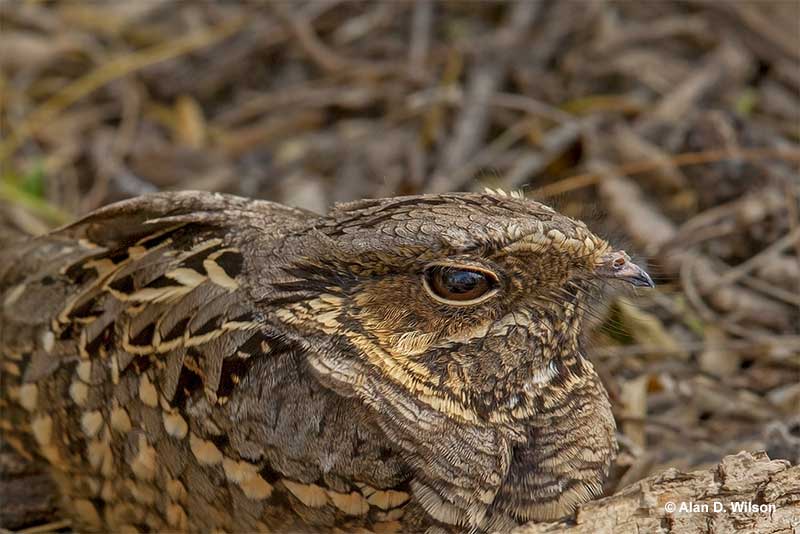
Common Pauraques are resident throughout their range in South America, parts of Central America, and a small area in the southernmost tip of Texas.
They are mottled in brown, gray, and golden tones and have long tails. Males have white outer tail feathers and a white band on the wings, whereas females have buffy feathers instead of white wing bands and less white feathers on their tails.
Compared to Common Poorwills, Pauraques are larger and have a longer tail. They also have white bars on their wings, which these poorwills do not have.
Chuck-will’s-widow
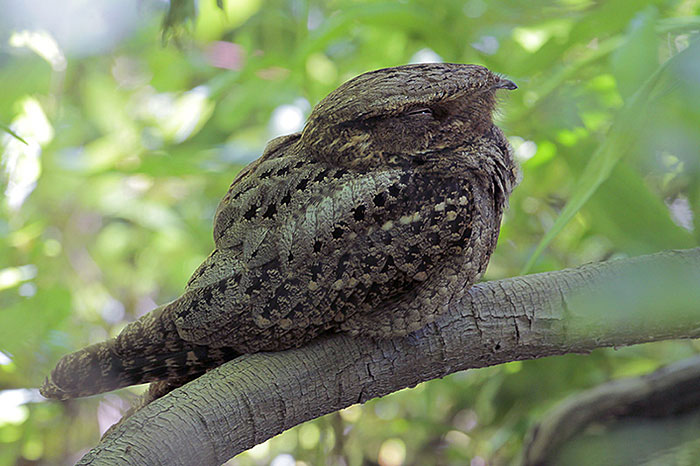
Chuck-will’s-widows breed in the southeastern United States and are resident in the southern half of Florida. Adults measure around 11-13 inches long, have a long tail, and are mottled in warm browns, black, and buff. Males have thin white stripes on their tails.
Compared to Common Poorwills, they are larger, more brownish, and have longer tails. Chuck-will’s-widows lack the white neck band of Common Poorwills and their ranges barely overlap.
Frequently Asked Questions
What does a Common Poorwill bird look like?
A Common Poorwill has a mottled gray-brown plumage, a compact stocky build, large dark eyes, and a short, slightly curved bill that opens into a gaping mouth.
Where do common poorwills live?
In North America, Common Poorwills inhabit open and dry shrubby habitats mainly in the western United States.
How do you find a common poorwill?
Finding a Common Poorwill might prove rather difficult due to their cryptic plumage and nocturnal lifestyle. However, if you’re determined, go out at night, especially around dawn and dusk, listen for its calls in suitable habitats, and be patient and observant while scanning the ground and low perches.
What is the diet of a Common Poorwill?
The diet of a Common Poorwill mainly consists of flying nocturnal insects.
