
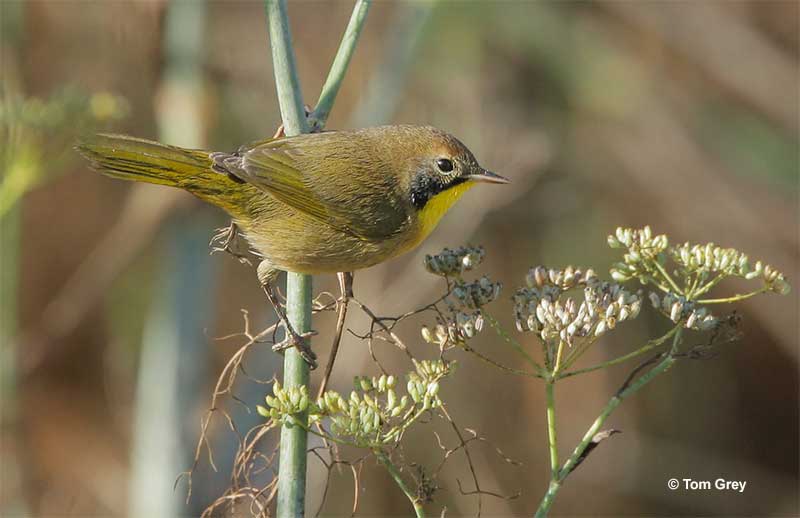

Common Yellowthroats (Geothlypis trichas), small yet vibrant, adorn marshes and shrubby habitats across North America with their striking yellow throats and olive-green plumage.
Known for their bandit-lie face mask and distinctive witchity-witchity-witchity song, these agile insectivores flit through dense vegetation, hunting for insects.
Identification
Common Yellowthroats are relatively small birds, measuring about 4.3 to 5.1 inches long with a wingspan of 5.9 to 7.5 inches. They have compact, rounded bodies and heads. Their bills are short and slender, their long tails slightly rounded and often cocked upwards, and their wings short and rounded.
Male
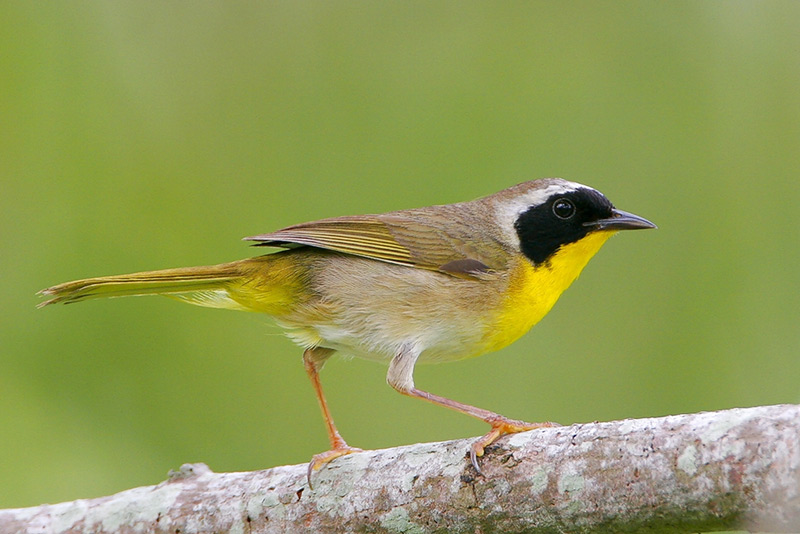
Male Common Yellowthroats have a distinct appearance. Their most eye-catching feature is the bold black mask that stretches across their eyes and forehead and down to the base of their neck.
Photograph © Greg Lavaty.
The upper side of the mask is bordered with a white-to-gray band. This contrasts with their vibrant yellow throat and upper breast. Olive-green feathers cover their back, tail, and wings, while their bellies are pale dirty yellowish.
Immature male Common Yellowthroats have similar, albeit duller plumage than adults, but their face mask is not well developed yet. It is faint and slightly patchy. Moreover, adult males have black bills whereas immature males have a lighter base.
Female
Female Common Yellowthroats have a less contrasting and more understated appearance. They have muted brownish uppersides with a slight olive tone that helps them remain unremarkable. Their throats, upper chests, and undertail coverts are yellow with the amount and brightness varying depending on location.
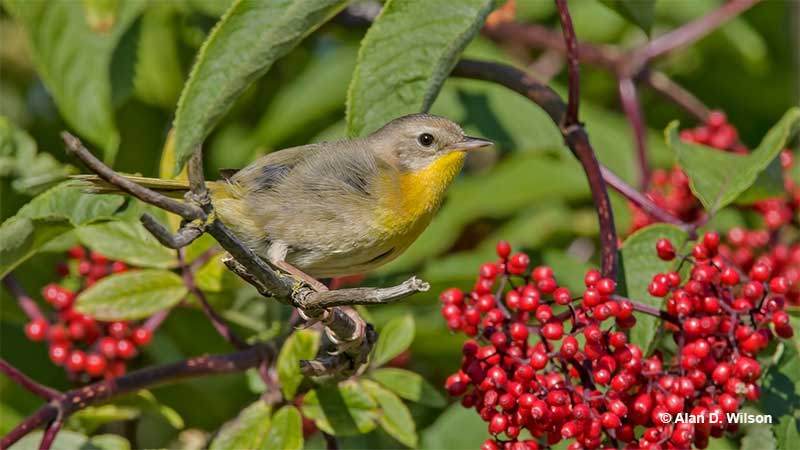
Instead of the striking black mask, her head is often unmarked or slightly grayish. Like the male, she has a slender bill but it is lighter-colored and slightly pinkish instead of black.
Immature female Common Yellowthroats are even more unnoticeable. They are pale brownish, have a pale bill, and yellow undertail coverts.
Vocalizations
The male Common Yellowthroat’s song is a series of short, musical phrases, often described as witchity-witchity-witchity or which-is-it, which-is-it, which-is-it. This song is clear, rhythmic, and repetitive and lasts for about 2 seconds.
They sing from perches within their territories, especially during the breeding season, to attract mates and defend their territories. Yellowthroats also have a warbling flight song.
Both sexes also give various calls. The most common call of the Common Yellowthroat is a sharp chip, chuck, or tik. Their flight call is a high-pitched chirp. Females produce a rapid series of chip notes when they are ready to mate and males chatter aggressively in response to other males.
Food
The diet of Common Yellowthroats mostly consists of insects, but also a few seeds and some grit. This includes various bees, flies, ants, beetles, grasshoppers, dragonflies, damselflies, moths, caterpillars, larvae, butterflies, termites, wasps, leafhoppers, aphids, mayflies, grubs, cankerworms, and spiders.
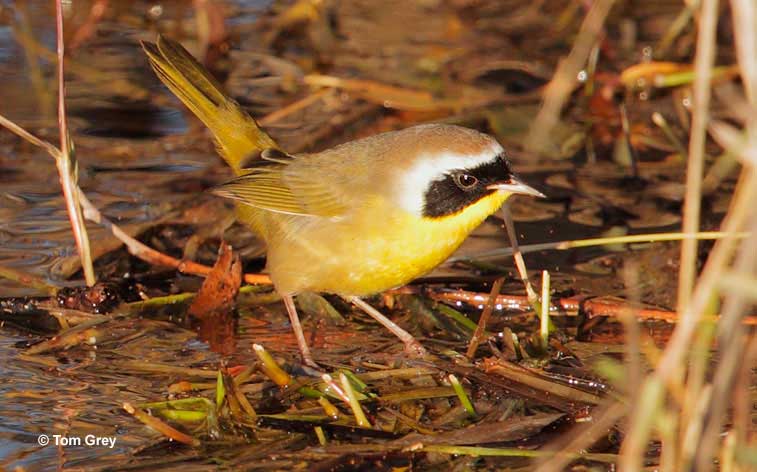
Common Yellowthroats are typically found foraging in areas with dense low growth, including shrubby areas, thickets, fields, marshes, wetlands, and forest edges. They prefer habitats with thick undergrowth and ample vegetation cover, where they can hunt for insects and other prey while remaining concealed from predators.
When foraging, they often glean insects from leaves, stems, and branches by hopping or flitting from perch to perch.
Sometimes, they hover briefly while picking insects off leaves or flowers. They may also hawk, meaning that they fly out to catch flying insects mid-air, or forage on the ground among fallen leaves, grass, or debris.
Nesting and Eggs
Common Yellowthroats are seasonally monogamous, generally speaking. Males arrive on the breeding grounds before females and establish and defend territories by singing and attacking other males. Courtship involves males following the female, flicking and fanning their tails and wings, and performing flight displays and singing.
Common Yellowthroats nest up to 3 feet above the ground in shrubbery, such as on tussocks of weeds, grasses, or shrubs or among sedges, cattails, or bulrushes. The female builds the bulky open cup of grasses, leaves, sedges, bark strips, and ferns and lines it with softer materials such as hair, fine grass, and bark fibers. It measures around 3.5 inches wide and 3 inches deep.
One female may raise up to 2 broods in a breeding season with 1-6, generally 3-5 eggs in a clutch.
Common Yellowthroat eggs are creamy white with dark, including black, brown, gray, and lilac specks, especially towards the larger end. They measure 0.6-0.8 inches long and 0.5-0.6 inches wide. Incubation lasts for around 12 days and is done by the female only while her mate brings her food.
After the eggs hatch, both parents feed their offspring. The young leave the nest after 8-10 days but are dependent on their parents for some time longer.
Current Situation
Common Yellowthroats range throughout North and Central America. They are resident along the southern coast of the United States, a small area along the southwestern coast of the United States, and central Mexico. Their breeding range covers most of the United States and the southern half of Canada and they migrate to Central America for the winter.
Common Yellowthroat habitats can be characterized as damp areas with dense low growth. They mostly prefer to breed in brushy marshes, swamps, and wet thickets but also nest in shrubbery along streams, moist brushy places, and briars.
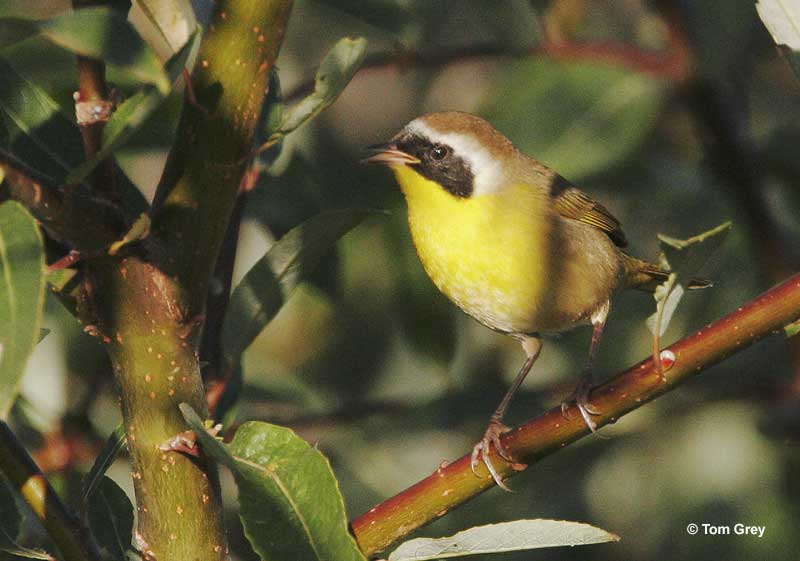
They thrive in areas with dense emergent vegetation, such as cattails, sedges, and bulrushes. These wetland habitats provide ample cover and nesting sites for the birds, as well as abundant food resources in the form of insects and other aquatic invertebrates.
Common Yellowthroats occasionally also inhabit grasslands and fields, particularly those with scattered shrubs or small patches of dense vegetation, although that is less common.
Common Yellowthroats are listed as least concern on the IUCN Red List. They are very common and numerous, with a population of around 77 million individuals, but their numbers are slowly declining. This is mainly due to wetland degradation and the use of pesticides.
Fun Facts
- Common Yellowthroats have 13 subspecies with the main differences being variations in the males’ face mask and the extent and vibrancy of yellow in their plumage. Southwestern birds have the most yellow in their plumage.
- Male Common Yellowthroats identify whether an individual is a male or a female by their face. According to one study, males choose to attack other individuals based on whether they have the black face mask or not. Researchers added a black face mask made of paper to a stuffed female and the males attacked it.
- Common Yellowthroats do not have a long average life expectancy. They only survive for a few years out in the wild. However, the oldest wild individual on record lived for at least 11 years and 6 months.
- The Common Yellowthroat stands out as one of the first bird species to be documented from the New World in 1766.
Similar Species
Male Common Yellowthroats can be identified quite easily thanks to their face mask, but it is a bit more difficult when it comes to females. We have introduced three of the most similar species and given some insight into how to tell them apart.
Nashville Warbler
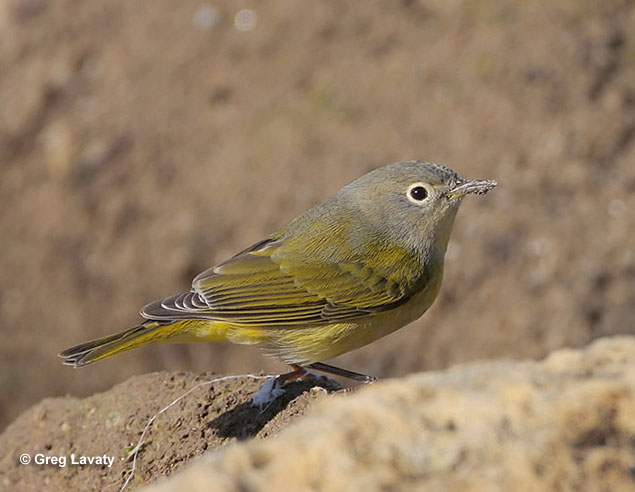
Nashville Warbler, loosely speaking, breeds in an area around the border of the United States and Canada and winters in Central America.
Males are yellow below, olive-green above, have gray heads, a small chestnut crown patch, and a white eye ring. Females are duller yellowish overall with dull grayish heads.
You might have trouble distinguishing between female and young Nashville Warblers and female and young Common Yellowthroats. Take a look at their undersides and heads. Nashville Warblers tend to have yellower undersides and grayer heads whereas Common Yellowthroats tend to have brownish heads.
Yellow-breasted Chat
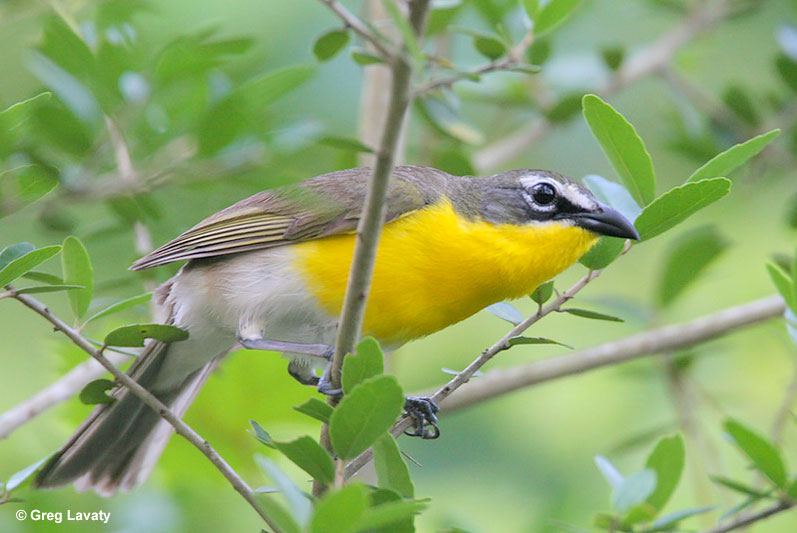
Yellow-breasted Chat mostly breeds in the United States and northern Mexico and migrates to the southern half of Central America for the winter. Adults have yellow throats and chests, white lower bellies, and grayish-olive uppersides. They are easily recognized by their gray face, white eye rings, and two white stripes – one above the eye and one below.
Yellow-breasted Chats are larger than Common Yellowthroats. You may mistake them for immature male Common Yellowthroats, but they don’t have the two white stripes on their face like the Chat does. Chats also have white, not yellow, undertail coverts.
Mourning Warbler
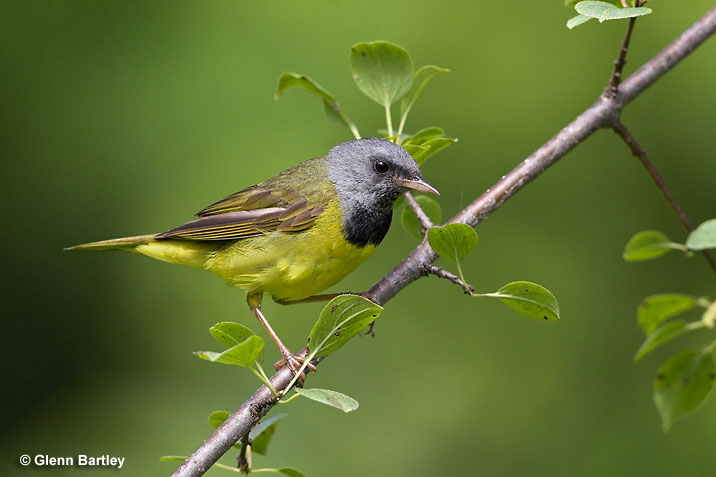
Mourning Warblers breed in southern Canada and the northeastern United States, migrating to northern South America for the winter.
Males have gray heads, a black patch on their chest, olive upperparts, and yellow underparts. Females and young birds are paler with otherwise similar plumage but lack the black patch on their chests. You may confuse females and young birds of these species.
However, keep in mind that Mourning Warblers have yellower throats and pure gray heads, whereas Common Yellowthroats have more brownish heads and are pale tan on the underside with a yellow throat, upper chest, and undertail coverts.
Frequently Asked Questions
What does a Common Yellowthroat look like?
The male Common Yellowthroat is characterized by a vibrant yellow throat and breast, a striking black mask extending across its face, and olive-green upperparts, while the female lacks the black mask and exhibits more subdued plumage with brownish upperparts and a paler yellow throat and breast.
What is the difference between Yellow-breasted Chat and Yellowthroat?
The primary difference between the Yellow-breasted Chat and the Common Yellowthroat lies in their size and face, with the Yellow-breasted Chat being larger and having two white eye stripes instead of a black face mask.
What is another name for the Common Yellowthroat?
Another name for the Common Yellowthroat is the yellow bandit or also the Maryland Yellowthroat.
