


Birds with black and brown are not uncommon, but it’s not often we stumble upon one.
Red is not the most frequently seen color in birds but some common species do have beautiful crimson and scarlet plumage. For example, the Brown-headed Cowbird, Common Grackle and Dark-eyed Junco are three of the better-known black and brown birds in eastern North America. However, most birds with brown in their plumage show this color on their wings.
Most of them have red highlights to look their best for potential mates. Learn about 15 of these beautiful birds below!
Common Grackle
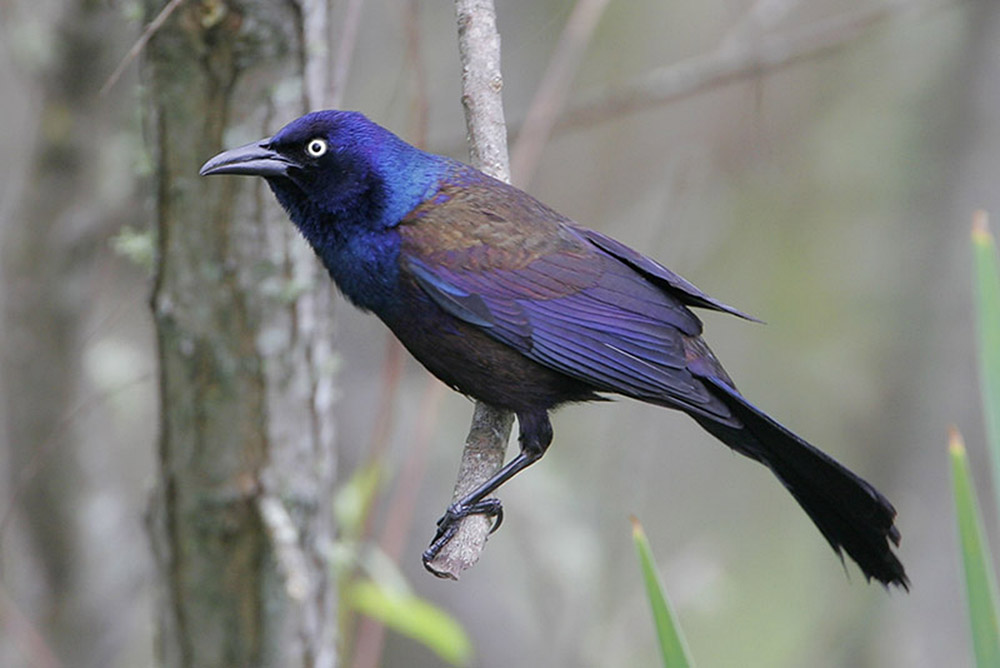
Common Grackles look black from far away, but you’ll see their iridescent purple heads and glossy bronzy bodies when you look closer. In addition, they have golden eyes that give them an intense expression.
These birds are 11.0 to 13.4 inches (28 to 34 centimeters) long, weigh 2.6 to 5.0 ounces (74 to 142 grams), and have a wingspan of 14.2 to 18.1 inches (36 to 46 centimeters). Common Grackles are larger than a Red-winged Blackbird and around the same size as a Mourning Dove.
Wild Turkey
Male Wild Turkeys, also called toms, are generally larger and stockier than females, measuring 39-49 inches long and weighing 11-24 pounds. Their plumage is dark brownish overall with subtle shades of red, gold, bronze, copper, and green iridescence giving it a metallic sheen.
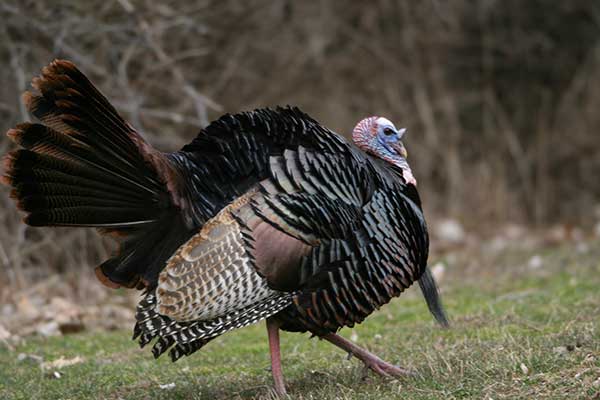
Males have a bare head and neck with skin tones varying from gray to blue to red. The fleshy outgrowth on their bill is called a snood and can change in length depending on their mood. They have carnucles on their neck and wattle on the underside of their neck, which changes color if they’re excited. Males also have a beard on their chest, which is a cluster of long, hair-like feathers.
Northern Flicker
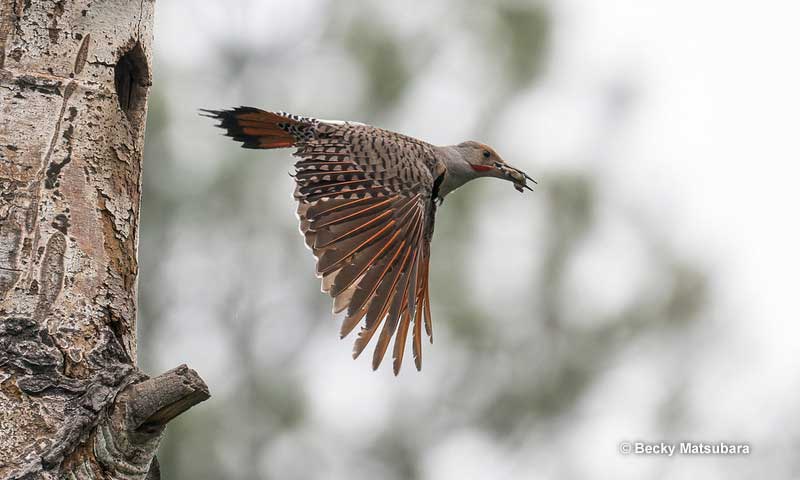
The Northern Flicker is a large woodpecker with gentle expressions and black-scalloped plumage. They have long, flared tails that taper off, rounded heads, and slightly curved bills.
When on a walk, you may find that you spook one up to the trees from the ground. The ground is not where you’d expect a woodpecker to be, but Northern Flickers mostly consume beetles and ants. They’ll dig for them with their slightly curved bills. When they fly, you can see a flash of color in the wings. The color changes depending on the region you’re in. The flash of color is yellow in the East and red in the West.
Eastern Towhee
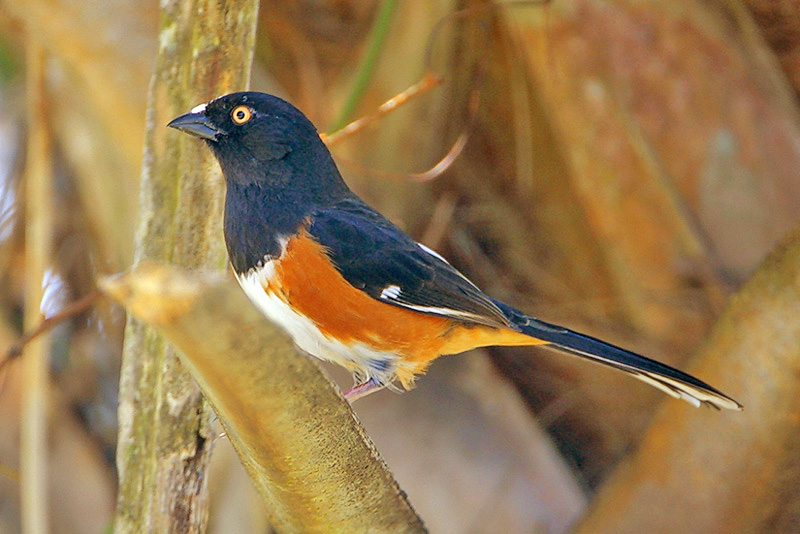
Male Eastern Towhee. Photograph © Greg Lavaty.
Eastern Towhees look like large sparrows. They have a chunky body, thick, triangular, and pointed bills, and long rounded tails. These birds generally have dark red eyes. However, individuals in Florida and along the southern Atlantic coast have pale, almost white eyes.
Male Eastern Towhees have black upperparts, a black head, and a black throat. Their bellies are white and their sides and the undersides of their wings are rust-colored. Males’ wings and tails are black with white marks along the edges.
Female Eastern Towhees have a similar plumage pattern. Their bellies are white, sides rufous, and wings and tails have white marks. However, their head, throat, back, wings, and tail are dull brown instead of black.
Dark-eyed Junco (Oregon subspecies)
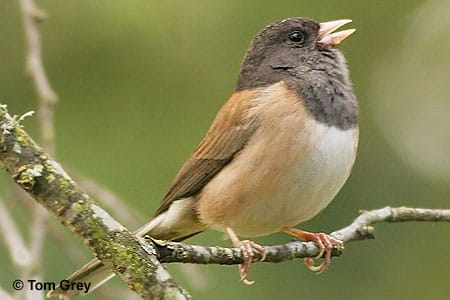
These juncos can be seen in most of Canada and the eastern United States. The “Oregon” junco has a light brown back, dark brown head, white belly, and buffy sides. These birds can be seen across the western U.S. More restricted regional differences include the “white-winged” and “pink-sided” juncos. These “white-winged” juncos are similar to the “slate-colored” junco and can be found in the Rockies.
The main difference between these two is the “white-winged” junco is a paler gray, dark face and white wing bars. The “pink-sided” junco is similar to the “Oregon” junco. It can be found in the western Great Plains and has pinkish-brown sides, a brown back, and a slate-gray head.
Spotted Towhee
Female Spotted Towhees look similar to males, but their colors are muted. Instead of black, their upperparts and throat are grayish brownish, and the rufous color on the flanks is a bit duller. If you see one flying, you can recognize one of these birds by the white corners of its black tail.
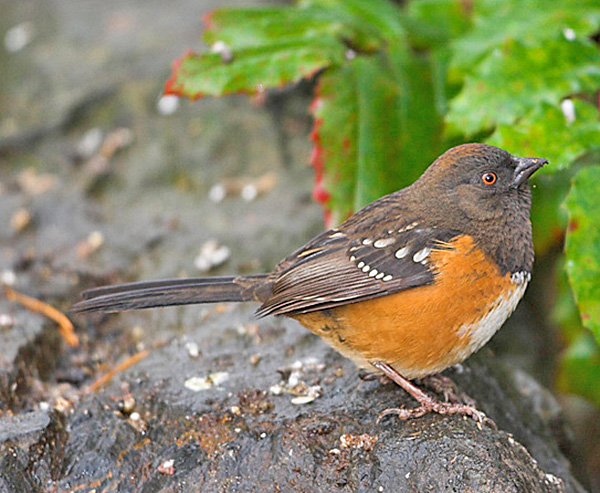
Female. Copyright Glenn Bartley
Juvenile Spotted Towhees are a patchwork of different shades of tan, brown, and pale buff. Their uppersides are warm chestnut brown, undersides tan with darker streaking, and wings and tail dark brown, almost black. Older but still immature individuals resemble females.
The spotted Towhee song sounds like a faster and less melodic version of the Eastern Towhee’s song. It starts with a few chirp notes and ends with a fast trill, lasting for about 1-2 seconds. Some birds only sing the trill.
Wood Thrush
Male and female Wood Thrushes look the same. They have reddish-brown upperparts with brighter plumage on their crown and the back of their neck. These birds also have fine black markings on their face, a white eyering, and a white “moustache” mark.
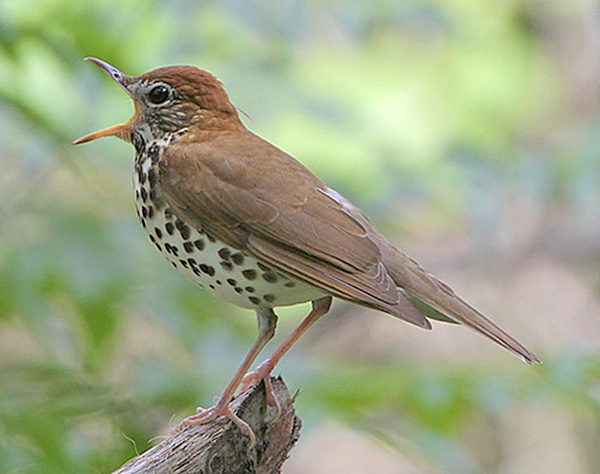
The Wood Thrush has an average-sized, dark beak with grayish-pink on the base of the bill, some brown on its lower flanks, and long, pink legs.
They have long wings with a buff mark on the underside of each wing, and a white undertail that extends about halfway down the underside of their medium length, slightly rounded tail.
Brown Thrasher
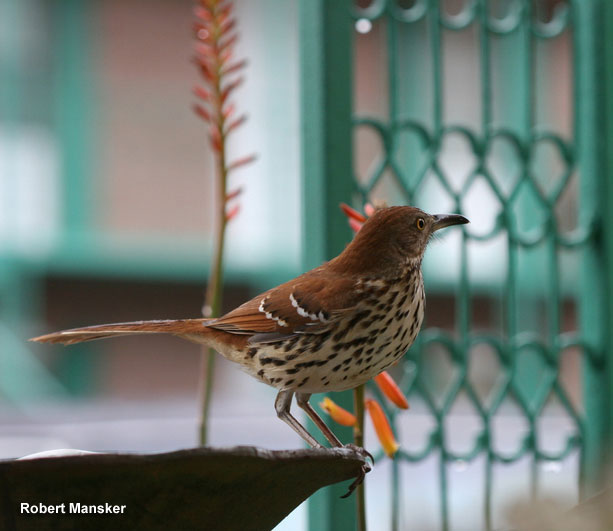
Brown Thrashers are a beautiful bird species, with both male and female birds looking the same. They have warm rusty-brown plumage on their upper side, black-and-white wingbars, and their underside is whitish with vertical dark streaks, which gives them a distinctive appearance.
Their pale, long, and slender legs and long, slightly curved black bill are also noticeable features. You might notice their brilliant yellow eyes, which are striking against their brown and whitish plumage. You can often observe it keeping its long tail cocked upwards.
Song Sparrow
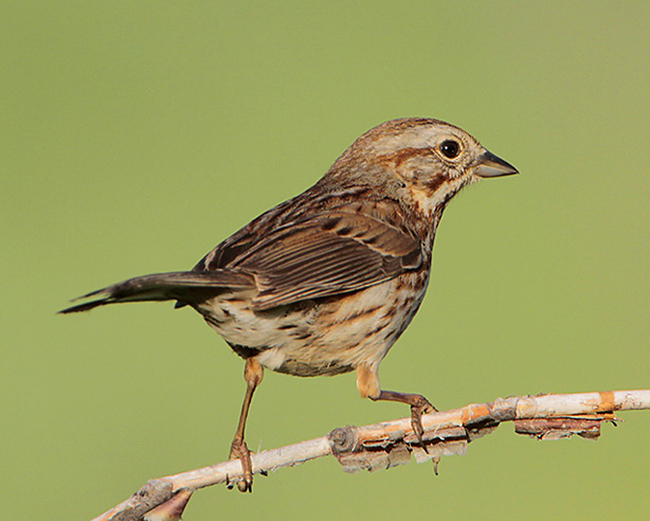
Song Sparrows are gray and red-brown above with streaks on their backs. They have mottled brown or red-brown wings, sometimes with two faint pale wing bars, and have a hint of a pale eyering.
Depending on where they occur, Song Sparrows can be darker, paler, or have different shades of brown but most birds have pale underparts with dark streaks on their sides and chest.
Most also have a dark spot on their chest, and a pale throat with dark borders.
They have a gray line on their crown, gray eyebrow, dark line going back from their eyes, and a dark mark on their face.
In the Aleutian Islands, Song Sparrows are larger and darker gray overall.
Song Sparrows sing a cheerful warbling song, “swit swit, swert swit treeeeeeee”.
Fox Sparrow
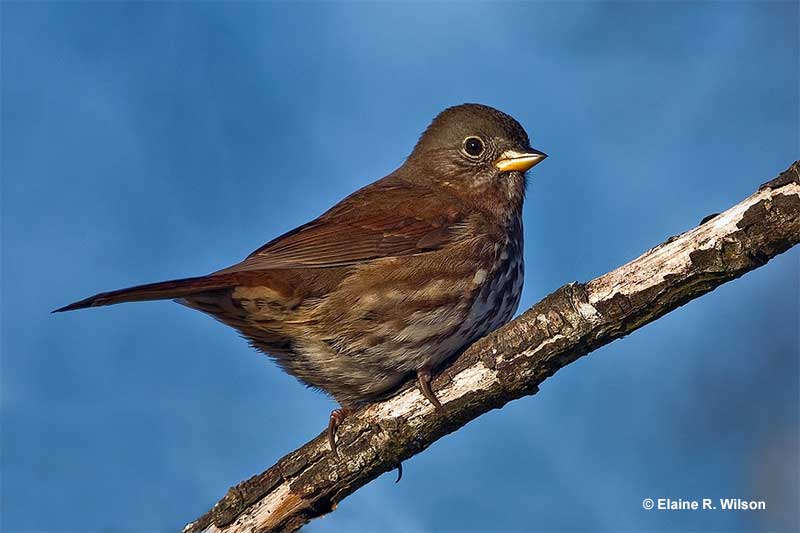
Eastern Fox Sparrows are handsome birds with gray and red-brown on their heads and back. They have rich, red-brown on their wings and tail, and red-brown streaking on their chest and sides.
Fox Sparrows from the Pacific Northwest are mostly dark brown and have dark brown mottling on their chest and flanks. Birds from the Rocky Mountains have gray on their head and back, and rich brown on their wings and tail. They also have blackish markings on their chest and flanks.
In and near California, another population of Fox Sparrows look like birds from the Rocky Mountains but have much larger beaks.
Northern Harrier (female/juvenile)
Female Northern Harriers look similar to male Northern Harriers. Adult females are brown overall and have black bands on their tails. Additionally, they have whitish undersides that are streaked with brown. They’re roughly the same size as males.
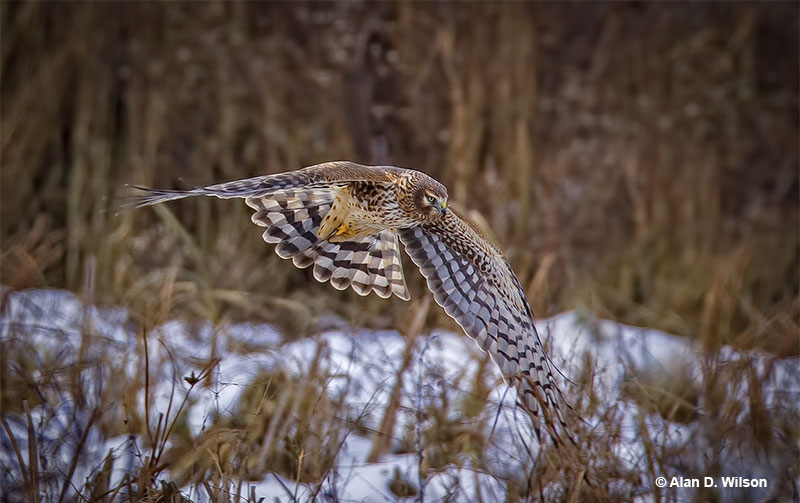
Female Northern Harrier © Alan D. Wilson
Juvenile Northern Harriers look almost identical to adult female Norther Harriers. They’re brown overall and have black bands on the tail. While adult females have whitish undersides that are streaked with brown, immatures have buffy undersides with less streaks.
Say’s Phoebe
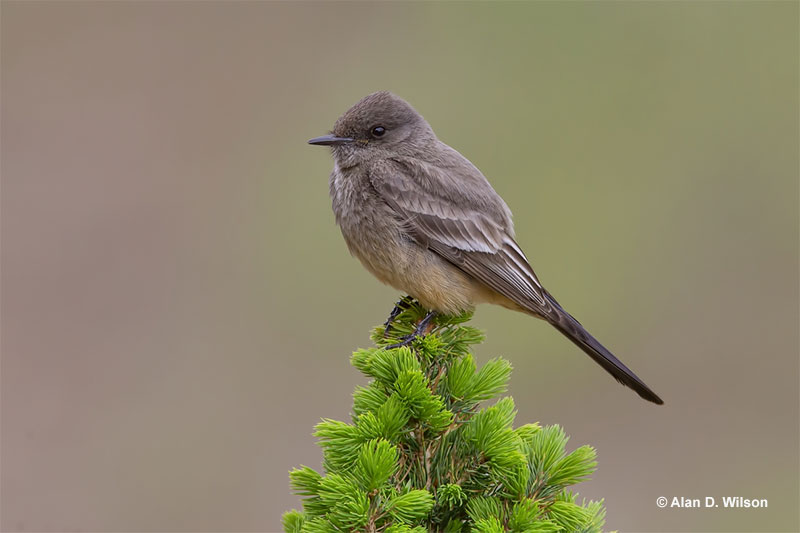
Say’s Phoebe has a relatively plain yet charming appearance. They’re on the smaller side, about 6.5-7.5 inches long with a wingspan of 13 inches. You can recognize one by their often flat-looking head and constant tail flicking.
Their plumage is typically brownish-gray on the upperparts and pale cinnamon-colored on the underparts with a gray breast. They have a slightly darker, almost black tail. Their black bills are relatively short, and their wings are long and pointed.,
Brown-headed Cowbird
The male Brown-headed Cowbird is a smallish songbird with a black body and a dark brown head. In certain lighting, its plumage shows glossy, dark blue highlights. It also has a short, finch-like bill, a fairly short tail, and black legs and feet.
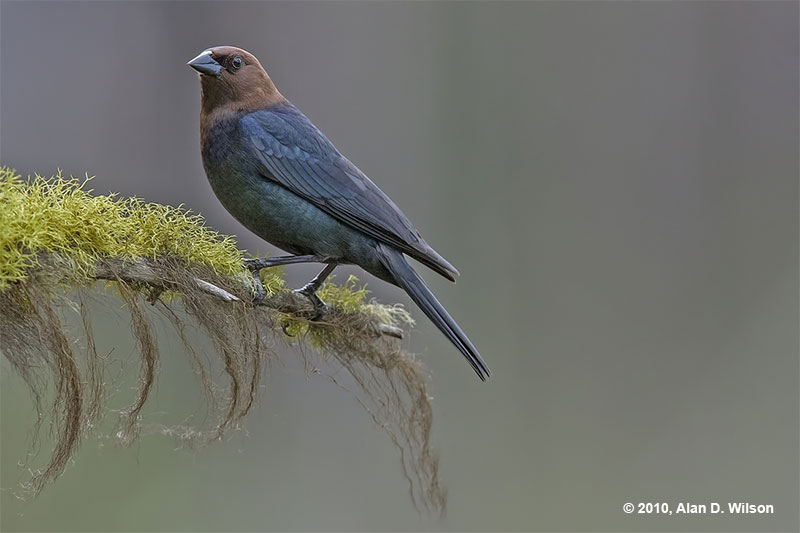
On average, this species is 7.5 inches long, has a wingspan of 12 inches, and weighs 1.5 ounces. Female Brown-headed Cowbirds look so different from the males, when people see them, many have no idea what it is!
They are pale, plain grayish-brown birds with a pale throat and usually, a pale eyebrow. They can also have indistinct streaking below and a faint, dark mark on each side of their throat.
Bottom line
Black and brown plumage helps birds survive by hiding them from predators, strengthening their feathers, helping them regulate temperature, and attracting mates. These natural colors are not just dull—they’re highly functional adaptations shaped by evolution.