
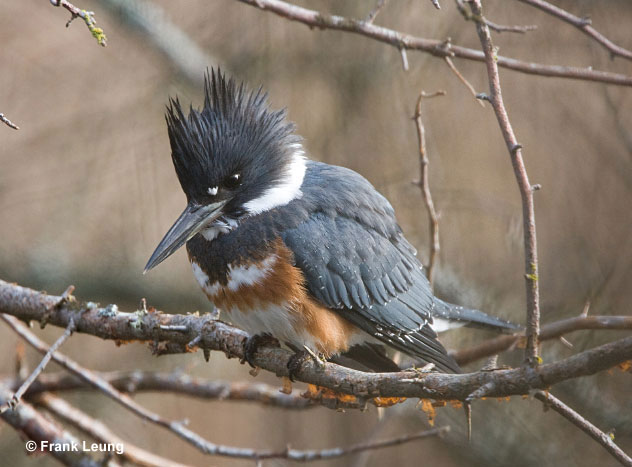

The Belted Kingfisher (Megaceryle alcyon), with its distinctive shaggy crest and bold, blue and white plumage, is a fascinating and highly skilled hunter found across North and Central America.
These birds are known for their impressive aerial acrobatics, as they dive headfirst into the water to catch fish. They are also known for their distinctive rattling calls, which echo across lakes and rivers.
Dive headfirst into this article to learn more about them!
Breeding Male
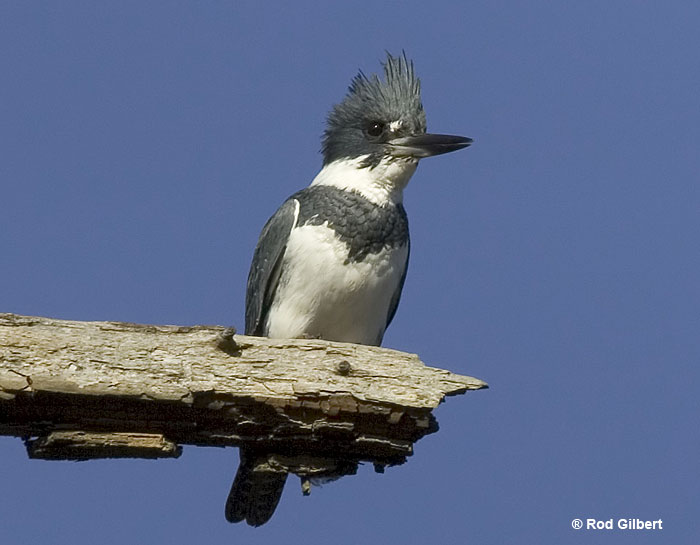
Male Belted Kingfishers are grayish-blue or bluish-gray above, mostly white below, and have a white collar, and a grayish-blue chest band.
The birds have a large head and doubly pointed crest, a straight, thick, and pointed black bill, short legs, and black eyes. There is a white dot between their eyes and bills. Their medium-sized tails are squared at the end and have white spotting, as do their wings.
Female
When it comes to female Belted Kingfishers, then they are one of the rare instances where a female bird is more colorful than a male.
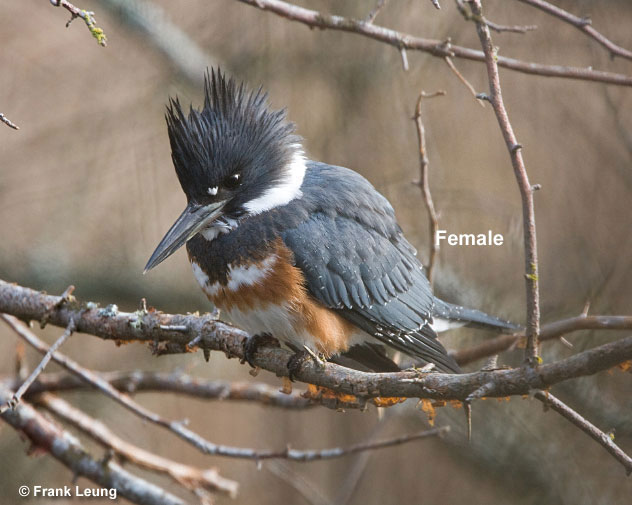
Their plumage is quite similar with a grayish-blue upper body and chest band, a white collar and belly, and spotted wings and tail.
However, they also have a rust-colored band across their bellies that extends down their flanks. On average, the female is also slightly larger than the male.
Juvenile
Belted Kingfishers have one, rarely two broods a year. The female lays 5-8, mostly 6-7 white and glossy eggs. Both parents take part in the 22-24-day incubation process and feed the young. The offspring leave the nest after 27-29 days and will be taken care of for another 3 weeks.
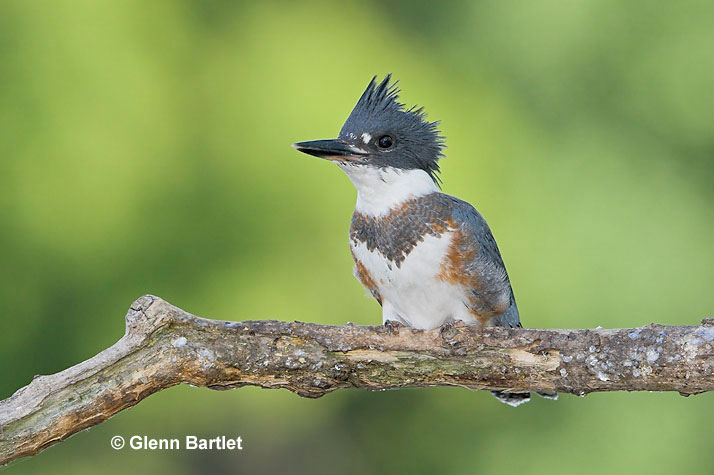
Juvenile Belted Kingfishers are quite similar to adults, although both sexes have that rust-colored band across their upper bellies.
However, the rufous color is a bit mottled when it comes to juvenile males, and female juveniles have a much thinner band than adult females.
Belted Kingfishers are medium-sized birds that grow up to 11-13.8 inches long and weigh between 4.9-6 ounces.
Habitat
Belted Kingfisher habitats are always near bodies of water that are often surrounded by forests. They prefer water bodies with clear and smooth water so they can detect prey. During the breeding season, their habitats must provide vertical exposed earth where they can dig their burrows into. You can find them near rivers, streams, ponds, coasts, and lakes that have dirt banks.
Belted Kingfishers nest in vertical or at the very least steep dirt banks. The pair digs a 3-6 feet long upward-curving horizontal tunnel that ends with the nest chamber. On rare occasions, they might also nest in tree cavities. The nest cavity is left as it is, although debris and undigested parts of prey might accumulate over time.
Diet
Belted Kingfisher’s diet mostly consists of fish, although they also feed on small birds, mammals, reptiles, insects, mollusks, aquatic crustaceans, amphibians, and fruit. Their preferred prey is fish between 1.5 and 5.5 inches in length.
Belted Kingfishers require still, shallow, and clear water for hunting. They have two hunting strategies – perch hunting and active hunting. When perch-hunting, they perch on a tree limb that overlooks the body of water. When they spot their prey, they dive head-first at an angle into the water.
During active hunting, they hover above the surface and dive straight or in spiraling into the water. They catch their prey with their bill and return to a perch, where they immobilize it, toss it into the air, and swallow it.
In warm water, they focus on slower-moving fish, such as suckers and perch pikes. If the water is too turbulent or the fish is too hard to catch, then their second food of choice is crayfish. If it’s impossible to catch fish, they also feed on insects, amphibians, snakes, mollusks, juvenile birds, and small mammals. As a last resort, they also munch on berries.
Behavior
Belted Kingfishers are quite solitary, only pairing up during the breeding season. They are seasonally monogamous, forming new pairs every new season. During the breeding season, they will pursue and call at intruders, including humans and predators. Other than that, they are shy birds.
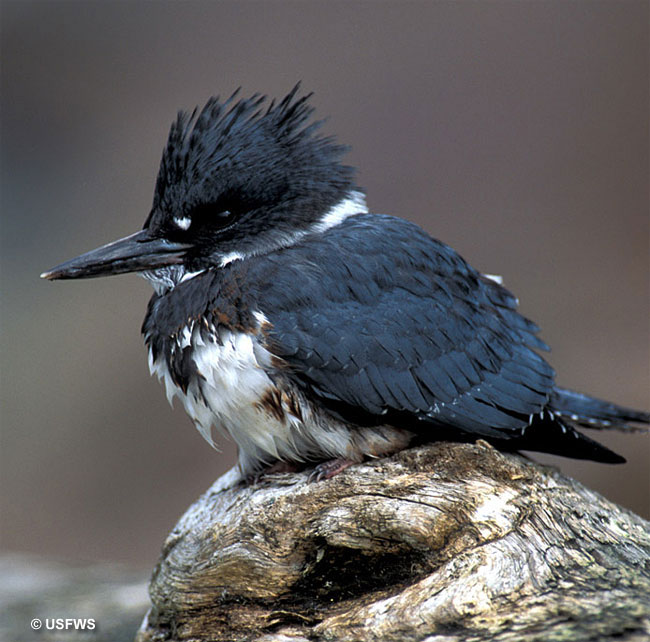
Kingfishers have only a few predators, all of which are aerial. They will repeatedly dive under the water until the predator leaves them alone.
Range (and seasonal changes)
Belted Kingfishers range throughout North and Central America, with some of its wintering range extending into the most northern reaches of South America.
Their breeding range extends throughout most of Canada and the populations there migrate to southern North America and Central America for the winter. Belted Kingfishers are year-round residents in most of the United States.
Belted Kingfishers’ population is stable and consists of 1,8 million mature individuals. They are listed as of least concern in the IUCN Red List.
Wing shape
Belted Kingfishers have a wingspan of 19-23 inches. Their wings are short and broad and whirr as they fly. These types of wings offer great maneuverability and quick acceleration, and the gaps between the primaries further increase maneuverability. They can also get quickly off the ground.
This is important, considering that they have to be adept at maneuvering to angle themselves perfectly when they dive to catch prey.
Fun Facts
- If Belted Kingfishers catch a prey item that is too large to gulp down in one go, they will leave a part of it protruding from their bill. When the first part is digested, they will swallow the other part.
- Some human activity has helped Belted Kingfishers expand their range. Activities such as building roads and digging pits have created banks that are suitable nesting sites for kingfishers.
- Nestling Belted Kingfishers can digest these parts of prey that are otherwise indigestible, such as bones, fish scales, etc. However, by the time they are ready to leave the nest, that ability is lost, which is why adults regurgitate pellets of said things.
- In different beliefs, kingfishers are regarded as powerful animals, as symbols of freedom, courage, balance, adventure, prosperity, and love. However, some regard kingfishers as bad omens.
Call
Belted Kingfishers use sound to claim territory and communicate with each other. Both the male and female call with loud and grating mechanical rattles that differ in pitch. They may also scream when intruders are nearby.
Similar Species
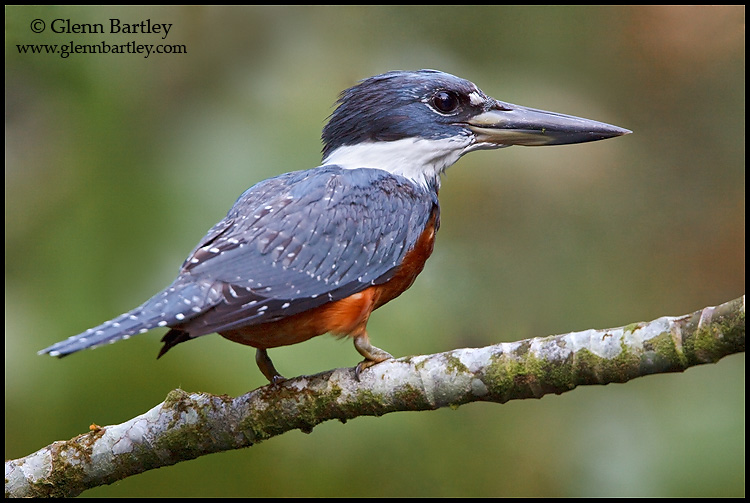
Ringed Kingfisher
Ringed Kingfisher
Belted Kingfishers and Ringed Kingfishers look similar in appearance. They have similar plumage, although Belted Kingfishers have an orange stripe running across their chest, and the belly is mostly white. Ringed Kingfishers have a rusty orange belly.
Ringed Kingfishers are not too common in the United States; they might be spotted in southern Texas.
The two birds are similar in size.
See more: The Kingfisher family
Frequently Asked Questions
Why is it called a Belted Kingfisher?
Belted Kingfishers got their name from the band or “belt” that runs across their breast.
Where are Belted Kingfishers found?
Belted Kingfishers are found throughout North and Central America and year-round in most of the United States. They live near clear, calm, and shallow bodies of water that have diggable banks near them, often in forests.
What eats a Belted Kingfisher?
Belted Kingfishers are eaten by a few aerial predators, such as Sharp-shinned Hawks, Peregrine Falcons, and Cooper’s Hawks.
