
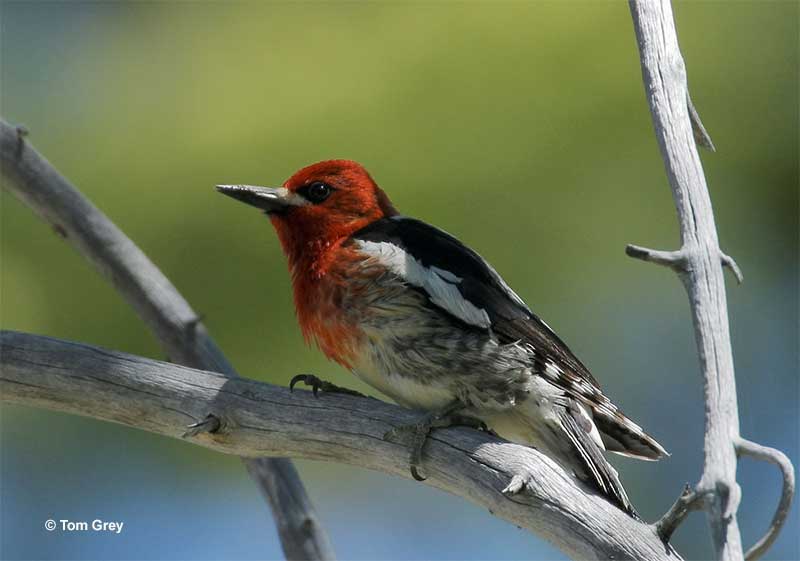

The Red-breasted Sapsucker (Sphyrapicus ruber), as the name suggests, is one of the four species that drum holes into trees and drink the sap oozing out of it. They are medium-sized woodpeckers with rather distinctive plumage black-white-and-red plumage.
However, the other sapsuckers are fairly similar, and identification is further complicated by the fact that the species often hybridize. So here is all the information you might need to make sure that the species you saw was indeed a Red-breasted Sapsucker.
Identification
Red-breasted Sapsuckers are rather distinctive medium-sized woodpeckers with a rounded head, long body, and black chisel-like bill. They measure between 7.9 to 8.7 inches long length and have a wingspan between 14.6 to 16 inches.
Both male and female Red-breasted Sapsuckers look the same. They are black above, with white mottling on the back and a long vertical wing patch on the wing. That wing patch is visible while the wings are folded.
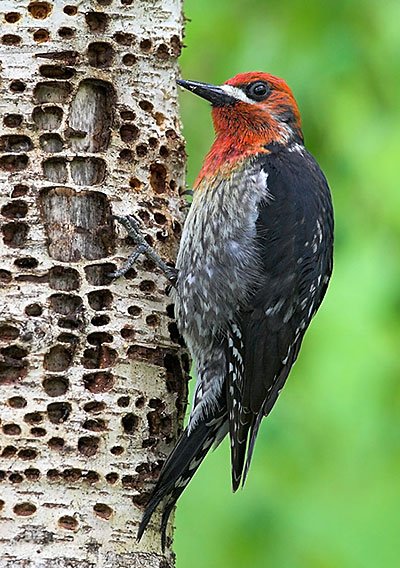
Their underside is whitish with dark streaking on the flanks and a yellow wash on the belly. Their most distinguishing feature is that their head, throat, and chest are entirely deep red. They only have a white spot between their bill and eye. In flight, their wing linings are mottled in black and white, and their black flight feathers are barred with white.
The Red-breasted Sapsucker has two subspecies, one of which can be found in south Alaska to west Oregon and the other in the southwestern United States.
Birds in the north tend to be brighter yellow below, have yellow bars on the back, and are darker overall. On the other hand, the red and yellow of the southern subspecies is slightly paler and they have white instead of yellowish bars on their backs.
Juvenile Red-breasted Sapsuckers are very dark overall. They are brownish-black with slightly paler underside and vertical white wing patch and may have a reddish tinge to their otherwise dark head.
Vocalizations
Red-breasted Sapsuckers call with a variety of normal and raspy squeals. Both sexes give a squealing call when approached by a rival, although it is more used by males. Males also squeal to attract potential mates during the breeding season. If a bird is in distress, they give raspy chattering squeals. Lastly, they also have a squealing waa call, mostly given by nestlings.
Like other sapsuckers, their drumming is also irregular. They start with a few rapid knocks, after which the drumming slows down.
Food
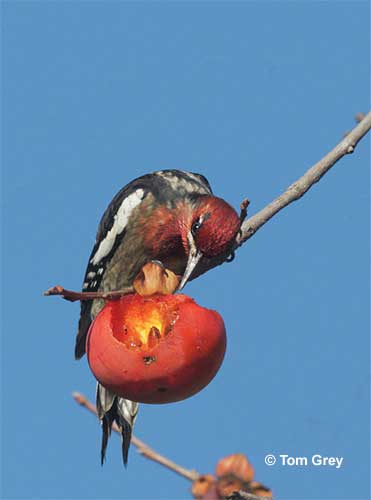
Red-breasted Sapsuckers are omnivorous, although their dietary preferences change slightly depending on the season. They focus on animal matter during the breeding season and plant matter in early spring, late fall, and winter when insects are scarce.
The animal part of their diet includes ants, mayflies, caterpillars, spiders, and other various insects and arthropods. They pick insects from tree trunks and crevices in the bark or snatch up those that got stuck in the sap. Occasionally you may see them fly out to catch them mid-air.
The plant part of their diet includes mostly tree sap, but also wild fruits and berries. They drill holes in various trees and wait for the sap to accumulate. Unlike some other woodpecker species, their tongues are rather short and have brushy tips, perfect for lapping it up.
Nesting and Eggs
Red-breasted Sapsuckers are monogamous, at least for the duration of one breeding season. They display by chasing each other, calling, pointing their bills up, revealing their throat, and swaying from side to side. Pairs may reunite in the following breeding seasons, although they seem to be attracted to the nesting site rather than to their previous mate.
Red-breasted Sapsuckers nest in cavities of trees that are dead or have dead parts. The cavity is generally around 50-60 feet above the ground, has an entrance 2 inches in diameter, and measures 10 inches deep on average on the inside.
Both members of the pair work on excavating multiple cavities in the same tree and then pick one. The bottom is lined with wood chips.
Females have one brood per year but may have a second one if the first one fails. They lay 4-7, mostly 5-6 eggs in a clutch. Red-breasted Sapsucker eggs are white and measure 0.8-1 inches long and 0.6-0.8 inches wide. Incubation lasts for 11-15 days with both male and female taking turns.
Both parents take care of their offspring. They feed them sap, insects, and fruit. After the young leave the nest 23-28 days after hatching, the parents keep an eye on them for another 10 days. They teach them how to fly to higher altitudes and how to extract sap from trees.
Current Situation
Red-breasted Sapsuckers range across the coastal western North America. They are mostly resident and most common in pine-hemlock forests. Their preferred breeding habitats are generally coniferous or mixed woodlands, but they can also be seen in orchards and other woodland habitats. However, wherever they choose to stay, they require dead trees for nesting.
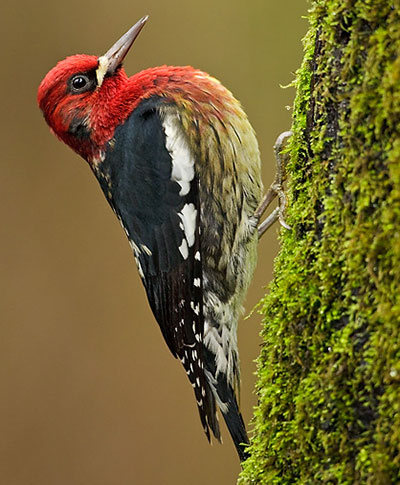
Photograph © Glenn Bartley
During the winter, the birds that breed in the northern part of the range migrate south, and individuals that breed in inland and upland locales often move to the coastal lowlands where the weather is milder. You can see them from sea level to 8,700 feet in elevation.
Red-breasted Sapsuckers are listed as least concern on the IUCN Red List. Their population has remained relatively stable over the years. The only thing affecting populations locally is forestry practices that remove dead trees, thus decreasing suitable nesting sites.
Facts About Red-breasted Sapsuckers
- The Red-breasted Sapsucker was considered conspecific with the Red-naped Sapsucker and the Yellow-bellied Sapsucker up until 1983. They are fairly similar and hybridize frequently.
- Red-breasted Sapsuckers are very defensive of their sap wells. Despite this, some hummingbird species, like the Rufous Hummingbird, follow the sapsuckers around to steal a sip if they can. This is because they sometimes arrive before the flowers have begun to bloom, so they need an alternative food source.
- The oldest Red-breasted Sapsucker on record lived to be at least 5 years old.
Similar Species
Red-breasted Sapsuckers are similar to the other sapsucker species. However, they are generally the easiest to identify out of all of them due to their uniformly deep red head, throat, and chest. Let’s take a look at some of the similar species.
Williamson’s Sapsucker
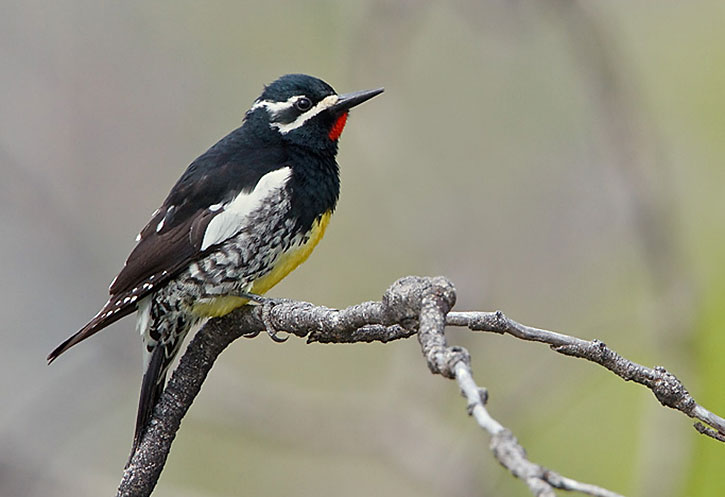
Williamson’s Sapsucker inhabits the mountainous regions of western North America and Mexico. Males are uniformly black above with vertical white wing patches, black-and-white-mottled flanks, a yellow belly, two white stripes of the face, and a red patch on the throat. Females are barred in black and white, and have a black patch on the chest, a pale yellow belly, and a pale brown head.
In comparison, the Red-breasted Sapsucker has a completely red head, throat, and chest. Their upper backs are mottled in white and while their bellies have a yellow wash, then it is generally not as vibrant.
Red-naped Sapsucker
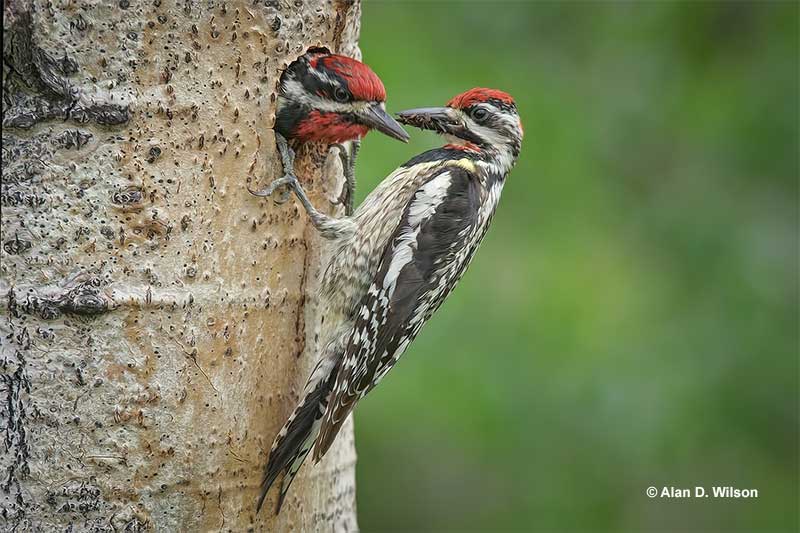
Red-naped Sapsuckers range throughout western North America. Adults are black above with white mottling on the back and have a white vertical patch on the wings and a whitish underside with striped flanks. Males have a red crest, nape, and throat, whereas females have a white throat bordered with red at the bottom and may have a white instead of a red nape.
Compared to Red-naped Sapsuckers, the Red-breasted Sapsucker has a uniformly red head, throat, and upper chest whereas the Red-naped Sapsucker has a black-and-white face pattern, either white or red throat patch, and a black chest.
Yellow-bellied Sapsucker
© Tom Grey
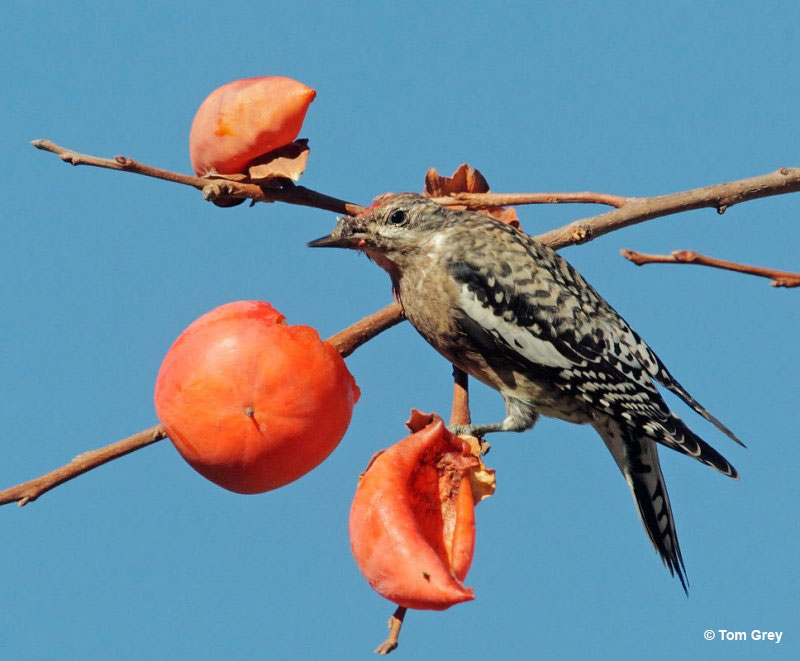
Yellow-bellied Sapsuckers breed in northern North America and winter in the southeastern United States and Mexico. Adults are black above with white mottling and a white vertical wing patch and have whitish to pale yellow underparts with dark barring on the flanks.
Males have a red crown and throat, whereas females have a red crown and white throat. You can tell which one it is by their face pattern. Red-breasted Sapsuckers have entirely red heads, throats, and chests, while Yellow-bellied Sapsuckers have a black-and-white face pattern.
Frequently Asked Questions
Are Red-breasted Sapsuckers similar to Red-naped Sapsuckers?
Red-breasted and Red-naped Sapsuckers are closely related and share many similarities. However, Red-breasted Sapsuckers have entirely red heads, throats, and breasts whereas Red-naped Sapsuckers also have a black-and-white face pattern.
How big are Red-breasted Sapsuckers?
Red-breasted Sapsuckers are medium-sized woodpeckers, measuring around 8-9 inches long.
Do Red-breasted Sapsuckers migrate?
Red-breasted Sapsuckers are mostly resident but may migrate short distances towards coastal and low-land areas for the winter.
Where do Red-breasted Sapsuckers live?
Red-breasted Sapsuckers live in coniferous and mixed forests of coastal western North America.
