

Red-naped Sapsuckers (Sphyrapicus nuchalis) mostly behave like other woodpeckers. They climb up and down trees, munch on insects, and nest in cavities.
However, as their name suggests, they like to drill holes in trees not to terrorize their next meal, but to drink sap. Both sexes are fiercely defensive of their sap wells and even chase intruders if their intimidation display doesn’t have an effect.
Here is all you need to know about them!
Identification
Red-naped Woodpeckers are medium-sized members of the woodpecker family, measuring 7.5-8.2 inches long with a wingspan ranging between 16.1-16.9 inches.
They have a sleek yet sturdy build with a wedge-shaped tail that aids in stability and balance during foraging along tree trunks. The back of their head has a slight peak, giving them a distinctive profile, and their body appears elongated when they’re clinging vertically to tree trunks.
Their long, broad, and rounded wings give them the maneuverability needed to navigate their wooded habitats. The species has a black, stout, and sharply pointed bill.
Male
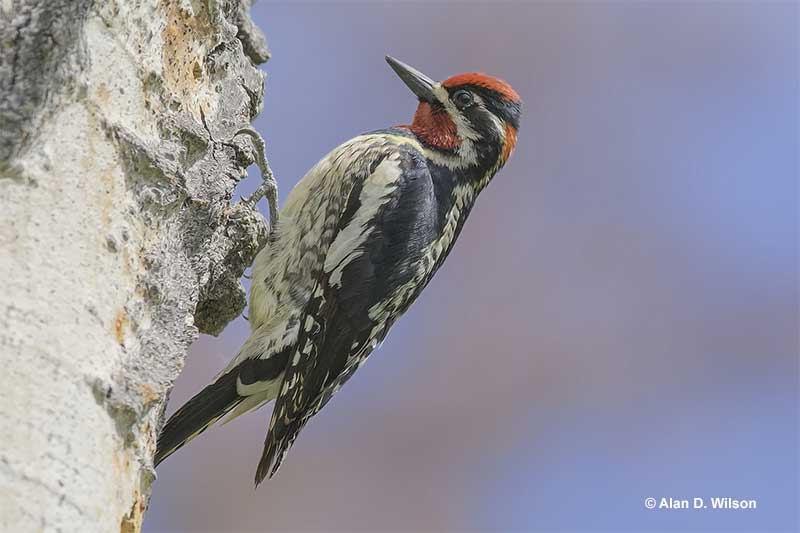
Male Red-naped Sapsuckers are painted in black and white and adorned with vibrant red accents. They are mostly dark above and pale below. Their black backs have variable amounts of whitish spotting, whereas their whitish undersides have variable amounts of black barring.

The white can have a dirty or yellowish hue. They have black wings with a long vertical white bar, visible while the wing is folded, and a black chest patch.
Their most notable and distinguishing features are their head, throat, and face. They have a black stripe running through their eye, bordered by a white one on either side. Their crown, nape, and throat are red.
Female
Female Red-naped Sapsuckers look very similar to males. They are black above with white spotting, whitish below with black mottling and they have a white vertical wing patch, a red crown, and a black chest. Unlike males, however, their throat is white with a red border at the bottom and their nape can be either red or white.
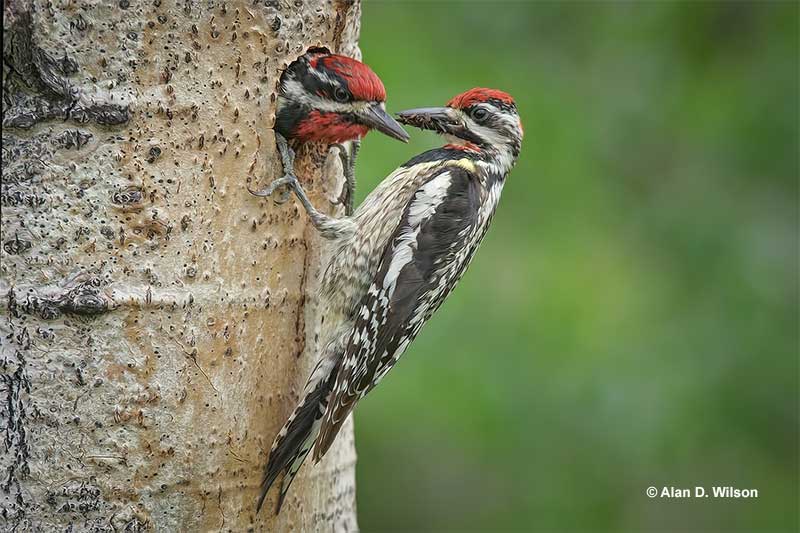
Juvenile Red-naped Sapsuckers resemble adults in the overall plumage pattern, but it has a brownish wash, their face pattern is not as strong, and they lack red. They also have a brown cap and a paler bill.
Vocalizations
Red-naped Sapsuckers have various rather harsh and squealing calls and are most vocal during the breeding season. Their most frequently given call is a harsh and squealing waa-waa-waa, which may resemble a seagull’s “laugh” or someone mimicking a crying child. This is often given as an alarm call.
They also emit soft slurred whee-ur or mew calls and give short squeals to attract a mate. In flight, especially during the early stages of the breeding season, mates may chatter with each other.
Furthermore, sapsuckers have a distinctive drumming pattern that sets them apart from other woodpeckers. It is irregular, beginning with a few quick hits, followed by a pause, and then continuing with a series of irregularly spaced knocks. While both sexes do it, then males tend to do it more often, using it to attract potential mates and assert their territories.
Food
Red-naped Sapsuckers are omnivorous. They prefer to feed on insects, particularly during the breeding season. However, their menu extends to encompass a range of plant matter as well, especially during colder months when insects are scarce.
The animal part of their diet includes various insects, ants, spiders, beetles, and flies. They glean them from tree trunks and snatch up those that have gotten stuck in tree sap. Unlike other woodpeckers, they often fly out to catch insects in mid-air.

The plant part of their diet includes tree sap, fruit, berries, and bits of tree tissues, especially cambium. They regularly drill tiny holes in the bark of mostly willow, birch, and alder but also other less sugary trees like pine in early spring. These holes are typically arranged in neat rows.
Red-naped Sapsuckers then return to the trees every once in a while to lap up sap. They eat wild berries and fruit year-round, although they may concentrate on them more during winter.
Nesting and Eggs
Red-naped Sapsuckers are seasonally monogamous. They generally stay together for a breeding season, although mates sometimes reunite in successive seasons. However, they may be attracted to the same nesting tree rather than their mate.
In early spring, unmated birds chase possible mates around the trees and call loudly. Courtship rituals involve showing off their throats by pointing their bills up, fluffing up their throat and crest feathers, and drumming at the nesting site. If a member of the pair is ready to breed, they give squealing calls.
Red-naped Sapsuckers nest in tree cavities from anywhere between 2 to 75 feet above ground, but mostly within the 6 to 60 feet range. They prefer deciduous trees bigger than 11 inches in diameter that are affected by heartwood decay fungus.
This makes the center of the tree soft and easy to excavate but leaves the outer part of the tree trunk firm. If suitable deciduous trees are not available, they may settle for dead or dying coniferous trees. They often return to the same tree year after year.
Both sexes help excavate the nesting cavity, although males do most of the work. The nest hole measures roughly 1.5 inches wide while the inside is 4.5 inches wide. They line the bottom of the cavity with wood chips.
These woodpeckers have 1 brood in a year with 3-7, mostly 4-6 eggs in a clutch. Red-naped Sapsucker eggs are white and measure 0.8-1.1 inches long and 0.6-0.7 inches wide. Incubation takes 8-13 days and is done by both sexes.
Males typically incubate at night, and females during the day. Both parents take care of their offspring, who leave the nest around 23-32 days after hatching. They care for them for roughly 10 more days after that.
Current Situation
Red-naped Sapsuckers range throughout western North America and Mexico. Their core breeding range is in the Rocky Mountains and Great Basin regions. The species is a short-distance migrant, wintering from the southwestern United States to Mexico. They may be present year-round around the area where their breeding and wintering ranges overlap.
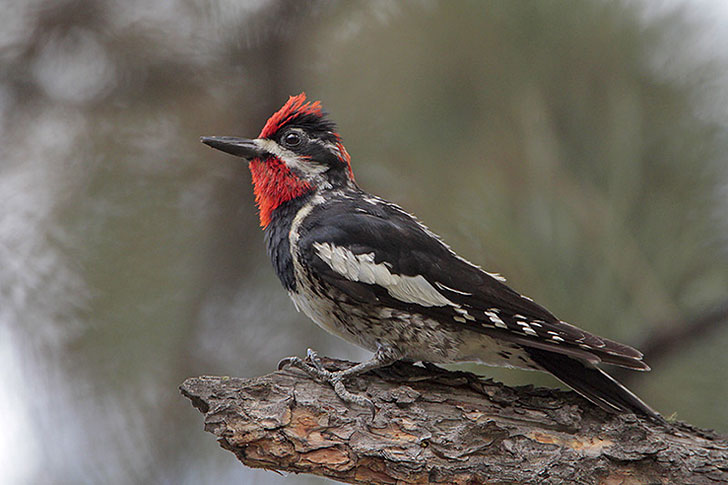
During the breeding season, Red-naped Sapsuckers inhabit deciduous or mixed forests, preferably with aspens, willows, and birch, and generally stay within 1,000 to 10,000 feet in elevation.
They sometimes also breed in gardens and yards. During winter and migration, however, they can be seen in other types of woodland habitats in both lowlands and mountainous areas, including riverside groves, pine-oak woods, and orchards.
Red-naped Sapsuckers are listed as of least concern on the IUCN Red List, and their numbers have been relatively stable. However, some forestry practices may locally influence their population size.
Facts About Red-naped Sapsuckers
- Until 1983, the Red-naped Sapsucker was considered conspecific with two other sapsucker species, the Yellow-bellied Sapsucker and the Red-breasted Sapsucker. They were separated into their own species based on significant genetic differences. However, the three species hybridize with each other quite often.
- Sapsuckers got their name from their distinct feeding behavior of drilling holes into wood and drinking the sap coming out of those holes. However, they technically do not suck the sap but rather let it ooze out and then lap it up with the tip of their tongue.
- The oldest Red-naped Sapsucker on record lived to be nearly 5 years old.
Similar Species
Red-naped Sapsuckers are similar to other woodpecker species, especially other sapsuckers. You can distinguish them from each other mainly by their head patterns. Let’s take a closer look.
Red-breasted Sapsucker
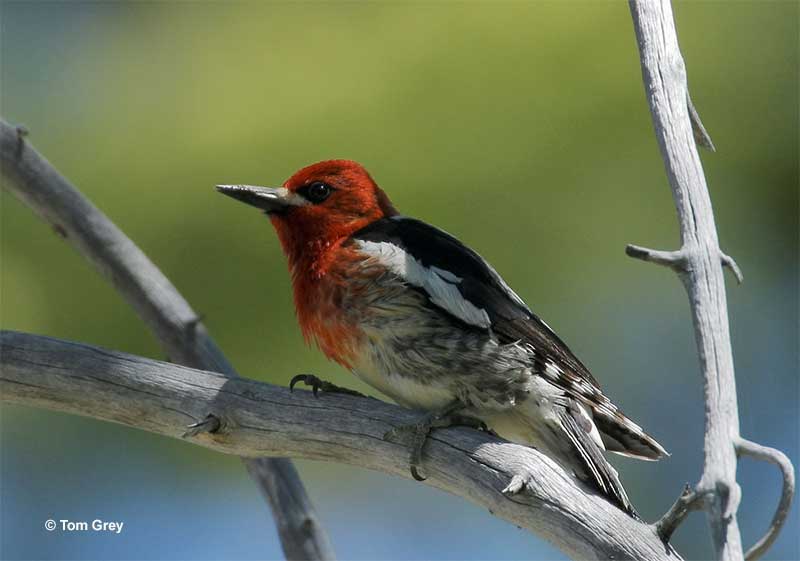
Red-breasted Sapsuckers range throughout the coastal western North America. Adults are mostly black above with a vertical white patch on the wing and some white mottling on the back.
Their underside is whitish with a yellowish wash and dark streaking on the flanks. Their heads, throat, and chest are deep red. On the other hand, Red-naped Sapsuckers also have a black-and-white pattern on their face and a black chest.
Yellow-bellied Sapsucker
© Tom Grey
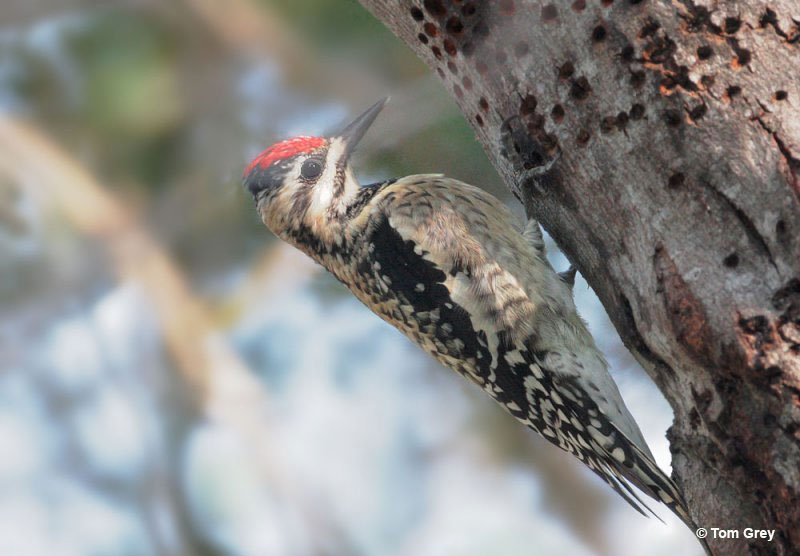
Yellow-bellied Sapsuckers breed throughout northern North America and winter in the southeastern United States and Mexico. They are black above with white mottling, have a white vertical wing patch, and are whitish below with dark streaking on the flanks and a black chest. Their face has a similar pattern to the Red-naped Sapsucker and they have a red crown and throat.
However, Yellow-bellied Sapsuckers do not have red napes like the Red-naped Sapsuckers do.
Williamson’s Sapsucker
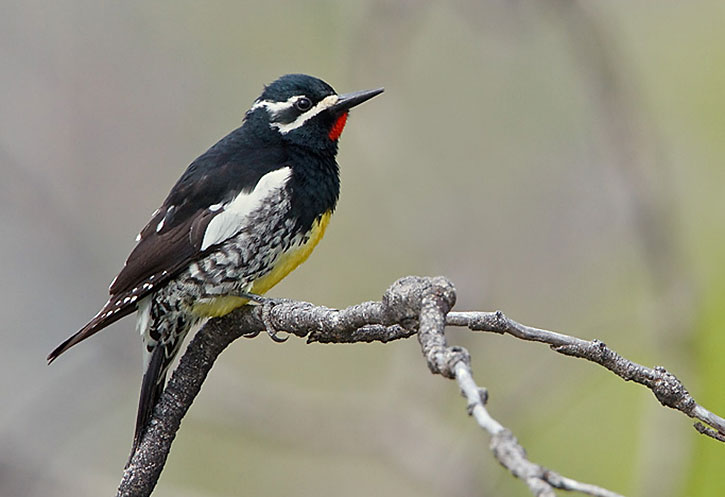
Williamson’s Sapsucker ranges throughout the coniferous or mixed forests of the mountains of western North America. Males are black above with white vertical wing patches and mottled black-and-white below.
They have a black chest, yellow belly, and red throat patch. Their head is mostly black with two white stripes above and below the eye. Females are barred in black and white overall but are paler below and darker above. They have a brownish head, a black chest patch, and a yellow belly.
Males of the species look similar, but male Williamson’s are uniformly black above, whereas male Red-naped Sapsuckers have white mottling. The former only has red on their throat, whereas the latter also has a red crown and nape. Female Williamson’s are more uniformly barred, lack the vertical wing patch, and have a brownish head as opposed to the black-white-and-red head of the female Red-naped.
Frequently Asked Questions
What is the difference between Red-naped and Yellow-bellied Sapsuckers?
The Red-naped Sapsucker has a distinct red nape (back of the neck), while the Yellow-bellied Sapsucker lacks this red nape.
What is the difference between a Red-naped and a Red-breasted Sapsucker?
The Red-naped Sapsucker has a black-and-white face pattern and a red nape, throat, and crown whereas the Red-breasted Sapsucker’s entire head and breast are red.
Where do Red-naped Sapsuckers live?
Red-naped Sapsuckers live in deciduous and mixed woodland habitats across western North America and Mexico.
Do Red-naped Sapsuckers have any predators?
Red-naped Sapsuckers have several predators, including black bears, squirrels, and birds of prey.
