
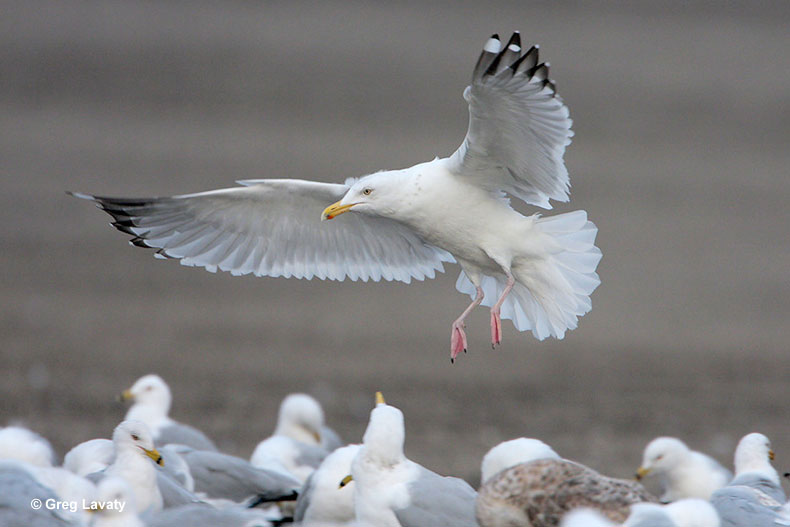

Herring Gulls (Larus smithsonianus) are the birds that come to mind when someone says ‘seagulls.’ They are rather large and easily recognizable thanks to their mostly white-and-gray plumage.
However, there are many almost identical gull species, so here is all you need to know to identify both breeding and non-breeding adults and even immatures in different molting stages from other species.
Identification
Herring Gulls are large and stocky, measuring 21-26 inches long with a wingspan of 47-61 inches. Females are generally smaller than males.
In flight, they look barrel-chested. Their feet are generally dull pink no matter their age or the season, but they can occasionally be yellowish or have a bluish tinge. The bill is yellow and has a red spot near the tip of the lower mandible. Their eyes are bright yellow with a yellow-to-orange ring around it.
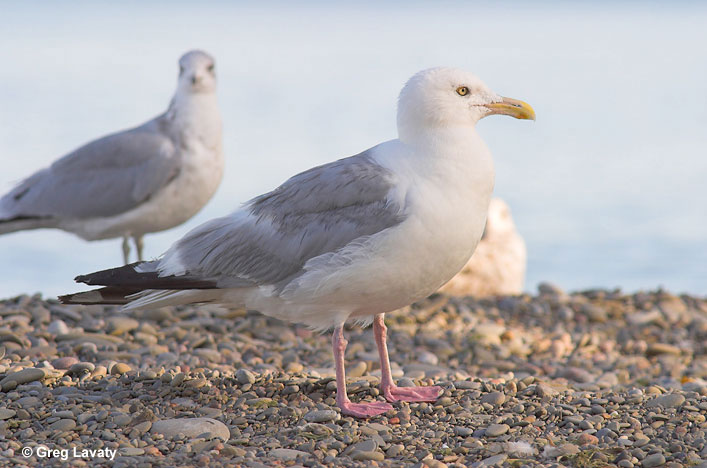
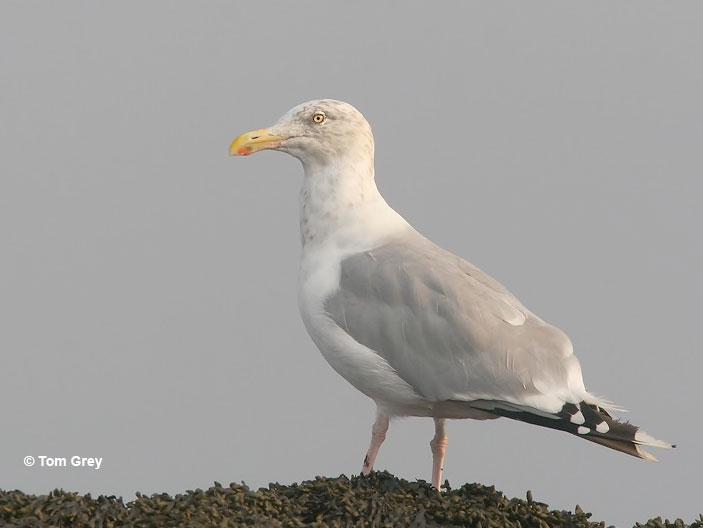
Male and female Herring Gulls have no obvious differences in plumage. They have white underparts, rumps, heads, and tails and pale gray upperwings and backs. Their wingtips are black with white spots and their underwings are grayish with dark tips.
During the non-breeding season, their otherwise pure white heads and neck become streaked with brown and the red spot on their bills turns brown.
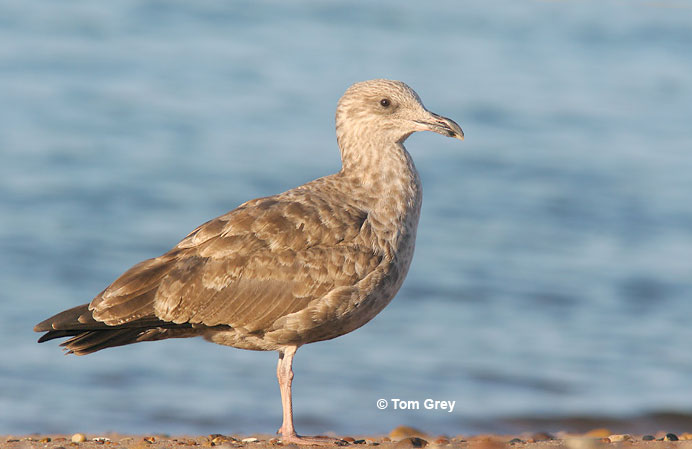
Juvenile Herring Gulls are dark overall. They have gray-brown plumage with fine white checkering on the neck, a brown rump with dark bars, a dark tail, dark outer primaries, and pale inner primaries. They have dark brown eyes and dark bills. The base of the bill becomes paler over winter.
It takes four years to get their full adult plumage and they go through several stages and can be very variable in appearance. Second winter immatures start developing gray feathers on their backs and become pale overall with pale brown streaking and mottling on the head, neck, and underside.
Their eyes turn pale, and their bills are also pale with a black tip. Third winter immatures look fairly similar to adults but still have some brown on their body, wings, neck, and head, a black band on their tail, pale yellow eyes, and a pale yellow bill with a dark band near the tip of its bill.
Vocalizations
Herring Gulls are vocal birds with a diverse range of 8-15 different cries and calls, coupled with various postures depending on the intention and context. These vocalizations serve multiple purposes such as displaying aggression, identifying partners, raising alarm, and disputing territory.
The drawn-out mew call, accompanied by a downward extended neck, is to attract attention in activities from courtship to aggression. Their ha-ha-ha-ha alarm call may transition to plaintive yeow or yelping keow as the level of threat rises. The latter call is very individual and can also be used to identify a specific bird. If the bird trumpets the keow-call more shrilly and in quick succession, it becomes their long call. Both sexes give repeated huoh-huoh-huoh calls during courtship and territorial disputes to indicate that they will hold their ground. Chicks beg for food with a klee-ew call, mimicked by adults during courtship.
Food
Herring Gulls are opportunistic omnivores, but they prefer to eat animal foods. The type of food they consume varies depending on the location and season. Individual birds often specialize in their feeding habits, meaning that they go after the same type of food. If possible and there are enough available resources, then they tend to pick and choose according to their dietary needs.
The animal part of their diet consists of almost anything they can gobble down. This includes various marine invertebrates, fish, insects, other juvenile and even adult birds, zooplankton, squid, mussels, worms, crustaceans, bird eggs, worms, and even carcasses and garbage.
They may also eat plant matter, such as roots, tubers, and seeds of various plants.
Herring Gulls may forage while flying, swimming, or walking. They often forage in scattered groups that swiftly come together once prey is found and may steal food from each other.
If they find food, they dip down to snatch it and may occasionally even plunge-dive into the water. In open water, they trail behind whales, other large predators, or even fishing vessels, exploiting anything that brings potential prey to the surface.
They are fairly intelligent – they drop hard-shelled items from high up down onto the rocks below to open them and some have even been reported using bait to attract larger prey.
Nesting and Eggs
Herring Gulls nest in colonies but sometimes also in isolated pairs. They are monogamous and generally mate for life unless the male fails to provide the female with enough food during egg formation or if the partners fail to synchronize their efforts to care for the eggs.
After bonding, the pair chooses the nesting site together. The nest is a scrape on the ground in sand, soft soil, or short vegetation about 10 to 15 inches across and deep enough to fit the eggs.
It is often situated under a brush or next to a rock or log for protection, cover, and privacy. They line the nest depression with various materials, including grasses, seaweed, plastic, rope, and feathers.
The pair has only one brood in a year with 1-4, usually 3 eggs in a clutch. Herring Gull eggs are buff to light olive with dark blotches, measuring 2.6-3 inches long and 1.9-2.1 inches wide. Incubation takes 27-32 days with both parents taking turns, although females usually incubate more while the male brings her food.
Chicks may stumble out of the nest only a day or two after hatching but can run freely around 1 week after. They fledge at around six weeks of age and are usually fed for up to 12-15 weeks of age, although sometimes parents may care for their offspring even until they are 6 months old.
Both parents provide food and protection, although males take on most of the feeding duties before the young fledge and females after.
Current Situation
Herring Gulls range throughout most of North America and coastal Central America. They mostly breed in Alaska and Canada with some of their breeding range extending into the most northeastern United States.
The wintering range covers the west coast of the United States, the southeastern United States, and the coasts of Central America. They have resident populations in northeastern North America along the southern coast of Alaska.
Herring Gulls prefer to live in coastal areas or around large lakes, including bays, beaches, piers, and coasts. They can also be found foraging at sea, mudflats, fields, marshes, and also further inland, including in urban and suburban areas, as long as there are bodies of water and food.
They are a common species and are listed as of least concern on the IUCN Red List. However, their population is in a steep decline with the main threats including overfishing, oil pollution, pesticide contamination, reduction in discards from fisheries, and population control programs.
Facts About Herring Gulls
- Herring Gulls generally have three eggs in a clutch with the third one hatching a day or two later than the others. This puts the third chick at a disadvantage since it gets less food and grows more slowly.
- Herring Gulls can drink seawater if they have to in order to survive. They have special glands for extracting salt from the water so it would not dehydrate them.
- The average lifespan of Herring Gulls is around 13 years. The oldest wild individual on record lived to be at least 29 years and 3 months old.
Similar Species
Herring Gulls have many similar gull species with only minor differences in size and plumage. This includes the Western Gull, Ring-billed Gull, California Gull, Glaucous-winged Gull, Iceland Gull, Lesser Black-backed Gull, and Great Black-backed Gull. Here are three of the most similar species and how to tell them apart.
Western Gull
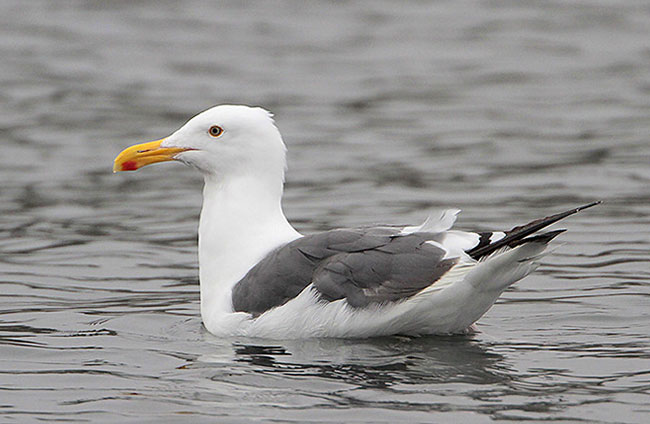
Western Gulls are mostly resident and range across the west coast of the United States and Baja California. They have white bodies, dark gray backs and wings, black wingtips, yellow bills with a white spot on the lower mandible, and dark eyes.
The main difference lies in the fact that Western Gulls have darker eyes and darker gray backs and wings. They also have a more bulbous bill tip than the Herring Gulls. Non-breeding adults have very little streaking as opposed to the heavily brown-streaked necks and heads of the non-breeding Herring Gulls.
Ring-billed Gull
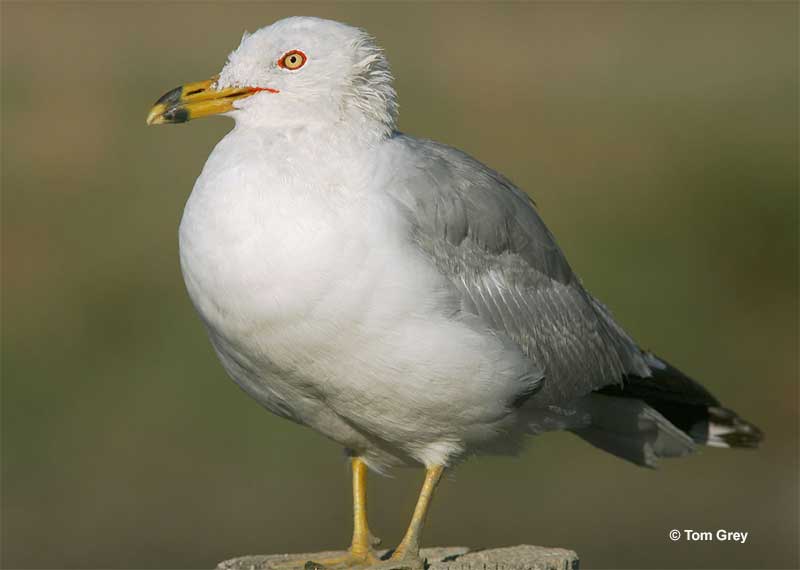
Ring-billed Gulls breed in southern Canada and the northern United States and winter in southern and along the coasts of the United States and in Mexico.
Adults are white with gray backs and wings, black wingtips with white spots, and a yellow bill with a dark band around the tip of it. Non-breeding adults have tan streaking on their heads and necks.
Compared to Herring Gulls, Ring-billed Gulls are smaller and less robust. They have yellow instead of pinkish legs and a dark band around their bills instead of a red mark on the lower bill. Non-breeding adults have less streaking than non-breeding Herring Gulls.
California Gull
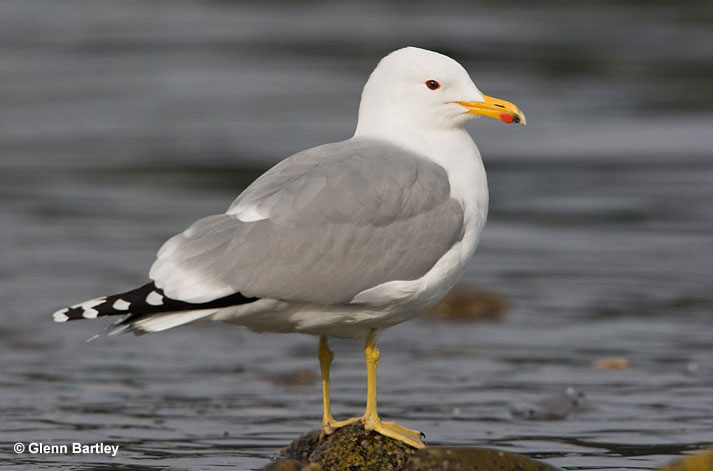
California Gulls can mostly be found breeding and wintering in the western half of North America and along the western coast of Mexico. Adults have a white body, gray back and wings, black wingtips with white spots, dark eyes, yellow legs, and a red spot on the lower bill. Non-breeding adults have dark-streaked heads and necks.
Herring Gulls, however, have pink instead of yellow legs, and bright yellow instead of dark eyes. In addition to the eyes and legs, non-breeding California Gulls keep the red spot on the lower mandible whereas in Herring Gulls it turns brown.
Frequently Asked Questions
Where do Herring Gulls live?
Herring Gulls mainly live around coastal areas or near large bodies of water across North America.
How big are Herring Gulls?
Herring Gulls are large gulls measuring 21-26 inches long.
What do Herring Gulls eat?
Herring Gulls are opportunistic omnivores but prefer animal foods, including fish, aquatic invertebrates, birds and bird eggs, and even dead animals.
Are Herring Gulls aggressive?
Herring Gulls are aggressive towards intruders and may even swoop at humans to steal food.
