
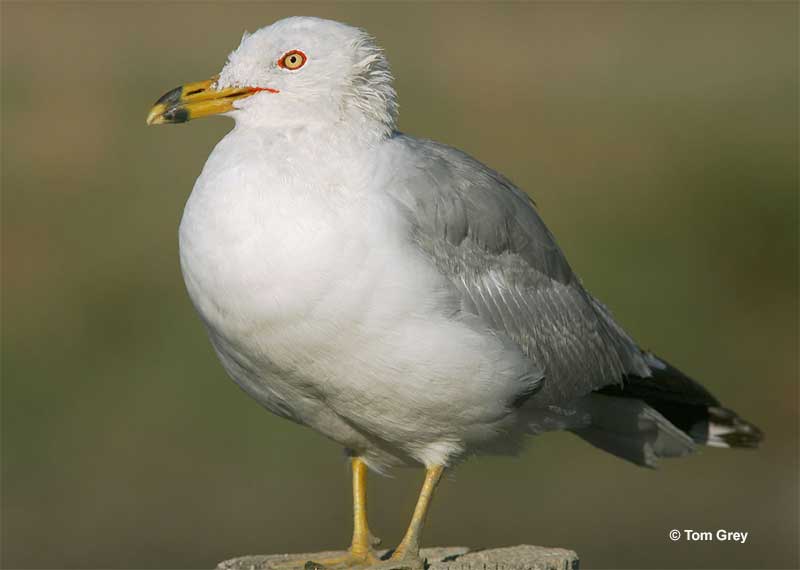

Ring-billed Gulls (Larus delawarensis) are bold and opportunistic birds known for their habit of begging for food and causing a ruckus.
They are frequently seen on beaches, in cities, and around landfills, scavenging for scraps. If you are not sure whether the gull you saw was indeed a Ring-billed Gull, then here is all the information you might need to know for certain!
Identification
Ring-billed Gulls are medium-sized birds with a sturdy yet streamlined build. They measure between 16.9 to 21.3 inches long and have a wingspan of 41.3-46.1 inches. When the bird is perched, their wings extend beyond their square-tipped tails. In flight, they fly on slender wings with easy and shallow wingbeats.
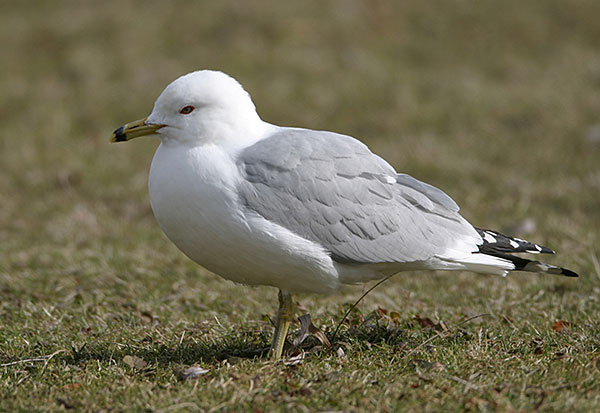
Male and female Ring-billed Gulls have the same plumage. They have white heads, necks, tails, and undersides. Their backs and wings are silvery gray, and their wings have black wingtips with white spotting.
Non-breeding adults look overall the same but have fine brown or tan streaking on their heads and neck. They have yellow legs and yellow eyes, and their short yellow bills have a black band around them, hence the name.
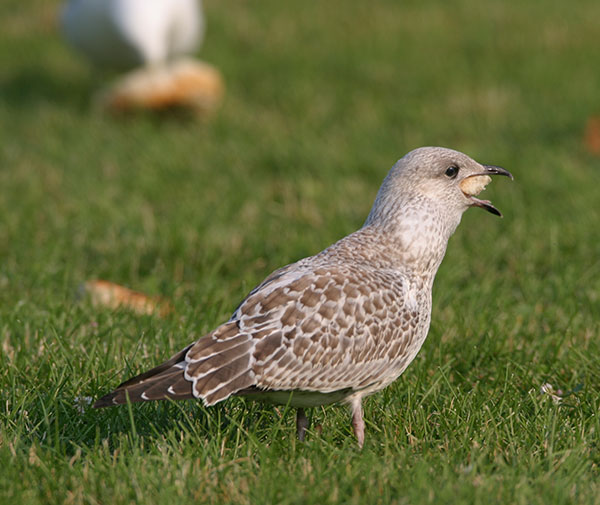
Juvenile Ring-billed Gull
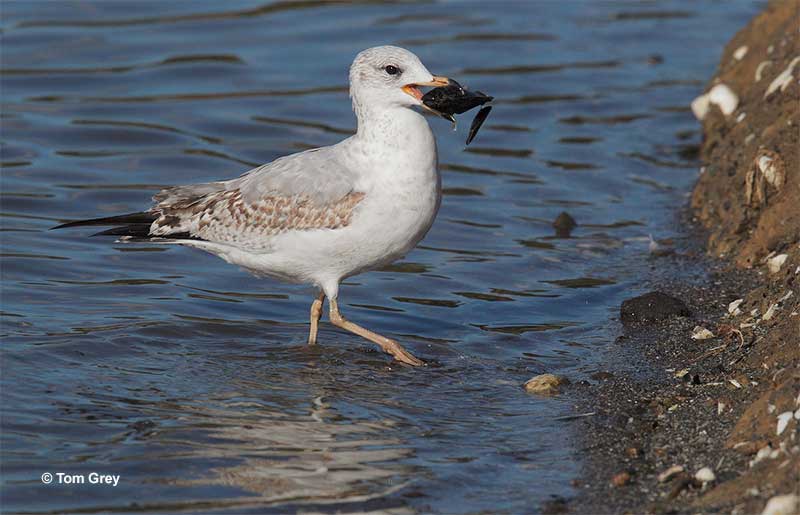
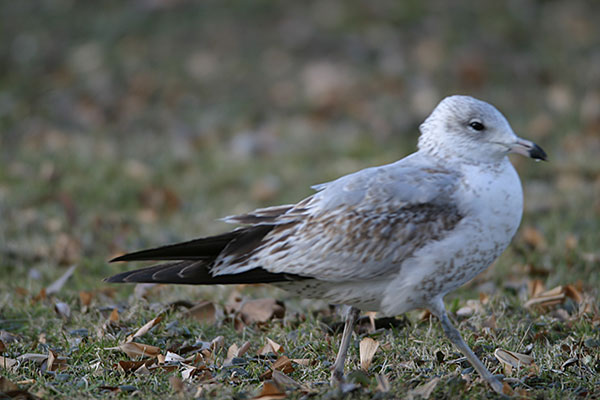
Their chicks come in two colors – some are buff and covered with dark spots, while others are gray. Juvenile Ring-billed Gulls are white with brown mottling and may have some gray spots on the wings. They are paler on the underside and head and have black wingtips. Unlike adults, their eyes are dark, their legs pinkish, and bills dark with a pink base.
They molt each fall and get their adult plumage in their third winter. In the first winter, they look fairly similar to juveniles and are still a patchwork of brown and white, but they also start developing gray feathers on their wings and back.
During the second winter, they are similar to non-breeding adults. Their bodies are white with tan streaking on the chest, neck, and head, they have gray wings, and their bills become yellow with a black band at the end.
Vocalizations
Ring-billed Gulls are noisy birds with various loud calls. You might recognize them best for their series of high-pitched rising squeals. Their two alert calls are high-pitched, squealing, and shrill kyow-kyow-kyow and a screeching kree-kree.
During non-aggressive encounters, including courtship and chick feeding, they give mew-calls. If they want to indicate submission, they give a short and high-pitched klioo and toss their heads.
Food
Ring-billed Gulls are opportunistic omnivores. Their diet varies with location and season, but they are willing to eat almost anything they can find, including carcasses of dead animals and garbage. In general, they prefer animal foods.
The animal part of their diet consists of both aquatic and terrestrial vertebrates and invertebrates. They eat various kinds of fish such as alewife, nine-spined stickleback, yellow perch, and smelt; insects such as flies, bugs, beetles, and dragonflies; rodents, earthworms, and bird chicks and eggs.
The plant part of their diet includes various fruits, vegetables, and grains, including cherries, strawberries, blueberries, and dates.
These gulls may forage alone, but often in groups, spacing themselves about 3-6 feet apart. They may forage while walking on the ground, wading in shallow water, swimming, or flying.
You can often encounter them on freshly plowed fields looking for earthworms or flocking to garbage dumps and landfills to steal scraps of edible garbage. In shallow water, they stomp the ground to reveal small invertebrates hiding under the upper layers of mud and sand.
They may also snatch insects in mid-air, fish from the surface of the water, and steal food from other birds. These gulls are a common sight at parks, beaches, docks, and marinas, begging for and accepting handouts from people.
Nesting and Eggs
Ring-billed Gulls nest in colonies with the size of the colony varying greatly from as little as 20 to as many as thousands of pairs.
They are generally monogamous, but in larger colonies, one male may take two females. Birds pair up right before or on arrival on the breeding grounds. During courtship, both the male and the female stretch up and repeatedly face toward and then away from each other. The male brings food for the female.
You may find Ring-billed Gull nests on the ground near bodies of water with sparse vegetation, such as rocky beaches or sandbars, on bare rock, soil, or concrete. They sometimes also nest in trees but that mostly occurs near inland lakes.
Ground nests are often built under or near low plants for privacy and protection. It is a shallow scrape in the ground, measuring 10-25 inches across and roughly 2 inches deep. They mostly line it with dead plant material such as twigs, grasses, lichens, moss, and leaves, although some leave it bare.
One pair has only one brood with 1-8, mostly 2-4 eggs in a clutch. One female can lay up to four eggs, so the clutches that have more than that are a result of trios with two females in it. Ring-billed Gull eggs are gray to pale olive to brownish and spotted with brown, measuring 2-2.6 inches long and 1.4-1.8 inches wide.
Incubation takes 20-31 days. Both parents take turns incubating the eggs and brooding and feeding the chicks. Chicks may start to wander the area around the nest within days of hatching. They can fly around 5 weeks after hatching and become independent 5-10 days after that.
Current Situation
Ring-billed Gulls range across most of North and parts of Central America. They breed in the southern half of Canada and northern United States and migrate to the southern United States and Central America for the winter. There are some year-round populations near the northwestern coast of the United States and in the northeastern United States.
Ring-billed Gull habitats are always tied to open areas with water, be it salty or fresh.
They are common along coastal areas, such as harbors, estuaries, docks, piers, wharves, mudflats, and bays. However, they can also be found inland, more than other gull species, including near lakes, agricultural areas with plowed fields, landfills, cities, ponds, streams, parking lots, and parks.
This gull species is very common and listed as of least concern on the IUCN Red List. They nearly succumbed to habitat loss and hunting, but nowadays their populations are increasing and so numerous that in some places they are considered pests.
Facts About Ring-billed Gulls
- Some Ring-billed Gulls mistake pebbles for eggs if the pebbles are similar in size and shape and bring them into their nest.
- Ring-billed Gulls have an average lifespan of 10-11 years. The oldest wild individual on record lived for at least 27 years and 6 months.
- Ring-billed Gulls are adept fliers and may even hover stationary in the wind. They like to play catch by dropping objects and then diving to catch them. It is speculated that they do so to hone their hunting skills.
Similar Species
Ring-billed Gulls are similar to various other gull species such as the Herring Gull, California Gull, and Laughing Gull. The differences are rather minor, so you have to be quite observant when trying to identify them. Here is how to tell them apart.
Herring Gull
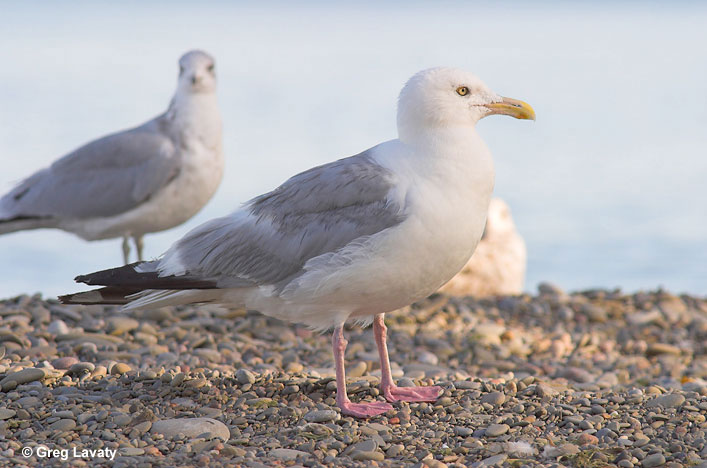
Herring Gulls range across North America and along the coasts of Central America.
Breeding adults have white bodies, silvery gray wings and backs, black wingtips with white spots, yellow eyes, pinkish legs, and yellow bills with a red spot near the tip of the lower mandible. Non-breeding adults look the same but have brown streaking on the head and neck and a brown band around the pale yellow bill.
Compared to Herring Gulls, Ring-billed Gulls are smaller with smaller bills and yellow instead of pink legs. Breeding Herring Gulls have a red spot on the lower mandible of their bills instead of a dark band around the bill.
California Gull
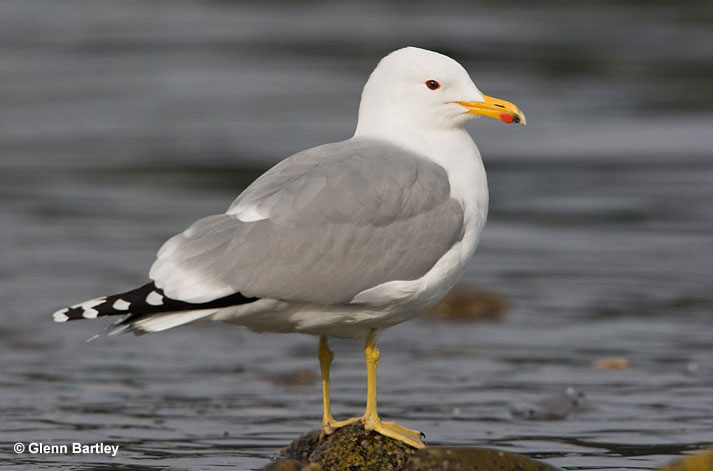
The range of California Gulls covers the western side of North America and the western coasts of Mexico.
Breeding adults have white bodies, gray backs and wings, black wingtips with white spots, yellow legs, and dark eyes. Their bills are yellow and have a red spot at the tip of the lower mandible. Non-breeding adults have brown streaks on the head and neck.
Ring-billed Gulls are smaller than California Gulls and have a dark band around their bills instead of a red spot on the lower mandible. California Gulls also have dark instead of yellow eyes.
Laughing Gull

Laughing Gulls breed along the northeastern coast of the United States and around the Great Lakes. The birds along the southeastern coast of the United States are resident.
Breeding adults have a white body, gray back and wings, black wingtips, a black head with white crescents around the eyes, and red bills and legs. Non-breeding adults have a white body, gray back and wings, black wingtips with small white spots, some gray smudging behind the eye, dark eyes, and dark gray bills and legs.
Breeding adults of the species are easily distinguishable due to the black head and red bill and legs of the Laughing Gull. Non-breeding-billed Gulls have yellow instead of dark eyes, yellow bills with a dark band instead of dark gray bills, and yellow instead of dark gray feet.
Frequently Asked Questions
Where do Ring-billed Gulls live?
Ring-billed gulls primarily live in open areas near water, including coastal regions such as harbors, estuaries, and mudflats, as well as inland areas near lakes, agricultural fields, landfills, cities, and parks across North and parts of Central America.
Do Ring-billed Gulls migrate?
Most Ring-billed Gulls are short to medium-distance migrants.
Are Ring-billed Gulls intelligent?
Ring-billed Gulls are relatively intelligent and resourceful, as they have a highly developed social structure and researchers recently discovered that they are able to pass the string-pull test.
What is the difference between Ring-billed Gulls and other gull species?
The main difference between Ring-billed Gulls and other gull species is that Ring-billed Gulls have a dark band around their bills whereas most other gull species have a red or black spot near the tip of the lower mandible.
