

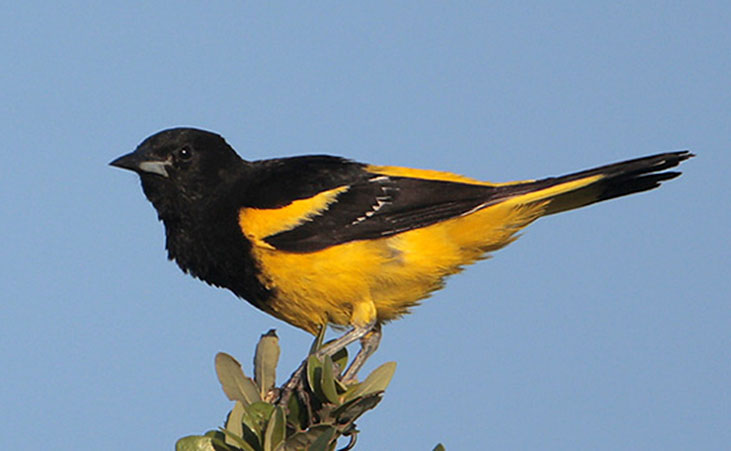
There’s something magical about catching a flash of color in the trees or across a meadow.
Some of the most unforgettable sightings are the yellow birds with black wings—bright as sunshine, bold against the sky. They’re not just pretty to look at; each has its own song, story, and way of living.
From goldfinches at the feeder to meadowlarks filling fields with music, these birds remind us how much joy nature can add to everyday life.
Let’s meet these birds and see what makes them so unforgettable.
American Goldfinch (Spinus tristis)
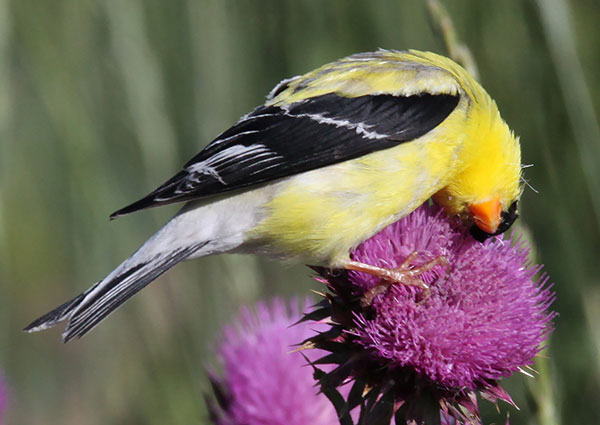
The American Goldfinch is one of the most familiar and cheerful yellow birds in North America, instantly recognizable for its bright plumage. Males in breeding season are a striking lemon-yellow with jet-black wings and a black cap, while females are more subdued, with olive-yellow tones and darker wings. This bold contrast makes the goldfinch the perfect example of a yellow bird with black wings.
Size & Wingspan: This small finch measures about 4.3–5.1 inches (11–13 cm) in length, with a wingspan of 7.5–8.7 inches (19–22 cm). It weighs just 0.39–0.71 oz (11–20 g), making it a very lightweight and agile songbird.
Migratory Behaviour: The American Goldfinch is a short-distance migratory bird. Populations across Canada and the northern U.S. move south during winter, often traveling to the southern U.S. and occasionally Mexico. Unlike many songbirds that migrate at night, goldfinches migrate during the daytime in loose flocks.
Habitat & Range: They thrive in open fields, meadows, weedy areas, and suburban backyards, especially where thistles and sunflowers grow. Their range covers most of the continental United States, southern Canada, and into northern Mexico.
Diet & Habitat: Unlike many birds that rely on insects, the goldfinch is almost entirely granivorous, feeding on seeds from thistle, sunflower, dandelion, and asters. They are frequent visitors at backyard feeders, especially those stocked with nyjer seed.
One unique trait of the American Goldfinch is its late nesting season. While most birds breed in spring, goldfinches wait until mid-to-late summer, when thistle and milkweed are abundant, providing soft fibers for nests and seeds for chicks.
Song & Behaviour: Goldfinches have a sweet, twittering call, often described as “per-chick-o-ree” in flight. They are highly social, often seen in small flocks, bouncing through the air with a distinct undulating flight pattern.
In short, the American Goldfinch is not only a symbol of summer but also a remarkable example of adaptation, beauty, and energy in North America’s birdlife.
Western Meadowlark (Sturnella neglecta)
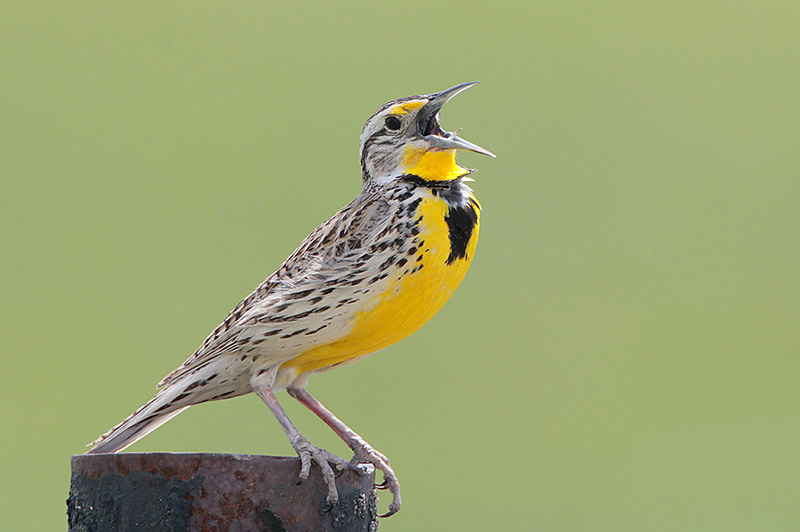
Size & Wingspan: A medium-sized member of the blackbird family, the Western Meadowlark measures 6.3–10.2 in (16–26 cm) with a wingspan around 16 in (41 cm). Its weight ranges from 90–150 g, and it is easily recognized by its bright yellow chest marked with a bold black “V.”
Migratory Behaviour: Northern populations migrate short distances to the southern U.S. and Mexico during winter, while meadowlarks in central and western states often stay year-round. Their movements are generally local and influenced by weather and food availability.
Habitat & Range: Found across western and central North America, this species favors grasslands, prairies, pastures, and open farmland. It avoids dense forests, relying instead on wide, open spaces where its song carries best.
Diet & Breeding: Meadowlarks are omnivores. In summer, they eat insects—especially grasshoppers, beetles, and caterpillars—providing protein for growing chicks. In winter, their diet shifts to seeds and grains. Nests are placed on the ground, woven from grass and often covered with a dome of vegetation for protection.
Song & Behaviour: Famous for its clear, flute-like song, the Western Meadowlark is considered one of North America’s best singers. Males often perch on fence posts or tall grasses to broadcast their melody, which serves both to defend territory and attract mates. On the ground, they walk with a deliberate, strutting gait, using the tall grass as cover. Highly territorial during breeding season, they become more social in winter, foraging in small flocks.
Yellow-headed Blackbird (Xanthocephalus xanthocephalus)

Size & Wingspan: The Yellow-headed Blackbird is a striking medium-sized icterid, measuring 8.3–10.2 in (21–26 cm) with a wingspan of 16–17 in (41–44 cm). Adults weigh between 44–100 g. Males are bold and unmistakable, with bright golden-yellow heads and chests set against glossy black bodies and wings, while females are more subdued brown with pale yellow markings.
Migratory Behaviour: This species is a short- to medium-distance migrant. Breeding populations across the western and northern U.S. and Canada move south to the southwestern U.S. and Mexico for winter. Migration typically occurs in flocks, often mixed with other blackbird species.
Habitat & Range: Yellow-headed Blackbirds are strongly tied to wetland habitats. They breed in marshes with dense stands of cattails, bulrushes, or reeds, often nesting over shallow water. In the non-breeding season, they shift to more open habitats—fields, grasslands, and agricultural areas—where food is abundant.
Diet & Breeding: Their diet is flexible. In summer, they consume insects such as dragonflies, beetles, and grasshoppers, which provide protein for nestlings. In winter, they turn to seeds and grains, often foraging in large flocks. Nesting takes place in colonies, with bulky cup-shaped nests woven among cattails or reeds. Males are highly territorial and will aggressively defend their nesting areas.
Song & Behaviour: The Yellow-headed Blackbird is famous for its rasping, harsh call, often described as a squeaky hinge or buzzing note. Though less melodious than meadowlarks, their vocalizations are distinctive and carry across marshes. Social by nature, they often forage and migrate in large flocks, sometimes numbering in the thousands, especially outside the breeding season. During breeding, males perch conspicuously to display their bright plumage while chasing intruders away from their territory.
Scott’s Oriole (Icterus parisorum)

Size & Wingspan: Scott’s Oriole is a medium-sized oriole, measuring 9.1 in (23 cm) in length with a wingspan of 12–13 in (30–33 cm). Adults weigh about 29–43 g. Males are unmistakable, with a bright lemon-yellow belly and undertail, contrasted by a black head, chest, back, and wings. Females are paler, yellow-green with dusky wings, but still carry the same two-toned look.
Migratory Behaviour: This oriole is a short-distance migrant. It breeds in the arid Southwest of the United States, particularly in Texas, New Mexico, Arizona, Nevada, and California, then winters in central and southern Mexico. Some populations in the southern U.S. may remain year-round.
Habitat & Range: Scott’s Orioles are strongly associated with desert habitats, particularly areas with yuccas, agaves, and other arid scrub vegetation. They are often found in foothills, canyons, and dry open woodlands, where yucca plants provide both food and nesting sites.
Diet & Breeding: Their diet is varied. They feed on insects, spiders, fruits, nectar, and will also consume cactus flowers and yucca nectar. They are known for their specialized association with yuccas, often weaving their nests into the leaves. Breeding pairs are territorial, with males defending suitable yucca stands. Females build hanging basket-like nests from plant fibers and grasses.
Song & Behaviour: The Scott’s Oriole is a strong, persistent singer. Its song is clear, sweet, and flute-like, often delivered from high perches in desert plants. Unlike the harsh call of the Yellow-headed Blackbird, the oriole’s voice is melodic, echoing across arid landscapes. These orioles are more solitary or found in pairs rather than large flocks. Their striking plumage and beautiful song make them a treasured sight for birdwatchers in desert regions.
Hooded Oriole (Icterus cucullatus)

Female Hooded Oriole
Size & Wingspan: The Hooded Oriole is a slim, graceful bird measuring 7.1–7.9 in (18–20 cm) with a wingspan of about 9.1–11.8 in (23–30 cm). It weighs 20–25 g, giving it a delicate, agile appearance. Males are strikingly colorful, appearing as a yellow bird with black wings and a black throat, while females and immatures are softer yellow-green with dusky wings.
Migratory Behaviour: This oriole is a medium-distance migrant, breeding in the southern United States—California, Texas, Arizona, and New Mexico—and wintering in Mexico and Central America. Some populations in coastal California remain through the year, but most migrate south in late summer.
Habitat & Range: Hooded Orioles favor open woodlands, suburban areas, and desert oases. They are especially attracted to palm trees, which provide ideal nesting sites. Their range extends across the southern U.S. and deep into Mexico, overlapping with other oriole species in some areas.
Diet & Breeding: These orioles feed on nectar, fruit, and insects. They are regular visitors to hummingbird feeders and are also drawn to citrus trees. During breeding, females weave an intricate, hanging nest—often suspended from palm fronds or tree branches. Their cup-shaped nests are tightly sewn from plant fibers, grasses, and even string.
Song & Behaviour: The Hooded Oriole has a sweet, warbling song mixed with chattering notes. While not as flute-like as the Scott’s Oriole, their songs are cheerful and often heard in neighborhoods where palms or flowering plants grow. They are agile foragers, creeping among leaves in search of insects or hovering to sip nectar. More social than some orioles, they may appear in small groups, especially outside the breeding season.
Audubon’s Oriole (Icterus graduacauda)

Size & Wingspan: The Audubon’s Oriole is a medium-sized songbird, measuring 7.5–9.4 in (19–24 cm) with a wingspan of 12.6 in (32 cm). It weighs about 31–42 g. Its plumage is striking: a vivid yellow body paired with a black head, tail, and wings, making it a distinctive yellow bird with black wings.
Migratory Behaviour: Unlike many orioles, the Audubon’s Oriole is generally a non-migratory resident. It remains in its territory year-round, ranging from northeastern Mexico into a small portion of southern Texas. Because of its restricted range, sightings in the U.S. are considered special.
Habitat & Range: This species prefers dense woodlands, thorn forests, and riparian thickets. In Texas, it is often found in mesquite groves and river corridors. Its range is limited compared to other orioles, being mostly concentrated in Mexico with only a fringe population in the United States.
Diet & Breeding: The Audubon’s Oriole feeds on insects, spiders, fruit, and nectar. Like other orioles, it is an adept forager, sometimes searching under leaves for hidden prey. During breeding, the female builds a woven, hanging nest in shrubs or trees. Both parents share in feeding the young, which are raised on a mix of insects and soft fruits.
Song & Behaviour: This oriole is known for its sweet, whistling song, softer and less flashy than some relatives but hauntingly beautiful. Its call notes are clear and musical, often repeated in a slow, deliberate pattern. The species tends to be secretive, staying within dense vegetation rather than perching in the open. Still, its striking colors and gentle song make it a prized find for birdwatchers in its limited U.S. range.
Male Evening Grosbeak (Hesperiphona vespertina)

Size & Wingspan: The Evening Grosbeak is one of the larger finches of North America, measuring 6.3–7.1 in (16–18 cm) in length, with a wingspan of 11.8–14.2 in (30–36 cm). Males weigh between 38–86 g, giving them a robust, thickset build. The male’s plumage is unmistakable: a brilliant golden-yellow body, a black head, tail, and wings, and bold white wing patches that flash in flight. This combination makes him a classic yellow bird with black wings.
Migratory Behaviour: Evening Grosbeaks are considered irruptive migrants, meaning their winter movements are unpredictable. In some years, large numbers move far south into the United States in search of food, while in other years they remain in Canadian forests. These irregular patterns are tied to seed availability in boreal forests.
Habitat & Range: They breed in coniferous and mixed forests of Canada and the northern United States, especially in mountainous regions. In winter, they may appear much farther south, even into the central and eastern U.S., often showing up suddenly at feeders.
Diet & Breeding: With one of the strongest bills among finches, males specialize in cracking large seeds, such as those of boxelder, maple, and spruce. They also eat berries, buds, and occasionally insects. During breeding, which occurs in northern forests, females build a shallow nest of twigs lined with softer material. Both parents feed the young, often with regurgitated seeds.
Song & Behaviour: The Evening Grosbeak does not have a rich song like orioles or meadowlarks. Instead, the male produces clear, whistled calls and short, sweet notes that carry well through forests. Behaviourally, these birds are highly social, often seen in noisy flocks during winter. Males are bold at feeders, where their striking colors and strong bills make them stand out immediately.
Conclusions
We’ve wandered through meadows, marshes, forests, and deserts to meet some of the most eye-catching singers nature offers.
These yellow birds with black wings aren’t just flashes of color—they’re characters, each with its own habits, songs, and ways of brightening the landscape.
From the bold calls of meadowlarks to the gentle whistle of orioles, they remind us how much life thrives around us. So next time you’re outside, keep watch—maybe one of these golden visitors will cross your path.