


Bobolinks (Dolichonyx oryzivorus) are medium-sized songbirds, also called rice birds, due to their affinity for cultivated grains, especially rice.
Males sport dark plumage with distinctive white and buffy yellow markings, while females are buffy with brown streaks, resembling sparrows. Here is all you need to know about them.
Identification
Bobolinks are medium-sized songbirds, measuring between 5.9 to 8.3 inches long with an average wingspan of 10.6 inches. They have a sparrow-like body with a short and conical finch-like bill. Their heads are large and flat, their eyes black, and their tails short and squared. When perched, their wingtips barely make it past the base of their tails.
Male
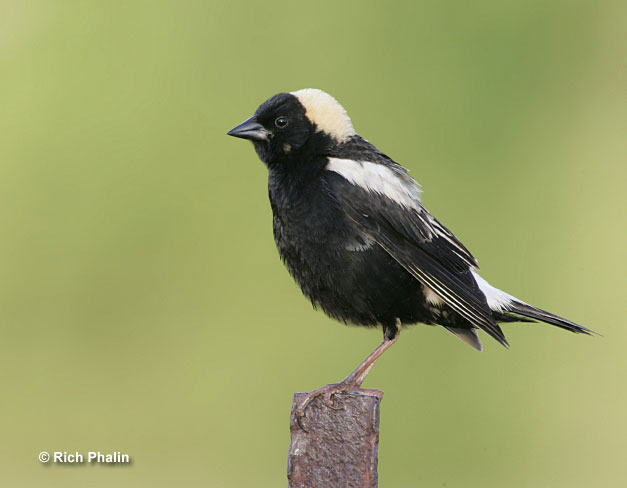
Male Bobolinks, in their breeding plumage, have an overall dark appearance and have blackish bills.
They have black undersides, black upper backs, white lower backs and rumps, and black wings with white shoulders. Their heads are black with a creamy-yellowish patch on the nape. Non-breeding males look like females.
Female
Female Bobolinks look similar to sparrows at first glance but are more yellowish and warmer-toned. They are pale warm yellowish-brownish below with dark brown streaks on the flanks.
Their backs are yellowish-buff with bold dark streaking, and their wings and tails are dark brown with buff edges. They have pale yellow-buff heads with brown stripes on the crown and through the eye. Females and non-breeding males have pinkish bills.

Juvenile Bobolinks look similar to females. However, they are paler and their markings are not as defined.
Vocalizations
Bobolinks sing bubbly metallic warbles that consist of 25-50 notes that vary from low-pitched buzzy sounds to high-pitched sharp tones.
Only the males sing, often while fluttering over fields or from perches to establish territory or attract females. They have two types of songs: the alpha and the beta song.
The former lasts for about 7 seconds while the latter for 4.5 seconds. Males choose the song type based on whether they are interacting with females or other males.
Bobolinks have various calls, with the most common of them being a sharp bink or pink, which they use year-round to communicate within flocks.
When faced with an intruder, both sexes may give a chunk-note. In addition, males may also give a see-yaw or a chenk and females a quipt-note. Males produce buzzing sounds during courtship and a sharp check when chasing other males. Females give quiet a quiet zeep when quarreling with other birds.
Food
Bobolinks are omnivorous with the specifics of their diet depending on the season and what is available.
During the breeding season, they mostly eat animal matter while on wintering grounds they mostly go for plant matter. While migrating, they tend to focus on grains. Parents feed their offspring only invertebrates.
The animal part of their diet consists of various small invertebrates. This includes spiders, millipedes, larvae, and insects such as beetles, grasshoppers, wasps, ants, and caterpillars.
The plant part of their diet consists of seeds of weeds such as dandelion, yarrow, false lupine, mallow, thistle, and cinquefoil; grasses and grains such as rice, corn, oats, and tassels.
Bobolinks generally forage during the daytime and in flocks. However, they feed alone during the breeding season and may forage after dark during migration to get enough energy to sustain their long flight. They look for insects on the ground, often gleaning them from the base of plants and on top of nonwoody plants.
Nesting and Eggs
Bobolinks are polygynous. In this case, a male can find himself up to four mates. This mostly occurs in areas that have plentiful food sources nearby and adequate cover for protection. The first female the male mates with is called the primary female, and the male prioritizes her and her clutch over the others.
Males arrive on the breeding grounds before females and establish territories. They flutter over fields and sing to advertise themselves to the females. The longer the flight, the healthier the male and the more likely the female is to choose him.

Once the courtship continues on the ground, the male droops his wings, spreads his tail, and points his head down to show the female his yellowish nape.
Bobolinks nest in grasslands on rather wet ground at the base of a bigger nonwoody plant within the male’s territory.
The female finds a well-concealed place among dense vegetation and prepares the nesting area by first plucking it bare and then creating a depression in the ground. She then builds a shallow open cup of grasses, weed stems, and other plant materials. The nest measures 2.4-4.3 inches across and up to 2 inches in height.
One female generally has one brood in a year, rarely two, with 3-7, usually 5-6 eggs in a clutch. Bobolink eggs are pale bluish-gray to reddish brown with darker spotting and measure 0.8-0.9 inches long and 0.6-0.7 inches wide. Incubation takes 10-14 days and is done by the female only.
Younglings leave the nest 10-14 days after hatching but have to hide in the surrounding vegetation for some additional days until they gather enough strength to fly.
Current Situation
Bobolinks can be found in North and South America. Their breeding range extends across southern Canada and most of the northern United States. They migrate to South America for the winter.
Bobolinks breed in open grassy fields and wetlands with dense grass and weed growth and a few low bushes, including damp meadows and natural prairies. However, since this kind of habitat is harder to come by nowadays, then they also nest in hayfields, especially in the eastern United States.
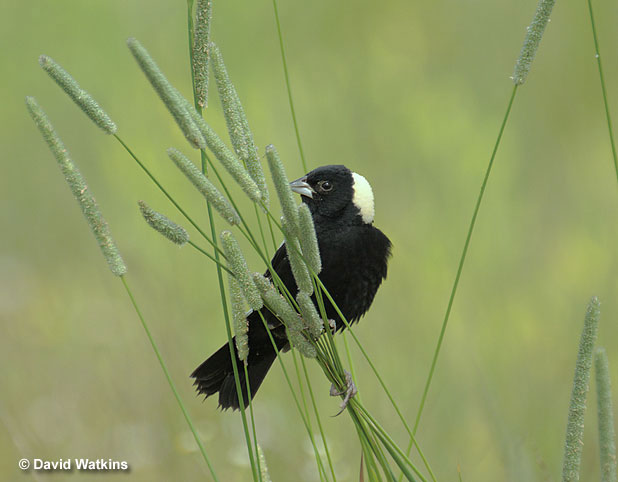
While migrating, they stop in marshes and fields, especially rice fields. In South America, they live in similar habitats.
Bobolinks are listed as a species of least concern on the IUCN Red List, but their population is declining. The main reason for this is habitat loss but they are also shot because people regard them as pests.
Fun Facts About Bobolinks
- Parental care is divided depending on the circumstances. If food is scarce and the weather is bad, then the males focus on bringing food, and the females on brooding. However, if the weather is better, then females brood less and dedicate more time to finding additional food.
- Bobolinks are among the most impressive migrants. Their yearly migration adds up to a whopping 12,500 miles! This means that throughout its lifetime, one individual travels roughly 4-5 times around the world!
- The scientific name for Bobolink is Dolichonyx oryzivorus. The second part of their name means ‘to devour rice’ or ‘rice devourer’. This refers to the bird’s habit of eating rice, especially during migration and winter.
- Bobolinks live for 4-6 years on average. The oldest wild individual on record lived to be at least 9 years old.
Similar Species
Bobolinks do not have many similar species but the ones they do can cause quite a headache when it comes to identification, especially if you only see them in passing. Here are the three most similar ones and how to tell which one is which.
Lark Bunting
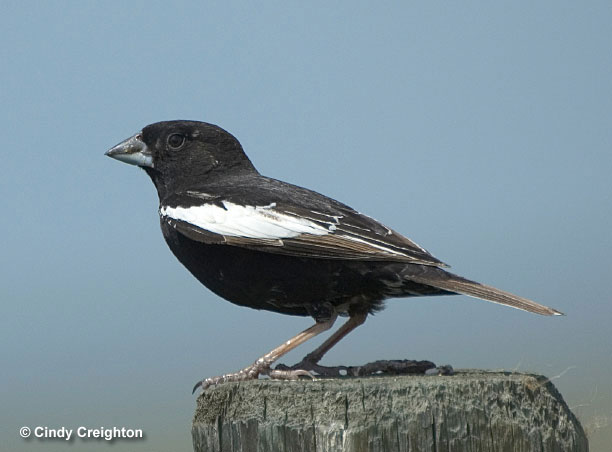
Lark Buntings breed in central North America and winter in the southern United States and northern Mexico. Breeding males are black with large white patches on the wings. Females and non-breeding males are brown above and pale below with brown streaking. Both sexes have gray bills.
Breeding male Bobolinks have a white lower back and rump and a yellowish-buff nape, whereas breeding male Lark Buntings lack those characteristics and are black.
Female and non-breeding male Bobolinks are warm and buffy overall, especially on the head, whereas female and non-breeding Lark Buntings are darker, and have whitish stomachs and dark streaks on their bellies.
Red-winged Blackbird
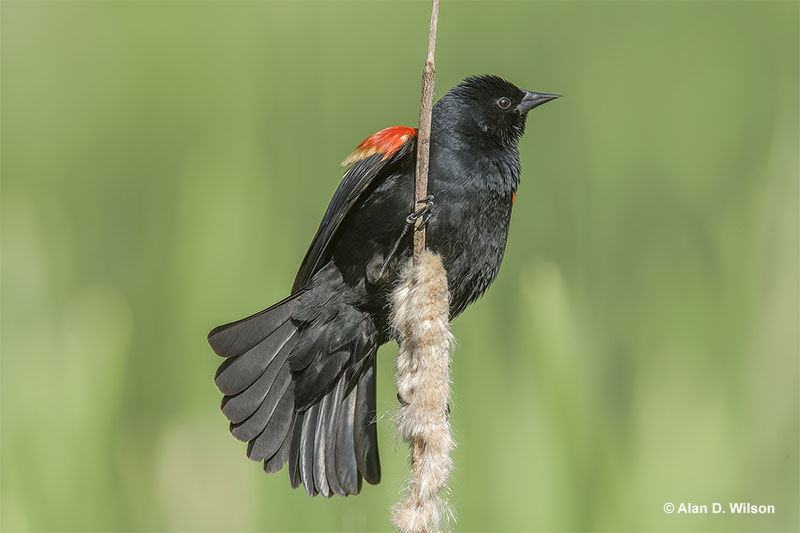
Red-winged Blackbirds are resident throughout most of the United States with their breeding range extending across most of Canada. Breeding males are black overall with red shoulder patches bordered with buffy yellow. Females are heavily streaked in dark brown with a buffier face and paler breast.
Male Red-winged Blackbirds only have red-and-yellow shoulder patches, whereas Bobolinks have white shoulders, a white lower back, and a yellow-buff nape. Female Red-winged Blackbirds have heavier streaking and are darker overall than female Bobolinks.
Grasshopper Sparrow
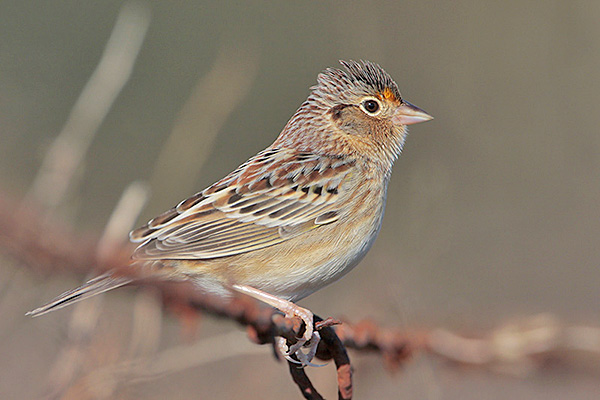
Photograph © Greg Lavaty.
Grasshopper Sparrows breed across the United States except for most of the western part.
Adults are small and sparrow-like in plumage. Their underside is unstreaked and buffy, their upperside streaked with browns, grays, and buffy tones, and they have an orange spot in front of the eye. The head of Grasshopper Sparrows has more dark markings and an orange spot in front of the eyes that the female Bobolink lacks.
Frequently Asked Questions
Why is it called a Bobolink?
The name Bobolink is thought to be derived from its distinctive bubbling song, often described as “bob-o-link” or “bob-o’-Lincoln”.
How rare is a Bobolink?
Bobolinks are fairly common across their range, although it depends on the location.
How long do Bobolinks live?
Bobolinks live for 4-6 years on average.
What does a female Bobolink look like?
Female Bobolinks are buffy yellow with brown streaking on the upperside and head, brown wings, and brown tails. They often resemble other sparrows.
Do female Bobolinks sing?
Female Bobolinks do not sing, but they give various one-noted calls.
What time of year do Bobolinks nest?
Bobolinks nest from late spring to early autumn.
