


The Red-breasted Nuthatch (Sitta canadensis) is a small songbird that you may see climbing head-first down a tree trunk or upside down along a branch.
Their rhythmic nasal calls echo through mature coniferous forests of western and northern North America. Here you can find more information about them and how to tell them apart from other nuthatches!
Identification
Red-breasted Nuthatches are small songbirds, measuring between 4.3 to 4.7 inches long with a wingspan of 7.5 to 8.7 inches. Their bodies are compact and plump, with a rounded shape.
They have a large, rounded head and virtually no neck. Their strong legs and feet are adapted for gripping onto tree trunks and branches. You can often see them climb down a tree trunk headfirst or along the underside of a branch. They have black eyes and their dark bills have a sharp end and are slightly upturned.
Male
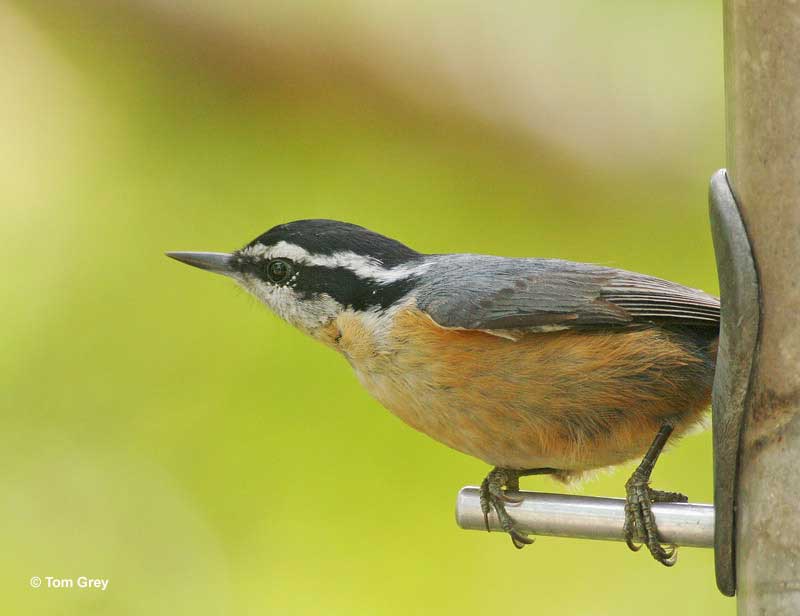
Male Red-breasted Nuthatches have blue-gray uppersides and are mostly rust-colored below. They have white-and-black heads. Their throats are white, they have a black cap, a black line through their eye, and a white line above it.
Female
Female Red-breasted Nuthatches have a similar but much duller plumage. Their uppersides are a dull bluish gray and their undersides very pale cinnamon. The white on their face is not as pure, but rather a very light gray. Their cap is bluish gray rather than black and the black line through their eye is duller and not as bold.

Juvenile Red-breasted Nuthatches look similar to females. However, the rusty wash on the underside is very pale, almost grayish. The white parts of its plumage are light gray and the head markings are not as well defined.
Vocalizations
Red-breasted Nuthatch songs consist of multiple nasal eeen-eeen-eeen sounds. They repeat the syllables fairly slowly and monotonously. Unmated males sing most often and both males and females can sing a slower and harsher variation of the song when defending their territories.
Their most common call is a nasal yank. This can be given fairly slowly and separately, linked together into a faster series, and it can be significantly sped up and repeated rapidly so it becomes a scolding chatter. The yank-notes and trills can be intercepted by nasal squeaks. They may also give the nasal high-pitched squeaks separately and in quick succession.
Food
Red-breasted Nuthatches are omnivorous, but the specific contents of their diet depend on the season and food availability. During the breeding season, adults mostly eat animal foods whereas during the non-breeding season, their diet focuses on plant matter. Young birds are fed insects.
The animal part of their diet mostly consists of arthropods, but overall includes beetles, caterpillars, crane flies, wasps, moths, earwigs, insect eggs, spiders, and ants.
As for plant matter, they mostly eat the seeds of coniferous trees, such as pine and spruce. They may also visit bird feeders for sunflower seeds, peanuts, and suet. If there is a lot of food and given a choice, they always choose the heaviest food item.
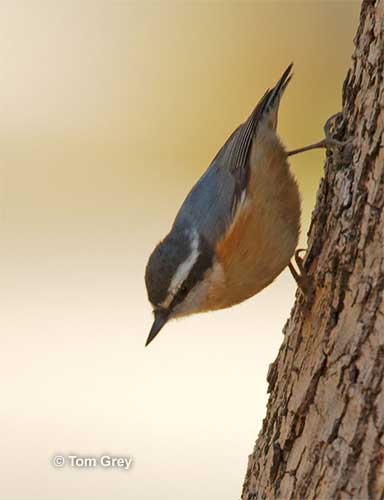
Red-breasted Nuthatches forage on their own or in pairs. They mostly climb up and down tree trunks, gleaning insects from the surface.
However, they also search for food along branches, stumps, and on the ground. If needed, they wedge food items into bark crevices and break smaller pieces off, or pry open seeds.
They sometimes fly out to catch insects in mid-air. Water is taken from small pools of water. This species may store food for fall and winter. They cache it in various places, mostly under bark on holes in tree trunks, but also on the ground.
Nesting and Eggs
Red-breasted Nuthatches are monogamous and stay together for at least one breeding season. Pairs form in winter and spring and defend their territory throughout the breeding season.
Males display to the female by singing, raising their heads and tails, drooping wings, swaying side-to-side, and fluffing their back feathers. They also bring food to the female.
Red-breasted Nuthatches nest in cavities generally 5-40 feet above the ground. The pair excavates the cavity together, most often in a dead tree, a dead branch, or area of a living tree, or into a tree stump, preferring tree species that have softer wood.
They may also occupy vacant woodpecker holes or nest boxes, although this is a rare occurrence.
The cavity measures around 2.5-8 inches deep. They then build the cup-shaped nest of grasses, shredded bark, various plant fibers, roots, and moss and line it with softer materials such as feathers, fine grasses, and fur.
One pair has only one brood per year with 2-8, generally 5-6 eggs in a clutch. Red-breasted Nuthatch eggs are white to creamy to pinkish white and speckled with rust-colored spots. They measure 0.6-0.7 inches long and 0.4-0.5 inches wide.
The female incubates the eggs for 12-13 days while the male brings her food. For the first week after hatching, the male continues providing food for his family while the female broods the young.
After this, both parents start bringing food and caring for their offspring. Young birds leave the nest around 18-21 days after hatching and become independent roughly 2 weeks after that.
Current Situation
Red-breasted Nuthatches are resident throughout western and northern North America. However, northernmost populations migrate to more southern parts of the United States for the winter.
They prefer to breed in semi-open coniferous forests or deciduous forests with coniferous stands, preferring trees such as spruce, larch, fir, western red cedar, hemlock, and pine.
Mature forests are ideal, perhaps because of more available nesting sites due to old and decaying wood.
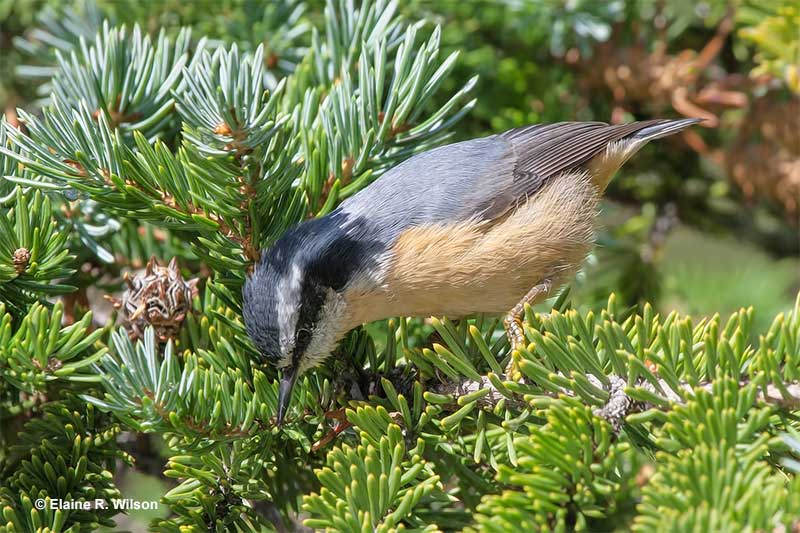
Eastern populations are more likely to accept deciduous trees if conifers are not available, and can be found residing in aspen, poplar, oak, birch, or maple. During migration and winter, they may appear in any wooded habitats but still gravitate toward conifers if available.
Red-breasted Nuthatches are common birds with an increasing population that are listed as of least concern on the IUCN Red List. The biggest negative impact comes from logging and forest management that removes dead trees, thus decreasing available nesting sites.
Facts About Red-breasted Nuthatches
- Red-breasted Nuthatch pairs smear resin on and around the opening of their nesting cavity to deter predators and other birds from entering. They avoid getting stuck on it by simply diving directly through the opening.
- Red-breasted Nuthatch pairs may stay together year-round and defend their territory.
- The oldest Red-breasted Nuthatch on record lived to be at least 7 years and 6 months old.
Similar Species
There are a few quite similar species to the Red-breasted Nuthatch. Most of them are other nuthatch species, but you might also confuse them for a Black-and-white Warbler. Here are the three most similar ones and how to tell them apart.
White-breasted Nuthatch
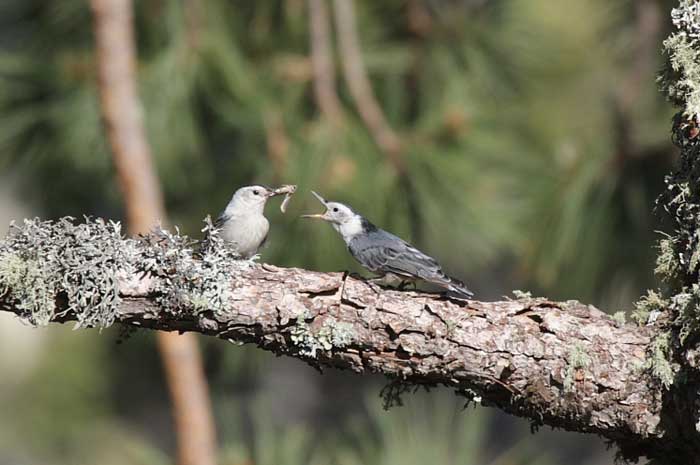
White-breasted Nuthatches are resident throughout most of the United States, southern Canada, and central Mexico.
Males have bluish-gray uppersides, white undersides, rust-colored spots on their undertail coverts, a white face and throat, and a black cap. Females have similar plumage but a bluish-gray instead of a black cap.
Compared to Red-breasted Nuthatches, the White-breasted ones are larger, do not have the black line through their eyes, and have a white instead of a rust-colored belly.
Pygmy Nuthatch
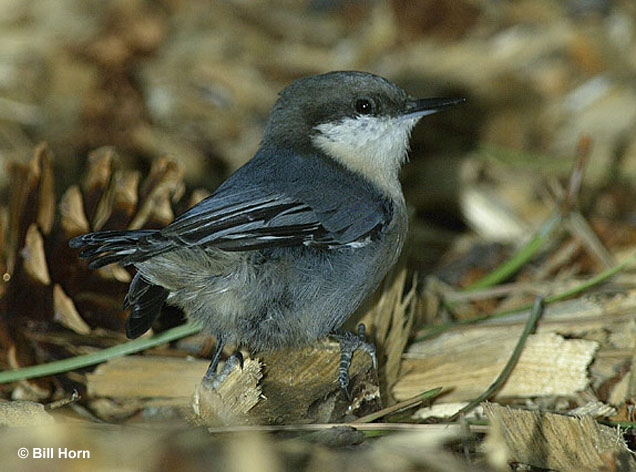
Pygmy Nuthatches have a spotty range throughout the western United States and Mexico. Adults are bluish-gray above and white to pale buff to light gray below. Their cap is dull brown and they have a black line through their eye that can be fairly smudgy.
They lack the Red-breasted Nuthatch’s rust-colored belly and a white line above the black eye line. In addition, they have a dull brown instead of a black or grayish cap.
Brown-headed Nuthatch
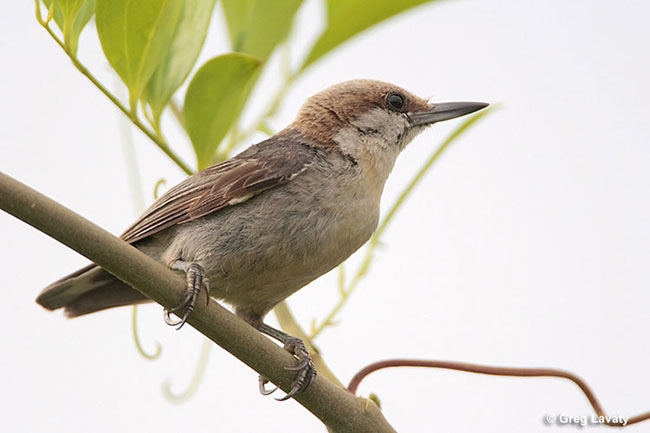
Brown-headed Nuthatches are resident throughout the southeastern United States. They have slaty blue backs and whitish undersides. Their throats are white, and they have a brown cap and a narrow black line through their eye.
This species is smaller than the Red-breasted Nuthatch. They have a brown head and a faint black eye line instead of a black cap, a white eyebrow line, and a strongly defined black eye line. Their bellies are also whitish instead of having a rusty wash like the Red-breasted Nuthatch has.
Frequently Asked Questions
What is the difference between White-breasted Nuthatch and Red-breasted Nuthatch?
White-breasted Nuthatch and Red-breasted Nuthatch have different head markings and undersides. White-breasted Nuthatches have a white head with a black cap, white undersides, and rust-colored patches on their undertail coverts whereas Red-breasted Nuthatches have a black cap and line through their eye, a white line between them, a white throat, and cinnamon undersides.
Are nuthatches intelligent?
Nuthatches are fairly intelligent. For example, they have been known to learn and respond to the warning calls of other bird species.
What color are Red-breasted Nuthatch’s eggs?
Red-breasted Nuthatch eggs can be pinkish white, creamy, or white.
Why are they called nuthatches?
Nuthatches got their name from their habit of wedging seeds and nuts into tree crevices and then hacking them open to reveal the inside.
