
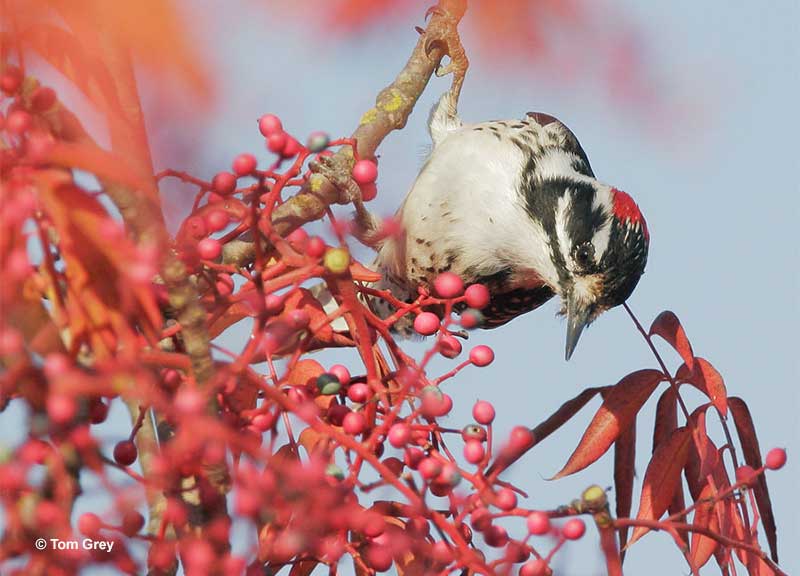

Nuttall’s Woodpeckers (Dryobates nuttallii) are fairly small black-and-white woodpeckers with a love for oaks.
They have a keen eye for insect snacks hidden within the bark and climb up and down tree trunks, but also traverse the smaller branches and twigs, unlike most other woodpeckers. Keep your eyes peeled for these charming characters!
Identification
Nuttall’s Woodpeckers are relatively small, measuring 6.3-7.1 inches long, and have a wingspan of 13-16 inches. Their body shape is similar to most other woodpeckers. They have a small, rounded head and a flat back, giving them an elongated appearance. Their tails are stiff and strong, offering support while they climb up and down trees in search of food.
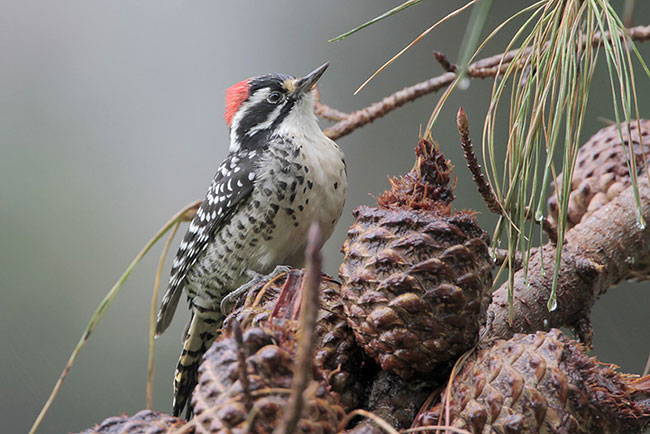
Male
Male Nuttall’s Woodpeckers are black above with white barring on their back, wings, and tail with a solid black spot just below the neck. They have whitish undersides with black barring and spotting on the flanks. Their head is black with two white face stripes, a white throat, and a red crown.
Female
Female Nuttall’s Woodpeckers look fairly similar to males. Their uppersides are black with white barring and their undersides whitish with black barring and spotting on the flanks. Their head is black with two white face stripes, a white throat, and a black crown.
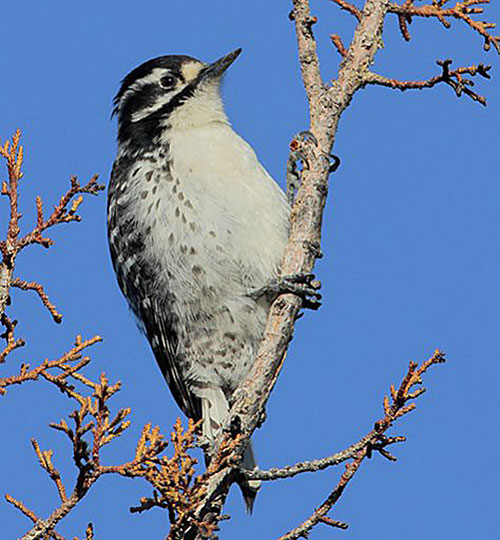
Female. Photograph © Greg Lavaty.
Juvenile Nuttall’s Woodpeckers look very similar to adults. Both female and male juveniles have a red crown patch, similar to adult males, but smaller.
Vocalizations
Nuttall’s Woodpeckers give a few high-pitched calls. Their basic call note is a single pit note, which pairs use to communicate with each other. This note also serves as a foundation for two of their other calls: the long call (or the double note) and the rattle.
The long call is a high-pitched, metallic, and slightly rolling pitit that can be used to communicate but also sound an alarm. You can hear it year-round, most often in the winter and spring. The rattle has a rolling quality and consists of 14-45 pit notes given in rapid succession.
They use it to establish feeding territories and typically emit it from October to May. During courtship, they also give a harsh shrieking kweek, similar to the call of an American Kestrel.
Nuttall’s Woodpeckers’ drumming is regular, fast-paced, and lasts for around one to two seconds.
Food
Nuttall’s Woodpeckers’ diet consists of both plant and animal matter. They primarily feed on insects and insect larvae, such as wood-boring beetles, click beetles, ants, scale insects, aphids, termites, weevils, caterpillars, millipedes, true bugs, spiders, and flies.
However, they also drink birch and willow sap and eat various berries, fruits, and seeds, including blackberries, elderberries, poison oak, and occasionally some grain.
Nuttall’s Woodpeckers, like most other woodpeckers, forage in trees while clinging to the tree trunks or branches and tapping and probing bark crevices for insects or gleaning them off vegetation.

However, they distinguish themselves from others by circling around branches and foraging on small twigs, maintaining balance by fluttering their wings rather than relying on their tails.
Males and females sometimes forage differently, with females focusing on thinner branches and twigs while males feed on the tree trunk and major branches. They also catch insects in the air.
Nesting and Eggs
Nuttall’s Woodpeckers are monogamous and may stay together throughout the year, although they generally interact with each other only during the breeding season. Their courtship displays involve raising their head feathers, fluttering display flights, and swinging their head from side to side.
Nuttall’s Woodpeckers nest in a cavity 3 to 60 feet but generally up to 35 feet above the ground. They may nest within both dead trees or living trees with dead trunks or limbs, favoring species like willow, cottonwood, or sycamore.
Sometimes, they also go for fence posts, utility poles, or other tree species. Excavation of the cavity is primarily carried out by the male, who creates a new nest cavity each year. The entrance to the cavity typically measures around 2 inches in diameter, leading into an interior cavity 11 inches deep on average. Wood chips from the excavation are used to create a lining at the bottom.
One female lays 3-6, mostly 3-4 eggs in a clutch. Nuttall’s Woodpecker eggs are white and measure 0.8-1 inches long and 0.6-0.7 inches wide. Incubation takes 14 days with both sexes taking turns.
Males take the night shift and females incubate during the day. Both parents take care of their offspring. The younglings leave the nest about 4 weeks after hatching but may remain dependent on their parents for a few weeks after that.
Current Situation
Nuttall’s Woodpeckers range throughout California and northwestern Baja California from 900 to 5,500 feet in elevation. They are non-migratory, remaining in their territories year-round. Their preferred habitats are oak woodlands, especially those near rivers, and they are almost always found near oaks throughout their range.

Additionally, they inhabit wooded suburban areas and woodlands adjacent to streams and rivers, especially in areas where oak trees are less prevalent. Nuttall’s Woodpeckers can also be spotted in wooded canyons and pine-oak woods in foothills. At the eastern edge of their range, they may occasionally venture into mesquite or other dry woods.
Nuttall’s Woodpeckers are listed as a species of least concern on the IUCN Red List and their population is slightly increasing. They are an important part of the ecosystem because they provide nesting cavities for other cavity nesters. However, due to their limited range and dependence on and preference for oak woodlands, they are very vulnerable to habitat loss.
Facts about Nuttall’s Woodpeckers
- In 1843, Nuttall’s Woodpeckers were named in honor of the naturalist Thomas Nuttall, an English botanist and ornithologist. While Nuttall was primarily renowned as a botanist, he also authored a groundbreaking tome on birds titled “A Manual of the Ornithology of the United States and Canada.” His work and love for nature also inspired the establishment of the first bird-focused organization in North America.
- Despite their preference for oak woodlands and oak trees, Nuttall’s Woodpeckers generally do not eat acorns!
- Like other woodpeckers, the Nuttall’s Woodpecker hammers its bill into trees 18 to 22 per second thousands of times throughout the day. To prevent brain damage, they have several specialized adaptations designed to absorb shock, like a spongy skull bone structure, elastic lower bill mandible, and tongue muscles wrapped around the skull.
- The oldest Nuttall’s Woodpecker on record lived to be at least 8 years and 9 months old.
Similar Species
Similar species to Nuttall’s Woodpecker include other woodpeckers such as the Ladder-backed Woodpecker, Downy Woodpecker, and Hairy Woodpecker. Here is how to tell them apart.
Ladder-backed Woodpecker
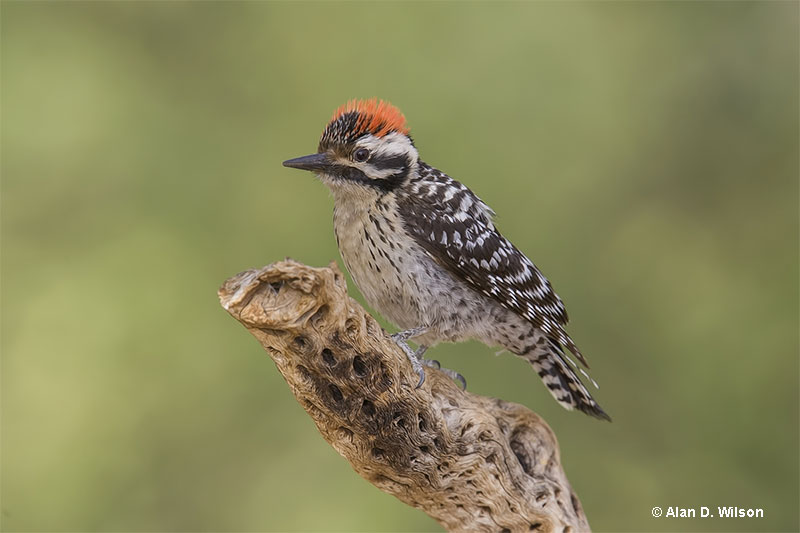
Ladder-backed Woodpeckers have a more extensive range and inhabit drier, arid landscapes and deserts. They are resident throughout the southwestern United States and most of Mexico.
Adults have a distinct black-and-white ladder-like pattern on their back and whitish to slightly buffy undersides with black spotting or barring.
They have white heads with two black stripes on their face, one running across the eye and the other from the base of the bill. Males have a red crown whereas females have a black one with a buffy patch in front of their eye.
These two species look very similar. However, Ladder-backed Woodpeckers have fully barred backs, whereas Nuttall’s Woodpeckers have a black un-barred patch near the nape of their neck. Although the males of both species have red crowns, then the Ladder-backed Woodpeckers crown extends farther forward whereas the male Nuttall’s also has a black patch.
Downy Woodpecker

Downy Woodpeckers can be found in various woodland habitats across North America. Their ranges overlap in parts of California, but the Downy Woodpecker is generally more associated with riparian areas.
Adults are mostly black above, with white checkering on the wings and a bold white stripe down the center of the back. They are whitish below and have a bold black-and-white face pattern. Males have a small red patch at the back of their heads.
Compared to Nuttall’s Woodpeckers, Downy Woodpeckers are slightly smaller. They have a white stripe down their back whereas Nuttall’s have a black-and-white barred black. The red crown patch extends further forward on male Nuttall’s.
Hairy Woodpecker

Hairy Woodpeckers range throughout North America and Mexico and overlap with the Nuttall’s Woodpecker in parts of California.
Adults are black above with a bold white stripe down the center of their backs and white spotting on their wings. They have whitish undersides and a black-and-white striped face pattern. Males have a red patch on the back of their heads.
Nuttall’s Woodpeckers have a black-and-white barred back and spotted flanks whereas the Hairy Woodpecker has a solid white stripe down their backs and white barring on their wings. Both males have a red crown patch, but Nuttall’s crown patch is larger and extends further forward on their head.
Frequently Asked Questions
Who are Nuttall’s Woodpeckers named after?
Nuttall’s Woodpeckers are named after English botanist and ornithologist Thomas Nuttall.
Where do Nuttall’s Woodpeckers live?
Nuttall’s Woodpeckers mostly live in oak woodlands throughout California and northwestern Baja California.
How similar are Nuttall’s and Ladder-backed Woodpeckers?
Nuttall’s and Ladder-backed Woodpeckers are very similar in terms of appearance. The barring on Ladder-backs extends all the way up their backs whereas Nuttall’s have a solid black patch near their nape. The red crown of male Ladder-backs is larger.
